Category Archives: Play

Bowl EP

I am not young, black, gay, or well acquainted with club drugs. What I am is a fierce advocate for theater as an art and communication form. Being in a performance space filled with 20-somethings who are stomping, clapping, hooting, and laughing, even while relating strongly to Morales trying to feel like an ice cream cone, was thrilling. That was my recent experience at a matinee of Nazareth Hassan’s Bowl EP, a joint production of Vineyard Theatre and National Black Theatre in association with The New Group.

If you are a fossil like me, you remember Extended Plays or EPs as the record albums comprised of a few songs. These days they are used by artists to stay on the charts while they are working on larger musical projects.  Bowl EP begins with short “tracks,” the titles of which are projected around the sides of the “bowl,” an empty swimming pool that Quentavius da Quitter (Oghenero Gbaje) and Kelly K Klarkson  (Essence Lotus) use for skateboarding… and other activities.  Similar to that short form, the scenes are performed by the same pair, but don’t firmly connect in style or content.

Also like an EP, much of what the two say to each other has more of the quality of song lyrics than naturalistic dialogue: abstract and disconnected, yet deeply emotional. They never call each other by name and there are no characters listed in the program.  They talk very little about their lives away from this space as if there is no meaningful world away from the bowl.   It’s even hard to tell how long they’ve known each other.  The exchanges do produce a recurring cycle: flirtation, overt sexuality, and comic relief as they try come up with a name for their nascent rap duo.  Their “yums” are quite different, but each one is greeted with acceptance.

At a turning point Kelly — bedecked in wrap skirt over jeans and a sparkling baby-T (costumes by DeShon Elem) — mentions a cathartic therapy session during which she was able to vomit up her demon and become her.  Then during an intensely intimate act she is able to do the same for Quint.  The demon expelled into the pool is the high energy Lemon Pepper Wings (Felicia Curry).  From here, this pan-gender all-knowing character with oversized anime head, pink and purple frills, beat up teddybear backpack and a heart shaped tailed, takes over.  The rapid “tunes” are replaced by a relentless tirade akin to a drum solo as he/she/they shares Quint and Kelly’s relationship past and future in gory detail, personally involving the audience as well.  (Shout out to the stage managers who facilitate the magic.)

Essence Lotus and Oghenero Gbaje in Bowl EP; Photo by Carol Rosegg

Much thought has gone into transforming the venue for this unusual work.  Seating is in the round and blocked off from the stage with chain link fencing.  Playwright Hassan follows the flow of his words in the actors’ movement accented by Teniece Divya Johnson’s fight and intimacy choreography.  Scenic design team Adam Rigg & Anton Volovsek have created a gorgeous curvaceous pool in peaceful sea-foam complete with useful ladders and a diving board to contain the ferocity of the action.  Kate McGee’s lighting simulates street lamps and headlights until the colorful shift to the unconscious.  The projections as designed by Zavier Augustus Lee Taylor telegraph the intensity and vibe of each beat with the formation of the lettering.  Music by Judah “Free Fool” Girvan caps the undertaking, even effectively incorporating some of the lyrics devised in earlier chapters.

Intentionally and undeniably different, Bowl EP continues through June 22 at the Vineyard Theatre, 108 East 15th near Union Square.  Runtime is 80 minutes without intermission. Tickets are available at https://vineyardtheatre.org/shows/bowl/  beginning at $37.80.  Seating is unique and a look at the chart is helpful in selecting your preferred location.  ADA seating is available in the North section.  A joint fundraising initiative is striving to provide tickets to first-time theatergoers, though if this production was on film the content would likely be rated M for violence and sexuality. The venue continues to offer two masked performances per run, honoring their commitment to make theater accessible to everyone.

Lights Out: Nat “King” Cole

In November of 1956, singer/pianist Nat “King” Cole became the first Black man to host a variety show on network television.  Though he eventually had multiple Billboard hits including Mona Lisa, L-O-V-E, and Nature Boy, he never secured a National sponsor for this groundbreaking program.  Major markets, especially those in the South, pressured advertisers to drop their support of the broadcast.  Despite an array of popular guest stars with household names, beaten down by the color barrier, NBC and Cole agreed to terminate the venture the following year after 53 episodes.

Lights Out: Nat “King” Cole, written by Colman Domingo and Patricia McGregor, uses the final taping of the Nat “King” Cole Show to explore not only this chapter in the life of the beloved crooner, but the systematic erasure of Black voices.  It’s an intriguing pick for a central character.  Though Cole participated in civil rights marches and avoided segregated venues, he felt his public role was one of an entertainer.  He sang ballads, not protest songs, even after a cross had been burned on the lawn of his home in a wealthy white Los Angeles neighborhood.  

The play is set in a television studio (scenic design by Clint Ramos) complete with an applause sign, clever lighting (Stacey Derosier), and a live “Nelson Riddle” band on the stage.  This enables the easy integration of music, live-feed camera work and audience reaction.  However, it quickly becomes obvious that this is not a recreation of one night.  Shortly before airtime someone (someTHING) causes the ghost light to flicker and briefly go out, allowing the spirit of Sammy Davis Jr. to explode onto the scene.  In an effort to inspire Cole to go out on a combative note, The Rat Packer takes him through a phantom version of events.  Classic song lyrics are incorporated into the spoken dialogue along with a mix of historical fact as seen through the lens of modern times and Cole’s personal reflection as imagined by Domingo and McGregor.

Dulé Hill in NYTW’s LIGHTS OUT; photo by Marc J. Franklin

Dulé Hill gives soothing voice and gravitas to Cole, a part he cultivated at the Peoples’ Light in Malvern, PA and further developed at the Geffen Playhouse in Los Angeles.  Daniel J. Watts, also reprising his role, grabs Davis by the lapels, practically ricocheting off the walls with intensity.  He is high octane gasoline to Hill’s humming battery pack.  Playwright McGregor directs, bouncing the two very different friends off one another, culminating in a dynamic dance number (choreography by Edgar Godineaux with tap by Jared Grimes). Though the plot line is choppy and likely to challenge those unfamiliar with the named celebrities and cultural touchstones, the songbook alone (arrangements and orchestrations by John McDaniel) makes for highly satisfying entertainment.  

Hill and Watts positively dazzle in the leads, capturing key qualities of their characters and steering clear of imitation.  The action is kicked off by Elliott Mattox’s convivial Stage Manager.  Cole’s white producer is portrayed in myriad forms by Christopher Ryan Grant.  Krystal Joy Brown makes an early impression as a purring Eartha Kitt, later embodying an enchanting daughter Natalie Cole. Also displaying range is another vet of the previous run, Ruby Lewis, who depicts both spunky Betty Hutton and sultry Peggy Lee.  Matriarch Perlina Coles, who first introduced Cole to the piano, is played with soulful sincerity by Kenita Miller with Mekhi Richardson performing as young Nat (and a younger Billy Preston) the afternoon I attended.  Adding a comedic touch is Kathy Fitzgerald as make-up artist Candy.  She is also featured in the highly creative live commercials that run throughout the program.   

You feel the ripples of connection move through different sectors of the audience depending on whether it is Cole performing his rendition of The Christmas Song, Lift Every Voice and Sing vocalized by mother Perlina, or young Natalie joining him for a duet of Unforgettable (something she created in the studio long after his death).  When you layer in the profound racism, disgraceful accepted stereotypes, and aggressions micro and macro, the entire experience becomes a social study as well as a piece of engaging theater.

Likely to fill you with a bubbling combination of elation and frustration, Lights Out: Nat “King” Cole provides a worthwhile conclusion to a bold season at New York Theatre Workshop.  Performances continue through June 29 on the main stage at 79 East 4th Street.  Runtime is 90 minutes without intermission.  The actors smoke heavily, making me grateful to remain a mask-wearer.  Tickets start at $49 and are available at https://www.nytw.org/show/lights-out-nat-king-cole/.

Glass. Kill. What If If Only. Imp.

The announcement of any performance of British playwright Caryl Churchill is cause for excitement.  She has long been a powerful and intriguing voice for gender equality, environmental protection, and sense of self while providing memorable entertainment.  On that score, the premiere program of four of her short works — Glass. Kill. What If If Only. Imp. — at The Public Theater is a disappointment.  Director James Macdonald and his artistic team have done a masterful job of making the production visually interesting.  But while moments gleam, it never comes together as a cohesive event.

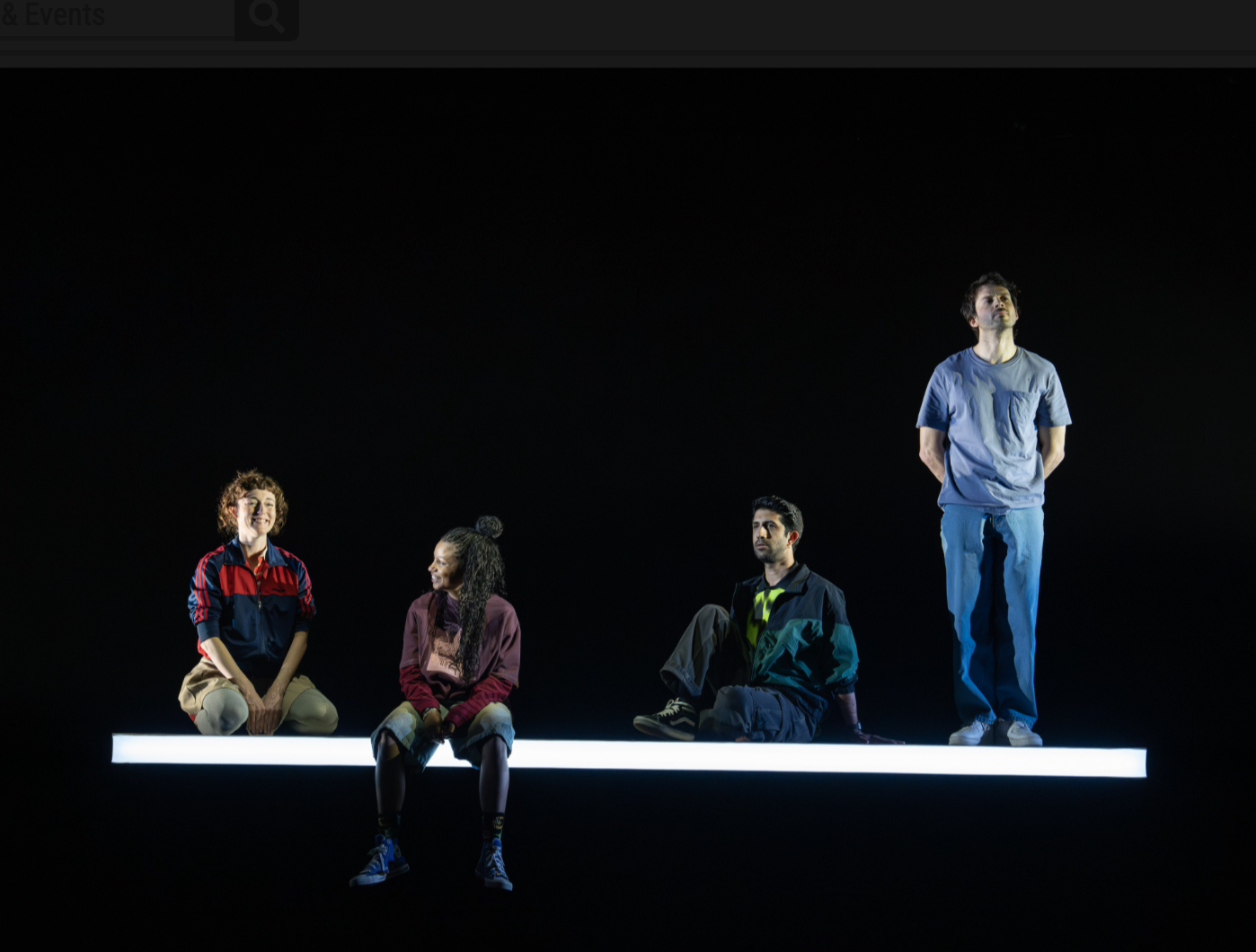
Glass explores the melancholy lives of four decorative items (Japhet Balaban, Adelind Horan, Sathya Sridharan, and Ayana Workman) beyond the confines of their shared mantelpiece. Designer Miriam Buether’s first impactful set is a solid LED jutting out from the darkness and demanding attention.  Though a soulful Workman gives depth to the glass figurine who is the catalyst for the tragic events that unfold, Glass plays out more like an acting class exercise than a full fledged work of theater.

Adelind Horan, Ayana Workman, Sathya Sridharan, and Japhet Balaban; photo by Joan Marcus

Deirdre O’Connell, who won a Tony Award for her solo work in Dana H, pulls off the chillingly violent patter of Kill.  Sitting comfortably on a puffy cloud, a sparkling god of Olympus recounts many evil deeds performed by men — from the prideful Tantalus to the warrior Agamemnon — in the Pantheon’s name.  The repetition would sound like the narration of a five-year-old were the content less bloody.  A knowledge of Greek mythology is essential for following the rapid-fire references, though the essence is clear from O’Connell’s tone and manner.

The first half is closed out with What If If Only, a meditation on love, loss, and the risks of second chances.  For this solemn reflection, Buether provides a still life setting in stark black, white and red.  The sound design of Bray Poor also plays a key role by reinforcing the oppressive atmosphere.  The philosophical theater game is anchored by John Ellison Conlee, who makes the absurd sound completely natural.  

Breaks between these plays are filled by two talented acrobats.  The first is Junru Wang, who performs a balletic work while her hands balance on small stools at the foot of the stage.  For the second, we are treated to what I christened a “juggler-tease” performed with flirtatious glee by Maddox Morfit-Tighe.  Unfortunately some of his choreography was out of the sight lines of the back half of the audience.  Whether these two talented people provide unity, distraction, or a fleeting moment of joy is up to the beholder.

The second half of the program is fully occupied by the more plot-heavy Imp.  Conlee and O’Connell portray Jimmy and Dot, friends close enough to consider themselves brother and sister of different parents.  The affable Jimmy lifts his mood with running and chess.  Slumped in a nearby chair, Dot is ill-temperated and unwell.  She also believes herself to be in possession of a magical imp imprisoned in a wine bottle.  

The rhythm of their lives is altered by the arrival of two newcomers.  First their niece, Niamh, a recent transplant from Ireland stops by.  (Horan is wonderful at delivering Neve’s wildest fears in recognizable Churchill style.)  Then the couch surfing Rob enters their lives (Balaban again).  The younger pair is tossed about, though who’s to say whether their bumpy ride is caused by a supernatural being, the differing attitudes of their hosts, or just life.

It is fitting that the stage on which Glass. Kill. What If If Only. Imp. are performed is framed in chase lights with definite personality (Isabella Byrd lighting design).  With its bitesized ideas and high level of engagement, it’s Caryl Churchill for the TikTok generation.  Churchill’s signature poetic language and extraordinary themes are intact, but there is too little structure.  The Playbill notes encourage us to look beyond conventional narratives, but humans are storytellers with a need for an organizing rope to hold.  The feeling left behind by experiencing these four shorts is more akin to a stroll through a depressive art gallery than witnessing an emotionally fulfilling theatrical work.  Performances continue through May 11th at the Martinson Theater at The Public, 425 Lafayette Street.  Running time is 2:15 with one intermission.  Tickets are available at https://publictheater.org/productions/season/2425/caryl-churchill-plays/ and start at $89.

Amerikin

With his promising recent promotion, loyal best friend, and gorgeous new baby, Jeff Browning seems to be well on the way to living the life he’s always dreamed of.  The acceptance of his application to a local organization — The World Knights — is almost assured, making him and his fragile wife, Michelle, members of a supportive community.  Despite all he has, a deep sense of belonging remains a missing piece.  True, the Knights are dangerously anti-Black, but Jeff doesn’t consider himself a bigot.  He would never have called his dog a racist slur if he lived within hearing distance of a person of color.  Yet Jeff is rocked to the core when his required DNA test reveals he is 14% Subsaharan African.

These events unfold in the first few scenes of Amerikin, a new work by Chisa Hutchinson presented by Primary Stages.  With its highly provocative and uncomfortable themes, it’s no wonder this production became a target of the current administration and lost its NEA grant.  But for those who enjoy their live performances dexterously delivered and dowsed with hot sauce, the play provides enough rousing dialogue and surprising twists.

Playwright Hutchinson has much that she wants to communicate and she uses both sharp wit and emotional intelligence to largely accomplish her goals.  The simultaneous display of past and present makes for engaging storytelling.  Well-earned laughter breaks up the mounting tension.  The breaking of the fourth wall by several characters is a less effective short-cut and too frequently employed.  

Tobias Segal and Daniel Abeles in Primary Stages’ 2025 production of AMERIKIN;
photo by Justin Swader

Housed primary in a perfectly scuffed up set by scenic designers Christopher Swader and Justin Swader, the production is shaped by intuitive director Jade King Carroll and a skillful acting ensemble. Daniel Abeles takes the lead in Act 1, imbuing Jeff with alternating waves of swagger and vulnerability.  Act 2 is anchored by Victor Williams as a dauntless clear-eyed Black Washington Post reporter, Gerald, and Amber Reauchean Williams as his self-assured college age daughter, Chris.  The seasoned political journalist is looking for a fresh angle, preferable one that is Instagrammable.  Chris’s life has been more profoundly impacted by the execrating pace of police brutality against her race.  Their banter-filled car rides between D.C. and Jeff’s home in small-town Maryland compellingly illuminate a generational divide and are highlights of the script.  

The outsiders are the ones who bring the schism between Jeff’s sense of self and harsh reality into focus.  Additionally, Tobias Segal as best friend “Poot” is sweetly well meaning, expressing what many in the audience are thinking.  His character is a welcome counterbalance to Luke Robertson’s solid but offensive sponsor, Dylan.  His “Black Labs Matter” T-shirt (costumes by Jen Caprio) says it all.  Jeff’s wife and ex-girlfriend, portrayed by Molly Carden and Andrea Syglowski respectively, are plot-fillers written with limited range.

Amerikin is to be praised both as a springboard for productive and thoughtful conversation as well as an evening of quality ensemble acting.  The program notes contain several warnings including discussion of postpartum depression and suicidal ideation and the ending is so punishing it diminishes what came before.  Runtime is 2 hours plus a 15 minute intermission.  Performances continue through April 13 as part of the AMPLIFY Festival being celebrated at 59e59 Theaters at 59 East 59th Street.  Tickets begin at $66 and can be purchased at https://www.59e59.org/shows/show-detail/amerikin/#show-info.  In honor of their founding year, Primary Stages has also made $19.84 lottery tickets available through the TodayTix app for every performance.

My Man Kono

For nearly 20 years, Toraichi Kono worked for Charlie Chaplin during the period when the silent film star rose to prominence and notoriety.  Originally hired as a driver, Kono became one of Chaplin’s most trusted confidantes: acting as his a social secretary, assisting with film production, and even playing a valet in three of Chaplin’s pictures.  Serving as a role model for other Japanese immigrants, Kono’s starry life was eventually upended by tragedy on the home front and a fishy arrest by J. Edgar Hoover’s FBI for suspected espionage.  Los Angeles based Asian American playwright Philip W. Chung has now melded the world of Hollywood with the immigrant experience in his captivating new work, My Man Kono, highlighting this man’s fascinating story.

Kono is presented as a rich and well-rounded character.  We see his early days in Japan as a charming film flam man wooing and winning over the woman of his dreams against his parents wishes. We celebrate his rise in a flashy and influential California circle while regretting his time away from loved ones.  Dinh James Doan has replaced Brian Lee Huynh in this pivotal role for the remainder of the play’s run.  He was still not completely at ease with the broad demands during Saturday’s performance, but there were only a few scenes in which he didn’t fully connect with the fine ensemble bolstering him.  Conlan Ledwith pulls off the physicality, charm, and smugness of Chaplin on screen and off also portraying the judge who holds Kono’s future in his hands.  Robert Meksin imbues lawyer Wayne Collins with the right amounts of warmth and gravity and Cody Leroy Wilson gives the buffoonish Alva Blake much needed grounding.  Emma Kikue is clearly having fun playing all of Chaplin’s wives including Paulette Goddard who drove a wedge between Chaplin and Kono.  Kiyou Takami does what she can with the underwritten part of Kono’s suffering wife Isami, countering her husband’s thirst for fame and fortune with one driven by honor and family.  James Patrick Nelson plays a variety of almost clownish enforcement heavies, while Jae Woo rounds out the cast playing suspected spy Itaru Tachibana among others.

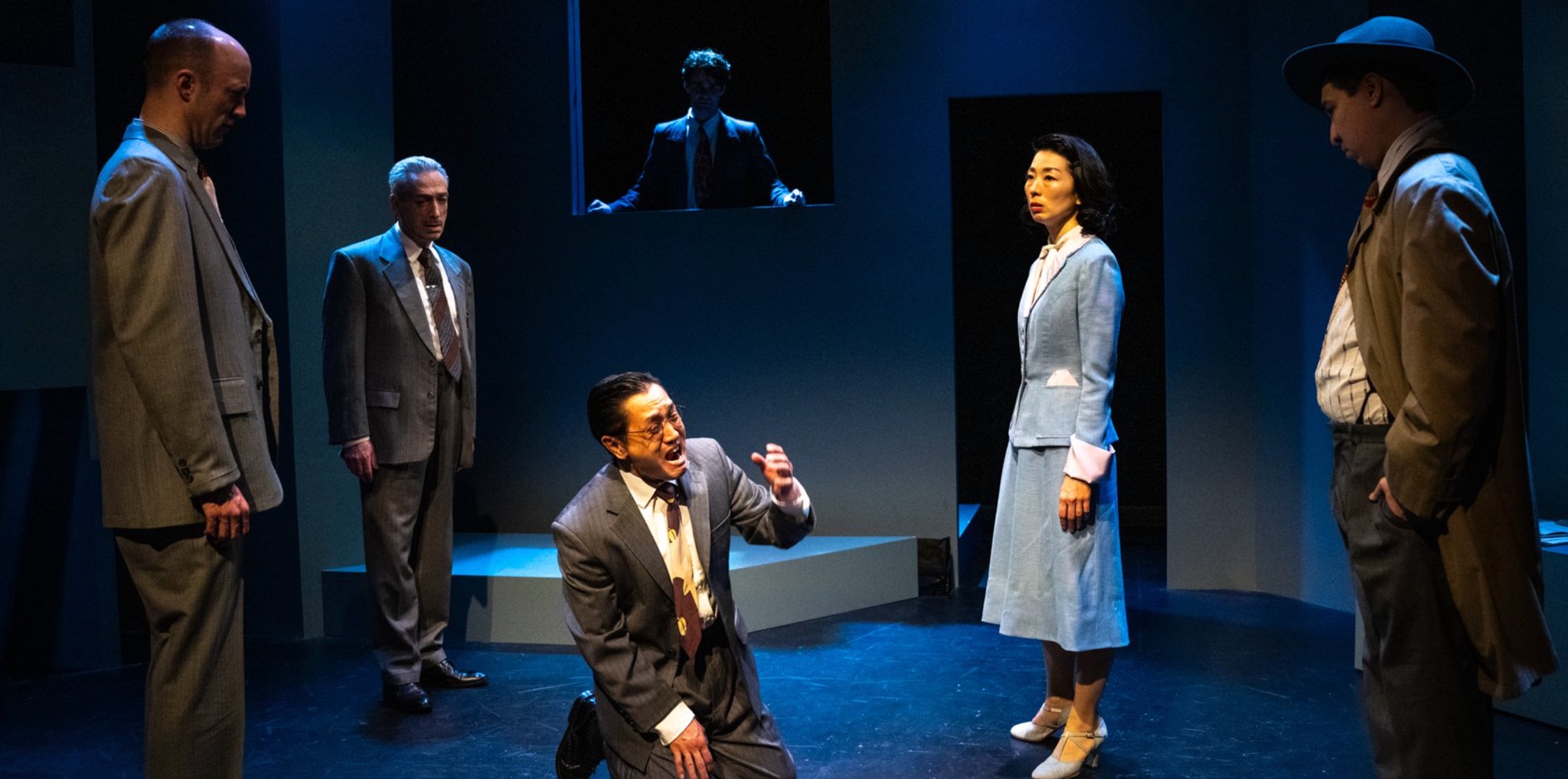
James Patrick Nelson, Robert Meksin, original cast member Brian Lee Huynh (kneeling), Conlan Ledwith (in window), Kiyo Takami, and Cody Leroy Wilson in My Man Kono; photo by Russ Rowland.

Director Jeff Liu has worked closely with set designer Sheryl Liu to make the most of the intentionally shallow configuration of the black box space.  Grey blocks with strategic cutouts are combined with Cinthia Chen’s projections to serve as everything from Chaplin’s elegant homes to a drab courtroom and represent geographically areas from across the US and Japan.  Sometimes the actors literally pop-up from the top or poke out through a window to grab attention.  Lighting designer Asami Morita supports this spirited concept.

Presented by Pan Asian Repertory as part of their 48th season, My Man Kono is a wildly engaging and informative piece of theater.  Sending American citizens — many of whom had offspring in our military — to internment camps because of their heritage is one of the most disgraceful chapters in our history.   Shameful questioning of what it means to be an American patriot reverberate in the present.  To see this period through the eyes of someone who was close to a Hollywood legend is an ingenious way to draw in a wider audience.  This World Premiere continues through March 9 at the A.R.T./NY Mezzanine Theatre on the second floor of 502 west 53rd Street.  Reserved seats are available at https://www.panasianrep.org/my-man-kono and are $35 for students, $60 for seniors and $70 for adults. 

Grangeville

Grangeville is the county seat of Idaho County and the setting for and title of Samuel D. Hunter’s latest play exploring life in his home state.  Older brother Jerry still lives in this town of slightly over 3000 people.  He is newly separated from his high school sweetheart Stacey, raising two kids, acting as healthcare proxy for his mother, and doing his best to support himself by selling RVs.  Younger half brother Arnold has distanced himself from all the bullying he received at the hands of his family and classmates.  Married for nearly 17 years to Bram, he lives and creates works of art in Rotterdam, the Netherlands.  The only thing these two seem to have in common is a little DNA.  But when it comes to light that their critically ill mother has made Arnold her Executor and granted him Power of Attorney, the siblings have no choice but to reconnect.

What follows is 90 minutes of stirring and often witty dialogue delivered by two versatile actors.  Similar to Arnold, Hunter has created a piece of art that both mocks and celebrates his birthplace.  This script is his usual blend of profound human insight and bookish humor.  If you’ve enjoyed my spoiler-free reviews, you should jump to the last paragraph.  There is simply no way to discuss this production without revealing something that is better experienced for the first time in the moment.  

Arnold and Jerry are so different they don’t even share similar memories from their past. Their search for and avoidance of common ground is enthralling.  In the meatier of the roles, Brian J. Smith portrays Arnold, the brighter and more settled of the brothers.  Smith’s ability to navigate Arnold’s swift transitions of emotional state is impressive and endearing.  Smith also plays Stacey just by adding a measure of softness to his tone and gestures.  Paul Sparks takes on Jerry, a man full of deep regret about his conduct as a younger man and consumed by unhappiness with his current circumstances.  At first, Jerry verbally tiptoes towards Arnold in their video chats.  As his need increases, so does the urgency in his language.  With a subtle change in posture and a waffling accent, Sparks then moves to the role of Bram.

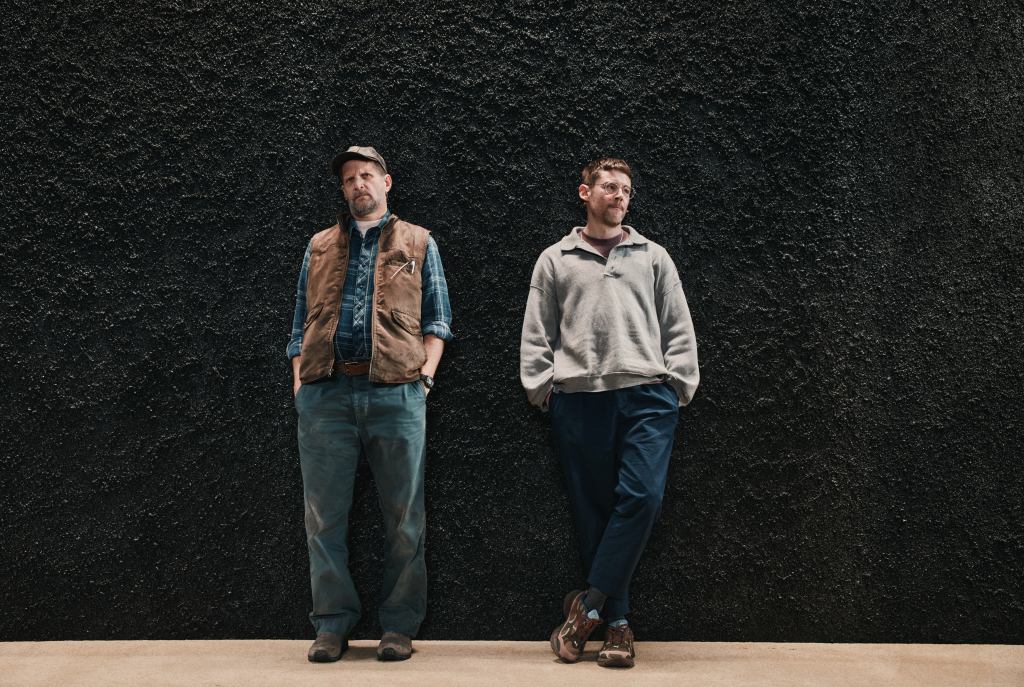
Paul Sparks and Brian J. Smith in Grangeville; Photo by Emilio Madrid

With the precision of an orchestra conductor, director Jack Serio enables his actors to delicately build towards an inevitable crescendo.  Initially we sit in darkness, fully tuned in to their choice of words and reflective pauses.  Movement is added as the exchanges increase in temperature and truthfulness.  Like Hunter’s characters, the black textured walls and dirty white door of the set by dots don’t fill out until far into the journey.  Stacey Derosier’s lighting and Chris Darbassie’s sound have similarly calculated arcs.  Props by Addison Heeren add the perfect punctuation.

Grangeville is a smartly written work that takes full advantage of live theater as a communication and entertainment vehicle.  The Signature-commissioned World Premiere continues through March 23 at The Alice Griffin Jewel Box Theatre, 480 West 42nd Street.  The house is shallow and well raked with the legroom of an economy seat on Spirit Airlines.  Run time is 90 minutes with no intermission and no re-entry permitted.  Tickets are available at https://signaturetheatre.org/show/grangeville/  and begin at $78 including fees.  Arrive early to take advantage of the pleasant cafe and small bookshop on the second floor.

Liberation

Tony nominee Bess Wohl’s latest endeavor, Liberation, is a memory play in which the narrator describes events from someone else’s experiences.  She imagines what it was like for her own mother in the early days of the fight for women’s equality.  Through a series of talking circles with her mother’s friends, she attempts to shine a light on the connection between personal decisions and societal evolution and gain a better understanding of her own choices.

A zestful Suzannah Flood takes on future mom Lizzie, Lizzie’s daughter, our leading lady, and the voice of the playwright.  Flood has an endearing everywoman quality and relatability.  Her opening monologue weaving together all four women is a highlight of the evening.  She addresses the herd of elephants in the room, beginning with the political victories that are slipping away.  To better appreciate The Now, Lizzie’s daughter will role-play her own mother.  The path Lizzie chose in her twenties led to our host’s very existence and we should become deeply invested.  But the ensuing storytelling is like learning ballet by drawing the steps on a blackboard.  We grasp the ideas intellectually, but without experiencing any authentic movement.

We are transported to Ohio in 1970 where budding journalist Lizzie is endeavoring to form a consciousness-raising group for women.  Five strangers have responded to her flyer and arrived at the local rec center.  Margie (Betsy Aidem) is a married woman with grown children whose entire life is consumed by caring for her family.  Dora (Audrey Corsa) is a young secretary whose intellect has been overlooked because she’s pretty.  Celeste (Kristolyn Lloyd)  — the lone woman of color — is an Ivy League graduate whose career has been blown off course by her ailing mother.  Isidora (Irene Sofia Lucio) is an Italian immigrant with creative ambitions who married for a green card and now wants out.  And Susi (Adina Verson) is living in her car and feeling completely exhausted by life.  Two others pass through the room.  Bill (Charlie Thurston) will eventually become the husband/father.  And Joanne (Kayla Davion) who arrives in search of her son’s lost backpack.  Her involvement in Act 2 provides one of the few exhilarating scenes in a series of otherwise predictable beats.

We are told these women are friends, but despite literally stripping themselves naked before one another, they do not truthfully reveal themselves.  Lizzie is too fearful of making a wrong move to be a leader or even anoint one.  We are reminded of the many limitations women faced in the days when they couldn’t open a bank account and no fault divorce was only legal in California.  But with only descriptions to go by, we experience a glancing blow rather than an enduring punch.  Stuck in chat mode, they all remain types from the era and never reach our hearts.

Adina Verson, Irene Sofia Lucio, Audrey Corsa, Susannah Flood, Betsy Aidem and Kristolyn Lloyd in Liberation; photo by Joan Marcus

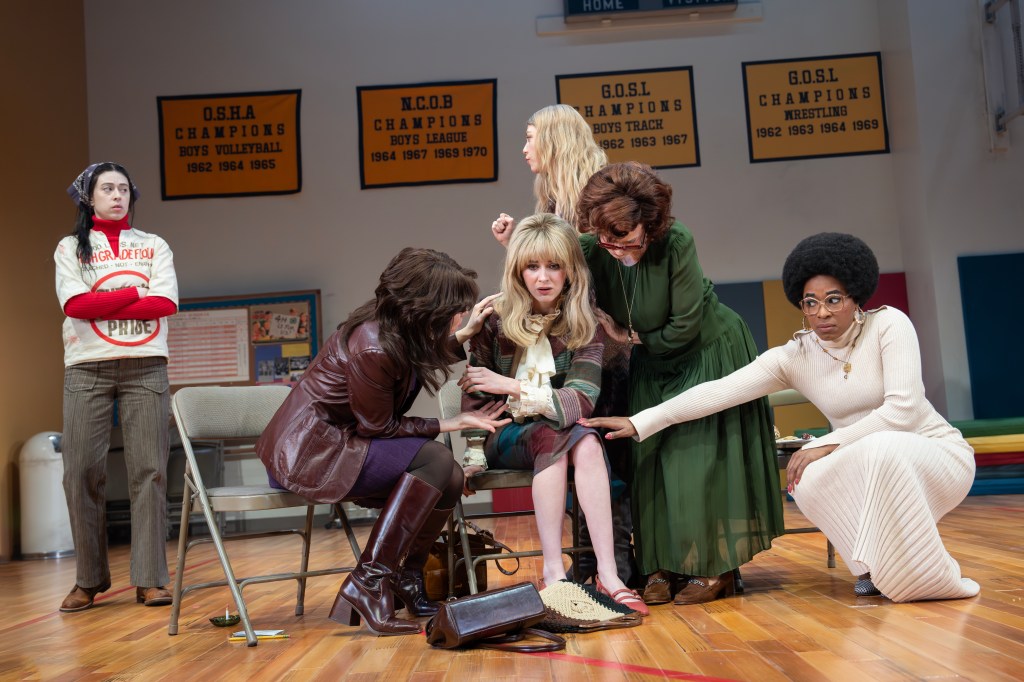
The cast is up for the creative exercise, playing their counterparts in both past and present and occasionally stepping into the role of Lizzie when a situation would be awkward for her daughter to recreate.  Director Whitney White provides as much variation as she can, using the gym equipment to change the composition of bodies.  Set designer David Zinn adds some color with an unlikely rainbow of gym mats while costume designer Qween Jean seems to have had a blast at the local thrift shops to reconstruct that fabulous 70s look.

To protect the actresses from having nude images of themselves released by the public, all audience members must place their phones into a locked Yondr Pouch.  Unfortunately, no one at the venue was responsible for assuring that devices had been silenced or turned off, so the performance was punctuated by rings and pings.  The woman next to me could only kick her purse more deeply under her seat and smile sheepishly.

Liberation would be more successful in its mission if the characters generated the same level of support towards one another as the actresses seem to.  The message that even a little gesture can move a cause forward is an encouraging one, especially in a time when many of us feel like we are losing ground.  Instead, these characters inflict a concept of equality upon one another that feels more like another form of repression.  

An Off-Broadway entry to Roundabout’s season, Liberation continues through Sunday, March 30 at the Laura Pels (111 West 46th Street).  Tickets are available at https://www.roundabouttheatre.org/get-tickets/2024-2025/liberation and begin at $80 including fees.  Running time is 2 ½ hours including a 15 minute intermission.

The Antiquities – A First Look

When I heard that Playwrights Horizons, Vineyard Theatre and Goodman Theatre were co-producing a project, I jumped at a ticket to a late preview.  The Chicago-based Goodman — the oldest ongoing venue in the area — is a Regional Tony winner known for its community inclusiveness.  Vineyard Theater in Manhattan is renown for its support of new voices and unconventional works.  And the focus of Playwrights Horizons is to develop writers whose works promote conversation.  Recently they nurtured the seemingly impossible to stage Stereophonic which won a Tony for its Broadway transfer. 

Added to my incentive was that the playwright, Jordan Harrison, wrote two plays that have stayed with me over the years.  The characters in his Maple and Vine become so uncomfortable with the abundance provided by  modern technology that they move to a town filled with 1950s re-enactors.  In Marjorie Prime, which put Harrison on the short list for the Pulitzer Prize, a digitally generated companion assists an aging woman in recapturing her memories.  Both works are alternatively witty and chilling as they explore the relationship between technological advancement and what keeps us human.

While the performance I saw of Harrison’s latest occurred too early in the run for me to write an official review, I wanted to share a few thoughts.  In A Tour of the Permanent Collection in the Museum of Late Human Antiquities — or simply The Antiquities — two AI curators guide us through a museum built for preserving essential chapters in the human story.  The Playbill includes a quote by Oscar Wilde: “Every portrait that is painted with feeling is a portrait of the artist, not of the sitter.”  In this case, the artists are the systems into which we’ve fed everything from our grocery lists to sensitive photos and we are merely the byproduct of their process.

The trip forward begins in 1816 — when Mary Shelley concocted an original horror story that has since become a metaphor for many of man’s inventions —  and ends in 2240.  The journey is disjointed and abrupt, with some scenes lasting mere minutes.  The diverse cast, described only as Man/Woman 1-4 and Boy, moves with skill and comfort through roles and tone, though not all interactions land with the same level of impact.  For nearly an hour, Harrison relies on an intelligent and informed audiences to fill in blanks. The ride back to 1816 smashes the museum metaphor, but mostly succeeds in stitching together the incidents we’ve witnessed.  The conclusion leaves a stinging mark. 

Kristen Sier and Julius Rinzel in The Antiquities, opening February 4, 2025 at Playwrights Horizons; Photo by Emilio Madrid

The co-directors are multiple award winner David Cromer and ascending star Caitlin Sullivan. This creative pairing may explain the wide range of flavors imparted by each bite-sized chunk.  It will be interesting to see what changes are made by the artistic team before the show is frozen.  The scenic design by Paul Steinberg is composed of metallic walls shiny enough to make us feel included by not clearly reflected. They move to constrict the characters, and are enhanced with a few set pieces.  Tyler Micoleau’s lighting is harsh and eery, blending well with the occasionally distorted sound design of Christopher Darbassie. 

The Antiquities is not an easy show, but it is an admirable offering for the subscriber base of the collaborating producers and others who don’t mind doing some cerebral heavy lifting.  After opening on February 4, the World Premiere runs through March 2 at Playwrights Horizons, 416 West 42nd Street.  Tickets begin at $52.50 and can be purchased at https://www.playwrightshorizons.org/about/production-history/2020s/2425-season/the-antiquities-jordan-harrison.  A second production begins on May 3 at Goodman’s Owen Theatre in Chicago.

Sojourners

Sojourners is part one of Nigerian-American writer Mfoniso Udofia ambitious interconnected nine play Ufot Cycle which intimately explores a multi-generational immigrant experience.  Over a dozen theaters including New York Theater Workshop, The Denver Center, and Berkeley Rep have introduced audiences across the United States to these deeply personal stories and unique characters.  Now the Huntington Theatre in Boston is bringing this special origin story directly into peoples’ homes with a live capture of a performance from their current season.  Directed by Dawn M. Simmons, this distinctive piece works well on a screen, within scenic frames designed by Jason Ardizzone-West.  

Woven into Udofia’s lines of dialogue are numerous details of the characters’ lives growing up in Etinan, an oil-rich area of Nigeria with its own local government.  Well educated and now residing in Houston, Texas on student visas, Ukpong and his pregnant wife Abasiama sit on a well worn couch in their small apartment reliving the days when they were first introduced for an arranged match.  Ama, as she is called, is following her superintendent father’s plan and studying hard to achieve the degree in biology that should assure her future. Her heart remains in her family’s compound as she cooks familiar foods and sings in her native language to her unborn child.  Ukpong, however, has been seduced away from his economic studies by the flash of rallies, Motown, and beer.  His lack of stick-to-itiveness is contrasted with goal-oriented Disciple, another Nigerian student who uses traditional African religious practices to focus his energies.  

Nomè SiDone brings charm and swagger to the role of husband, but while the couple is playful, their abode is “not home; it’s something else.” Ama’s night shift at the local Fiesta Mart and Gas Station has brought her in contact with Moxie, an illiterate streetwalker with ambitions of her own.  Despite her socioeconomic level, the native born Moxie initially looks down on the woman she simply calls “Africa.”  Abigail C. Onwunali is brilliantly expressive as Ama, a woman who knows her worth and can’t believe the many ways people have been careless with her.  So there is singular warmth that emanates from Ama’s scenes with Asha Basha Duniani’s vulnerable yet defiant Moxie.  Their unexpected relationship forms the true heartbeat of this story, along with inspiring a strong craving for Snickers.  Ama’s interaction’s with Joshua Olumide’s Disciple are more uneasy, though the discord adds an interesting flavor to the pot.

Abigail C. Onwunali and Asha Basha Duniani in Sojourners; photo by Marc J. Franklin

As a first chapter in a longer tale, the 1978-set Sojourners unsurprisingly draws to an end, but with an open-ended conclusion.  We are left wanting to know what possibilities await and what will have to be shed in order to reach the next target.  Fortunately, we won’t have long to wait.  The second play in the series, The Grove, begins performances at the Huntington Calderwood (527 Tremont St. Boston) on February 7, 2025.  Udofia completed that piece before Sojourners and its foundation should be set by this solid first layer. 

Digital tickets to Sojourners begin at $30 and can be used until midnight on December 29.  An introduction to the performance is delivered in two languages, perfectly setting up our 2:20 journey.  The platform is stable and the well-directed feed includes closed captioning.  Visit https://www.huntingtontheatre.org/whats-on/sojourners/ to purchase and read more information.

In the Amazon Warehouse Parking Lot 

Like the cruel corporation that manipulates Jen, Ani, Sara and their co-workers, for the most part In the Amazon Warehouse Parking Lot delivers the goods.  What this piece has in common with several of this year’s Off-Broadway productions is an over-stuffed plot that takes on too many critical issues to the detriment of them all.

Similar to Carol Churchill’s memorable Far Away, playwright Sarah Mantell begins by sketching oblique fine lines of a chilling future in a failing country and dramatically discloses details of the lives of an outrageously exploited underclass.  (Churchill twice won the Susan Smith Blackburn prize that Mantell was awarded for this work.)  Descriptions of an advanced climate crisis set to the “music” of Sinan Refik Zafa’s enveloping sound, are vivid, alarming, and all too possible.  The abusive work environment is also cleverly revealed and based just enough on reality to strike a chord.  The more publicized love story is not as well motivated and becomes a distraction.  It doesn’t help that Donnetta Lavinia Grays, who otherwise turns in a strong and steady performance, can’t conjure up any chemistry with Deirdre Lovejoy.   Ultimately, this thread may be essential to the playwright, but not to the play.

In her personal note, Mantell explains her intention to make this production “both art and a hiring document” particularly for women, trans, and nonbinary actors over 50.  The reward for her worthy goal is a memorable cast — Grays and Lovejoy are joined by Barsha, Sandra Caldwell, Ianne Fields Stewart, Tulis McCall, and Pooya Mohseni — so congenial and cohesive it is easy to believe they hang out at the (still open!) West Bank Cafe after every performance.  With no clear path forward, these people can only move “towards.”  Their palpable warmth is in stark contrast to Emmie Finckel set.  The characters are unmoored in a sea of cold conveyer belts and unwelcoming mountains awash in the purple hues of Cha See’s lighting.  

Ianne Fields Stewart, Pooya Mohseni, Tulis McCall; Photo credit: Valerie Terranova

Director Sivan Battat  draws on their background in ritual and diverse mythological storytelling to enrich the anchoring “around the campfire” scenes.  Even the most peculiar and futuristic banter feels organic.  (A lighter detail is Mantell’s selection of the social deduction party game Werewolf as the group’s preferred method of entertainment.)  The more mixed result stems from the monologues about how each of the workers spent their first night sleeping in a vehicle.  This often repetitive contrivance begins to bog down rather than deepen the unfolding of events.    

At its core, In the Amazon Warehouse Parking Lot  is a story of families lost, found, and made. The elements largely come together in a satisfying theatrical experience with a refreshing cast you will want to see more of.  While there are missteps in the dance between Mantell’s personal mission and broader audience appeal, if you give yourself over to her vision (as the mostly under-35 audience did at the performance I attended) the effects will linger.  Presented in association with Breaking the Binary Theatre, the world premiere continues on the MainStage theater at the Playwrights Horizons (416 West 42nd Street) through November 17.  Runtime is approximately an hour and half with no intermission.  Tickets begin at $62.50 and can be purchased at https://my.playwrightshorizons.org/events/amazon.