Category Archives: Play

John Proctor is the Villain

Writers are often told to write what they know.  Playwright Kimberly Belflower has gone several steps further.  In John Proctor is the Villain she has boldly written from her very marrow, jangling the skeletons in our collective social-values closet.  Raised in Appalachian Georgia, Belflower sets her piece in a one stoplight town in her home state, using the locally accepted ways and belief systems to draw parallels between a circle of high school sophomore girlfriends and the characters in Arthur Miller’s The Crucible.  The year is 2018 and there is much in these young women’s lives that was not solved by Harvey Weinstein’s arrest.

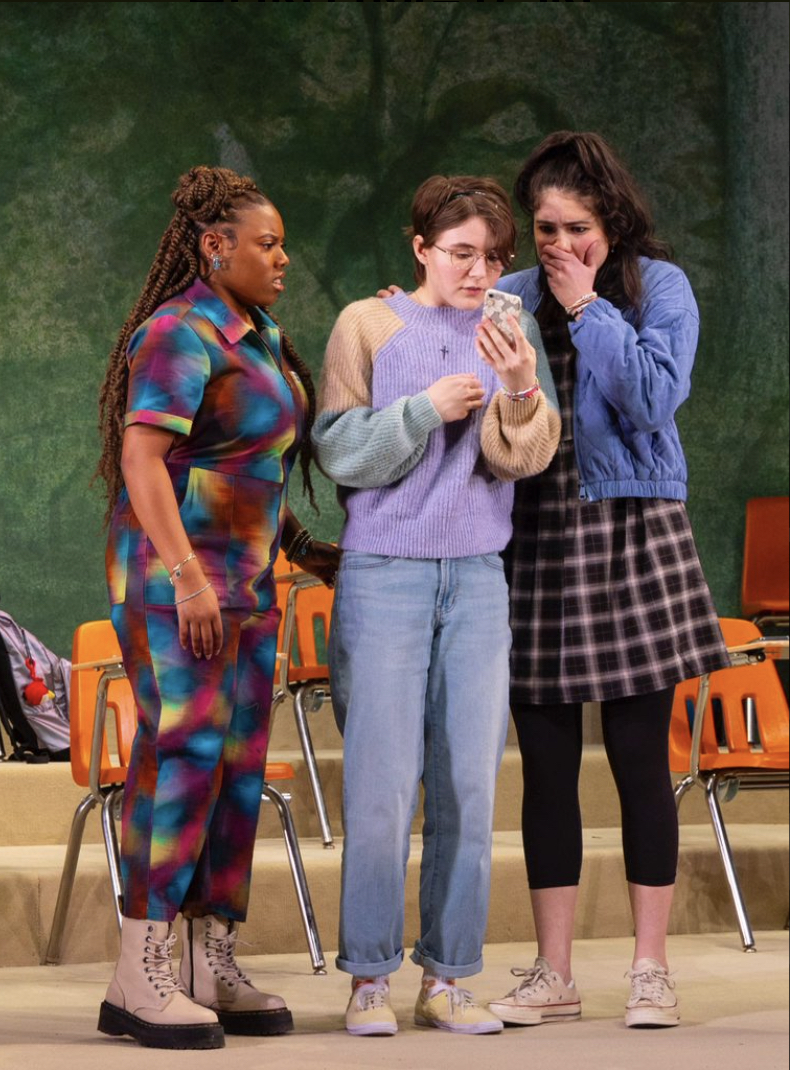
Victoria Omoregie, Jules Talbot, Haley Wong in John Proctor is the Villain; directed by Margot Bordelon; photo by T Charles Erickson

The dialogue is wicked-smart, filled with references from classic literature to song lyrics.  Though all are understandable because of clever context, only one is fully explained.  Belflower begins Act 1 in a classroom where sex education has been buried inside English-Lit, all the better to rush through the uneasy curriculum.  Along with getting a quick hit of each of “Villain’s” characters, this opening enables teacher Carter Smith (a  charmingly approachable Japhet Balaban) to also introduce any audience members not already familiar with Miller’s work to the major themes of The Crucible and the historical background of Witch Hunts.  It also becomes clear very quickly how much the study of the arts is giving meaning and purpose to the lives of these students

While serious issues of feminism, sexuality, body positivity and all varieties of belief run under the surface, front and center is a story of the power of female friendship.  The young ladies are created with some stereotypical DNA, but every one is layered with unique and endearing details.  Caught in a very personal #MeToo scandal through the actions of her father is Ivy Watkins (a warm Brianna Martinez).  Her former best friend Shelby Holcomb (a thorny Isabel Van Natta) has just returned to school after an unexplained “sabbatical” which might be connected.  Often speaking truth to power is Nell Shaw (a high-octane Victoria Omoregie) bringing “worldly wisdom” to the conversation from her upbringing in Atlanta.  At the other end of the confidence spectrum is Raelynn Nix (a fabulously wriggly Haley Wong) the local preacher’s daughter. The ultra serious Beth Powell (a ready-to-spring Jules Talbot) launches a feminist club in part to boost her college application but also to give them a container for discussing their feelings. They have a developing ally in Mason Adams (a sweetly awkward Maanav Aryan Goyal ) who experiences a particularly lovely character arc.   Filling out the attendance sheet is Raelynn’s ex-boyfriend Lee (Benjamin Izaak) and the class guidance councilor Bailey (Olivia Hebert) who are essential to the plot.

Seasoned director Margot Bordelon, who has a history of amplifying new voices, seems to have deep love for these characters, bringing out every delicate moment of discomfort and rage with authenticity.  The school room’s simple set by Kristen Robinson changes temperament with the help of Aja M. Jackson’s lighting.  Sound designer Sinan Refik mixes snippets of pop tunes with school bells and eery noises to further shift the tone of the room.  The girls also make themselves heard in their choice of wardrobe (Zoë Sundra) and in Raelynn’s case evolving eye make-up.

Whether it is exploring weighty matters (like why is “too much” simply parental shorthand for “a girl)” or making us laugh in solidarity, John Proctor is the Villain always keeps us entertained.  True enjoyment requires the ability to think big and a tolerance of of other points of view.  It is available as an On Demand stream from The Huntington Theatre in Boston through March 24.  Running time is about 100 minutes with no intermission. Digital tickets are available at four price points starting at $30 and can be purchased at https://bostontheatrescene.huntingtontheatre.org/28317/28319.  

Dragon Lady

Sara Porkalob had received praise for playing a white Founding Father, Edward Rutledge, in the Broadway revival of 1776.  But she had never had the opportunity to represent someone with her Filipino background until she wrote a role for herself.  Her solo performance — Dragon Lady — tells the colorful story of Porkalob’s grandmother, Maria Porkalob Sr.  A karaoke-loving daughter of a gangster, Maria I moved from the Philippines to the Pacific Northwest as a pregnant newly wed wife of an American soldier.  (Senior made a cameo in the show until her death in 2022 and now appears in projection.)  The show premiered in 2017 and has been touring the country, now joined by Dragon Mama, another Porkalob creation told from Sara’s mother’s perspective.

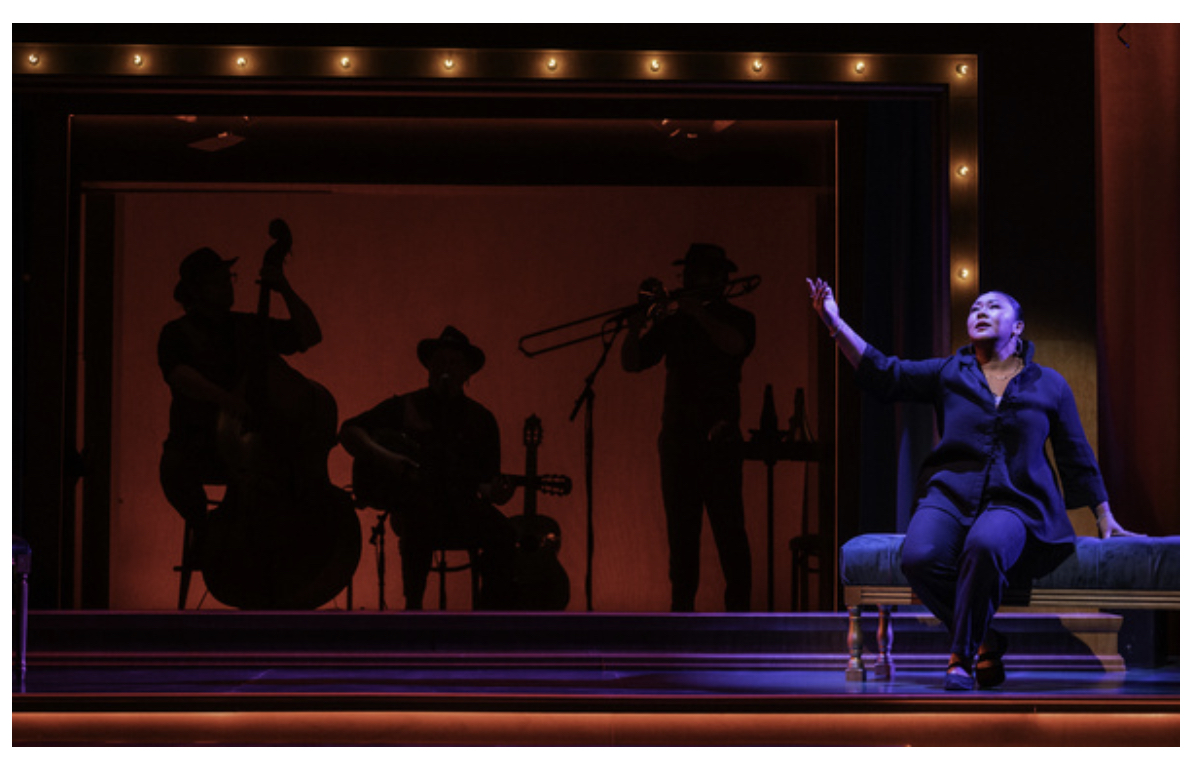
The Pittsburg Public Theater recently shared Dragon Lady with a broader audience through the League of Live Stream Theater, a non-profit that works primarily with regional theaters to broadcast their productions in real time.  Built tenderly from a 9 minute senior year workshop assignment, the production runs 2:15 and spans over 40 years.  Designed in a framework of a cabaret act with a three piece band, Hot Damn Scandal (Pete Irving, Jimmy Austin, and Mickey Stylin), the performance is engaging and freeing.  On the night before her 60th birthday, Maria Sr. pulls her granddaughter aside in order to share some family secrets.  Sara’s mother, Maria Jr., is obviously not the matriarch’s biggest fan.  By revealing some less-than-flattering elements of her history, the elder Porkalob hopes to at least elicit understanding of if not forgiveness for her past actions from the newest generation.

Sasha Jin Schwartz’s set, bathed in blue with its raised rounded platforms and crisscross patterns, conveys the essence of a casino or nightclub.  Under the guiding hand of director Andrew Russell and leveraging the intimacy of this ¾ round space, Porkalob changes skins in a flash, portraying those closest to Maria Sr. including her father, lovers, and five children. Each relationship shines a little more light into the painful darker corners (physical lighting by Spense Matubang).  There is a particularly lovely and insightful exchange between Maria Sr’s two sons, Ron and Charlie, when they were younger.  Sara’s singing voice is remarkably strong and soaring as she delivers a range of musical numbers from torchlight to jukebox.  Mixed with atmospheric sound by Erin Bednarz, the selections help shift the mood and lighten the load.  

Sara Porkalob backed by the Hot Damn Scandal in Dragon Lady at Pittsburg Public Theater

Having broken away from the comfort of scene partners and backdrops, Porkalob has had to tap deeply into her own power as an artist.  By appreciating the value of a personal story and sharing a genuine human experience, Porkalob has given us a work that resonates far beyond her own family.  The language and themes are decidedly R-rated and intended for audiences over 18.  A third play, Dragon Baby, told from Sara’s vantage point, as well as a TV adaptation of the entire cycle are currently in development. 

For more information about Sara Porkalob and The Dragon Cycle, visit http://www.saraporkalob.com/.  To explore the rest of the Pittsburg Public Theater Season, visit https://ppt.org/.  To learn more about upcoming real-time simulcasts by the League of Live Stream, visit https://www.lolst.org/.  

Sunset Baby

My first experience with Sunset Baby – Dominique Morisseau’s 2012 drama being revived at New York’s Signature Theatre – was a series of tweets from colleagues grumbling about the treatment of the playwright’s program insert. Indeed the tiny handout is a puzzling choice of physical manifestation for her enticing invitation to the audience to fully participate even vocally in her tale of a recently released social revolutionary, his traumatized daughter, and her loving thug of a boyfriend.  But it wasn’t so much that the “Permissions of Engagement” were on a 4×6 piece of paper in nine point font. The more disappointing aspect was that the production did not elicit so much as a peep from Sunday’s audience.

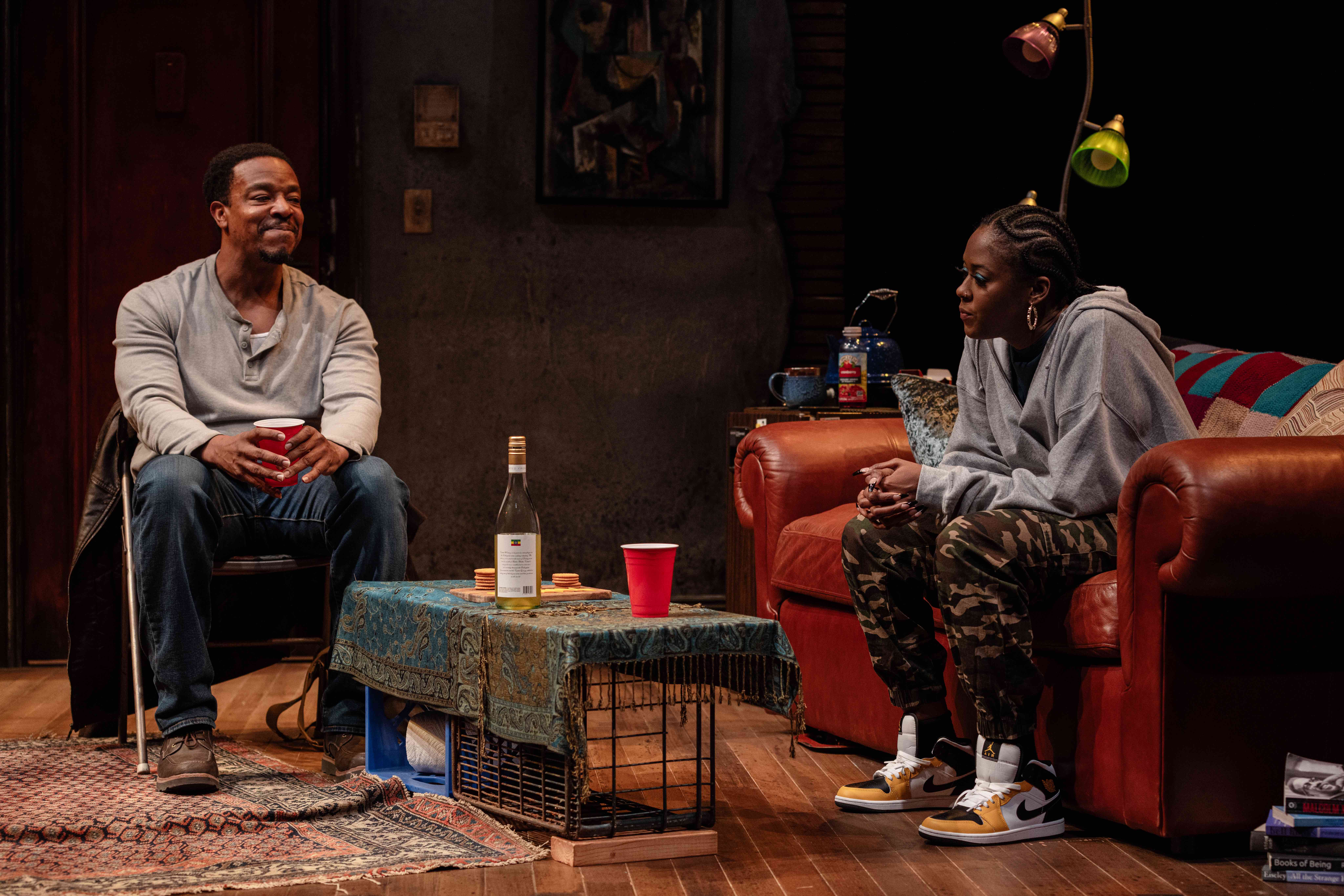
Russell Hornsby and Moses Ingram in Sunset Baby; Photo Credit, Marc J Franklin

The ability to fulfill Sunset Baby’s promise is boldly displayed in the concise history of the show’s world displayed on the wall outside the theater door. It is visible in Wilson Chin’s economical yet thoughtful scenic design with its peeling paint, well-used furniture, and intriguing choice of artwork.  The decision to move the proscenium forward and raise the rake between the rows increases the accessibility and brings the audience further into this room.  Small touches from a shower caddy (props by M. Picciuto) to the nearby train (sound by Curtis Craig & Jimmy Keys) bring the setting into clearer focus. The promise is most palpable in the emotive performance of Russell Hornsby as Kenyatta, who in warm and slightly trembling tones opens the show by vividly describing not only the struggles of his role in the Black liberation movement and resulting incarceration, but of the bigger challenge of trying to be a loving father. And it occasionally pokes its head out in Morisseau’s careful plotting such as the discovery that Kenyatta’s daughter Nina expands her world beyond her rundown room in East New York by watching the Travel Channel.  Indeed, Morisseau’s knowing and complex feelings about parenthood are strongly woven throughout the dialogue. But none of these sparks ever becomes flame in the frustratingly inert 90 minute runtime.

What seems to have put a dulled layer between the work and the experience of it are artistic choices by director Steven H. Broadnax III.   The pacing is slow and there are false notes along the way.  Nina comes home from her “job” as a fake hooker who helps her boyfriend, Damon, lure black men into dark alleys to rob them.  She slips off her shiny royal blue thigh-high boots — among the apt selections by costume designer Emilio Sosa — only to wrap her cozy pink bathrobe around her skin-tight leather mini. Is this a symbol for her constant discomfort or an inability to smoothly incorporate a wardrobe change?  The actress embodying Nina, Moses Ingram, has proven herself capable of deep emotional range.  But here she is stuck at the pitch of a petulant teen. Nina’s lack of full development is most notable in a pivotal scene between her and Kenyatta. It should play like a musical movement that shifts from minor to major.  Instead this sly turning point is tonally more like a repeated refrain.  As her literal partner in crime, J. Alphonse Nicholson is also wedged into a single groove when the character could be providing meaningful counterpoint. 

I deeply admire Signature Theatre as a surviving safe harbor of affordable, expansive community theater. The commitment to reexamine an older work by Dominique Morisseau that focuses on the personal impact of the socioeconomic divide is a timely one. But Sunset Baby 2024 misses an opportunity to more engagingly enlighten a new audience about the fallout from another period during which the Black community’s efforts to serve their own were villainized and politicized.  

The first of three offerings this season, Sunset Baby runs through March 10 in the Romulus Linney Courtyard Theatre at the Pershing Square Signature Center (480 W. 42nd Street).  Tickets are available at https://order.signaturetheatre.org/events and are $59/$79/$99/$119.

Australian Theatre Live – Emerald City

In 2014, when the artistic director of the Griffin Theatre Company,  Lee Lewis, had the opportunity to direct any play she wished, she reached back nearly 30 years to David Williamson’s comedic drama Emerald City.  The work continues to travel maddeningly well through time.  Using his own experience as a springboard, the Australian playwright examines the struggle between artistic passion and the desire for money and power.  Available to stream on the relatively-new-to-the US Australian Theatre Live, it is a treat for those who missed it during an early run produced by New York Theater Workshop.

The city in question is not the one Dorothy visited, but rather the glittery harbor-famed Sydney where in-demand screenwriter Colin (Mitchell Butel) has recently relocated his family from the more staid and traditional Melbourne.  He hopes the colorful energy of his new surroundings will be creatively renewing after his latest film disappointed at the box office.  But a new partnership with the well-connected vulgarian Mike (Ben Winspear) plays havoc with Colin’s priorities and reputation.  A secondary plot involving Colin’s wife of 18 years, Kate, (Lucy Bell) centers on book publishing and the question of who can tell a story, once-again relevant in the season of The Killers of the Flower Moon.  Colin’s agent, Elaine, (Jennifer Hagan), his bank manager, Malcolm, (Gareth Yuen) and Mike’s live-in girlfriend, Helen, (Kelly Paterniti) play pivotal roles in the unfolding of events.

Kelly Paterniti as Helen and Ben Winspear as Mike in Emerald City;
photo by Brett Boardman

There are two main reasons why the play still resonates.  While there has been an increase in the appetite for quality on screens big and small, there is still little profit to be made in arthouse projects: a dilemma for talent.  But there is also a timelessness to Williamson’s satiric conversation and smartly drawn characters.  His observational ability is on full display, especially when actors break the fourth wall and make us coconspirators.  Focus whips between them connecting with their audience and being in the moment, providing side-by-side viewpoints.  Butel is particularly skilled at humorously parroting the others.  Though it is the men who take up most of the 125 minute runtime with their posturing and machismo, the women with their deeper combination of beauty and brains are the ones behind the more surprising and memorable moments.  The piece begins to drag a bit towards the end, though that may be my post-pandemic attention span unaccustomed to two full acts.

Designer Ken Done supports the central conflict with his backdrop for Act I playfully drawn and the one for Act II dressed for business, shrouded in beige fabric.  A single couch and coffee table serve as all living rooms and a sole desk and sectional Everyman’s office.  This allows director Lewis to squeeze every millimeter from the tiny stage, including the area between staircases, and facilitates seamless handoffs between characters at a brisk pace.  Lighting designer Luiz Pampolha provides emphasis as does costumer designer Sophie Fletcher’s pops of color.

The Griffin was launched by actors and remains artisan-focused.  In his introduction to the digital version of Emerald City, Williamson makes clear that this is not a film but rather a first rate production viewed from the best seat in the house.  Indeed the camerawork is smooth and obviously well rehearsed, the sound is pristine, and the acting style genuinely theatrical.  Closed captioning is available as is a 10 second back button.  The stream costs $7.99 at https://stream.australiantheatre.live/ and is just one entry in a growing library developed with the intention of expanding access to Australian performing arts.

Merry Me

The new comedy Merry Me has plenty going for it.  The layered writing by Hanson Jung is packed with witty spins on pop culture and references to classicists from Euripides to Shakespeare all built around a structure most similar to a Restoration Comedy.  The cast — everyone making a New York Theatre Workshop debut — is masterful.  It would be easy to play up every clever note, which would also be exhausting.  Instead the punches are delivered in slowly rising waves under the direction of the always excellent Leigh Silverman.  It’s all quite attention getting and yet somehow lacks stickiness, which is not meant to be a sexy pun despite the prominence of bawdy humor in the dialogue.

Marinda Anderson, Esco Jouley, Shaunette Renee Wilson and Nicole Villamil in Merry Me; photo by Joan Marcus

The plot unfolds on the front lines of a war that has been paused by a well-known Angel (sassy  Shaunette Renée Wilson).  She introduces us to the interdependent characters as she and her cohorts manipulate their lives.  There is Lieutenant Shane Horne (magnetic Esco Jouléy) who having seduced the General’s Wife (pixieish Cindy Cheung) is on a quest for her next “Merry.”  Shane enlists the help of therapist Dr. Jess O’Nope (exuberant Marinda Anderson) to convince the rather dim General Memnon (David Ryan Smith with just the right amount of dopiness) that they are now heterosexual.  Meanwhile the General’s equally dim son Private Willy (Ryan Spahn taking the hit for cis white men everywhere) has smuggled his beautiful new wife Sapph (Nicole Villamil managing an incredible balancing act between allure and innocence) onto the base.  Bored out of her mind and her body, she dresses in “boy drag” in order to explore her surroundings and seek out Shane. 

Playwright Jung pulls in references from Illyria to Wakanda with a hefty serving of Kushner and a soupçon of E.L. James.  All of her characters are self aware and often speak in stage directions and subtext. The energy is that of an old-fashioned farce but the would-be cliches are almost literally turned on their heads.  Having directed many productions in the NYTW space, Leigh takes actions that would typical be horizontal and stages them vertically with wonderful results.  There is one tiny portable foley door that gets run in and out of, but for the most part that classic farcical piece is “performed” by a remarkable back wall designed by Rachel Hauck.  The effects are fully achieved with the help of Barbara Samuels lighting and Caroline Eng and Kate Marvin’s sound design.  

A combination of intellectual exercise and frank sexuality, unsurprisingly Merry Me is attracting an unusual blend of followers.  The age range of the audience was fresh out of college to well into AARP membership.  Faces represented the colors of the rainbow.  And reactions spanned from gently bobbing heads to energetic fist pumping.  Performances continue through November 19 at New York Theatre Workshop, 79 East 4th Street.  Runtime is 90 minutes with no intermission.  Full priced tickets are $65.  For more information visit https://www.nytw.org/show/merry-me/.    There is room in this world for something different even if it isn’t enduring.

The Half-God of Rainfall

At a time when the performing arts are struggling, it is fitting that the wonderful New York Theatre Workshop is hosting a theatrical event that takes much of its inspiration from the early Greeks.  Similar to the dramas of that time, The Half-God of Rainfall combines elements of religious mythology, social commentary, and contemporary politics.

The piece opens with a nod to the ancient tradition of oral storytelling as the players introduce themselves with their real names along with their god-selves.  Working together, the performers weave a tapestry of poetry and dance as they tell the tale of Demi, the product of a particularly violent rape by Zeus: one of many abuses perpetrated by the King of the Gods against human women.  Having won a wager with Sàngó, a fellow god of Thunder, Zeus took as his prize Modúpé, who almost instantly gives birth to a half-god child, Demi.  His despair can make rivers rise and his rage can make it rain.  But his real power manifests on the modern basketball court where every shot is a winner. Despite his many victories, his smoldering rage against his father always burns.

In this realm, the gods of all traditions know one another and many are no better than the mortals over whom they have dominion.  Encompassing so many deeply felt themes occasionally bends the narration out of shape, but the dazzling visuals and all encompassing soundscape keep you enraptured. The audience was invested enough that towards the end they elicited a loud gasp at a critical moment.  While some familiarity with the various pantheons would be helpful, playwright Inua Ellams includes enough background information that the plot can be followed without it.  Even the basketball reference are based on pop culture and never “inside baseball” as it were.

Taibi Magar’s direction is masterful, filling the scene with otherworldly energy enhanced by movement director Orlando Patoboy.  She also incorporates Orisha movement choreographed by Beatrice Capote.  The set by Riccardo Hernández with projections designed by Tal Yarden is in constant motion with swirling images of clouds, water, and the cosmos itself.  The stage continues the natural theme, covered in black sand that moves and lets out a soft crunch beneath the actors’ feet.  The physical experience is expanded with the sound design of Mikaal Sulaiman and lighting designed by Stacey Derosier.  Costume designer Linda Cho builds on basic black towards the shimmering waters of a fertility goddess.

The ensemble moves with fluidity throughout the work, their disparate voices adding variation to the verse.  Mister Fitzgerald gives Demi a radiant joy.  Jennifer Mogbock brings both strength and warmth to Modúpé, her body moving with the combined powers of grace and strength.  Jason Bowen as Sàngó and Patrice Johnson Chevannes as Osún make a fittingly splendid couple under whose protection Modúpé lives.  Kelley Curran’s Hera and Michael Laurence’s Zeus employ unnecessary Greek accents, but the two shine in their other supporting roles.  Only Lizan Mitchell over-modulates, consequently distorting her lines as the trickster Elegba and several other deities. 

Mister Fitzgerald as Demi, The Half-God of Rainfall; photo by Joan Marcus

As many Greek heroes learned, a great adventure often begins by being blown off course.  This production was disrupted by COVID only to wind up in just the right hands.  The result is an ambitious epic that draws a diverse audience much needed by today’s theater world.  Despite its themes, The Half-God of Rainfall is a human-level spectacle born of collaboration and heart.  (There is a trigger warning for a depictions of sexual violence and a use of flashing lights and haze for dramatic effect.)  Performances continue at the New York Theatre Workshop (79 East 4th Street) through August 20 and $65 tickets are available at https://www.nytw.org/show/the-half-god-of-rainfall/.  Runtime is about 90 minutes and mask-only performances are available.  A co-production of NYTW and Harvard’s American Repertory Theater, the show will be moving next to Cambridge, MA in September.

Primary Trust

I usually don’t make my reviews personal, but my experience while watching Primary Trust and the themes within this gorgeously crafted play are inexorably intertwined.  With gentle brushstrokes, Eboni Booth introduces us to 38 year old Kenneth, one of the few Black people living in Cranberry, a suburb of Rochester, New York.  His ethnicity is only a minor contributor to Kenneth’s isolation.  Having lived an extremely restricted life since the death of his mother when he was only ten, Kenneth’s coping mechanisms are intricate and ritualized.  But somehow his idiosyncrasy has left him uniquely suited to meeting people at their own level.

There is a deliberate “let’s pretend” quality to the entire production.  From the opening moments, Kenneth speaks directly to us in his halting and self-reflecting style.  Long thoughtful pauses rest between effervescent bursts of storytelling.  All the activity comes with musical accompaniment composed by Luke Wygodny, punctuated by the ding of an “order up” bell.  Marsha Ginsberg’s whimsical scenic design takes the phrase “small town” and makes it literal, including a miniature church, bank, and big box store alongside Wally’s, the tiki bar that serves as Kenneth’s sanctuary.  Lighting by designer Isabella Byrd leaves long shadows on the ground well before winter sets in.  Costume designer Qween Jean employs a more muted color palate than her signature style until an essential jacket makes its appearance at a pivotal moment. Two actors play multiple roles, sometimes barely turning around before switching.  Yet the play is never anything less than genuine and heartfelt.  The entire audience was sufficiently swept up to respond emotionally to every turn.

William Jackson Harper is utterly perfect as Kenneth, balancing warmth, vulnerability, fear and heart.  It’s Harper’s first stage appearance since 2017 and it was my first live theater attendance since March of 2020.  Previously, theater played a major role in my life.  Many of my friends come from that world and it was often the way I entertained others.  Vacations have been planned around seeing a specific work or actor. The temporary loss of that pursuit was profound.  But Primary Trust is all about bringing people in.  At its core is the celebration of coming out of seclusion.  To have Kenneth welcome me as a member of the audience into his life could not have been more impactful. And though I don’t have much more in common with the character, I do share his deep belief in the power of one good friend.

Jay O. Sanders, William Jackson Harper, and Eric Berryman; photo by Joan Marcus

Director Knud Adams, who often works with new material, delicately mines Booth’s script, uncovering the layers of joy, sorrow and hope. Providing support and stability for Kenneth is his best friend Bert, played with sweet good nature by Eric Berryman.  Jay O. Sanders seems to be having the time of his life portraying (among other characters) Kenneth’s two very different bosses.  The first — the owner of a bookstore— has the difficult task of laying Kenneth off after twenty years of a comfortable relationship.  The loss of his job shatters the comfortable if confining structure of Kenneth’s life, and the chink of light shining through the holes is both frightening and filled with possibility.  Helping Kenneth step through the gap is April Matthis’s Corinna, the only one of a multitude of Wally Waiters who wants to see Kenneth as more than an eccentric customer.  Completing the ensemble is a Musician played by understudy Paul Lincoln in the performance I attended.  So essential is he in setting the beat and tone, that Mr. Lincoln received his own loud round of applause.

Roundabout has obviously worked to make this production inclusive.  The company offers clear and sensible guidelines to audience members and the staff makes themselves very available to help.  To get you in the mood for what is to come, the lobby has been decorated to resemble a tiki bar, complete with projected fish tank and artificial grass.  The ticket confirmation warns audience members not to arrive late.  I can only reemphasize their strong recommendation.  Missing any of the first few minutes of the show will leave you with quite the wrong impression of what is transpiring.

Primary Trust is a work of true beauty.  It was nurtured at the 2021 Ojai Playwrights Conference and is a recipient of an Edgerton Foundation New Play Award.  Running time is an absorbing 95 minutes with a realistic denouement.  It is playing at the Laura Pels Theater in the Harold and Miriam Steinberg Center for Theatre (111 West 46th Street) through Sunday, July 2.  (Note that Harper is out the weekend of June 9.)  Tickets start at $56.  $4.95 COVID cancelation insurance is available.  Visit www.roundabouttheatre.org for additional information including special performances.

Chicken & Biscuits

Theatre Squared continues to make their season available to a nationwide audience with a lively recording of their opening night of Douglas Lyons’ family dramedy Chicken & Biscuits.   It’s another cohesive and enjoyable ensemble production from the Fayetteville, AK based non-profit and winner of a special 2022 Obie Award. 

I saw a Zoom reading of the work in March of 2021.  As was typical of that time and medium, it was messy, but I enjoyed the interrelationships and the realistic tension between characters.  In its final form, the story unfolds almost entirely in one-on-one conversations, so it doesn’t flow so much as interconnect.  Many of the rough edges have been sanded down so that the understandable conflicts are aired and settled at an almost unnatural pace.   But the comedic exchanges and not-so-gentle ribbing remain in place.  Whether you will find this satisfying or frustrating depends on how much you value resolution over the journey to get there.

Baneatta and Beverly are two dramatically different sisters brought together by the death of their much-loved father.  It is clear from Baneatta’s opening prayer that the siblings are poles apart in style, attitude, and social position.  Quite simply, they drive each other crazy.  They even compete over who can feel more grief over the loss of a parent.  A gap between expectation and reality divide the other family members as well: mothers and children, sister and brother, partners and parents.  But the snipes stem more often from wanting the target to have the best life possible rather than deliberate viciousness.  As one character observes, “miscommunication ruins a lot of love.” 

Director Denise Chapman digs as deeply as she can to find the heart and humanity of each personality.  The vivacious cast brings a warm energy to the entire proceeding.  Robert Denzel Edwards is a stand out as Kenny, in part because his character is given the most vivid speech about his inner life.  With his sincere ability to listen, Edwards helps Justin Mackey as his white Jewish boyfriend Logan and Candace Jandel Thomas as Ken’s wounded sister Simone shine in their scenes togethers.  In another sequence, Maura Gale as Brianna covers 40 years of emotional history, providing a strong core to the plot and perhaps the toughest role.  She plays well against Kathy Tyree and Tameka Bob, respectively keeping Baneatta and Beverly in their defined lanes.  Michael A Jones lends solemnity as Baneatta’s husband Reggie, while Jordan Taylor sits on the other end of the spirit seesaw as Beverly’s Tik Tokking daughter La’Trice.

Photography at Theatre2 of Kathy Tyree and Tameka Bob in Chicken & Biscuits, Fayetteville, Arkansas on April 4, 2023.

As usual for T2, the artistic team supports the overall vision while keeping budget in mind.  Working almost entirely in black, costumer designer Devario D. Simmons gives us terrific textural queues about each character’s dominant qualities.  Marie Laster’s airy church set dominated by a rose window, illuminated cross and arched doorways creates a flexible space that is defined and refined by Athziri Morales’s soft lighting.  

According to American Theatre Magazine, Chicken & Biscuits was the 2nd most performed play across the USA in the 2022-23 season (right behind Clyde’s by Lynn Nottage).  The banter and relatability make for a pleasant viewing experience and sometimes that’s just what’s needed in these psychically exhausting times.  It runs though May 14 at TheatreSquared (477 W. Spring St., Fayetteville).  Live performances are at 7:30pm Tuesday through Saturday with 2pm matinees on Saturday and Sunday.  Digital streamers are available for 24 hours beginning at noon Central Time on the selected date.  Customer service is first rate.  Tickets run from $20-$54 and can be purchased by calling (479) 777-7477 or by visiting theatre2.org.

From The Mint Vault — Days To Come

“Lost Plays Found Here.”  So says The Mint Theater punningly about their mission.  Founded in 1992 by Artist Director Jonathan Bank, the company gives new life to neglected plays primarily from the 1930s.  Always polished, frequently charming, and often stunningly relevant, the line-up has included The Voysey Inheritance by Harley Granville-Barker, Rachel Crothers’ A Little Journey, and several works by the nearly forgotten Teresa Deevy.  They have made their home in several comfortable venues around Manhattan, most recently City Center and Theater Row.  

Financially slammed like every other small theater during COVID, The Mint occasionally opens their vault of recorded shows as a passive income stream.  Their current offering is the intense drama, Days to Come.  Written by Lillian Hellman between two better known plays — The Children’s Hour and Little Foxes — the plot unfolds over the course of a month in 1936 during a strike against a factory in a small Ohio town.  Hellman chose to focus on the social impact the strike has on the close community.   She conducted interviews with workers and management of the Wooster Brush Company to help her create characters of depth and conviction without the aim of solving their issues.  Andrew Rodman, the owner, and Thomas Firth,  the most vocal of the workers, are friends.  Their long-term relationship makes their conflict more complex, especially when outside forces intervene.  As events unfold it becomes clear that simply knowing a person over time doesn’t guarantee you can anticipate their actions. 

Director J.R. Sullivan builds the tension between various pairs of characters, each with a distinct style and agenda.  Larry Bull is the heart of the show, imbuing Andrew with surprising sensitivity and self-awareness.  In contrast, Chris Henry Coffey’s Tom is all gut reaction.  Coming between them is Ted Deasy’s Henry Elliot, a lawyer who’s wealth and style mask a grimy interior.  In arguably the most difficult role, Mary Bacon successfully balances the symptoms of Andrew’s sister, Cora’s, mental illness with genuine if misguided concern.  The rest of the cast includes Janie Brookshire, Dan Daily, Roderick Hill, Betsy Hogg, Geoffrey Allen, Kim Martin-Cotten, Wendy Rich Stetson and Evan Zes.

Larry Bull, Chris Henry Coffey, Ted Deasy, Roderick Hill, and Janie Brookshire in Days to Come; Photo by Todd Cerveris

Recorded in August of 2018, the stream is very stable and there’s no log in process, though a valid email address is required.  Audio quality is excellent and subtitles easy to read. It is shot from the audience viewpoint with straightforward camera work which never distracts.  Costume designer Andrea Varga sets the tone with wonderful fabrics, which can be seen with increased clarity.   And even on a small screen, the Rodman’s living room designed by Harry Feiner is lush with decorative detail. 

The original Broadway production of Days to Come was a disaster.  The influential William Randolph Hearst stormed out and the run lasted a mere seven days.  While the work isn’t the most relatable or smooth of The Mint’s productions, it is well worth the two hour investment.  It’s available On Demand at https://minttheater.org/ free of charge though April 2.  A request for support will appear in the upper right hand corner at the end, by which time I hope you, too, are a fan.

Pipeline – Streaming on Demand

Pipeline is one of those thrilling intimate dramas that pulls you into its core with genuine emotion and basic human truths.  Written by Dominique Morisseau and presented at Lincoln Center Theater one year after the completion of her famed trilogy, The Detroit Project, it won the Edgerton Foundation New Play Award.  Every one of the well-drawn characters has an arguable viewpoint, proving that the most provocative and intelligent questions rarely have straight answers.

The entire cast of six is perfectly calibrated to provide an affecting high-energy 90 minute ride.  Each character is under pressure, but despite their shared sense of oppression they simply can’t manage to give each other a break.  The story opens on an earnest Karen Pittman as Nya, a teacher in a typically underfunded public school.  Although she is fiercely dedicated to creating relatable materials for her inner-city students, she has agreed to send her only child Omari —  an appropriately grave Namir Smallwood — to a private boarding school.  He is clearly bright enough to compete academically, but privilege isn’t contagious and Omari has been undone by the environment.  His long-brewing rage has boiled over during a lesson on Richard Wright’s Native Son, a controversial book often criticized for bolstering a destructive stereotype of young black men.

As mother and son work along their distinct paths in search of conflict resolution, we also meet two of Nya’s co-workers: Tasha Lawrence as a frustrated and mouthy white fellow teacher, Laurie, and Jaime Lincoln Smith’s Dun, a caring security guard who has history with Nya.  Providing some lightness to the mood is a delightfully sincere Heather Velazquez as Omari’s girlfriend, Jasmine.  Perhaps most critical to setting all the events in motion is Morocco Omari’s Xavier, Nya’s ex-husband who is out of step with both her and their son.

Namir Smallwood as Omari and Karen Pittman as Nya in Lincoln Center Theater’s Pipeline.

Thanks to a partnership between LCT and BroadwayHD, the work is currently available to viewers nationwide with rewarding results.  Blending recordings from August 22 and 24 of 2017, Habib Azar’s direction for the screen(from stage direction by Lileana Blain-Cruz) draws the audience even deeper into the profound rage and passing joys of the characters.  Significant details from a bandaid to a tremor are more visible in closeup.  The short scenes are keep flowing by using film clips as bridges.   Presented in three-quarter round with the audience as a classroom, this production also serves as an introduction to the jewel box of a house that is the Mitzie Newhouse.

The creative team has supported the required fast pace.  Scenic designer Matt Saunders defines the space with a wall of white washed concrete masonry and simple set pieces.  Location is further established using projections by Hannah Wasileski.  Yi Zhao’s variations of light and shadow along with Justin Ellington’s sound work together to increase emphasis of key moments.  

At a time when public schools are increasingly lacking in financial and community support, Pipeline draws sharp lines from a personal story to the bigger picture.  The questions it raises are sure to linger in your heart and mind long after the last curtain call.  In honor of Black History Month, Pipeline is featured with a stellar line-up that also includes 2010 Tony Award-winner for Best Musical, Memphis; American masterpiece, Porgy and Bess recorded in San Francisco’s splendid War Memorial Opera House; and the incomparable Audra McDonald in Lady Day at Emerson’s Bar & Grill.  Learn more by visiting https://www.broadwayhd.com/categories/celebrating-black-artists.