
At the intersection of visual art, movement, music, and the written word lives the collaborative company Happenstance Theater. Under the Artistic Co-Direction of Mark Jaster and Sabrina Selma Mandell, the current troupe has been together for over a dozen years, creating, staging and then touring with what they term Poetic Theatre. It’s the type of operation that includes the crew roles of Visionary Tornado (Mandell) and Minister of Thoughtfulness (Sarah Olmsted Thomas).
Just opening in Theater B at 59E59 Theaters, their piece Juxtapose: A Theatrical Shadow Box is inspired by Joseph Cornell with the whiff of a storyline influenced by the films of Jean-Pierre Jeunet and Jacques Tati. The result is one of charming engagement, more about sensory experience than narrative. Upon entry to the house, one is confronted by a large white wooden frame against a black backdrop with a collection of props on either side. (Examples of Cornell’s work are on view near the theater door for those unfamiliar with his famous boxes comprised of found objects and ephemera.) This central structure takes on various interpretations throughout the performance, but primarily signifies the walls and halls of a lodging house at a time of widespread environmental and political upheaval.
Just like Cornell’s artwork, each scene is intricately assembled with items — a ladder, a ball, a rope — that take on meaning because of their relationship to other elements in the tableau. The rhythm is gentle and likely unfamiliar, with dialogue playing a secondary role to other sounds as well as expansive silence. Shape, color and space are as important as words and phrases like “odd bird,” “through the roof” and “out of the blue” take on unexpected form.
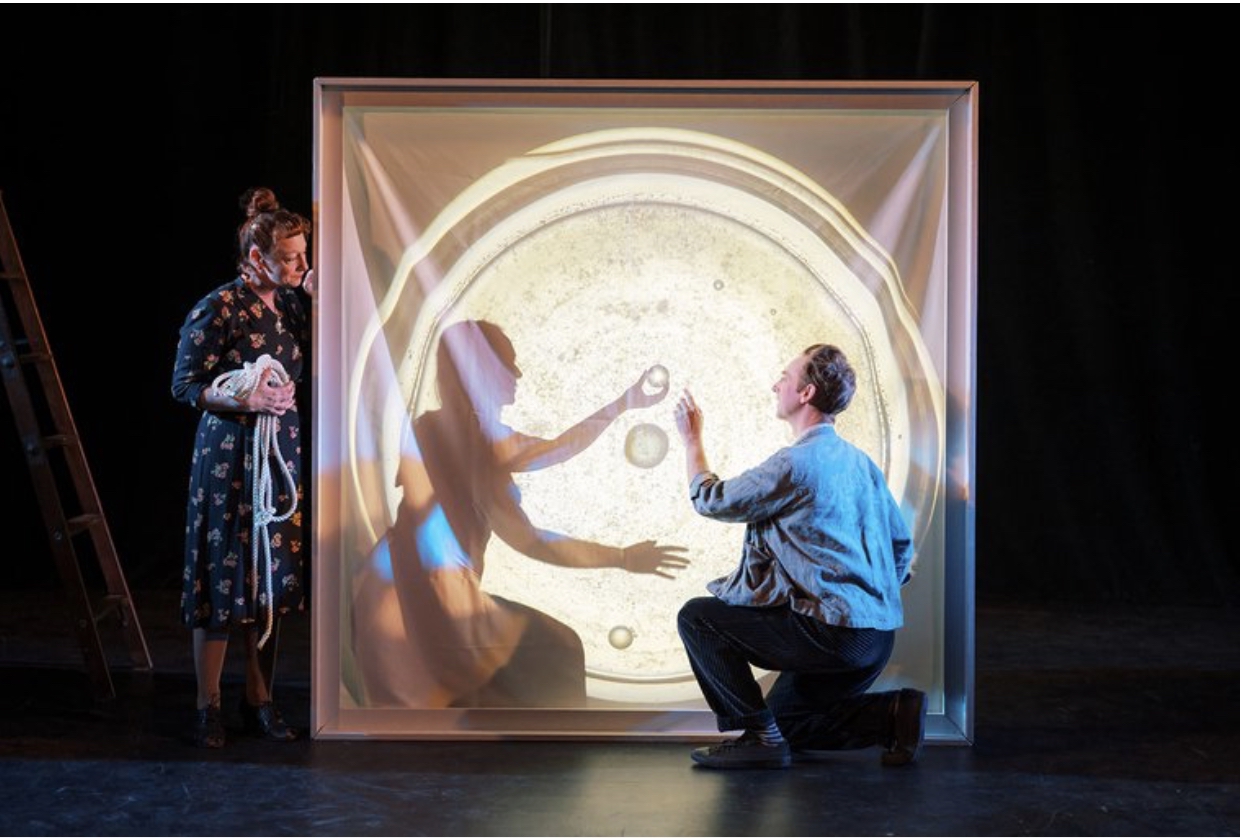
The script’s structure is closer to a short story collection than a traditional stage play. Yet it is possible to discern the caring feelings that flows among the characters. Mark Jaster’s dandy Collector has an apartment filled with natural wonders that fascinate even the uninitiated. Upstairs is Olmsted Thomas’s Étoile, a ballerina with an anxiety disorder whom the others seek to console. Her unusual neighbor Blue, portrayed by puppeteer Alex Vernon, uses pantomime and physical adroitness to provide joyful distraction to his found family. Their daily rhythm is interrupted when Gwen Grastorf as Spilleth literally crashes into their lives. Every interaction is overseen by their nimble concierge, Rosabelle, played with a commanding air by the multi-hatted Mandell. (She also designed the costumes.)
Direction is handled by Jaster and Mandell, but this is a team sport and every player enhances the energy of the others. They are also supported by skilled outsiders who add ingredients to the complex brew. Madeline Oslejsek’s sound design mixes otherworldly noises with crackling radio announcements and controls the listed musical cues so that they appear to emanate from Rosabelle’s old victrola. And lighting design by Daniel Weisglass and Kris Thompson augments the choreography and sleight of hand.
There is something remarkably expansive about witnessing Juxtapose and the evolving art form of Happenstance. Though there is a haunting sense of jeopardy from the moment the house lights dim, the feeling that dominates is one of pulling together. It is being performed at 59E59 Theaters, 59 east 59th Street. Running time is 75 minutes without an intermission. Tickets are $44 for all remaining shows through January 25. Visit https://www.59e59.org/shows/show-detail/juxtapose-a-theatrical-shadow-box/ for details and purchases.




 The Unforgettable Line
Lynn Nottage on Mlima’s Tale
Playwright Lynn Nottage is seemingly everywhere. Her wide appeal and astonishing tonal range stretch from the gut-wrenching Ruined to the broad humor of By the Way, Meet Vera Stark. Two of her plays — Clyde’s and Sweat — are among the ten most produced of this year’s season. The operatic version of her drama, Intimate Apparel, for which she wrote the libretto, is currently on PBS as part of their Great Performances series. And she wrote the book for the Michael Jackson jukebox musical, MJ, now playing on Broadway. Her long reach is made possible in part by a form of self-care. She gives herself a mental break from covering thornier issues by simultaneously writing a comedy.
Last Thursday in an evening co-presented by the Center for Fiction in Brooklyn and Theatre Communications Group (TCG), the two-time Pulitzer Prize winner sat down for her first conversation with Damon Tabor. The investigative journalist wrote an article, “The Ivory Highway,” that inspired her play Mlima’s Tale. He had tracked the intertwined entities responsible for the horrendous international ivory trade. Offenders include poachers, smugglers and all-too-knowing buyers. Moved by what she read in his piece, Nottage buried herself in research. It revealed a genuine possibility of a world without elephants and she felt the need to sound an alarm. She educated herself about the communication style of elephants, especially their deeply social nature. Eventually she developed a story from the viewpoint of a rare big-tusker, beginning with his murder and following the trail through all of those who were complicit in his death. She named him Mlima, Swahili for mountain.
The script is structured as a series of one-on-one conversations illustrating the chain as Mlima’s tusks move from one possessor to the next. Always one for putting a face on an issue, Nottage had the lead character of Mlima portrayed by a human actor. This enabled her to let him more easily communicate to the audience and bring his emotions fully into the room. Rather than using the traditional approach of hiring the production crew after the cast had begun their work, Nottage brought the entire team together from day one, resulting in a more cohesive artistic statement. Oscar winning director, Kathryn Bigelow, brought her genuine outrage and big picture thinking to the initial run-throughs. The impactful concept of having Mlima physically leave his mark on all the perpetrators by smearing them in white came from costume designer Jennifer Moeller.
Mlima’s Tale, was nominated by the Outer Critics Circle in several categories when New York’s Public Theater presented the world premiere in 2018 under the direction of Jo Bonney. The book can be purchased here: https://shop.aer.io/tcg/p/Mlimas_Tale/9781559369114-9511. Performances are currently playing at 1st Stage in Tysons, Virginia and due to open soon at the Arsht Center in Miami, Florida. Productions are also being prepared internationally, though significantly not in China where the ivory trade still flourishes.
Image: Ito Aghayere, Sahr Ngaujah and Kevin Mambo in the 2018 World Premiere of Mlima’s Tale. © Joan Marcus.