
A Letter to Harvey Milk is a slightly flawed gem of a musical, giving voice to some little seen characters. The work is based on a Lesléa Newman’s short story which follows mildly eccentric but loving Jewish characters as they discover and embrace their identities as lesbians. In this case the seeker is Barbara, a Connecticut transplant earning a little extra money by teaching a writing class at the JCC in San Francisco. Her unexpected partner in self exploration is Harry, a widowed retired butcher who finds himself drawn to her classroom and her energy. What binds them is the titular letter that Harry composes as an assignment. The honest love and sincere appreciation expressed to his activist friend pulls Barbara into Harry’s story. She revels in the company of someone who is seemingly so comfortable with his choices. Their developing friendship takes them both to unexpected places.

Adam Heller and Julia Knitel with Aury Krebs in the background. Photo by Russ Rowland
The book by by Jerry James, Ellen M. Schwartz, Cheryl Stern and Laura I. Kramer provides enough detail to follow both Harry’s and Barbara’s struggles with love and loneliness. Throughout are two culturally significant threads about homosexuality and Judaism through time and in context. There are a few small gaps in logic such as how Barbara can be making any money with only one student, but those are easy to set aside. What doesn’t come through with sufficient clarity is the critical figure of Harvey Milk. He is painted in such broad strokes, those unfamiliar with his ground-breaking achievements will see a badly dressed kook with terrible eating habits. Perhaps the script suffered from too many cooks. Lyrics by Ellen M. Schwartz work better to move the story along and provide atmosphere. Music by Laura I. Kramer isn’t very memorable, but it does suit the words, particularly the Yankee Doodle Dandy treatment of some of Harvey’s most famous speeches.
Generally, the women in the cast outshine the men. Julia Knitel — who previously starred as Carole King in the touring company of Beautiful — has a soothing voice and magnificent articulation as she shapes Barbara’s story. As Frannie, Harry’s deceased wife who is by his side for the journey, co-lyricist Cheryl Stern is the comic relief, delivering Elaine Stritch-style patter and emphasis. And in her one big number, Aury Krebs is a dream. Michael Bartoli captures Harvey Milk’s patterns and mannerisms, but as described earlier, he isn’t given enough to work with. Supporting players Jeremy Greenbaum and CJ Pawlikowski do a fine job playing multiple roles. The weak link is Adam Heller who was off key as a singer and lacked sufficient variation as an actor. He has extensive Broadway experience, so perhaps it was just an off night.
Evan Pappas’s staging is clever, especially in the more intimate moments. The charming set by David L. Arsenault captures the feel of the Castro district of San Francisco complete with muted colors and a big Bay window. The orchestra, under the direction of Jeffrey Lodin, is perched on a balcony above so they are in view and adding to the ambiance. The costumes by Debbie Hobson are pitch-perfect, notably Barbara’s anklets and sweater vest and Frannie’s tidy suit. Christopher Akerlind’s lighting effectively changes color palette to the match the mood of each scene.
While A Little to Harvey Milk is still at a “great potential” stage of development, it is already a genuine crowd pleaser (for the right crowd) and impressive bang for the buck. Struggling with shame and the need for self-truth resonants even with those who are straight and/or gentile. It runs through May 13, 2018 at the Acorn, part of Theater Row. Tickets are $79 – $99 and can be purchased at Telecharge.com or by calling 212-239-6200.

![Noel Joseph Allain, Julia Sirna-Frest, and Leah Karpel in [PORTO] -- Photography by Maria Baranova](https://theunforgettableline.com/wp-content/uploads/2018/03/noel-joseph-allain-julia-sirna-frest-and-leah-karpel-in-porto-photography-by-maria-baranova.jpg?w=525&h=350)

 I attended the performance of your play, Some Old Black Man, at 59E59 Theaters on Saturday, February 10. Co-star Roger Robinson was out sick, replaced by Phil McGlaston. I understand that Mr. Robinson has been with the production since the beginning and that it is your request that the show not be reviewed without him. Certainly I was disappointed not to see his turn as Donald, but it was a marvelous afternoon nonetheless. I wanted to take this opportunity to applaud your wonderful work in full view of my readers.
 The lyrics rely heavily on the use of the F-word. There are also long asides recited over a single note in almost every song. These devices seem lazy given Goodman’s clear and strong opinions. Most non-musical sections bring a smile and several are big-laugh worthy. At a few intervals, Goodman asks the audience to participate, though mine was decidedly shy. Gags include the aforementioned wise vaginas and a team of uncooperative dancing boobs. Of the routines that stem from higher chakras, the right wing cheerleaders (pictured here) are among the most fully drawn. The modern twist on Vanilla Ice’s theme is genius. Another skit in which characters speak in Siri is just right. The only bit that fell completely flat featured two literal empty nesters who contemplate getting hooked on painkillers. This is one topic for which no amount of distance is enough.
 Many of us have experience working with someone who’s a big picture dreamer. Unchecked by a healthy skeptic — much less an opponent with a better idea — they good-naturedly lead their team down a path to The Emoji Movie or Pets.com. Greg Pierce starts out telling one such story in Cardinal in which Lydia Lensky returns to her hometown with the wild idea of literally painting it red. With tremendous enthusiasm and few facts, she persuades the locals that this gimmick will attract tourism and new business.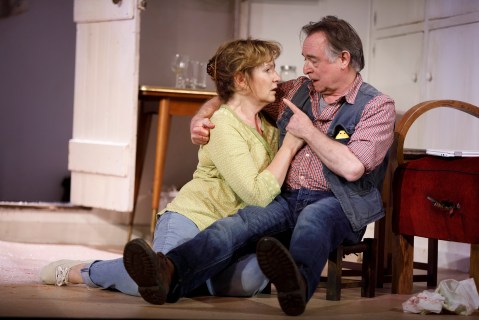
 The Unforgettable Line
Dogs of Rwanda
Dogs of Rwanda is like that really sweet guy you wanna like, but you just can’t get beyond his shortcomings. There are several unfortunate distractions that prevent it from being as powerful as it should be. Given that the Rwandan genocide took place in 1994 and the audience spans a large age range, a short background beyond the artistic director’s statement would have helped. By necessity, the tale we hear is a deeply personal one and moments are certainly shocking, but they are not given sufficient context or a sharp enough lens through which to see. There are also some artistic choices that have hindered the impact of the piece.
The script by Sean Christopher Lewis is delivered as a monologue told solely from the point of view of David Zosia, who at 16 volunteered for a church run spring break program in order to spend time with his crush, Mary. At their Ugandan camp, they are assigned laundry duty working just downstream from Rwanda. When the fight between the Tutsis and the Hutus breaks out, bodies begin floating by the horrified youth. The pair is drawn deeper into the conflict when they attempt to help a local boy named Gods Blessing. Over the course of 90 minutes, David vividly describes what happened at the time and also 20 years later when he receives a note from Gods Blessing that takes him back to Africa. The audience is present to bear witness to his account: an integral role in any deeply meaningful ritual.
David is portrayed by Dan Hodge, an actor and director with an impressive resume. Unlike most solo performances this isn’t Hodge’s story and that is the first stumbling block to its success. Hodge never fully inhabits the role: he is acting not being. The only other person on stage is musician Abou Lion Diarra who accompanies David’s tale with original music performed on a variety of percussion instruments. This creative embellishment was added by the Urban Stages team, but the execution doesn’t quite work. Hodge is inconsistent about including Diarra in the action, sometimes exchanges glances and sometimes ignoring him. Furthermore, the talented Diarra is often so swept away by the joy he finds in playing that it is easy to catch him smiling incongruently to the horrors being described.
Actor Dan Hodge with instrumentalist Abou Lion Diarra. Photo by Ben Hider.
There is also the critical issue that David is essentially a selfish SOB. Everyone else we hear about — Mary, Gods Blessing, and his current girlfriend — have been treated with contempt by our narrator and guide. He is not without redeeming qualities, having literally bled to share at least some of his story with the public in a book called Letters From The Red Hill. While David is certainly contrite by the end, that is where we leave him, never witnessing any actual change in his behavior. This makes his confession a rather hallow one. How can we forgive David as we are meant to if we never see him embody the lessons he claims to have learned and put them into action?
Urban Stages Founder, Frances Hill, and Director of Musical theatre, Peter Napolitano are responsible for the meandering direction. The creative team is the same as the one that brought Zhu Yi’s A Deal to life. Their vision is much murkier this time around. The set by Frank J. Oliva is made to look like a village clearing with a faux earthen floor and thatch peering through a side opening. It lends an interesting flavor to the atmosphere, though the setting is only appropriate some of the time. John Salutz’s lighting casts long shadows which may be intended to add mood but come across as an amateurish mistake. The brilliant Ryan Belock has once again designed the projections, but the screen is at an angle over Hodge’s head. This is effective for planes, trees, and clouds, and a head scratcher for ocean waves.
While not completely successful as a drama, Dogs of Rwanda can serve as a reminder of the dehumanizing effects of war, the atrocities committed based on tribalism, and the many treasured places around the globe devalued by Americans. It is a worthy end to a season in which Urban Stages has been shining a light on works with an international point of view. It runs through Saturday, March 31, 2018. Tickets for are $35 ($25 during previews; $50 on opening and $15 student rush) and may be purchased via OvationTix at www.urbanstages.org or by phone at 1.866.811.4111.