Category Archives: Uncategorized

The Liar

Set Design ALEXANDER DODGECostume Design MURELL HORTON Lighting Design MARY LOUISE GEIGER Original Music ADAM WERNICK Sound Design MATT STINE

Kelly Hutchinson and Carson Elrod in The Liar Photo Credit: Richard Termine

Decidedly cute, The Liar, is currently brightening the Classic Stage Company just off Union Square.  This quick-paced farce is adapted by David Ives of Venus in Fur fame from a comedy written by Pierre Corneille, a man known better for his well-received tragedies.   The light-hearted (and one could say well-timed) story centers on Dorante, a man who tells lies as easily as he skewers his friend with an invisible sword.  Written in iambic pentameter — including a few lines purloined from mighty Shakespeare — the crafty script is dotted with modern references to personal ads, fraternity handshakes, and general self-awareness.  This keeps the 17th century spirit intact while making the work relevant and entertaining for a broad audience.

Director Michael Kahn commissioned the piece in his role as artistic director of the Shakespeare Theatre Company in Washington DC, where it received a world premiere in 2010.  A quick perusal of the Who’s Who reveals a seasoned cast well connected with both the director and the writer, as well as a number of quality Off Broadway houses.  The results are surefooted if not stunningly original or particularly generous to audience members seated on the sides of the 3/4 round.

As portrayed by Christian Conn, Dorante is smooth if somewhat lacking in the necessary magnetism to fully hold the center.  He keep things flowing as fluidly as the falsehoods roll off the rogue’s tongue.  As the object of his current fancy, Clarice, Ismenia Mendes delivers too many of her lines at a high pitch squeal, leaving her nowhere to go as her situation escalates in intensity.  Amelia Pedlow in the role of Lucrece has slight advantage as her character is silent for much of play’s first half, allowing her to step into her own power in Act Two.

These leading players are greatly upstaged by the stars of the subplot, starting with Carson Elrod as the loyal and eternally truthful Cliton.  His joyful performance perfectly balances physical and verbal humor to delightful effect.  Even better is Kelly Hutchinson who by all appearances is having the time of her life playing twin sisters Isabel and Sabine. Kudos to wig and hair designer J. Jared Janas for finding the perfect clip-on to aid Ms Hutchinson in her rapid changes between the two.

Scenic designer Alexander Dodge supports the lively pace, keeping settings simple with a few flown-in paintings and chandeliers and other set pieces pushed into place by the characters.  Award winning costumer, Murell Horton, decks the cast in easy to move in gowns and tunics with a nod to the proper period.  Original music, which adds a frothy layer, was developed by Adam Wernick in his CSC debut.

Great for a date and a safe bet for Mom, The Liar provides a carefree, low stakes two hours.  Tickets are available through February 26, 2017 at http://www.classicstage.org/season/the-liar/

The Present

(Note: This review is based on the December 24, 2016 preview performance.)

The PresentThe supremely talented Cate Blanchett has come to Broadway.  Unlike many film celebrities who flounder on stage, Ms. Blanchett is the former co-artistic director of the Sydney Theatre Company, where she also made her theater debut nearly 25 years ago.  The same incredible nuance she brings to her on-screen characters is alive and in proper proportion in her role as Anna in The Present, a modern reinterpretation of an unpublished play by Anton Chekhov.  I would recommend this show simply for the opportunity to bathe in her deeply considered and exceptional work.

Furthermore, there are additional elements to be enjoyed here.  Just as her character has invited friends to celebrate her birthday, Ms. Blanchett and playwright/husband Andrew Upton called upon close associates to share in this production.  Richard Roxburgh — who is technically the star as the pivotal Mikhail— has played opposite her many times including in Chekhov’s Uncle Vanya and The Seagull.  When I say he makes a terrific libertine, it’s meant to be a compliment.  The cast is rounded out by other actors who have collaborated frequently at STC and elsewhere.  There is an easy flow among them that only intensity over time can produce.  The range of feelings comes across as genuine even when the words sound less so.  Of particular note is Chris Ryan who gives the fragile and naive Sergei remarkable depth in his few scenes.

If you‘ve ever slogged through a so-called lost work, you can imagine that the finding of the play itself is a mixed blessing.  The original piece is a 300 page rambling tale which was locked away in Chekhov’s desk where it was unearthed after his death.   Upton is certainly skilled at updating classics, giving them new life for a modern audience.  This is a more challenging task when the piece in question has been deliberately set aside by its creator after being rejected by its intended leading lady.  Particularly adroit at restyling pre-revolutionary Russian drama, Upton has previously adapted Uncle Vanya plus two Gorkys and a Bulgakov.  For this unnamed tome, Upton chose to move the period to the more accessible 1990s and age the characters to add believable complexity to their emotional lives.  (I recommend reading his author’s note provided in the program to help you jump into the world and understand the relationships he has sculpted out of Chekhov’s rock.)

The first act of The Present is nearly two hours long, yet it moves steadily on waves of insightful conversation and palpable emotion.  It is surprisingly the far shorter second act that gets bogged down when the vodka-soaked characters more consistently speechify and the plot turns frustratingly soapy.  Director John Crowley has added a naturalness – if also an aural challenge – to the action by having his talent move about without any conventional awareness of the placement of the audience.  Alice Babidge provides a clean canvas for the colorful characters with stark scenic and costume design.  Only sad balloons and tacky streamers are employed to communicate the less-than-festive air surrounding Anna’s birthday bash.  Stefan Gregory’s edgy music and sound design add several strong jump-out-of-your seats moments.

If you relish the opportunity to see deeply connected old friends *play* deeply connected old friends, make time to catch this somewhat uneven endeavor.  Limited engagement ends March 19, 2017.  For tickets and information visit http://thepresentbroadway.com.  Shorties like me should note that the mezzanine of the Ethel Barrymore Theatre has those high hand rails attached to each aisle seat and along the edge of the balcony.  At 5’1” I was just able to see over them from the third row.

In Transit

In Transit Circle in the SquareIn Transit is a delightful bon-bon box of a musical.  A loose structure of interconnected stories holds together 11 appealing New Yorkers and 16 catchy production numbers.  A prerecorded introduction by the producers reminds us that all the sounds we hear are created by human voice.  The pieces are performed a cappella and the “orchestra” is a beatboxing whiz appropriately named Boxman.
As evidenced by the many hearty laughs and heartfelt claps, the tales told are highly relatable.  It’s not so much new ground broken as old ground covered in a fresh way.  A few of the jokes might be missed by those unfamiliar with the eccentricities of the New York subway.  But the human elements touched on are universal.

The foot-tapping melodies are filled with clever rhythmic wording. The feel-good energy comes from proven sources.  The book, music and lyrics come with a warm and friendly pedigree having been created by Kristen Anderson-Lopez of Frozen fame along with James-Allen Ford, Russ Kaplan and Sara Wordsworth.   Deke Sharon who worked on Pitch Perfect — the movie that brought “aca” to a wider audience — developed the splendid vocal arrangements, which tease out all the details.

In the central part of inspiring actress Jane, is the engaging Margo Seibert.  Last seen on Broadway in Rocky, she fittingly knows when to punch a note.  As her agent, Trent, Justin Guarini brings sensitivity and thought to his every line.  James Snyder is her slightly beaten-down puppy of a love interest with the gentle tone.  Their emotionally spot-on duet “But, Ya Know” is a highlight.  Providing abundant humor and attitude is Moya Angela in her roles as a boss, a mother and a station agent.

Every other part is brought to life by a large cast gifted singers.  There is unmatched support needed when every lead is also someone else’s backup. Holding them all together is Boxman, alternately played by Chesney Snow and Steven “HeaveN” Cantor.  I saw Snow handle the immense and intense responsibility of this Greek chorus/human sound machine and can well understand why it would take at least two sets of vocal chords to cover 8 performances a week.

The production is directed and choreographed with high energy by three-time Tony winner Kathleen Marshall.  She makes terrific use of her deep bench and the 3/4 round stage.  Donyale Werle creates myriad public and private spaces, and of course train cars, using brightly colored plastic seats, lighted stairways and a moving belt.  And costume designer Clint Ramos has provided easy looks plus a show-stopping gown of MTA cards.

If like me you are more than ready to inject a little joy in your day, In Transit is the perfect pick-me-up.  Running a lively 100 minutes, the show is a fit for many tastes and ages.  Tickets are currently available through June 25, 2017 at http://www.intransitbroadway.com/.  All seats at The Circle and the Square have terrific sightlines, so $89 will get you there.

Natasha, Pierre and the Great Comet of 1812

119529-denee-benton-and-brittain-ashford-in-natasha

photo by Chat Batka

When it comes to Natasha, Pierre and the Great Comet of 1812, I am of two minds. My first mind was captivated by the elaborate and imaginative stagecraft. The scenic design by Mimi Lien reaches all the way to the back row of the theater, with drapery-covered walls dotted by family portraits.  Throughout the mezzanine, golden end tables adorned with  artificial candlelight are placed every fourth seat. Down below, the stage is divided into several sections representing Pierre’s study as well as the salons and ballrooms of other aristocratic homes in Moscow.  Each area has audience and orchestra members interspersed. A maze of platforms and ramps allow dancers and singers to encircle viewers with ecstatic performance.  This has the added benefit of ensuring an immersive experience no matter where you sit. For Rachel Chavkin’s inspired undertaking of direction alone, I would recommend this upbeat event to some.

However, my second mind was numbed by Dave Malloy’s pedantic and instantly forgettable musical numbers. I have experience playing in a Renaissance orchestra and I’ve studied jazz piano, so I’m pretty good at picking up a tune. Yet there was not one number from this show that I could remember by the time I reached  7th Avenue. Using phrases from Russian folk tunes is clever, but it is simply irritating when long stretches of dialogue are set to the same five note pattern.

I attended on a night that Josh Groban was unavailable. His standby Scott Strangland, who sang the role of Pierre in Boston, is a more solid figure with a similar vocal style. (To those thinking perhaps this is why I am less praiseful than some, I quickly add that this is very much an ensemble piece.) Standouts in the cast include the expressive Amber Gray who purrs as Hélène a manipulative  adulteress and a delicious Lucas Steele as her rakish brother Anatole.  Both are holdovers from the Ars Nova production.  On the other end of the spectrum is Grace McLean who for her Broadway debut has been taught that a pitchy screech is a great way to communicate high emotion in her role as matron Marya D.

To the credit of the entire cast, I heard each and every line.  I would still recommend that anyone unfamiliar with War and Peace read the synopsis and study the family tree provided in the program.  The primary source for the libretto is a 1922 translation by Aylmer and Louise Maude.  Covering a mere 70 pages of the classic work, the plot stops at a major turning point for the lead characters, which isn’t a very satisfying place at which to end.  While I admire Malloy’s ambition, his lyrics are insipid with little clever turns of phrase beyond the opening number.  I don’t expect everyone to be Lin-Manuel, but I did anticipate shrewder storytelling.

There are times when Bradley King’s lighting and Nicholas Pope’s sound are so frantic their design feels like being on a date with someone who’s already won you over but keeps trying so hard that you start questioning your initial impressions.  Paloma Young’s costume topped off with Leah J. Loukas’s hair and wig design are as period-punk-playful as necessary to support Ms. Chavkin’s creative vision as well as the exuberant movement of the ensemble.

Natasha, Pierre and the Great Comet of 1812  is certainly a joyful one-of-a-kind experience though built around a sadly bland musical score.  It is playing at the newly curtailed and quite comfortable Imperial Theater.  A new block of tickets through September of 2017 is on sale at http://greatcometbroadway.com.

The Illusionists ●Turn of the Century

illusionistsBefore reading on, you should know that I LOVE magic.  I have binged on Penn and Teller: Fool Us and have a serious crush on Ricky Jay.  I didn’t even hate Now You See Me 2 and it was spectacularly awful.  In short, The Illusionists Turn of the Century is my kind of crowd pleaser.  I am obviously not alone.  This is the third time this franchise has hit Broadway for the holidays and for the most part it delivers.

The usual magical acts are all here: a lady sawed in half, a floating ball that lights up a backdrop night sky, and birds out of handkerchiefs and in one case out of another bird.  While they are all skillfully executed it is not for them you should pay Broadway prices.  It is the more uncommon, and in some senses subtle performers, that are the bigger draw, starting with The Grand Carlini. This ingenious character — a magician marionette who performs his tricks through the hands of Spanish illusionist Justo Thaus — is not only the most original in the line-up, but also the most firmly planted in the “Turn of the Century” portion of the title.  The effect is captivating and a true marvel.  I have deliberately chosen not to include a photo of this section so that it can reveal itself to you in real time.

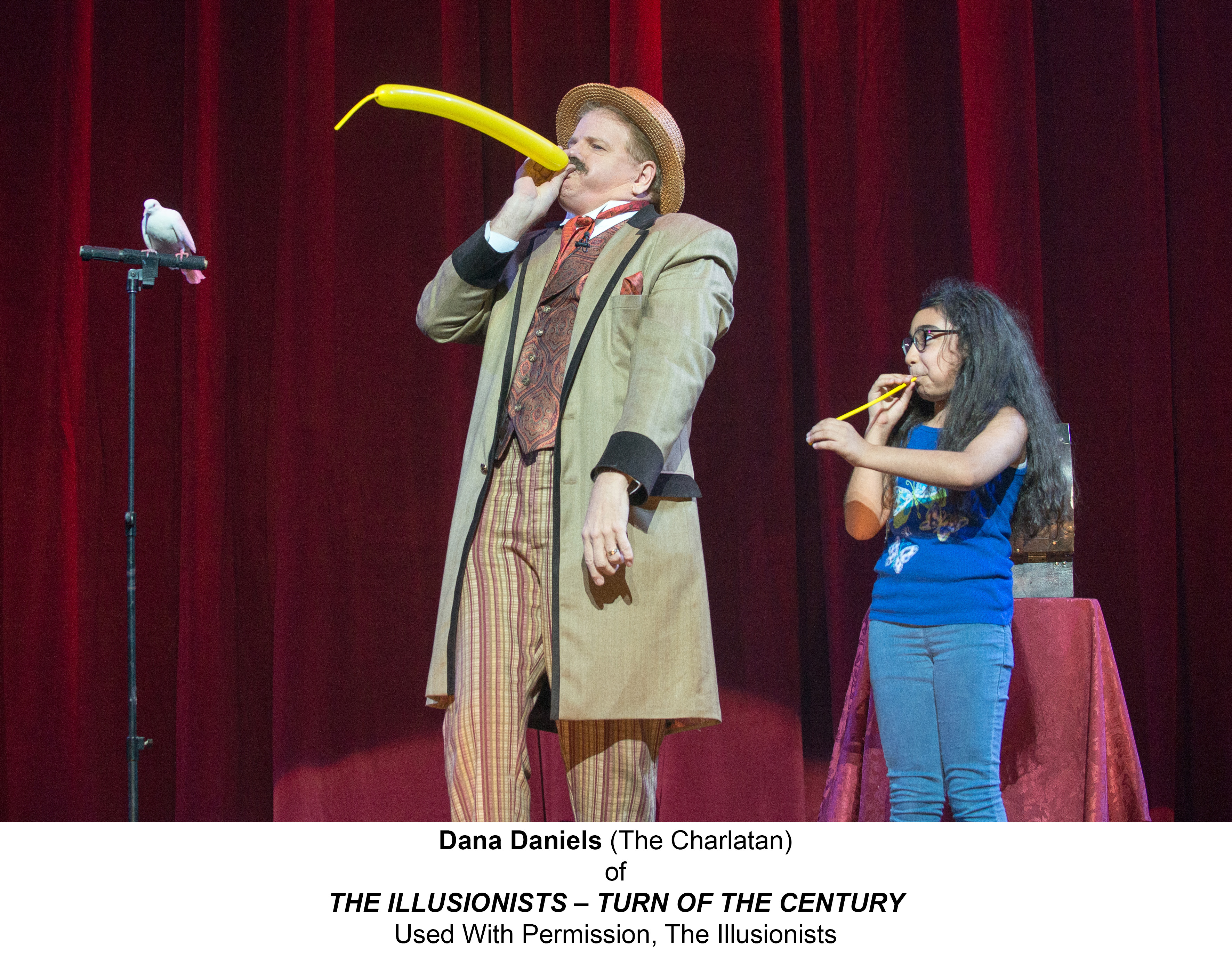
Another memorable duo is Dana Daniels (the Charlatan) and his psychic parrot Luigi.  Their family-friendly routines are so hilarious I was actually able to make someone laugh until they cried just by describing them.  A completely different kind of cute arrives in the form of Jonathan Goodwin, The Daredevil.  (Apparently there was at least one Equinox open in 1903.)  He is a returning character and audience favorite from The Illusionists’ last New York run.  As the only member of the cast who does not rely on slight on hand, he delivers the most gasp-inducing moments in the show with his Houdini-inspired stunts.  Among the more familiar acts, Austrians Thommy Ten and Amelie Van Tass (The Clairvoyants) stand out.  You may have seen these “what am I holding” theatrics before, but never with such a level of detail.  No wonder these partners were awarded the infrequently bestowed title World Champions of Mentalism.

Much of the suitably over-the-top atmosphere comes from the choice of The Palace Theater as home base.  The 1913 vaudeville house was renovated by the Nederlanders in the mid-sixties, but retains its somewhat gaudy features.  These have been enhanced by scenic designer Todd Ivins.  (A few of the parlor tricks are carried out in an actual parlor setting.)  At times, handheld cameras feed an ornate center screen in order to project smaller movements beyond the first few rows.  Angela Aaron’s period costumes add lovely flair as does the eerie music of Evan Jolly.

The quick pace and ever-changing mood of The Illusionists Turn of the Century make it an obvious choice for parents seeking special seasonal entertainment that everyone can enjoy.  With its good-natured spectacle, the show also seems like great date material.  Performances run through the first of the year at the Palace Theater.  For tickets and information visit http://www.theillusionistslive.com/turnofthecentury. Remember to dress well; about a dozen audience members wound up on stage.

Heisenberg

HeisenbergMTCFriedman TheatreIf the name “Heisenberg” has frightened you into thinking this is a dense play about quantum mechanics, never fear.  It is, rather, about the most everyday of occurrences: two dissimilar people getting to know each other and determining the substance of their relationship.  Like protons, can they come together to form something bigger and more powerful?  And if they do, what is the potential for that configuration to change?

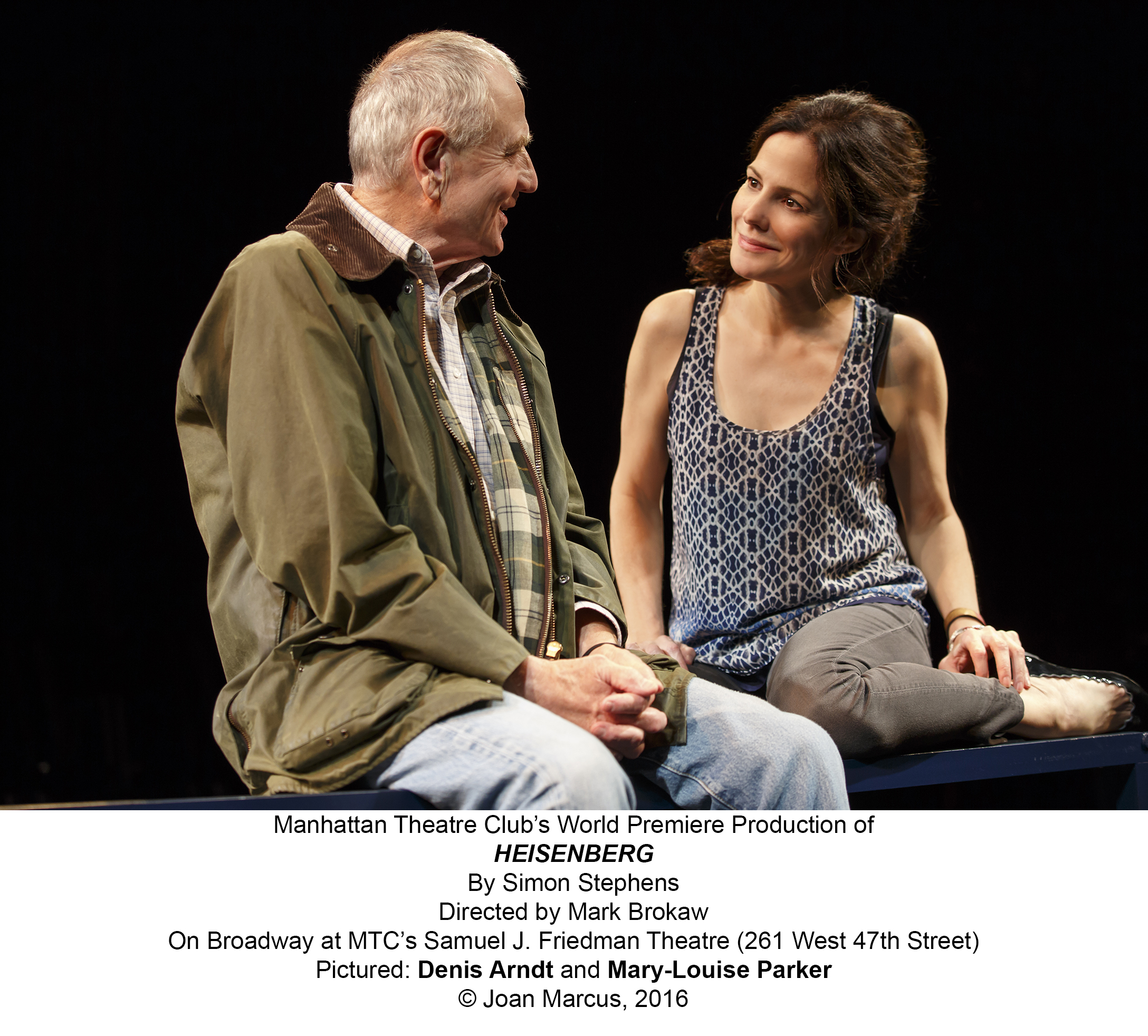
The series of somewhat commonplace conversations about life, work, and love is made compelling by two gifted actors: Denis Arndt as Alex and Mary-Louise Parker as Georgie.  The disparity in their ages is the least significant of their differences.  I had heard about their incredible chemistry, but that’s not the word I would use to describe their bond.  What flashes between them struck me as more skillful than emotional, like trapeze artists who know exactly when to extend their arms even when there is no music.  There is much communicated in a simple smile or touch.  But it is absorbing artistry, not as impassioned as I expected.

The slow-burn of personal revelations is pepped up with flashes of humor and provocative uncertainty.  Simon Stephens, who so brilliantly adapted The Curious Incident of the Dog in the Night-time, has here provided a simple dialogue with a intriguing angle.  We learn fairly early on that Georgie can tell a convincing and detailed lie.  That makes everything she says and does suspect, even when she’s admitting to lying.  It’s a tribute to the characters’ development — their ultimate sweetness and vulnerability —  that I found myself wondering for days whether the key turning points of their journey together stemmed from genuine crisis or Georgie’s well-constructed (possibly dubiously motivated) flights of fancy.

Heisenberg was commissioned by Manhattan Theatre Club and played off-Broadway last summer at City Center. Within its new Broadway home, director Mark Brokaw has recreated the proper space for his intimate yet significant production, greatly reducing the size of the stage by placing 200 members of the audience in seats on the stage.  The feeling is more of a small town sports arena than a professional New York theater, which is no doubt intentional.  With limited room to move, the two actors can’t help but confront each other at every turn. in action as well as in word.  Outlines of locations from a train station to a butcher shop to a hotel room are defined by scenic designer Mark Wendland using folding tables and chairs. Scenic beats are created with Austin R. Smith’s lighting and David van Tieghem’s sound.

Three of the closest people in my life I met randomly through uncharacteristic circumstances.  So it is not a surprise that the underpinnings of Heisenberg resonated with me.  If you, too, know that experience of a chance encounter that alters your life or you simply enjoy seeing potential unfold between strangers, then you will find Heisenberg an engrossing way to spend 80 minutes.  It is playing through December 11, 2016 at the Samuel  J. Friedman Theater.  For tickets and information visit http://heisenbergbroadway.com.

Oslo

Whether or not Oslo is your kind of play depends in large part on your enjoyment of the drama of diplomacy and the language of complex interpersonal communication.  The piece by J.T. Rogers is based on the true events that led up to the Oslo Peace Accords: the extraordinary peace deal between The PLO and Israel signed into being on September 13, 1993.  The little-known backstory — particularly the delicate and perhaps heroic involvement of the Norwegians in the series of intricate and touchy conversations between lifelong enemies — will hold a genuine fascination for some.  For others, the intervening 23 years of failure and violence will overshadow the struggle reproduced on stage.  Yes, Oslo portrays an incredible opportunity, but one that could not be held together long with cleverness, waffles and Johnny Walker Black.

Purely as an entertainment, Oslo has a lot to offer.  Though it clocks in close to 3 hours, it never stops moving.  There is a surprising amount of action in what could have been an overly-talky script.  History has been condensed and characters melded for ease of understanding without great loss of accuracy.  The crackling dialogue flecked with humor is interspersed with clarifying remarks made directly to the audience.  Positions are dealt with even-handedly, delivering the clearest picture possible of what’s at stake for all parties involved.

The vast cast under the seasoned hand of Bartlett Sher is first rate.  While I did not buy his closing remarks about the lasting impact of the proceedings, the always excellent Jefferson Mays as Terje Rød-Larsen makes an eager and human guide.  His noble and gifted wife, Mona Juul, is played by Jennifer Ehle with integrity and warmth that radiates to the exit doors.  Henny Russell in multiple roles adds charm and laughs by turns.  But it is Uri Savir the Director-General of Israel’s Foreign Ministry as portrayed by Michael Aronov who electrifies the space and keeps us rooting for something positive to emerge from the flutter of words.  Designer Michael Yeargan provides simple furniture supplemented with projections by 59 Productions which makes moving through locations quick and easy to follow.  Catherine Zuber’s costumes add “schlub”, utility and class in all the right places.

The short run currently at Lincoln Center Theater’s Mitzi E. Newhouse through August 28 (http://www.lct.org/shows/Oslo/) is sold out.  However it’s a good bet that lovers of mildly-fictionalized history and political intrigue will assure Oslo is repeated from time to time for at least as long as the Mideast face-off persists.

The Golden Bride

The Yiddish musical The Golden Bride first premiered on February 9, 1923, a time when new laws were being implemented that would strongly limit the number of Eastern European Jews permitted to immigrate to America.  It is essential to keep this filter in place when experiencing the latest remounting by the National Yiddish Theatre Folksbiene at the Museum of Jewish Heritage.  While the lively music by Joseph Rumshinsky and fine operatic singing have weathered the test of time, much of the theme and relationships are bordering on the offensive when viewed through a modern middle-aged lens.  (I can’t begin to imagine what younger audience members would make of it.)

The piece opens like a Russian flavored Gilbert and Sullivan with a brightly colored set behind a cohesive chorus.  The orchestra led by Zalmen Mlotek can be glimpsed through a scrim center stage.  Louis Gilrod’s cute lyrics are in Yiddish with English and Russian titles projected on the top of the proscenium.  Trilling notes are hit and words well articulated by an impressive sprawling cast.

The basic set-up is presented within the first few songs.  Two young women have unexpectedly come into large sums of money and will therefore be able to make great marriages.  This storyline may have worked perfectly as a tool for helping those newly arrived from the Russian Empire to a disorienting home in the USA.  But to the ears of the uninitiated, this plot will seem worn and unwelcome leading to a tough struggle through the next two hours.  Other bits like their fumbling with the English language and the muddled-ness of a hard-of-hearing character are even more potentially wounding in 2016.

There are moments of levity that survive the journey through the years much better.  The core of the comic space is held by high-spirited Adam B. Shapiro in the clownish role of Kalmen.  The relationship between the charming Pinkhes (Bruce Rebold) and his doting wife Toybe (Lisa Fishman) sparkles in both their Russian inn and as they attempt to adapt to their perception of life as upper class Americans.  Glenn Seven Allen and Rachel Zatoff give broad but amusing performances as would-be actors Jerome and Khanele.  Tougher jobs are given to the central young lovers Misha (Cameron Johnson) and Goldele (Rachel Policar).  But despite all the unsavory talk of money and position, there is a sweetness to their bond that shines through.

To make this production happen, it truly took a village.  The program lists over 200 “supporting producers” who participated in an online fundraising campaign specifically to revive The Golden Bride.  This tells me that there is a thirst for high caliber historically insightful entertainment.   Whether or not this includes you will depend largely on your ability to alter your perspective.  You can test your cultural flexibility through August 28 by purchasing tickets at http://www.nytf.org.


Stet

Photo Credits: Jocelyn Kuritsky, Lexi Lapp

Photo Credits: Jocelyn Kuritsky, Lexi Lapp

The term “stet” comes from the Latin to “let stand” and is the instruction given by an editor when an alteration made to a text should be ignored in favor of what was originally written.  It is also the title of a new play by Kim Davies based on the incidents surrounding Rolling Stone’s article about a particularly brutal campus rape.  The piece was eventually retracted over erroneous reporting methods.  What remained, though, was a heightened awareness that these crimes were all too common.  While this production should be commended for reigniting that important conversation as well as raising money for the advocacy group Take Back the Night, sadly and astonishingly it falls short of being an engaging theatrical experience.

The director, Tony Speciale, also holds a co-developer credit, so it is surprising he has given himself so many challenges with moving forward what should be a compelling story.  The characters are often separated by their cellphones and walls, deadening what should be emotional undercurrent.  Lead actress and another co-developer Jocelyn Kuritsky seems rudderless as she moves through the story.  Her poorly defined often strident reporter, Erika, is neither ambitious nor caring enough.  Far better is Bruce McKenzie, who is genuine as Phil, her encouraging but off course editor who takes on the delicate subject of a gang rape at a college fraternity.  (This echoes the content of the Rolling Stone piece from a few years ago.)  Another standout is Déa Julien as a well-intentioned recent graduate who has been tasked by the college to counsel rape victims.

Yet, what could be a deeply affecting event never moves beyond the surface.  Clearly the biggest problem is the script itself.  There is an important message to be delivered about how the media attaches a scale to the impact of one rape story over another.  There is also the way society persists in maintaining different rules for different genders.  Neither of these potential themes is properly explored.  Too many stretches are talky exchanges with none of the raw impact essential to bring us in.  The scenes drift along without a central viewpoint.  As a result, we find out little about these characters other than their connection to a violent and appalling act.  Even Ashely, who is the victim of the crime and the heart of Erika’s story, is a shell of a person.  Here the story telling is so vague, the truth remains in doubt without enough to ponder.

Stet is obviously a labor of love for the Abingdon Theater and its collaborators.  I hope they continue to develop this brave work so that it becomes all they intend it to be.  It was recently extended through July 10 and tickets are available at http://abingdontheatre.org/stet/.

The Healing

In The Healing, a circle of friends who met at a religious camp 25 years ago reunites to honor the death of one of their own.  Before you can roll your eyes, let me add that the situation is set in motion by Samuel D. Hunter, the Obie Award winning playwright behind A Bright New Boise.  In both cases, Hunter explores what happens when extreme faith meets life’s curveballs with stunning agility and clarity.

Here he adds an extra thought-provoking layer.  All of the main characters and the actors who portray them are disabled.  This is both significant and irrelevant.  Commissioned by the Theater Breaking Through Barriers, the piece provides a welcome opening for a group of gifted actors who have more limited opportunities.   The work was written specifically for this cast and that customization shows in their ease with one another.  In the lead role of Sharon, the heart of the group, Shannon DeVido — a comic, improv artist, and frequent Hunter collaborator — conveys a delicate balance of command and doubt.  (Regrettably on this occasion her perfectly timed moments of reflection sometimes lead to too quiet a delivery.)  Even stronger and more approachable is actor/speaker/filmmaker David Harrell as down to earth Donald.  Jamie Petrone and John McGinty are adorable as newly coupled Bonnie and Greg.

Their presence on stage also holds up an important mirror to an underserved audience of partially sighted and deaf as well as those with limited mobility.  The energy zooming in both directions is electrifying.  Ultimately, though, this is simply a terrific story about friendship, loyalty and getting through the day.  While The Healing isn’t quite up to Boise’s level of greatness, Hunter’s set-up is intriguing, every little touch has relevance and the dialogue simply flows forward.  As a result, the script could be well executed by any talented troupe, all be it less sincerely and powerfully.

This world-premiere production has been well-mounted at the small Clurman Theatre in Theater Row.  UK and US director Stella Powell-Jones brings her delicate touch to even the most uneasy of the play’s beats. Jason Simms’ set design wonderfully captures the watched-too-much-QVC-ness of Zoe’s living room.  And I would give Christopher Metzger a separate round of applause for Mary Theresa Archbold’s physically overwhelming outfits for her role as the nearly defeated Laura.

If you like your theater on the natural side, The Healing will strike many graceful notes.  Tickets are available through July 16 at http://www.theatrerow.org/clurmannowplaying/.