
With its simple narrative, The Glass Menagerie has always lent itself to reinterpretation. For those unfamiliar with the Tennessee William’s classic, the play centers on the Wingfield family. Many years before the opening scene, Mr. Winfield abandoned his wife Amanda and their two children Laura and Tom, now in their 20s. A former Southern belle who proclaims to have had a fleet of suiters, the socially skillful Amanda is overly focused on her children and the molding of their lives. Having suffered childhood illness, Laura is so painfully shy she has no friends or career prospects. Her one joy is her collection of glass animals. Tom has had to set aside his dream of being a writer and works at a shoe warehouse in order to pay rent on their shabby St. Louis apartment. Amanda is determined to find a suitable husband for Laura in order to provide for their future and perhaps free Tom for a better life.
Told from Tom’s viewpoint and relayed as his recollection of events, The Glass Menagerie is referred to as a memory play. Tom himself cautions the audience that what they see may not be precisely what happened. Plot points are therefore more representational than factual. The much anticipated visit from the Gentlemen Caller who may sweep Laura away can stand in for any elusive wish. Laura’s much discussed disability is represented as a psychological wound as often as it is depicted with a physical leg brace.
In the current iteration staged by Austin Pendleton and Peter Bloch, the recurring theme of illusion takes center stage. It is emphasized in Tom’s love of movies, Amanda’s revisionist past, and Laura’s hazy self-image. The piece opens with Tom performing slight of hand. Many props remain illusionary, with the entire cast miming everyday actions such as drinking coffee and smoking a cigarette in an intentionally unrealistic manner. The essential Gentleman Caller’s visit seemingly haunts the lives of the family, hanging over the room as fully as the father’s portrait which stares down from the back wall.

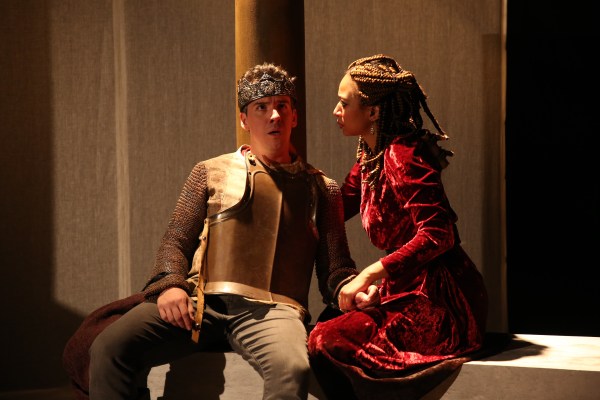
Alexandra Rose and Ginger Grace in Glass Menagerie at The Wild Project
While it is an intriguing approach, the production’s gauziness makes it difficult to latch on to the characters. The relationships feel flattened by their hallucinatory essence. As is described in the script, Gentleman Caller Jim is the most three dimensional, brought to appealing life by Spencer Scott. But the other performers are left nearly bloodless. Pendleton/Bloch collaborator Matt de Rogatis’s Tom shows brief flashes of frustration. When he is downstage speaking directly to us, Amanda and Laura are often upstage as if in his thought bubble. But he too is sometimes crammed upstage and many of his character-defining moments are therefore obscured. Frequently placed behind a scrim literally separated from everyone and cloaked in shadows, this Laura (a single-noted Alexandra Rose) floats like a phantom through her scenes. Most significantly Amanda (a fiery Ginger Grace ) is strongest when she is alone on stage, leveraging what’s left of her Southern charm to sell magazine subscriptions.
The deliberate ghostlike features work far better as an integral part of the production design. Steven Wolf’s lights are initially neatly focused on Laura’s collection of glass animals, slowly broadening to reveal the tattered set. Gothic furniture designed by Jessie Bonaventure is missing limbs and top off with glass elements lending them an air of incompleteness. The father who abandoned his wife and children eerily looms over their plight in a large photographic projection. Sean Hagerty original haunting music from unseen dance halls along with discomforting sounds effects orchestrated by Allison Hohman emphasize the nature of memory and complete the spectral landscape.
A curiosity best suited to fans of the play, The Glass Menagerie is running at The Wild Project (195 East 3rd Street, between Avenues A & B) though October 20. Runtime is 1 hour and 45 minutes without an intermission. Tickets are $35 and are available through Brown Paper Tickets at 1-800-838-3006 or by visiting www.theglassmenagerieplay.com.







Dropping Gumballs on Luke Wilson
On a soundstage, a talented production team is preparing to shoot an AT&T commercial featuring beloved Luke Wilson. The creative concept is to drop red gumballs around the star to symbolize all of Verizon’s dropped calls. Despite a lack of time to test the hastily put-together rig, prop lead Rob is able to toss the small projectiles just shy of Luke’s shoulder and the first few takes go smoothly. Then a case of nerves sets in and a few of the hard objects hit Luke squarely on the head. The actor sees stars; the director —award-winning documentarian Errol Morris — sees excitement and orders the crew to deliberately aim for the performer on the next take.
This is the set-up of the aptly named Dropping Gumballs on Luke Wilson, which is based on true events. Though the Directors Guild of America takes set safety very seriously, sadly there are occasional incidents of a director demanding a dangerous shot, as happened in this case. Rob Ackerman accurately has commercial Assistant Director, Alice, threaten to report Morris to the Guild. The script also provides enough background to realistically make her vulnerable to manipulation. It’s a creative stand-in for any project on which a concerned would-be whistleblower has instead been made complicit through intimidation. If only the playwright had trusted his audience to get his very clear and impactful message. Instead, after a lively and thought-provoking 55 minutes, he burdens the additional 20 with outright lectures on broader issues and political topics ranging from gender discrimination to Nazis. It’s an unnecessary departure from the previous territory that mars an otherwise engaging production.
First time director, famed playwright Theresa Rebeck, does an imaginative job of bringing us deep inside the physical set of the commercial and the mind set of each participant. The results are visually stimulating and often laugh-out-loud funny. The assorted screens that are employed by Morris for playback at the shoot are also used to show us the crew’s previous experiences that have brought them to this critical moment. (Yana Birkukova provides the ideal video design.) The nearly all-white set designed by Christopher and Justin Swader shows off these projections to great effect. Emphasis is achieved by Mary Ellen Stebbin’s well-placed lighting, which often shifts to a befitting green-screen green. The look is completed by the essential craft service table. Costumes designed by Tricia Barsamian will make any production pro feel right at home. All-important clever props are provided by Addison Heeren.
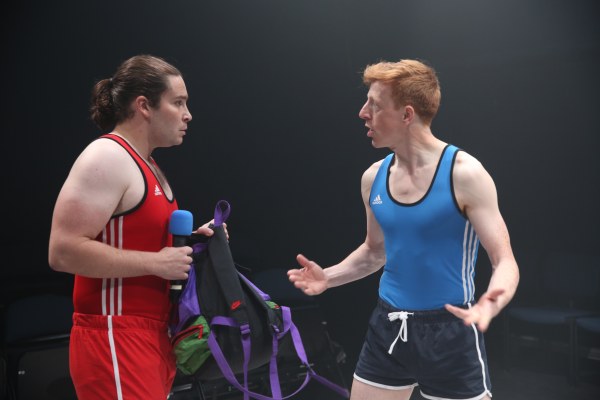
The Cast of Dropping Gumballs on Luke Wilson; Photo by Carol Rosegg
As a former prop person, Rob Ackerman makes the prop man, also named Rob, his spokesperson. George Hampe does a fabulous job of growing increasingly manic as character Rob struggles to remain the voice of reason and the closest thing we get to a hero. With a get-on-with-it gruffness, Dean Nolen is well cast as his boss and seasoned rigger, Ken. Reyna De Courcy is less successful at maintaining an appropriate emotional build in the role of their assistant, Jenny, becoming akin to a cartoon character with jerky motions and high-pitched yelps of displeasure. With enough charm and swagger, Jonathan Sale could easily be Luke Wilson’s deliberately pudgy body double. It’s less easy to know how well David Wohl impersonates Errol Morris. The part is written in one obnoxious note, though the theater vet certainly manifests a typical ego-driven artist. In the toughest role, Ann Harada swings rightly between assuredness and fear as Alice, but she struggles to differentiate the other small parts she takes on in memory and flashback.
Ackerman’s love of television production and those who strive to keep it creative and truthful shines through despite a dip in the ending. It is easy to see why both Luke Wilson and Errol Morris have given the project their blessing. With a little reworking of the last section, Dropping Gumballs on Luke Wilson has the makings of insightful modern satire. Running time is 75 minutes with no intermission. It plays through July 6, 2019, in the Mezzanine Theater at at A.R.T./ New York Theatre (502 W. 53rd Street). Tickets are $25 for union card holders, $30 general admission and $40 for reserved seating. For purchasing and additional information, visit TheWorkingTheater.org or call the Box Office (Ovationtix) at 866.811.4111.