Away on Australian National Theatre Live

Michael Gow’s Away remains one of the most produced plays in Australia.  First performed nearly 40 years ago and set in 1967/68, it explores grief, family relationships, and xenophobia against the backdrop of a distant war in Vietnam.  Away may be considered uniquely Australian, but those themes are timeless and have continued to reverberate, making this play forever relevant and moving.  Fortunately for those of us in this hemisphere, an all-around excellent production from 2017 — a co-production of the Malthouse Theatre and Sydney Theatre Company — is available to watch on Australian National Theatre Live.  With a first rate cast led by Heather Mitchell at her biting best as Gwen, this layered revival makes for a fulfilling 1:40 for any theater fan.

Bookended by the words of William Shakespeare, the action opens with the final scene of an emotive and balletic high school production of A Midsummer Night’s Dream.  The evening is hosted by the outwardly jovial Roy, whose wife Coral is consumed with depression over their son who died in battle.  Puck has been played by the sweetly awkward Tom, the only child of working class English expats, Harry and Vic.  He has fallen for his costar, Margaret, whose nouveau riche parents, Jim and Gwen, aren’t thrilled about the boy’s attentions.  All three families leave for beachside holidays over Christmas break, but at three very different levels.  Roy and Coral are flying to a ritzy resort where they’ve been regulars.  Margaret, Gwen and Jim are off to an upscale caravan park in their luxury camper-van packed with fishing equipment and other gear.  Meanwhile, Tom, Harry, and Vic load their lean-to pup tent into the family car.

Playwright Gow seamlessly blends lighthearted humor, social commentary, and surreal fantasy.  The three parallel stories beautifully and economically unfold, with all the actors playing ancillary characters in each other’s tales.  The juxtaposition of the high anxiety of Gwen with the genuine warmth of Vic set up the confrontations that ripple through each encounter.  There is no situation Gwen can’t make worse nor one that Vic can’t see the best side of.  The young couples’ exchanges ring true and are deeply touching.   There continue to be reverberations of Midsummer with an increasing number of besotted Bottoms among the dancers and a Shakespearean-sized storm brewing.  Tom often watches from the sidelines, like Puck overseeing his handiwork, though Tom has little control over any story, especially his own.  

Cast of Away (2017); Production Photo by Prudence Upton

Even through the lens of a camera crew, the top notch design shines through.  Powerfully directed by Malthouse Artistic Director Matthew Lutton, the staging includes several etherial dances choreographed by Stephanie Lake.  Though the stage remains nearly bare throughout, there is always a strong sense of place centered around an almost-magical wardrobe (set and costumes designed by Dale Ferguson).  Most of the surroundings are conveyed in light and sound with Paul Jackson’s lighting providing the eery warm glow of backstage, garish pink of a dance floor and stark whiteness of a deserted beach.  The atmosphere is made more jarring by the discordant sound design of J. David Franzke.  In addition to Ms. Mitchell, the cast includes Liam Nunan (Tom), Naomi Rukavina (Margaret), Glenn Hazeldine (Roy), Wadih Dona (Harry), Julia Davis (Vic), Marco Chiappi (Jim), and Natasha Herbert (Coral).

This stirring production of Away was among the first dramas uploaded to Australian National Theatre Live during the pandemic.  While there is no substitute for being in a darkened room with strangers, the service (https://australiantheatre.live/) does a first rate job of sharing a range of quality work live-captured by Peter Hiscock and his crew.  The concept is to allow a wide audience to enjoy these productions regardless of their location, income level, or physical limitation.  Subscriptions are $7.99 per month or $74.99 per year and a free trial is available.

Three Houses

For a play named after a family dwelling, Dave Malloy’s Three Houses has surprisingly little structure.  Set in a magical cocktail bar with an orchestra that can follow along in any key, three strangers share their experiences in a confessional open-mic night.  When the pandemic broke out, each one of them had just gone through a break-up with a partner and found themselves secluded and struggling mentally.  While there are similar strands within their tales, their ordeals only lightly touch, like their pinkies when they finally share a table.  Along the way, there are some wonderfully creative moments and beautiful melodies.  But like the current drive along the crumbling Highway 1 in Big Sur, a final point remains illusive.

In House #1, Susan (Margo Seibert) had been researching her next novel in Finland when COVID hit.  Unable to get back to the United States, she retreats to her grandmother’s abandoned house in the Latvian woods.  In a haze of red current wine, weed, and OCD, she uses the time to learn what she can about her ancestor.  House #2 is set to more uptempo tunes as we move from the deep woods to the sunny desert.  When her aunt returns to Korea leaving her New Mexico home unoccupied, Sadie (Mia Pak) takes refuge there.  Painfully missing her girlfriend, she further retreats into a SIM she has meticulously modeled on memories of her grandparents.  House #3 is actually a small basement apartment into which Beckett (J.D. Mollison) has moved after the end of his marriage.  On every level, it becomes the darkest of the dwellings, especially after he learns that his grandparents have just passed away in Ireland and paranoia sets in.  

Three Houses is the final piece of Malloy’s trilogy which includes Ghost Quartet and the memorable Octet.  Having written the music, lyrics, book and orchestrations, this work completely embraces his usual fascination with fables.  As they grapple with the effects of isolation and regret, each of our storytellers develops a relationship with a fictional being represented by puppets with tremendous personality designed by James Ortiz.  Elements of The Three Little Pigs play key roles and even show up in a sweater.  But when the inevitable wolf finally makes it to the door, he is dressed in grandma’s nightgown, which for fairytale purists will be perplexing.  

Mia Pak (with Pookie the Household Dragon) and Margo Seibert in Three Houses

All three soloists are terrific and support each other vocally and energetically.  Henry Stram and Ching Valdes-Aran appear as all of the mystical grandparents.  Scott Stangland rounds out the cast exuding something between command and menace as the bartender/MC Wolf.  However, Annie Tippe’s direction is both mystifying and maddening, especially given her assured hand with Octet.  The same black box space has been splendidly designed by the imaginative team of dots to feel warm and inclusive and a tad old-fashioned.  Fabric is draped all along the mezzanine, and the orchestra members sit in armchairs adorned with crocheted throws.  Center stage is an elaborate wooden bar, but even from the middle of the side section — normally a great spot in ¾ round — I could not make out what was on the changing backdrop behind it.  The vast majority of the staging is forward facing with the actors sometimes positioned side-by-side blocking each other from view.  Lighting designer Christopher Bowser has added some attention-getting effects and Haydee Zelideth costumes are a likewise literally colorful component that visually adds to the stories.  Nick Kourtides envelops the audience with his sound design, which appropriately alternates between feeling comforting and smothering.

Ultimately, Three Houses is more like a trio of discontinuous chapters of an unfinished novel than a fully fleshed out musical.  While the emotive songs and fanciful imagery of Octet have carried over, the clear interconnection of  those characters is missing here.  But there is some interesting terrain explored in finding discipline amid chaos and all the ways in which you can and can’t get to know someone else and — through them — yourself: vast themes to cover in a mere 100 minutes.  The production runs through June 9 at the Signature Theatre  (480 West 42nd Street) where Malloy is Premiere Resident.  Tickets ($49 – $124) and information are available at https://signaturetheatre.org/show/three-houses/

EPIC Players’ Spring Awakening

For their current musical production, EPIC  — an acronym for Empower, Perform, Include and Create — has chosen Spring Awakening.  Boasting memorable harmonies by Duncan Sheik and scathing lyrics by Steven Sater, it was a Tony winner for the original Broadway production and nominated again for its revival.  It famously gave rise to the careers of Jonathan Groff and Lea Michele.  But despite its starry origins, it is best remembered for the bluntness with which it explores abuse, neglect, and desperation. The seemingly insurmountable challenges of adolescence are what resonated particularly strongly with the neurodivergent cast, whose community is often desexualized, infantilized, and sometimes even mistreated.  (Cast members are all over the age of 16 and on the spectrum of autism.) 

Based on a 19th century work by German playwright Frank Wedekind that was subtitled A Children’s Tragedy, there are unfortunate ripples in today’s world in which healthcare for women and protections for the queer community are being restricted.  The Romeo and Juliet of sorts are Melchior (William Ketter) and Wendla (Sydney Kurland), his former childhood friend.  Her deeply repressed childhood has left her ill-equipped to take care of herself and longing to feel absolutely anything.  In a classroom where there is no room for critical thinking, he has read so much unsanctioned material that he has figured out the mysterious world of sex.  Their collision course is set.

Sydney Kurland and William Ketter

More lost to each other are Mina Cuesta’s Ilse and Reuben Baron’s Moritz.  Both have been abandoned by family, but she has found freedom and shelter within an artistic community, while he is utterly adrift.  Arguably the most charismatic pair are Hanschen played by deaf actor Samuel Langshteyn and his voice emotively interpreted by Chloe Rose Solomon.  Their literal intertwining provides many of the most bewitching moments.  All are backed by a chorus exemplifying range and expressiveness. 

Chloe Rose Solomon and Samuel Langshteyn

EPIC has always excelled in their musicality and this production is no exception.  The orchestra under musical director Blake Bauer is lyrical and clear.  Cast member Laisha Gonzalez delivers Martha’s solo in “The Dark I Know Well” with an Amy Winehouse soulfulness.  Cuesta provides Ilse with the voice of an angel complete with a wing-like shawl (costumes by Nicole Zausmer) that she bestows on a thoroughly dispirited Moritz in “Blue Wind”. And in an Act II showstopper, “Totally Fucked”, Ketter grabs a hand-mic to transform into full-on rock idol.

Mina Cuesta and Reuben Baron

Director Travis Burbee has placed his cast down the middle of the black box space so the attendees provide support from both sides.  The layout constricts the range of motion possible by the large troop of actors, but it boost the level of intimacy with the audience. Burbee also handles the violence in a way that is visceral without being unnecessarily graphic. (The team worked with a Mental Health Counselor, an Access Coordinator, and an Intimacy and Fight Director to support the cast throughout the development process.)  The set by designer Matthew Imhoff is centered around a long plot of earth, which at times symbolically nourishes the affection-starved teens.  Soft banks of lights by Cameron Filepas rise like plantings on either end.  

Deeply meaningful to a generation, Spring Awakening gives the EPIC cast a darker voice.  A content warning is announced before the lights dim.  Noise cancelation headphones are available and audience members are invited to decompress in the lobby if needed. Running time is 2 hours and 10 minutes.  Performances are Wednesday through Sunday until May 19 at ART/ NY’s The Mezzanine Theatre, 502 West 53rd Street, 2nd floor.  General admission Tickets start at $35. $20 Video streaming tickets will be available during the second week of shows. All tickets can be purchased online at https://epicplayers.ticketspice.com/epic-players-presents-spring-awakening-.

EPIC Players’ Spring Awakening

CAST:
Wendla: Sydney Kurland 
Martha: Laisha Gonzalez 
Thea: Rachel Barcellona 
Anna: Katherine Tepan 
Ilse: Mina Cuesta
Melchior: Will Ketter
Moritz: Reuben Baron
Hanschen: Samuel Langshteyn
Ernst: Josh Cartagena
Georg: Rafiq Tate
Otto: Shafer Gootkind
Adult Women 1:  Shoshanna Gleich
Adult Women 2: Samantha Elisofon
Adult Man 1: Gerard Riley
Adult Man 2: Max Tunney
Ensemble: Henry Houghton
Ensemble: Emy Ramos
Voice of Hanschen: Chloe Rose Solomon 

CREATIVE TEAM AND CREW:

Director: Travis Burbee
Assistant Director:  Gabe Girson 
Music Director: Blake Brauer
Choreographer: Miles Butler
Stage Manager: Sydnee Davis
Production Manager: William Morris
Assistant Stage Manager: Carol Hoverman
Assistant Stage Manager: Cassidy Kaye
Director of Artistic Sign Language: Kailyn Aaron-Lozano
Intimacy and Fight Director: Hannah “Rock” Roccisano
Intimacy and Fight Assistant: Scarlet Yousif
Scenic Designer: Matthew Imhoff
Sound Designer: Sean Ramos
Costume Designer: Nicole Zausmer
Props Designer: Madisen Frazier
Light Designer: Cameron Filepas 

Executive Artistic Director: Aubrie Therrien
Front of House:  Talia Eapen
Access Coordinator: Jamie Rose Hays
Mental Health Counselor: Taupa Fogo-Toussaint

Production Photos: Zui Gomez

Shimmer and Herringbone

At the opening of its full and fleeting 85 minutes, Shimmer and Herringbone introduces us to a range of people each trying on a pile of clothing and judging themselves in a mirror.  It’s a familiar dance with capes and belts as unhelpful partners.  Their search is not just for the right look, but the right feeling; one they might just find at the titular vintage clothing store.  

With witty and insightful rapid-fire exchanges written by Ellen Maddow (who appears within the play as Rhonda, the over-sharing dressing room lady) and Paul Zimet (who directs with deep understanding), the play is located in a city sophisticated enough to be home to a semi-famous soap actor (Jack Wetherall), a townhouse-owning retired teacher (James Tigger! Ferguson), and the aforementioned boutique.  But it is also small enough to enable the chance encounters and meaningful interactions that only happen in a true neighborhood.  Maddow also wrote the music played by a live string trio (Rachel Feldhaus, Marija Kovacevic, and Agustin Uriburu who good-naturedly appear on stage and fully participate) which the characters acknowledge as the soundtrack to their actions.  In their lightest moments, they are moved to dance in celebration, guided by choreographer Sean Donovan.

From details in the dialogue, the story is unfolding shortly after the toughest winter of the pandemic.  Residents are no longer wearing masks of the N95 variety, but they are still veiled.  Their outfits shape how they feel about themselves and also how they wish to be perceived by others.  Each is slightly oddball, but utterly endearing.  We meet Louise Smith’s Grace, a real estate agent who is forever staging her surroundings, and her former best friend Lizzie Olesker’s Lilly, an ornithologist who seems to relate quite strongly to the pigeons she studies.  There is also Lilly’s struggling entrepreneur daughter Bree (Ebony Davis) and Bree’s possible business partner, a former actress named Melanie played by Talking Band co-founder Tina Shepard.  The actors seem to be having a blast and the audience is tickled just to be in their company.

James Tigger! Ferguson, Louise Smith and Lizzie Olesker; photo by Maria Baranova

The true star of the show is arguably Serbian costume designer Olivera Gajic.  She has stocked the central store and surrounding closets with a delightful and nearly indescribable wardrobe.  Our attention is further captured by the deceptively simple set and revealing videos of Anna Kiraly.  Additional color is brought forth by Mary Ellen Stebbins’s lighting.

Like a small scale and less mysterious Tales of the City, Shimmer and Herringbone is above all about self-acceptance and living comfortably in ones own skin.  It also provides a humorous and uplifting visit with literally colorful characters who form a most-welcome community.  A creation of the 50 year old interdisciplinary company, Talking Band, this play with music continues through May 19 at Mabou Mines’ Second Floor Theater at 122CC, at 150 First Avenue near Saint Marks Square in Manhattan. Performances take place Wednesday – Saturday at 7pm and Sundays at 2pm.  Tickets are $30-$35 and can be purchased at https://talkingband.org/works/shimmer-and-herringbone/.

Staff Meal

A staff meal at a typical restaurant is an opportunity for the entire crew to be treated as equal members of a “family.”  However, in Abe Koogler’s Staff Meal currently being served up at Playwrights Horizons, there is something odd transpiring around the table.  While the enthralled servers moan in delight, what we see is unremarkable.   The true source of their reaction is imperceivable to outsiders.

At this same unnamed venue, Ben (Greg Keller) and Mina (Susannah Flood) are out on a what would strike most of us as a dreadful first date, though they seem quite comfortable with each other’s horror-tinged stories.  Their waiter (Hampton Fluker) is on a mesmerizing walk through the dark, deep, and disorganized wine cellar.  And the Servers (Jess Barbagallo and Carmen M. Herlihy) are just giddy to be employed by the elusive Gary Robinson (Erin Markey who is also — somehow — the chef and a vagrant) a man of wealth whose philosophy is what keeps them full.  Along the way, these characters don’t just break the fourth wall, they bulldoze it, build a fresh one, and then smash that one with a mallet as exemplified by Audience Member (Stephanie Berry).

Vagrant (Erin Markey) goes job hunting in Staff Meal; photo by Chelcie Parry

Similar to many artistic endeavors that were completed during the pandemic, Koogler’s piece is much more intent on capturing an unfamiliar mood than it is on telling a story.  The restaurant at its center is a unique universe with a distinct environment and even — it would seem — its own gravitation pull.  Individual scenes are like a Matryoshka Doll in reverse, with each character revealing a bigger, more colorful veneer without changing much of the plot’s shape.  Koogler imbues them all with astoundingly vivid and detailed memories and imaginations.  Poetic meditations on food, love, the past, and being of service are passionately delivered.  But while the people on stage search for common ground, you too might be casting about in hopes of feeling a connection. 

Under the hand of director Morgan Green, the artistic team functions in concert to support the absurdist tenor of the work.  Comparable to quarantine at COVID’s height, time spirals and sense of place becomes illusive.  Jian Jung’s papered walls are both elegant and nondescript.   The costumes by Kaye Voyce start off as commonplace and morph into outright bizarre.  As the players grow increasingly wary, Masha Tsimring’s lighting follows that tone.  Tei Bow’s sounds and music complete the vague and uneasy landscape.

Not unlike the restaurant that is Staff Meal’s home base, this play serves up some novel flavors. If you are willing to hover somewhere between drama and performance art, you might savor the experience without the need to define each morsel.  But also akin to dining in that central establishment, the undertaking might leave you feeling hungry for something more solid.

Staff Meal continues through May 19 at the Peter Jay Sharp Theater on the 4th floor of Playwrights Horizons at 416 West 42nd Street.  Running time is one hour and 35 minutes with no intermission.  Tickets are $51 – $91 and can be purchased at https://my.playwrightshorizons.org/events/staffmeal.

Agreement

The younger generations in America may not remember “The Troubles,” a violent nationalist, religious and political conflict in Northern Ireland that lasted over 30 years and reverberated through England and mainland Europe. It was declared at an end on Good Friday of 1998 after a long and difficult negotiation led to an agreement between factions.  The brave and complex process that led to the signing of this historical document is dramatized in Agreement, currently running at the JL Green Theatre in New York.

Senator George Mitchell (Richard Croxford) had been sent by then-President Bill Clinton to facilitate the proceedings.  He described it as simultaneously juggling knives and balloons.  For those unfamiliar with this historic event, the other participants in the room were:

Gerry Adams (Chris Corrigan): president of Sinn Féin, which was associated with the new Irish Republican Army

Bertie Ahern (Ronan Leahy): a Christian Conservative who served as the equivalent of Prime Minister of Ireland

Tony Blair (Martin Hutson): the newly elected and immensely popular British Prime Minister

John Hume (Dan Gordon): founder of the Social Democrats and Labour Party who won the Nobel Peace Prize

Mo Mowlam (Andrea Irvine): Secretary of State for Northern Ireland in Blair’s cabinet

David Trimble (Ruairi Conaghan): the leader of the Ulster Unionist Party who became the first leader of Northern Ireland

These introductions are covered in the first minutes of the play and characters frequently break the fourth wall to update the audience on their thinking and motivations.  Most of the cast members don’t look much like their real-life counterparts nor do they attempt imitation.  Rather they capture the essence of each person as seen through smiling Irish eyes.  With the gruff plain spoken delivery of his first line, Chris Corrigan’s Adams gets a knowing chuckle from the audience.  Dan Gordon’s John Hume, the realist of the group, delivers the clearest insider view. Martin Hutson plays Blair as a puffed up buffoon, high on his “mandate” stardom.  As Ahern, Ronan Leahy wonderfully performs the highest wire act both emotionally and politically.  The lone woman, Andrea Irvine has some of the same struggles as her opposite number, not given enough to do to fully define herself.  

The cast of Agreement at the Irish Arts Center

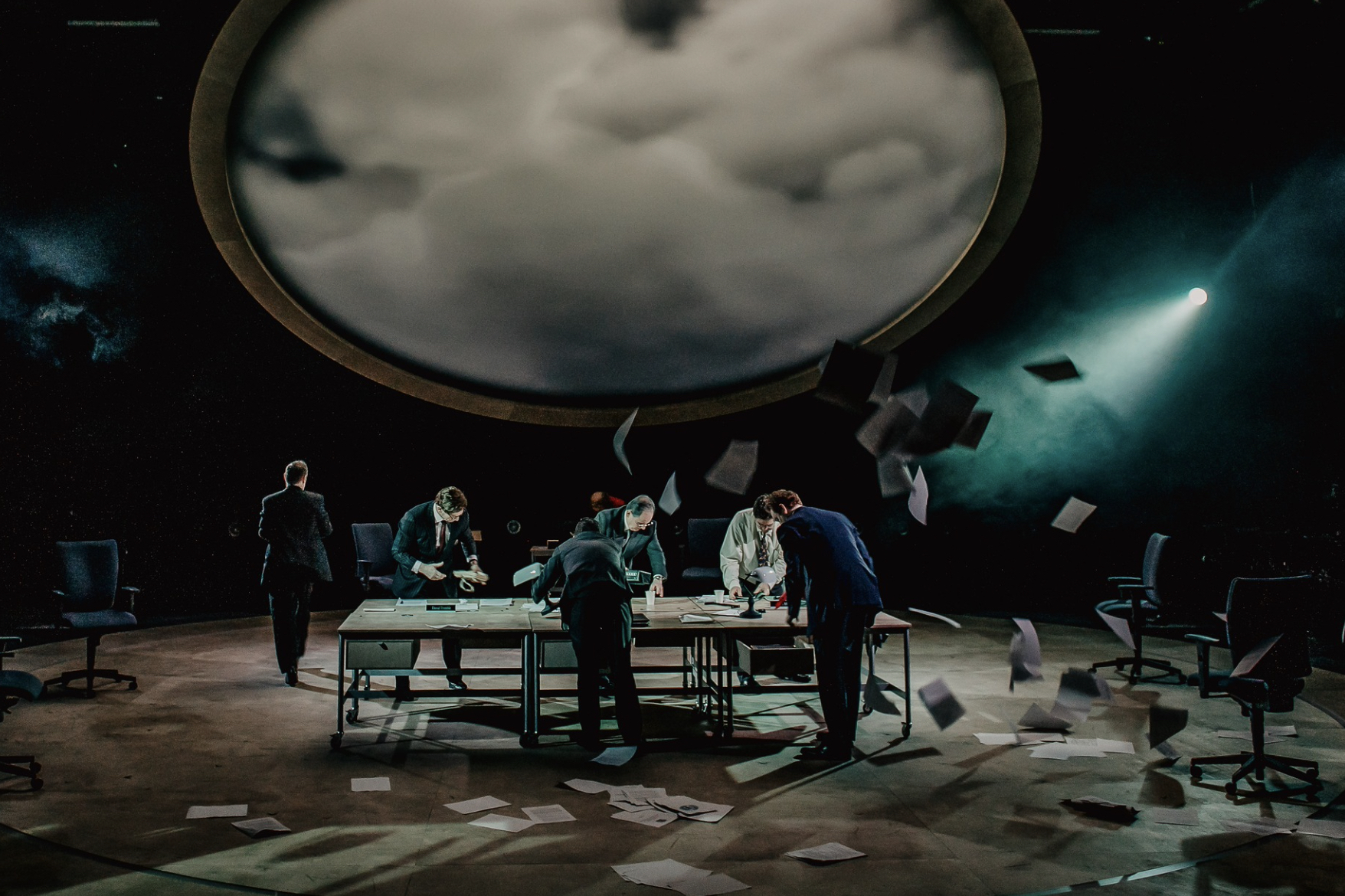
Director Charlotte Westenra could have done more to vary her actors’ approach to the text, but her straight-line approach does help audience members remember who stands where on the thorny issues.  With the focus on playwright Owen McCafferty’s fiery exchanges of dialogue, the artistic craftwork is also kept to a minimum.  The set by Conor Murphy centers on an overhead projection screen of a slowly shifting cloudy night sky.  It also serves as a television monitor and timekeeper with videos designed by Eoin Robinson.  Desks and chairs are continually rearranged by the players, more to provide variety than to establish any particular sense of place.  May Tumelty turns up the heat and the lights at key moments, which are punctuated by the contributions of composer Kate Marlais.

It is significant that the work is simply called Agreement and not “The Good Friday Agreement” or even “*The* Agreement.”  At a time when civil discourse and true negotiation seem impossible, the happenings portrayed are a refreshing reminder that informed and motivated people can find their way to a middle ground if they stay true to the greater good.  Despite passionate disputes over critical areas, democratic principles held. Ah!

Agreement continues through May 12 at the newly christened JL Greene Theatre in the Irish Arts Center, 726 11th Avenue.  The venue opened at the end of 2021 and boasts comfortable seats, a welcoming café, and a conversational staircase.  The production comes to us from the Lyric Theatre of Belfast.  Running time is 1 hour and 48 minutes with no intermission. Tickets are $25-$90 and can be purchased at https://irishartscenter.org/event/lyric-theatre-agreement.  

Fish

We’ve heard the old proverb, “Give a man a fish and you feed him for a day; Teach a man to fish and you feed him for a lifetime.”  But what are you supposed to do if you don’t have the money for a rod, line, or bait?  That is the provocative question behind Fish, a world premiere play by Kia Corthron currently running at Theatre Row on 42nd Street in New York.

The story revolves primarily around Latricia, known as Tree, a sharp 18 year old senior attending a typical urban high school that is short on funds and long on drop outs.  The teen has much more on her plate than 100 word essays.  With her mother incarcerated for a minor drug violation, she is responsible for running the household and overseeing her high-energy asthmatic 11 year old brother, Zay.  To add to her burden, her best friend LaRonda has won a spot in the Peak and Pinnacle Academy Charter School.  While only on the 6th floor of the same building as the rundown public school, with its gleaming computer lab and health center it might as well be on Mars.  English teacher, Jasmine Harris, can see Tree’s intellectual curiosity and capability below the layers of tough talk and anger.  But she’s so overburdened by the “teach to the test” requirements of Common Core she doesn’t have the time or tools to draw them out.  

Director Adrienne D. Williams does a brilliant job of incorporating the posture and movement of today’s cellphone obsessed youth.  Scenic designer Jason Simms has divided the small stage into three sections with smudged walls, mismatched chairs, and familiar posters, so that the action can move seamlessly from classroom, to project, to the streets.  The sound design by Michael Keck incorporates the thumping beats that greet us at the theater door.  Nic Vincent’s lighting design includes flickering fluorescents, an illuminated metaphor for the overall decline.  Scenes are cleverly titled overhead with the names of typical high school classes, for example “Speech and Debate” for a heated argument between teacher and student.   

Torée Alexandre makes a very believable Tree.  Even though she captures the cadence of a typical teen, with the guidance of dialogue coach Xavier Clark she takes the speed of delivery down just enough to make every impassioned word come across to the oldest of ears.  Equally good is Mikayla LaShae Bartholomew as best friend LaRonda, especially with dialogue that emphasizes the girls’ genuine caring for each other.  Acting as a worthy foil in her exchanges with Tree is Rachel Leslie as Jasmine Harris.  The cast also includes Josiah Gaffney as a sweet and playful Zay and Morgan Siobhan Green, Margaret Odette, and Christopher B. Portley playing multiple classmates and teachers.

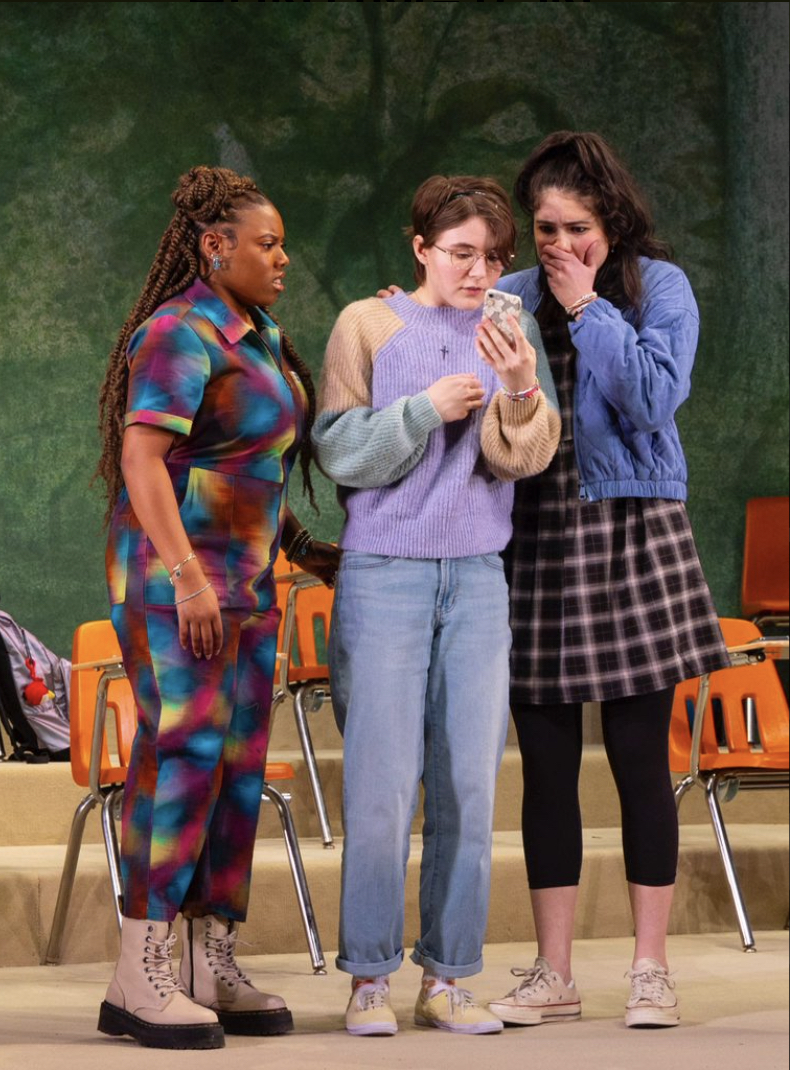
Josiah Gaffney and Torée Alexandre in Fish at Theatre Row

This scathing portrait of a failing system and the magic of having a teacher see the value within a student would have been enough to satisfyingly sustain the 105 minute runtime.  Instead, the storytelling becomes defused in the last 20 minutes, with several tangential issues introduced.  It’s unfortunate that after all the times she is let down, Latricia doesn’t get the full attention that she deserves from the audience either.

Fish — a co-production of Keen Company and Working Theater — is playing in Theatre 4 at Theatre Row through April 20.  The script contains mature language and tough themes and is most suited to those over 10.  Running time is 105 minutes with no intermission.  Tickets are being sold on a sliding scale starting at $0 and can be purchased online (https://bfany.org/theatre-row/shows/fish/), by phone (212-714-2442 ext. 45,) or in-person (410 W 42nd Street).  You can learn about how to pick the price point that suits your budget by visiting www.keencompany.org/tickets.

Cambodian Rock Band

The actions perpetrated by the Khmer Rouge in Cambodia were so extreme they are quite literally incomprehensible to many Americans.  The brutal regime very nearly decimated the cultural heritage of the Southeast Asian nation.  Nearly a quarter of the population was wiped out including the majority of doctors, teachers and artisans.  To this day, it is considered one of the world’s least developed countries by the United Nations.

Lauren Yee’s play with music, Cambodian Rock Band, takes us through the Cambodian Civil War and genocide through the eyes of one family and a prison commander who has finally been brought to trial on charges of Crimes Against Humanity.  It’s 2008 and Chum has arrived in Phenom Penh for a surprise visit with his American-born daughter, Neary.  She has been investigating Duch, who oversaw the murder of so many prisoners that only seven were found alive at the time of liberation.  For reasons that become obvious, Chum has conflicted feelings about his “lost” homeland and would love nothing more than for his child to give up her fact-finding mission, return to the USA and attend law school.  Flashbacks to 1975 complete the picture.  A time when music thrived in the country, these scenes include the amateur recording of the titular rock band with songs by Dengue Fever under the musical direction of Jason Liebson.  (Whether they have you dancing at your seat or tapping your foot with impatience to get on with the story depends very much on your love of tunes from that period.)

The work warmly humanizes the examination of the different ways in which people respond to danger and the instinct to survive. Using Duch as a narrator, Yee never lets us forget that we are watching a play orchestrated by a storyteller who can manipulate the plot.  Along the way, she weaves enough fact into the dialogue to carry everyone along without feeling lectured to.  Director Nelson T. Eusebio III skillfully handles the transitions between history, thriller, and dark comedy.  The ensemble — Eileen Doan, Jojo Gonzalez, Alex Lydon, Shawn Mouacheupao, K Chinthana Sotakoun, and Greg Watanabe — radiate emotional energy.  Many cast members perform dual roles, enhanced by the costume designs of Yoon Bae. The stark set by Riw Rakkulchon keeps our attention on the powerful language with the concert elements, including colorful projections by Caite Hevner, allowing us to breathe or maybe even scream. 

K Chinthana Sotakoun as Neary/Sothea; Photo Credit Wesley Hitt

In light of our own current struggles with authoritarianism and the reevaluation of America’s role on the international stage, the themes explored in Cambodian Rock Band ring even louder than in 2019 when it premiered.  While Yee softens the blows of the story with song, she never blunts the message.  Running time is 2 ½ hours including a 15 minute intermission.  Theatre Squared provides a lounge with a live stream at their venue in Fayetteville, Arkansas for those who need to take a mid-performance break.  There is also the option to stream the production from home, which is how I was able to see it in New York.  Performances continue through March 24.  Visit https://tix.theatre2.org/overview/25509/ for ticket prices and further information.

John Proctor is the Villain

Writers are often told to write what they know.  Playwright Kimberly Belflower has gone several steps further.  In John Proctor is the Villain she has boldly written from her very marrow, jangling the skeletons in our collective social-values closet.  Raised in Appalachian Georgia, Belflower sets her piece in a one stoplight town in her home state, using the locally accepted ways and belief systems to draw parallels between a circle of high school sophomore girlfriends and the characters in Arthur Miller’s The Crucible.  The year is 2018 and there is much in these young women’s lives that was not solved by Harvey Weinstein’s arrest.

Victoria Omoregie, Jules Talbot, Haley Wong in John Proctor is the Villain; directed by Margot Bordelon; photo by T Charles Erickson

The dialogue is wicked-smart, filled with references from classic literature to song lyrics.  Though all are understandable because of clever context, only one is fully explained.  Belflower begins Act 1 in a classroom where sex education has been buried inside English-Lit, all the better to rush through the uneasy curriculum.  Along with getting a quick hit of each of “Villain’s” characters, this opening enables teacher Carter Smith (a  charmingly approachable Japhet Balaban) to also introduce any audience members not already familiar with Miller’s work to the major themes of The Crucible and the historical background of Witch Hunts.  It also becomes clear very quickly how much the study of the arts is giving meaning and purpose to the lives of these students

While serious issues of feminism, sexuality, body positivity and all varieties of belief run under the surface, front and center is a story of the power of female friendship.  The young ladies are created with some stereotypical DNA, but every one is layered with unique and endearing details.  Caught in a very personal #MeToo scandal through the actions of her father is Ivy Watkins (a warm Brianna Martinez).  Her former best friend Shelby Holcomb (a thorny Isabel Van Natta) has just returned to school after an unexplained “sabbatical” which might be connected.  Often speaking truth to power is Nell Shaw (a high-octane Victoria Omoregie) bringing “worldly wisdom” to the conversation from her upbringing in Atlanta.  At the other end of the confidence spectrum is Raelynn Nix (a fabulously wriggly Haley Wong) the local preacher’s daughter. The ultra serious Beth Powell (a ready-to-spring Jules Talbot) launches a feminist club in part to boost her college application but also to give them a container for discussing their feelings. They have a developing ally in Mason Adams (a sweetly awkward Maanav Aryan Goyal ) who experiences a particularly lovely character arc.   Filling out the attendance sheet is Raelynn’s ex-boyfriend Lee (Benjamin Izaak) and the class guidance councilor Bailey (Olivia Hebert) who are essential to the plot.

Seasoned director Margot Bordelon, who has a history of amplifying new voices, seems to have deep love for these characters, bringing out every delicate moment of discomfort and rage with authenticity.  The school room’s simple set by Kristen Robinson changes temperament with the help of Aja M. Jackson’s lighting.  Sound designer Sinan Refik mixes snippets of pop tunes with school bells and eery noises to further shift the tone of the room.  The girls also make themselves heard in their choice of wardrobe (Zoë Sundra) and in Raelynn’s case evolving eye make-up.

Whether it is exploring weighty matters (like why is “too much” simply parental shorthand for “a girl)” or making us laugh in solidarity, John Proctor is the Villain always keeps us entertained.  True enjoyment requires the ability to think big and a tolerance of of other points of view.  It is available as an On Demand stream from The Huntington Theatre in Boston through March 24.  Running time is about 100 minutes with no intermission. Digital tickets are available at four price points starting at $30 and can be purchased at https://bostontheatrescene.huntingtontheatre.org/28317/28319.  

Dragon Lady

Sara Porkalob had received praise for playing a white Founding Father, Edward Rutledge, in the Broadway revival of 1776.  But she had never had the opportunity to represent someone with her Filipino background until she wrote a role for herself.  Her solo performance — Dragon Lady — tells the colorful story of Porkalob’s grandmother, Maria Porkalob Sr.  A karaoke-loving daughter of a gangster, Maria I moved from the Philippines to the Pacific Northwest as a pregnant newly wed wife of an American soldier.  (Senior made a cameo in the show until her death in 2022 and now appears in projection.)  The show premiered in 2017 and has been touring the country, now joined by Dragon Mama, another Porkalob creation told from Sara’s mother’s perspective.

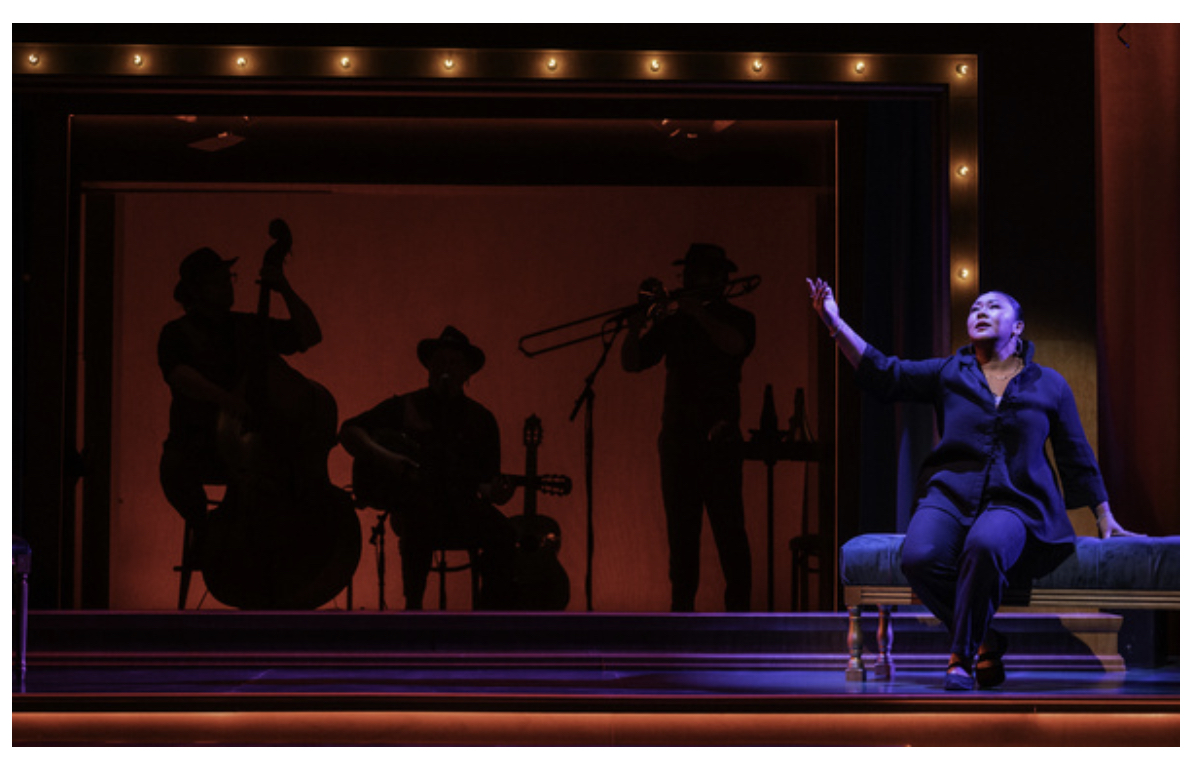
The Pittsburg Public Theater recently shared Dragon Lady with a broader audience through the League of Live Stream Theater, a non-profit that works primarily with regional theaters to broadcast their productions in real time.  Built tenderly from a 9 minute senior year workshop assignment, the production runs 2:15 and spans over 40 years.  Designed in a framework of a cabaret act with a three piece band, Hot Damn Scandal (Pete Irving, Jimmy Austin, and Mickey Stylin), the performance is engaging and freeing.  On the night before her 60th birthday, Maria Sr. pulls her granddaughter aside in order to share some family secrets.  Sara’s mother, Maria Jr., is obviously not the matriarch’s biggest fan.  By revealing some less-than-flattering elements of her history, the elder Porkalob hopes to at least elicit understanding of if not forgiveness for her past actions from the newest generation.

Sasha Jin Schwartz’s set, bathed in blue with its raised rounded platforms and crisscross patterns, conveys the essence of a casino or nightclub.  Under the guiding hand of director Andrew Russell and leveraging the intimacy of this ¾ round space, Porkalob changes skins in a flash, portraying those closest to Maria Sr. including her father, lovers, and five children. Each relationship shines a little more light into the painful darker corners (physical lighting by Spense Matubang).  There is a particularly lovely and insightful exchange between Maria Sr’s two sons, Ron and Charlie, when they were younger.  Sara’s singing voice is remarkably strong and soaring as she delivers a range of musical numbers from torchlight to jukebox.  Mixed with atmospheric sound by Erin Bednarz, the selections help shift the mood and lighten the load.  

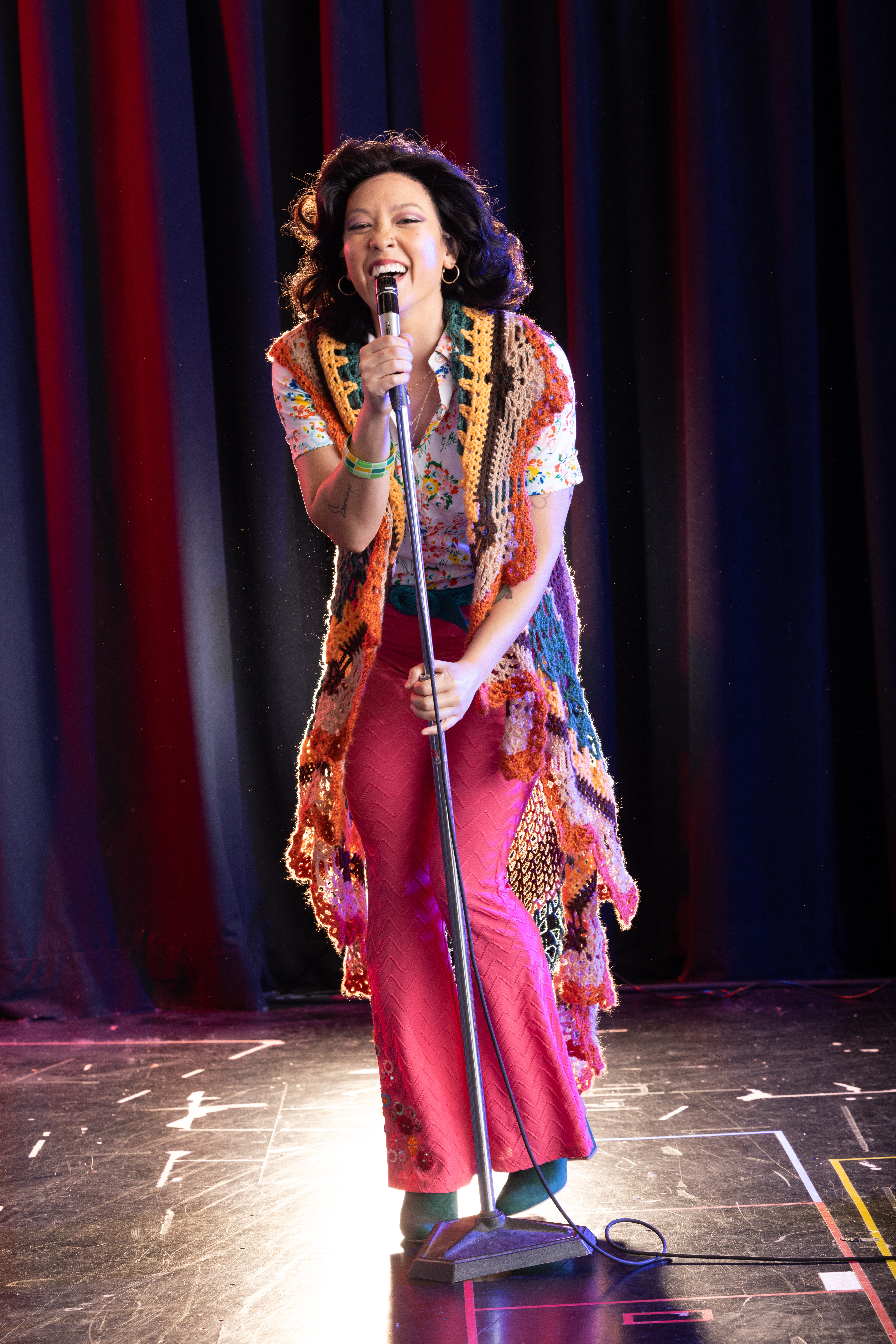
Sara Porkalob backed by the Hot Damn Scandal in Dragon Lady at Pittsburg Public Theater

Having broken away from the comfort of scene partners and backdrops, Porkalob has had to tap deeply into her own power as an artist.  By appreciating the value of a personal story and sharing a genuine human experience, Porkalob has given us a work that resonates far beyond her own family.  The language and themes are decidedly R-rated and intended for audiences over 18.  A third play, Dragon Baby, told from Sara’s vantage point, as well as a TV adaptation of the entire cycle are currently in development. 

For more information about Sara Porkalob and The Dragon Cycle, visit http://www.saraporkalob.com/.  To explore the rest of the Pittsburg Public Theater Season, visit https://ppt.org/.  To learn more about upcoming real-time simulcasts by the League of Live Stream, visit https://www.lolst.org/.