Tag Archives: Cathy Hammer

The Price of Thomas Scott

Long before there was Reverend Moore in Footloose, there was dance adversary and forceful chapel congregant Thomas Scott. Scott has been offered a small fortune for his declining neighborhood textile business.  The problem?  The new owners would turn the desirable corner location into a dance hall: a devil’s playground as far as Scott is concerned.  A righteous Protestant Nonconformist, he must now weigh his family’s future against his steadfast convictions.

Despite being written in 1913 by rising star Elizabeth Baker, The Price of Thomas Scott is brimming with modern dilemmas.  Class still dictates potential opportunity for education and career.  Our highly divided social climate is filled with the voices of strong convictions that have soured into prejudice.  Many become even more entrenched in the familiar and pass judgement on those who are open to differing opinion.  Yet as time moves forward, the seemingly outrageous and unusual can find more acceptance.

Scott’s family in question includes his far-sighted and talented daughter Annie (a radiant Emma Geer), whose creativity is stifled by her tasteless clientele.  Her brilliant brother Leonard (Nick LaMedica who does his best to come across as a teenager) has the potential to become upwardly mobile.  Their mother Ellen (an underutilized Tracy Sallows) longs to retire with her husband to Tunbridge Wells where they first met.  While Scott himself (a crackling Donald Corren)  has built his life around his chapel and now seems driven to protect everyone’s prospects for entrance to heaven.  Temptation is provided in the form of Wicksteed (a polished and eloquent Mitch Greenberg) a former friend now employed by the successful Courney Company.  The story is made richer by the Scott’s friends and neighbors played by Andrew Fallaize, Josh Goulding, Jay Russell, Mark Kenneth Smaltz, Ayana Workman and Arielle Yoder.

THE PRICE OF THOMAS SCOTT by ELIZABETH BAKER Tracy Sallows, Donald Corren and Emma Geer Photo by Todd Cerveris

Tracy Sallows, Donald Corren and Emma Geer.  Photo by Todd Cerveris.

Director Jonathan Bank is constrained in his approach, relying heavily on Tracy Bersley’s choreography to pick up the momentum.  All the action takes place in the back parlor of the Scott’s shop, represented by the perfectly rundown set created by Vicki R. Davis.  The charming mostly muted costumes by Hunter Kaczorowski tell the story of period and class in pre-WWI England.  The hats on display illustrate the gap between Annie’s instinct for style and her clients’ misguided requests.  Shifts in the lighting by Christian Deangelis and music and sound by Jane Shaw help set mood and pace. 

All are in service to the clever and often humorous words of Ms. Baker.  Growing up in a household similar to that of the Scotts, she took in her first play at the age of 30.  In short order she had transformed from an obscure stenographer to recognized playwright.  At first you may need to navigate the various accents and a few older expressions, but then the flow is established and the characters come into focus. However, the ending will feel extremely abrupt to a modern audience.  (Those around me failed to clap for a full 30 seconds, though they appeared stunned more than unhappy with the performance.) The production team seems to have recognized Baker’s departure from what has become an acceptable character arc and tacked on a post-curtain call “coda” to better manage expectation. Your reading of the Artistic Director’s statement and dramaturgical notes will help you better appreciate the work.

The Price of Thomas Scott poses some deep questions through pleasant voices.  It is Mint Theater’s latest project in support of giving new life to neglected women playwrights.   Runtime is 90 minutes with no intermission.  It is playing through March 23 at the Beckett Theatre in Theatre Row.  Full priced tickets are $65, though there are several discount options including $32 day-of Rush.  For more information and to purchase seats visit http://minttheater.org/current-production/

Bonnie’s Last Flight

Pack a bag full of whimsey and climb aboard Bonnie’s Last Flight.  This imaginative new play by the prolific Eliza Bent is taking off at Next Door at NYTW.  Your experience of the extended metaphor begins as soon as you receive your confirmation from the theater.  First class passengers are allowed to enter first and receive pre-performance wine and snacks.  (Though bibs on the back designate them as First Class, Comfort Plus or Economy, all the chairs are the same and there are no bad seats in the house.)  Upon entering, you are immersed in a representation of a cabin surrounded by oval windows and Virgin inspired overhead lighting.  Leg room is generous, though there is a limit of one carry-on per person.

Despite the title, the head of your crew is Jan. Thirty-one years ago during the rise of feminism, the then sexually naive teen found herself pregnant and alone.  She chose to carry the child to term.  Though she gave her daughter up for adoption, the chapter derailed her lifelong ambition to become a writer.  Taking a job as a “waitress of the skies” she continues to jot down ideas between trips down the aisle to serve brownies.  Her inspiration is a manic Mark Twain who is almost always by her side.  Recently accepted into a renowned Chicago based writing program, she’s finally hanging up her wings to follow her abandoned dream.

Jan’s story is one of many we learn during our fictional flight to Chicago and it is by far the most linear. The remainder of Ms. Bent’s script includes several personal episodes told by the rest of the crew as if glimpsed through cloud cover.  Jan’s counterpart is the well-meaning, high-energy and somewhat dimwitted LeeAnne who is also struggling to course-correct her life. Rounding out the cabin team is Jan’s devoted longtime colleague Greig, moved by items he finds left in seat back pockets and under seats.   Up in the cockpit is Tony, whose obviously lack of fitness to fly is one of the play’s plot holes.  His calling his co-pilot Erik “Jesus” is a running joke.  The troupe also portray other characters from the past.  To reveal more about the titular Bonnie would be a small spoiler, but she too is on board.
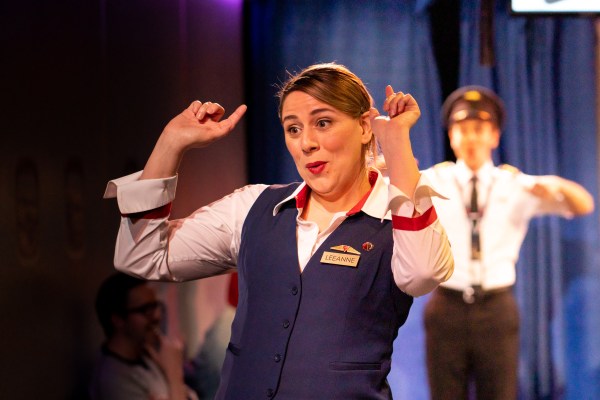
Ceci Fernandez in Bonnie's Last Flight. Photo by Shun_Takino

Ceci Fernandez in Bonnie’s Last Flight. Photo by Shun Takino.

In the elegant and graceful body of Barbara Walsh, Jan is a marvelous character, surprisingly well rounded and deeply sympathetic given the short amount of time we get to spend with her.  Greig Sargeant’s Greig isn’t given as much depth, but he acts as a sweet partner and balances Ceci Fernandez’s frantic and funny LeeAnne.  While those three are tonally in sync, the others seem to have stumbled in from a much more farcical piece.  The cockpit duo played by Sam Breslin Wright and Federico Rodriguez veers firmly into stock character territory.  Playwright Eliza Bent’s own clown-like Twain nearly pulls the piece over the slapstick edge, though this is apparently integral to her vision for the work.  

Director Annie Tippe cleverly choreographs the motion using the confined space defined by airplane body, aisles and jump-seats.  A good portion of the runtime is devoted to skits and business including clips of inflight movies.  This necessitates looking from side to side like a tennis match and occasionally completely turning around to see a curtained area behind you.  A few times, an unwitting “passenger” is included in the action.  Scenic design by Meredith Ries and costumes by Heather McDevitt Barton make the best of a small budget. Small overhead monitors expand the performance space and creative wigs and accessories make for quick changes.  The live action is supplemented by videos by David Pym and sound by John Gasper, which in previews had some technical glitches.  (For anyone who has tried to use Go-Go inflight wireless, this is not out of step with the rest of the gag.)

With tickets starting at $25, Bonnie’s Last Flight is a pleasant diversion, delivering some great fun and mild food for thought.  Can we lose our emotional baggage as easily as a major carrier sends the suitcase clearly marked for Rome to its hub in Abu Dhabi?  It is playing through March 2 as part of Next Door at NYTW, 83 4th Street near 2nd Avenue. Tickets are available online at NYTW.org, by phone at 212-460-5475, or in-person at the NYTW Box Office. Be warned that similar to a real flight, it will be impossible to leave before reaching the final destination.
Blue Ridge

Alison only knows one way of being.  All waving arms and defensive language, she’s a fast talker in all the meanings of that phrase.  Having been incarcerated for taking a hatchet to her lover’s car, she’s been released into the loving care of a church-sponsored sober house in the Blue Ridge Mountains of Western North Carolina.  We meet her at her very first group session where she recites Carrie Underwood lyrics instead of the bible passage she’s supposed to have prepared.  Within minutes she’s telling the circle why she’s not really responsible for her crime and emphasizing that, having never done drugs, she doesn’t have need of any one of the twelve steps.  

Anyone who has experience with someone in recovery will know exactly how this story is going to unfold.  That’s the essential problem with Blue Ridge, now playing at the Atlantic Theater Company’s Linda Gross Theater.  While Abby Rosebrock’s script is beautifully written with textured dialogue, it doesn’t have anything new to say about mental health, boundary issues, or the powers of addiction in its many forms. Only those who find a new path have a real prayer of moving on intact enough to survive in the outside world.

blueridge.dress.1064

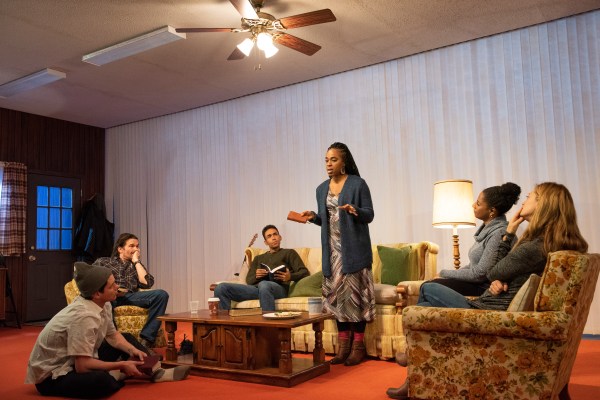
From lower left: Peter Mark Kendall, Chris Stack, Kyle Beltran,  Kristolyn Lloyd, Nicole Lewis and Marin Ireland in Blue Ridge. Photo by Ahron R. Foster.

In the hands and body of stage steady Marin Ireland, Alison is particularly irksome.  Her constant shrillness and twitching makes it hard to believe anyone in this substitute family would warm to her.  This is especially true of her devoted roommate Cherie, played with deep sincerity by the excellent Kristolyn Lloyd.  The male housemates’ reactions come from two diametrically opposed yet equally predictable directions.  Peter Mark Kendall brings genuine vulnerability to the easily beguiled Cole while the endlessly watchable Kyle Beltran’s Wade creates friction in his struggle to find inner strength.  The program’s co-founders are equally ill-equipped to lead everyone safely through a  troubled journey. Pastor Hern (a smooth Chris Stack) weakly attempts to guide the housemates in a more mindful direction, and Nicole Lewis’s insufficiently defined Grace generally lives up to her name by simply finding the good in what comes naturally to each of her residents.  

Director Taibi Magar successfully explores the shifting mood as the house moves from warm community to too close for comfort.  Confrontations have a palpable and fiery emotional core.  Her pacing is off, though, with the play running nearly 15 minutes over the prescribed two hours on Thursday night.  Mikaal Sulaiman provides the intelligently curated soundtrack for both conflict and healing. Unfortunately, some of the other design choices are distracting.  Why is the ten year old furniture of Adam Rigg’s set in a palate associated with the late 70s?  Why does Amith Chandrashaker’s lighting incorporate an incongruous brilliant December sunshine streaming through the window and ugly fluorescent overheads that play a supporting role for just a few minutes?  Why, while indicating the passage of time through Thanksgiving throws and a Rudolf mantlepiece, do we need to break the story’s flow and see each item put in place by the glow of a proscenium of LEDs?  

Taken as a whole, this production of Blue Ridge is flawed and consequently frustrating.  Writer Rosebrock has obvious talent, but her storytelling has not yet been brought into focus.  However, if you are fascinated by the ways in which broken people can either fit together with or puncture those around them, you may find enough with which to engage. This limited run is scheduled through Sunday, January 27th.  Regular tickets begin at $65 and can be purchased online at atlantictheater.org, by calling OvationTix at 866-811-4111, or in person at the Linda Gross Theater box office (336 West 20th Street between 8th and 9th Avenues). 

The Baby Monitor

The shattering impact of an “I love you” with a “but” clause is at the heart of The Baby Monitor, currently mounted as a workshop production at the 14th Street Y.  The plot centers around the suspicions a woman harbors concerning her gay cousin’s treatment of the toddler son he shares with his husband.  By fleshing out this nightmare scenario with all-too-common misunderstandings stemming from distinctions in race, class and religion, playwright David Stallings has delivered something far richer than an issues play.  It is a thoughtful examination of the ways in which simply tolerating differences rather than embracing them can cause irreparable damage to our societal fabric.

The scene opens on a family Thanksgiving.  Rejected by most of his strict Catholic family after coming out, Damon has invited his close cousin Claire and her husband Josh to join him and his husband Phillip to celebrate the holiday along with their two-year-old son and nanny.  The evening includes a great deal of reminiscing and chardonnay and concludes with flipping through the new family’s photo album.  A combination of tainted religious doctrine and personal frustration leads Claire to react inappropriately to one of the pictures.  Her misguided good intentions have the potential to destroy the happiness of everyone involved.

David Stallings, Leo Goodman, Amanda Jones, and Hector Matias. Photo by Michael Dekker.jpg

David Stallings, Leo Goodman, Amanda Jones, and Hector Matias. Photo by Michael Dekker

Even at a time when gay marriage is legal and children stemming from these unions are not uncommon, it has been hard for many people to move beyond ingrained beliefs.  Stallings realistically explores a variety of viewpoints stemming from these slow-to-shift societal norms.  The genuine danger that can grow from preconceived notions is revealed in peeling layers.  While there is certainly an ideology that skews left running underneath, the dialogue is stealthy, with little slips of the tongue that indicate early on that Claire’s love for Damon has many qualifiers attached to it.  By making Phillip and the nanny Soledad immigrants from the Dominican Republic, Stallings can additionally explore the role culture and class play in the escalating tensions.

Stallings also stars as Damon, a performance infused with deep passion.  Héctor Matias is positively dreamy as Phillip, accustomed to keeping up his guard except around the family he clearly adores.  Stallings is less successful in his drawing of female characters.  Though Amanda Jones strives to manifest Claire’s sympathetic backstory, the character is essentially unlikable and therefore challenging to portray.  This is magnified in her scenes with Leo Goodman’s wonderfully nuanced Josh, who is most often given the voice of reason.  Greta Quispe similarly struggles to give balance to Soledad, whose personal journey could make for an equally compelling play.  However, Mel House is strong in her too-brief performance in the critical role of activist Shelly.

For this production, the black box theater has been set up in 3/4 round with a simple set of padded tiles and wooden boxes.  Lighting designed by Kia Rogers is used to shift the setting and to mimic a violent climatic moment.  Direction by Stallings’ husband Antonio Miniño is skillful, with an engaging blend of quiet touching moments and palpable strain.

As much as it is a powerful drama, The Baby Monitor is also an important conversation starter.  Developed on both coasts of this divided country, it would be wonderful if this work could find its way into the middle.  The production contains very brief partial nudity and is recommended for ages 16 and over.  It is playing through December 16 at the 14th Street Y, 344 East 14th Street near 1st Avenue.  General Admission tickets can be purchased by calling 646-395-4310 or by visiting www.differenttranslation.com.  Prices are $25 for adults and $22 for seniors and students.  $5 rush tickets are available 15 minutes before curtain for those living in zip codes 10003 and 10009.  

Dr. Jekyll & Mr. Hyde

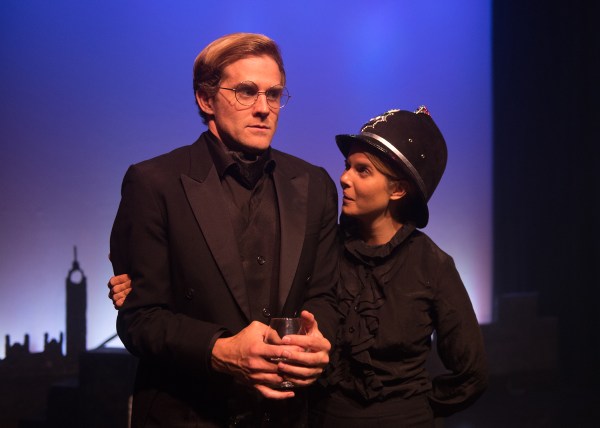
The first glimpse of a miniature cardboard cutout of the London skyline sets the tone for an evening spent with Dr. Jekyll & Mr. Hyde.  Wildly creative and deceptively simple, this retelling of Robert Louis Stevenson’s classic novel is one selection from this year’s Fringe Encores line-up.  Well curated by Artistic Director Darren Cole and his team, the series brings to the nonprofit SoHo Playhouse the very best shows from the world’s most well regarded fringe festivals including Brighton, Edinburgh, Hollywood, Limerick, Orlando, and Toronto as well as New York.  It’s theater for lovers of lively and inventive works.

At first, the dapper Burt Grinstead as Dr. Jekyll plays straight man to Anna Stromberg, varying her accent and exchanging aprons, hats, pipes, and other bargain bin objects in rapid succession as she takes on every other character.  It’s a tour de force performance for the actress, who also directs the piece.  Several purposefully awkward lectures later, Mr. Grinstead gets in on the fun with his brilliant transformation from mild Jekyll into villainous Hyde, played out in effective silhouette.  From there, the pace accelerates until the play’s dramatic conclusion.

Officer Hug - Cooper Bates Photography

Burt Grinstead and Anna Stromberg; photo by Cooper Bates

The two actors wrote the script, which is witty with just enough scare to keep audience members jumping.  Their adaptation retains many of the major plot points from the original book while taking quite a few creative liberties.  The character line-up has been streamlined.  This gives Ms. Stromberg the opportunity to show the full range of her talent without giving herself a coronary.  As playwrights, they have also infused the story with contemporary relevance: heightening the social commentary and playing up the frustrations associated with Victorian era repression by providing Jekyll with a feminist love interest.  It all works to tell a tale that is at once familiar and completely fresh.

The suggestive sets are composed of black interlocking wooden pieces with hidden compartments that reveal essential details in white.  Mood changes are emphasized with solid color lighting behind a plain backdrop.  These physical elements are augmented with a wonderfully produced soundscape of gulls, clock chimes, and musical flourishes.  

At 75 minutes,  Dr. Jekyll & Mr. Hyde takes you on a highly engaging ride that ends before it can become repetitive.  With its pun-filled dialogue, clever production design and remarkably flexible two person cast, it’s low-budget entertainment done right.  And with tickets available for as little as $25, it’s also tremendous night-out bang for the buck.  

The “best of the fests” runs through December 16 at the SoHo Playhouse, 15 Vandam Street off 6th Avenue near Spring.  To see a calendar of remaining performance dates and purchase tickets, visit www.fringeencores.org.

The Thanksgiving Play

In the right hands, satire can be a terrific educational tool.  This was clearly in the mind of award-winning playwright and activist Larissa FastHorse when she chose to go broad with The Thanksgiving Play.  Pained by the way the typical Thanksgiving story obliterates the voices of her people, the Sicangu Lakota uses laughter rather than lecture to take on all those insulting myths.  This is the award winner’s first New York production and it’s a worthy entrance. Through her four well-intentioned if off-base characters, she blows up those oft-repeated stories of pilgrims showering America’s indigenous peoples with respect and side dishes.  The results are uneven and she’s likely preaching to at large number of regular choir members, but a good time can still be had.

Thanksgiving Play

Greg Keller, Jennifer Bareilles, Jeffrey Bean, and Margo Seibert; photo by Joan Marcus

The economical cast of achingly progressive characters are developing a holiday performance that celebrates Native American Heritage month for a elementary school audience.  The director of this play within a play is Logan, an anxiety prone vegan who has pulled together an array of small niche grants in order to fund her vision of a more honest Thanksgiving story.  Her school play will co-star Disney-obsessed actress Alicia and Logan’s yoga-loving street performer boyfriend, Jaxton.  Rounding out the “creative team” is Caden, a playwright-wanna be and first grade teacher.  For the majority of the 90 minute runtime, these well-intentioned souls improvise and brainstorm their way towards an increasingly awkward outcome.  Their endeavors are occasionally interrupted by wildly off-kilter musical numbers covering all the cringe inducing story elements they are trying to leave behind.

Under the direction of Moritz Von Stuelpnagel, the dialogue starts out at such a high pitch it doesn’t have enough room to grow.  Jennifer Bareilles as Logan is a constant bundle of nerves.  Greg Keller’s Jaxton’s oozes PC doctrine from every pore.  Margo Seibert’s Alicia is such an airhead she’s perfected the art of looking at the ceiling.  And Jeffrey Bean’s Caden is like a Jack Russel terrier, excited just to be in their company.  All four quality actors do their best to add range and fair better with the piece’s physical humor.   These moments includes an uncoupling ritual and reading aloud from several fantastically illustrated textbooks.

The design team mostly strikes the right comedic notes.  The single set by Wilson Chin combines classic classroom elements with some of the most appropriately inappropriate theater posters.  Costume designer Tilly Grimes delivers equally well with liberal casual and tacky pageant wear.  Lighting created by Isabella Byrd highlights the action as it shifts from faux intense to intensely faux.

As both a comedy and a lesson plan, this production of The Thanksgiving Play would likely earn a B- for its insufficient build and variation.  But it has heart and successfully serves as a reminder that the upcoming family holiday is fraught with misunderstandings that go far down and way back.  Certainly if you’ve ever had a Caucasion friend who built a sweat lodge right next to his jacuzzi to honor “their heritage,” you will recognize FastHorse’s creations.  And even if you haven’t, you’ll be reminded that what you’ve learned about US history is not necessarily the full story. 

Performances are scheduled to run through November 25 at the Peter Jay Sharp theater at Playwrights Horizons.  For tickets and information visit https://www.playwrightshorizons.org/shows/plays/thanksgiving-play/.

The Lifespan of a Fact

In this age of high anxiety and bitter divide, it didn’t seem possible that anyone could write a play that was both timely and hilarious.  Amazingly The Lifespan of a Fact — based on true events surrounding the development of an article about a Las Vegas teen’s suicide — achieves this blissful combination.  Written in vivid detail by nonconformist writer John D’Agata, the original 2005 article was assigned for fact-checking to an ambitious magazine intern, Jim Fingal.  D’Agata and Fingal’s conflict over the nature and role of facts spanned seven years and resulted in an essay and a book which in turn inspired Lifespan’s script by Jeremy Kareken & David Murrell and Gordon Farrell. With so many fingers on keyboards, this production could have been a cacophonous mess, but the logic and story are sound. Fingal’s on stage persona makes a strong case for journalistic integrity and thorough research.  Equally persuasive is D’Agata’s viewpoint that the right words, however poetic, are needed to attract and hold readers’ attention. Perhaps most importantly for Lifespan’s audience, their 90 minute argument elicits many cathartic chuckles.

The well crafted material hits the intended target in large part because of the wise direction of Leigh Silverman.  She has a keen instinct for when to punch up the humor without going too broad.  Rather, she peels back the layers of each of the three characters in slowly building rhythm.  She has the great advantage of being blessed with a magnificent cast, each of whom has an incredible sense of pace and timing.  Charmingly obsessive in his role of fact checker Jim Fingal, Daniel Radcliffe is physically taut and verbally cranked to 11.  He prepared for the role by actually working as a fact checker for New Yorker magazine, which clearly gave him a strong foundation on which to draw character details.  His opponent in the battle of wits, writer John D’Agata, is bought to irritated life by a blustery and brilliant Bobby Cannavale.  That the two actors are nearly a foot apart in height adds a shiny layer of physical humor on top of their perfectly orchestrated banter.  Standing between them with a commanding hand and a touch of grace is the charismatic Cherry Jones as the magazine’s editor, Emily. 

7013b The Lifespan of a Fact, Pictured L to R, Bobby Cannavale and Daniel Radcliffe, Photograph by Peter Cunningham, 2018

Many hands add their own magical touch to bringing out the best in the piece. Mimi Lien’s scenic design includes some smile-inducing details.  Linda Cho’s costumes give good visual cues.  The playwrights have raised the stakes by putting their characters on a four day deadline.  Projections by Lucy Mackinnon and music and sound by Palmer Hefferan keep us on edge as the clock ticks stressfully onwards towards publication day.  

Suitable for teens and up, The Lifespan of a Fact brings much needed smart laughter to Broadway’s fall season.  Though the ending may be unsatisfying to some, the overall experience is everything you want from an afternoon or evening at the theater.  It is playing at Studio 54, which has particularly good sight lines.  Tickets for performances through January 13, 2019 are for sale at https://www.lifespanofafact.com and on most entertainment apps.  A limited number of affordable $40 seats are available for purchase in-person at the Studio 54 box office for same-day sale.

Bernhardt/Hamlet

In 1899, Sarah Bernhardt decided to take on the role of Hamlet.  The most famous actress of her—perhaps of any — time was no longer comfortable playing ingenues, and the parts written for women in their 50s held no interest for her.  Her daring gender crossing is considered a seminal moment in the history of performing arts.   She could keep a pet tiger and a fleet of lovers, and even sleep in a coffin, but her decision to play a man was treated by critics at the time as one “eccentricity” too far.  The event should have made for a compelling play, at least for theater buffs and cultural historians.  Unfortunately in Theresa Rebeck’s Bernhardt/Hamlet, the excitement is smothered by too much talk and upstaged by scenes written by the Bard himself.

Bernhardt/Hamlet is the first commissioned original work that Roundabout has brought to Broadway.  Despite a lengthy development process, the piece still feels like it was created by committee and at the very least could do with another round of editing.  There are a number of enlightening themes explored in Rebeck’s script including the inner life of Shakespeare’s famed Danish Prince.  It becomes obvious that Hamlet and Bernhardt share an almost crushing doubt about their purpose.  Strongest of all are Bernhardt’s observation about gender issues that persist to this day, especially the challenges facing talented women who are too old to play 20 something convincingly and too fierce to take a tiny supporting role.  Bernhardt had successfully portrayed Cleopatra, Cordelia, Desdemona and Ophelia, all of which had become inappropriate.  What was left for an actress of her range to play except Shakespeare’s most defining role?  Sadly, too much of the banter sounds like it’s coming from the head instead of the heart, robbing the exchanges of any emotion that could move and inspire the audience.  The production comes across like someone sharing the love of ballet by drawing it on a chalkboard. 

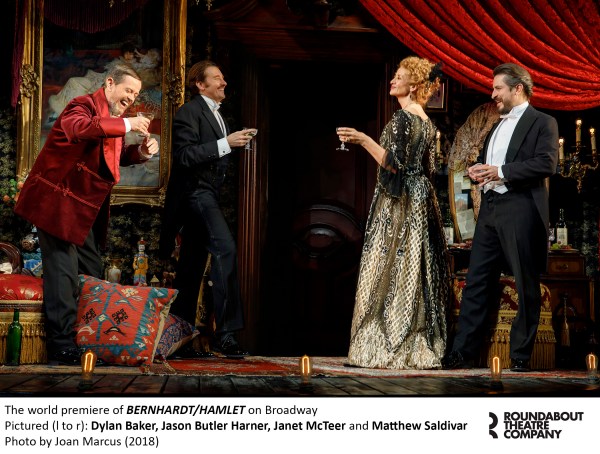
0462_Dylan Baker, Jason Butler Harner, Janet McTeer, Matthew Saldivar in BernhardtHamlet, Photo by Joan Marcus, 2018

The characters’ nattering is made worse by the static direction of Moritz von Stuelpnagel.  Even the more crackling stretches of Rebeck’s dialogue are choked off by the lack of movement. The enclosed feeling is made worse by Beowulf Boritt’s suffocating set.  Never has Paris seemed less lively. This lack of energy becomes is most noticeable during fast paced scene changes, which are accompanied by dramatic original music by Fitz Patton.  At least costumes by Toni-Leslie James and hair and wigs by Matthew B. Armentrout are appropriately jazzy.

What’s happening front and center is worthy of the Divine Sarah.  Like the one-of-a-kind star she is portraying, Janet McTeer dominates the stage with her honeyed voice, graceful stature and sheer presence.  Slightly more exaggerated is Dylan Baker’s performance as Constant Coquelin, Bernhardt’s frequent leading man.  Though he can’t match her vigor, he injects wit into their banter.  Jason Butler Harner as her lover Edmond Rostand embodies a realistic combination of lust and haplessness.  As his wife, Ito Aghayere who sparkled in Junk last season, is disappointing and flat in a significant scene.

At nearly 2 1/2 hours, Bernhardt/Hamlet will likely be a slog for all but the most dedicated lovers of “straight” theater. It’s a missed opportunity to share a shining moment when a talented actress took charge of her own career.  Bernhard, Hamlet, and Ms. McTeer all deserve better.  Tickets are on sale through November 11 at https://www.roundabouttheatre.org/Shows-Events/Bernhardt-Hamlet.aspx.

Head Over Heels

Like one of its stars, Peppermint, Head Over Heels has a refreshing sense of self.  A blend of 16th Century verse, music by 1970s pop stars The Go-Go’s, and an ultra modern “love is love is love” message, Broadway’s newest musical eludes “pegging”.  Based loosely on The Arcadia by Sir Philip Sidney, the story follows King Basilius as he attempts to defy a prophecy delivered to him by Pythio, the Oracle of Delphi. She declares four tragedies will befall his kingdom, each one signaled by a veil falling from the sky. Should all come to pass, the land is doomed. Determined to cheat fate, Basilius packs up his citizens and travels deep into the woods.  Anyone who knows their way around a Greek myth can predict how successful the well-meaning ruler’s plan will be.

The Go-Go’s repertoire —including Mad about You, Cool Jerk and Vacation — contains many catchy ear-worms, but they are hardly known for their deep meaning.  While the dialogue is often witty, characters sometimes tee-up the next production number by delivering forced lines. If hearing that what makes this kingdom distinctive is that they’ve “got the beat” makes you cringe, you should have second thoughts about purchasing tickets. On the other hand, if you find yourself going along with the playfulness, there is more where that came from.

There is none of the over amplification which dominates rock musicals and every word is clearly articulated. Many eyes will be on the aforementioned Peppermint, a fierce RuPaul Drag Race competitor and first “out” trans  actress to develop a lead of a Broadway musical. Her Pythio may be the only character to literally sparkle, but she is not alone in that quality of performance. The cast – some of whom have been with the production since its early days at the Oregon Shakespeare Festival – is uniformly strong and everyone seems to be having one heck of a good time. In particular, Andrew Durand steals every scene he’s in as the sweet shepherd Musidorus on his road to self discovery and empowerment. Bonnie Milligan making her Broadway debut is another standout as the difficult and vain Pamela, the older of the king’s two daughters. She ably avoids becoming a tedious “fat joke” by infusing her character with gentle confusion which elicits compassion. She is well paired with Taylor Iman Jones’s Mopsa, her several-steps-ahead admirer.

Head Over HeelsA New Musical

Taylor Iman Jones in the San Francisco Production of Head Over Heels

Director Michael Mayer has his cast members veer towards the hammy, a superfluous move with this broad book created by Jeff Whitty and adapted by James Magruder. The moments that are less heavy handed are also more visually exciting, including a seduction scene accomplished in shadows. The production design wonderfully captures the glow and fizz of The Go-Go’s heyday as well as the bejeweled styling of the court of Queen Elizabeth I. Scenic designer Julian Crouch’s amusing backdrops include fake curtains and two dimensional trees in a pallet that is pure disco. Arianne Phillips picks up this mixture in her costume design in which half naked male suitors are topped with metallic ruffs, and bows are painted onto the princesses’ elaborate dresses.  Hair and makeup by Campbell Young Associates complete the look to whimsical perfection.

Familiarity with The Go-Go’s is not essential, but it adds to those moments when distinctive guitar licks foreshadow an upcoming production number. Sadly, though, something is off with Kai Harada’s sound. It is admirable that the creative team chose to use only female band members, but their output lacks sufficient depth and energy.  This becomes particularly noticeable upon exit when the original article can be heard throughout the lobby.

Perhaps because it’s a fun and flashy romp, Head Over Heels is attracting a particularly undisciplined audience to the Hudson Theater. The young woman next to me crackled her way through a large bag of gummy bears throughout the 2 hour 15 minute runtime, while the 60-something woman behind me got so drunk that by Act Two she was discussing the quality of the house wine with her friends in what can only be described as her outdoor voice. It may help you get into the proper mood by imagining yourself at the Globe with sawdust under your feet and jolly old England just outside the door. Tickets are on sale now through June 30, 2019 at https://headoverheelsthemusical.com.

Fire in Dreamland

There is a burning spark at the center of Fire in Dreamland, Rinne Groff’s new play which opened at the Public Theater last night. It comes in the form of Rebecca Naomi Jones who pours everything she has into the central role of Kate. Kate is sad and frustrated, desperate to fulfill her promise to her father to do something meaningful with her life. She finally finds inspiration and hope when she meets Jaap, a European would-be filmmaker in New York on a student visa. In total contrast to Kate, Jaap is completely focused on a passion project: a film he’s conceived based on the true story of the fire that destroyed the flashy Dreamland Amusement Park at Coney Island in 1911. Kate is consumed by Jaap’s enthusiasm and charisma, throwing herself body, soul, and bank account into his vision.

The mostly linear story opens with a direct confession to the audience and is interspersed with startling glimpses into the past, punctuated by bright lights and the sound of a film clapboard. As Kate struggles to find her life’s purpose, she identifies first with Dreamland’s Nubian lion who escaped a fiery circus tent only to be shot by police and also with the mermaid-clad carnival worker who led a herd of ponies to safety. Similar to last season’s film and critical darling Florida, there is also a more important story on the edges of Coney Island involving a housing project damaged in Superstorm Sandy.  The metaphors keep piling up until — to add one more — the play becomes a large Amazon box filled with air bubble cushions protecting a six pack of batteries and a pair of tube socks. It’s a lot to unpack for a somewhat disappointing outcome.

Enver Gjokaj and Rebecca Naomi Jones; Photo by Joan Marcus

Enver Gjokaj and Rebecca Naomi Jones; Photo by Joan Marcus.

Ms. Jones is on stage for almost the entire hour and 40 minute run time. The amount of energy and dedication she gives to sharing her character’s process of reinvention is impressive. Enver Gjokaj does not quite match her in intensity,  bringing insufficient magnetism to the role of Jaap. Rounding out the cast, Kyle Beltran is outstanding as the idiosyncratic Lance, Jaap’s dedicated assistant director who appears to be on the spectrum sexually and emotionally. (It’s a shame he does not join the action until an hour into the performance. I could have enjoyed an entire play about this multi faceted character.)

Groff’s script has the same uneasy mixture of the random and the planned that is swirling around in Kate’s brain. There are moments of humor as the playwright makes good use of the communication gaps that stem from both language and gender differences. Unfortunately there is also a credibility gap in a filmmaker having envisioned every shot seemingly without any knowledge of how to bring any of it to fruition.  It is hard to believe Jaap could be Kate’s catalyst for change. There are moments of truth that shine through, but a number of scenes seemed forced and contrived. Director Marissa Wolf making her New York debut has a clever touch and uses the three-quarter round space beautifully. The weaker plot points are propped up by the imaginative lighting design of Amith Chandrashaker, whose work also gave clarity to [Porto]. Susan Hilferty’s boardwalk inspired set and whimsical wardrobe lend an appropriate carnival vibe to the proceedings. Original music by Brendon Aanes is invaluable, particularly in orchestrating a vivid soliloquy that becomes more of a movie than anything Jaap is ever likely to produce.

While there is a great deal of artistic merit to this production of Fire in Dreamland, it still seems like a project in development. Whether like Kate you wish to take a leap into this story will depend on how much you value the creative process even when the results are mixed.  It plays through August 6 at The Public Theater.  For tickets and information visit https://www.publictheater.org/Public-Theater-Season/Fire-in-Dreamland/