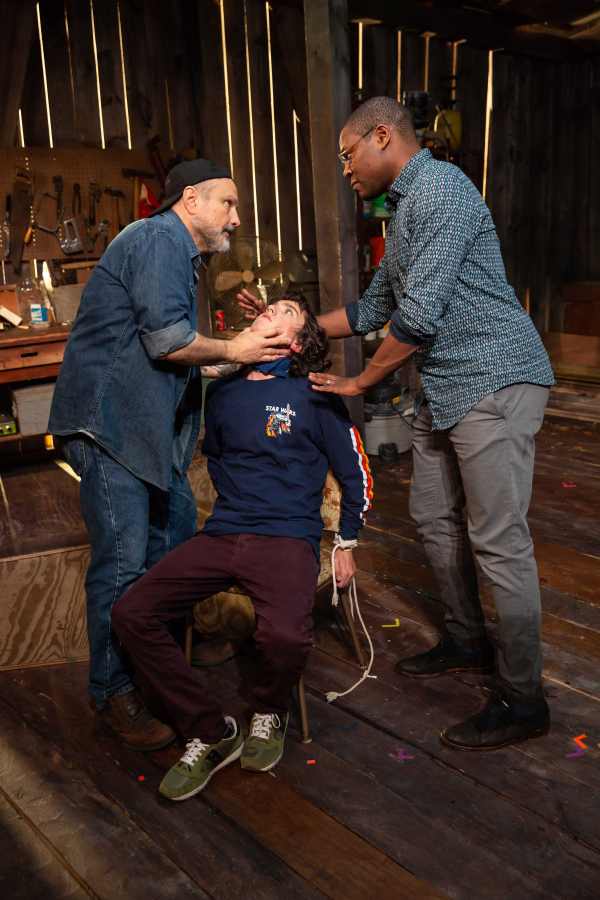
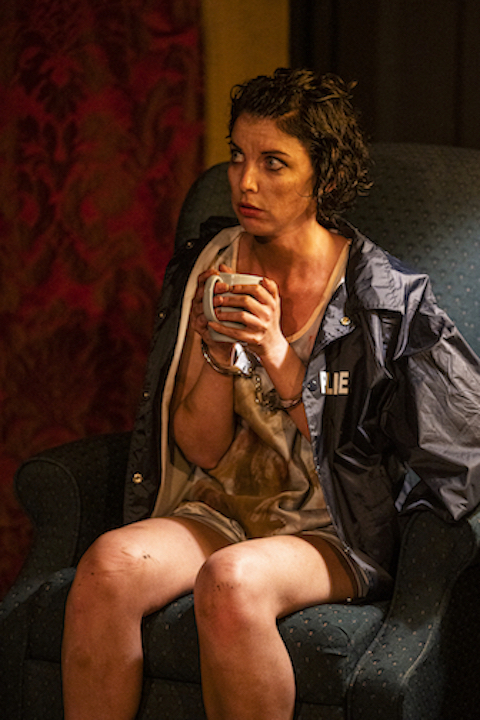
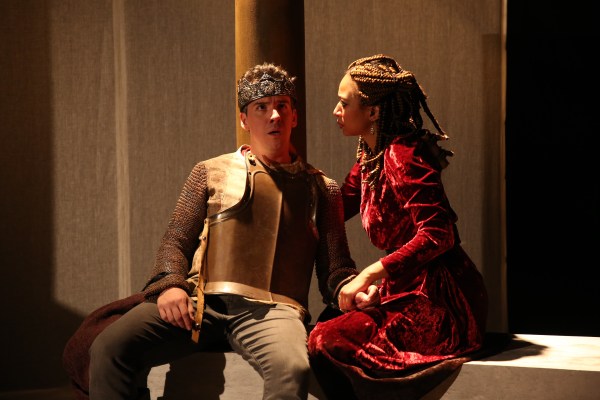
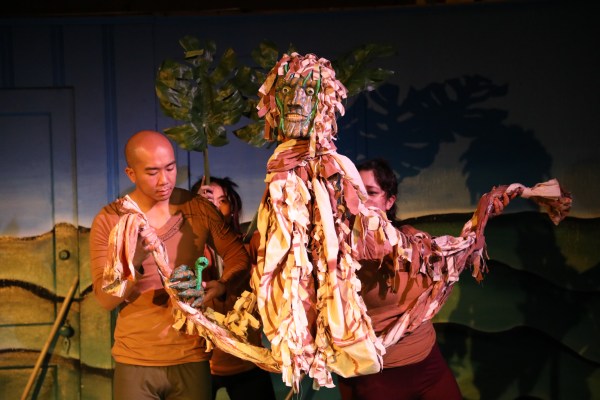
The fog-bound woods of Bolinas are the setting for the Midsummer Night’s Dream-like meanderings of the characters at the center of Fruiting Bodies. In reality, this town is as described by Asian-American playwright Sam Chanse: deliberately secluded from the rest of the Northern Bay Area by the townspeople who removed the highway signs that marked the exit. Though there is no fairy Puck, there is a sprite of sorts: A Boy who by turns is the brother/son, an abandoned 10-year-old, and a giant talking mushroom. All of them influence the actions of Ben and his daughters Mush and Vicky. Their environment functions as a fifth player. The bare trees that spin as the people are drawn deeper into the landscape are paired with soft welcoming rocks in the evocative set by Reid Thompson. Lighting design by Jeanette Oi-Suk Yew brings out a magical quality and Kate Marvin provides nature’s moody background music. Costume designer Sara Ryung Clement provides Vicky’s Instagram-ready outfit and the rest of the workhorse wardrobe.
In biology, the “fruit body” is the sexual phase in the lifecycle of fungi. At their most literal, the mushrooms on the forest floor are the fruiting bodies of Chanse’s visionary world. Each grows from a rotting tree, releasing spores into the air as it attempts to start new life. The family members are also struggling to leave a mark on the world, one quite literally. Yet each one has a passion that is met with disapproval. They were at some point connected, but that body has been rotted by disagreement and negative judgment. It’s a melancholy but recognizable sensation that Chanse evokes beautifully and poetically.
As the piece opens, the sisters are in Vicky’s treasured Tesla on their way to Bolinas to pick up their father who has gotten lost in the woods. The third generation Japanese American has gone mushroom hunting, a pastime that according to his Japanese tradition can bind family members together. But fittingly for the increasingly addled Ben, he has forgotten to bring younger daughter Vicky as promised. Instead, he has meet up with a young boy whom he mistakes for his son Eddie, the first sign that Ben’s mind isn’t what it once was. The sisters are also disconnected. The gulf that started to form years ago when their Finnish mother left has deepened now that Vicky is proudly at work on a communication app and activist/artist Mush has the lofty goal of cleansing the world of preconceived notions of beauty and power.
Fruiting Bodies is still developing, having been fostered by the creative environment of the Ma-Yi Writers’ Lab. Along the way to opening night, the work shed about 35 minutes and an intermission, leaving a still leisurely 100 minute experience. Like mushrooms in a pan, there are many concepts being tossed about. Big themes including homophobia, ethnicity, and the power of celebrity are introduced alongside more everyday family conflicts. The play is as much about mood as it is about substance. Throwing morels, buttons, and chanterelles into his paper sack, Ben quite literally goes through the day with a mixed bag and in a fog. For all his intentions to serve as model head of the household, he can’t seem to see his son and daughters clearly enough to genuinely bond with them. Some may find the ending less a conclusion and more a stopping point on a longer path. The playwright seems to have done this deliberately given that two of the most heated arguments are given simultaneously, sometimes blending, but just as often drowning each other out.

Kimiya Corwin, Emma Kikue, Jeffrey Omura and Thom Sesma; Photo by Carol Rosegg
Director Shelley Butler knows how to get the most from her nimble cast and wonderland scene. In Thom Sesma’s hands, Ben is both sympathetic and maddening, taking joy in some moments while completely oblivious to others. Kimiye Corwin and Emma Kikue don’t yet have the chemistry of the sisters, though both are highly skilled and may find the right rhythm. The role of The Boy and his many facets is the most challenging and Jeffrey Omura flits expertly among them. His shifts from teenage exasperation to slightly menacing creature of the dark are executed with ease and limberness.
Though a little thin on plotting, Fruiting Bodies make for an entrancing event. For a brief time, you’ll be pulled away from your everyday experience and into these enchanted woods. It is playing through May 19 in the Beckett Theater in Theatre Row (410 W. 42nd Street) in Manhattan Tickets range in price from $32.25 to $42.25 and can be purchased by calling Telecharge at 212-239-6200 or online at www.telecharge.com. More information is available on The Ma-Yi Theater Company website at www.ma-yitheatre.org.


All Our Children
At a time when the US government has been separating families at the border, All Our Children sends an impassioned message about the responsibility we share as a society to protect the most vulnerable among us. The play by Stephen Unwin is a work of fiction based on true events that took place in Germany between 1939 and 1941. In a lesser-known chapter from that time, the Nazis sent 100,000 mentally and physically impaired people to the gas chamber. It was felt that their deaths were efficient and even compassionate since these citizens could never properly contribute to the development of the Third Reich.
The intentionally claustrophobic piece is set entirely in the office of Victor Franz, a doctor whose clinic has been repurposed to quickly diagnose and dispatch the children under his care. Director Ethan McSweeny has staged the work in the round so that the audience encircles the doctor, witnessing the slow dismantling of the acceptance he has maintained of his role in these casual murders. The audience in turn is enveloped in a wall of file cabinets which contain the children’s medical files, a powerful image in the minimalist set by Lee Savage. Somber radio music, part of Lindsay Jones’s sound design, is used to effectively illustrate the passage of time. Simple period costumes by Tracy Christensen complete the look and tone, sending us back to that horrible period.
Karl Kenzler brings a combination of gruffness and vulnerability to his role of Dr. Franz as he ping-pongs between professional obligation and personal discomfort. But the actor cannot escape the circular emotional arc with which the character is burdened. Unwin is a seasoned director and teacher and this is his first time as playwright. The results are heartfelt but thinly executed. The other four characters are drawn in stark black or white, a weakness that often plagues stories that involve the Nazis. Furthermore, Franz’s tolerance for many of his encounters isn’t properly explained or realistically motivated.
KARL KENZLER and JOHN GLOVER, Photo by Maria Baranova
Among Franz’s foils are his pious maid, Martha, (a fluttery, sweet Jennifer Dundas) a genuinely caring woman who tries to reconnect him with his sense of responsibility to heal and give comfort to his young patients. There is also Elizabetta (a too broad and harsh Tasha Lawrence) representing all the grieving mothers who love their children no matter their limitations. Most important is Bishop von Galen (the always excellent and engaging John Glover) who attempts to appeal to Franz’s long-lost soul. Counterbalancing them all is the clinic’s administrator, Eric (an appropriately oily Sam Lilja), who is not only a member of the SS, but also guilty of statutory rape. He’d be twirling his mustache if only he had one. It is only his embodiment of pure evil that eventually breaks through Franz’s trancelike state.
Recommended for ages 13 and older, All Our Children lacks nuance, but delivers on its examination of a particularly shameful practice. It is playing through May 12th in the versatile Black Box Theater at The Sheen Center, a project of the Archdiocese of New York. Runtime is a scant 90 minutes with no intermission. Tickets are $65 and $80 for general admission and can be purchased at https://www.sheencenter.org/shows/allourchildren/2019-04-06/. For those wanting to delve deeper into the topic, post-performance talkbacks are scheduled throughout the run. The play is also accompanied by an exhibit in the Sheen Center gallery, Little Differences: The Portrayal of Children with DisABILITIES Throughout History.