
If you admire our 45th President, you will likely consider Robert Schenkkan’s Building the Wall a bunch of liberal hysteria. If on the other hand you are of the opinion that Mr. Trump’s policies have been injurious to the country, witnessing this production is like having someone poke a finger into the wound and fish around for the bullet. The event is deeply painful and one can only hope to slightly feel better when it’s over. For lovers of dramatic art, the extreme discomfort is offset somewhat by the exceptional lead performance delivered by James Badge Dale.
What often makes dystopian fiction palatable is that it takes place at a distant time or in a parallel universe. This unpleasant tale unfolds in an El Paso, Texas prison in autumn, 2019. Rick, the character portrayed by Mr. Dale, has been sentenced to death. Over the course of 90 minutes we learn the details of his crimes through the questioning of Tamara Tunie’s Gloria, an historian who has come to capture Rick’s side of the story.
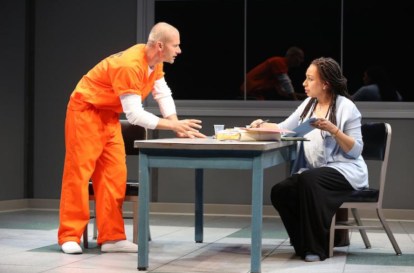 Though obviously embellished, Schenkkan’s premise is firmly rooted in current headlines. There are references to true life incidents from as recent as February of this year. Unfortunately, his dialogue — no doubt hastily written — is not realistic and often sounds like a PowerPoint lecture. There is an additional challenge in having only one of the characters with something concrete to say. The events are all in the past, with no action or dramatization of scene. We get a few flashes of insight into Gloria, but for the most part Ms. Tunie is stuck asking, “why”. Alot.
Thankfully, the focus is on Rick, who in the hands and mouth of Mr. Dale acquires depth that isn’t on the page. One only has to flip through Dale’s IMDB photos to appreciate his chameleon-like range. Confined in space and time, Rick attempts to take us on his journey from ex-military blue collar worker with a GED to a felon on death row. Each step in his descent is made to sound completely reasonable, as is often true of Trump’s fans on the 6 o’clock news. Perhaps that is part of the problem. The play doesn’t stray far enough from a fairly predictable path until the last few irony-tinged lines. As a result, it doesn’t give us much to think about except the faint hope that the worst will indeed be in the rearview in two years.
Director Ari Edelson, Founder of theatrical incubator The Orchard Projects, adds some essential physicality to Rick’s yarn spinning. Tunie is little more than a coatrack. Antje Ellermann’s set is suitable for its purpose. Passages of time are defined by Tyler Micoleau’s subtle shifts in shaded lighting though Bart Fasbender’s tedious music and sound detract from rather than build tension.
Building the Wall has already played in four cities and is scheduled to be in New York through July 9. If you wake up one morning feeling too good, you can likely score a $20 ticket and revel in Mr. Dale’s performance. We may be in a political crisis, but there are more imaginative and helpful conversations on this topic than the one offered here. Visit http://buildingthewallplay.com for details.


 An equally important character is the set by Nigel Hook. Every piece has impeccable timing. Not since Alan Ayckbourn’s Bedroom Farce have I seen furniture collapse so slowly and perfectly. (I will not give away any of its more clever secrets.) The purposeful fiasco is deftly staged by director Mark Bell. His training at Ecole Internationale de Theatre and experience teaching at LAMDA likely influence the more overt style of this buffoonery.
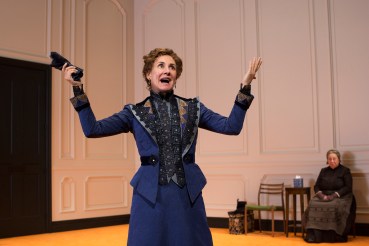 Nora Helmer’s exit from Henrik Ibsen’s A Doll’s House was the door slam heard around the world. Since 1879, scholars, sociologists, and others have speculated about her fate. Now playwright Lucas Hnath attempts to reveal what came next in A Doll’s House, Part 2, using modern language and the commanding Laurie Metcalf to deliver a post-feminist message about marriage, freedom and self-knowledge.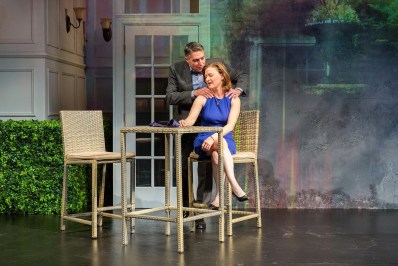
![[4]_Jenn Colella and the cast of COME FROM AWAY](https://theunforgettableline.com/wp-content/uploads/2017/03/4_jenn-colella-and-the-cast-of-come-from-away.jpeg?w=370&h=270) When the air space above New York closed on 9/11, nearly 7000 passengers were diverted to Newfoundland off the coast of eastern Canada. That airport had retained several large runways dating from a time when flights between the United States and Europe had to stop and refuel. Suddenly inhabitants of this 43,000 square foot island had to prepare to double their population for an unknown duration.
When the air space above New York closed on 9/11, nearly 7000 passengers were diverted to Newfoundland off the coast of eastern Canada. That airport had retained several large runways dating from a time when flights between the United States and Europe had to stop and refuel. Suddenly inhabitants of this 43,000 square foot island had to prepare to double their population for an unknown duration.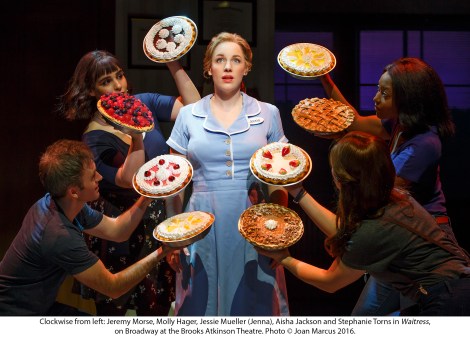 The sweet story of a sorrowful originator, the soaring melodies of Sara Bareilles, and the soulful voice of Jessie Mueller blend like butter, sugar, and flour. Together they produce a tasty joy-inducing creation that was nominated for four Tony Awards in 2016. Regular readers of this column know I am not the world’s biggest fan of modern day musicals, but I honestly can’t wait to see Waitress again. And I’m not just saying that because the entire theater smells like pie.
 The supremely talented Cate Blanchett has come to Broadway. Unlike many film celebrities who flounder on stage, Ms. Blanchett is the former co-artistic director of the Sydney Theatre Company, where she also made her theater debut nearly 25 years ago. The same incredible nuance she brings to her on-screen characters is alive and in proper proportion in her role as Anna in The Present, a modern reinterpretation of an unpublished play by Anton Chekhov. I would recommend this show simply for the opportunity to bathe in her deeply considered and exceptional work.
 The Unforgettable Line