Tag Archives: Cathy Hammer

This is Government

There is a mighty fine line between “timely” and “too close to home.”  No one at 59E59 could have predicted that Trump ally and conservative activist Charlie Kirk would be shot and killed a few days after This is Government began previews.  But the horrifying uptick in our political violence had to be on the minds of everyone watching a play about a bomb threat taking place outside a Washington D.C. Senate office building.  While Nina Kissinger has infused her dark subject with humor, it feels too gracious to meet the brittle moment.

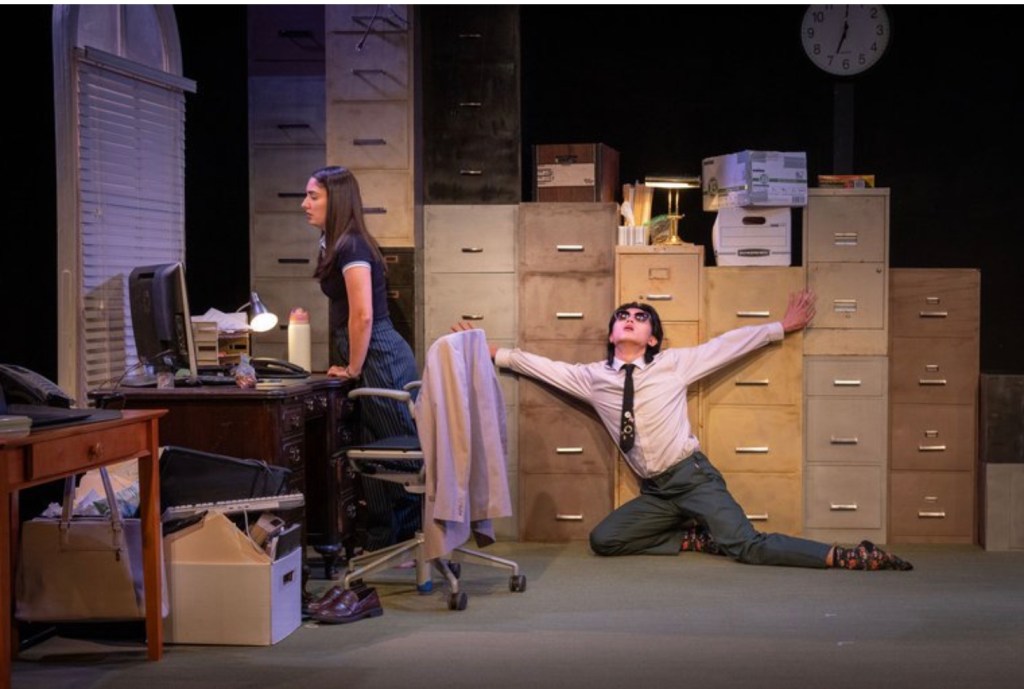
Scenic designer Daniel Allen sets the scene within an off-kilter office.  To serve the direction, file cabinets are piled across the back in a staircase formation and the third desk floats chairless mid-stage.  Within these strange walls are the interns for Senator Bachmann whose vote will determine the fate of a critical healthcare funding bill.  Rudderless and crippled by anxiety is recent college grad Emi (Kleo Mitrokostas).  One year younger, Tip (Charles Hsu) is four times more interested in influencing the world through his monologues than within the bureaucratic structure.  Their supervisor is former intern Kaz (Vann Dukes), a non-binary pragmatist with political ambitions of their own.  The three have been receiving regular calls from Stevie (Susan Lynskey), whose pleas to speak with the Senator have grown increasingly frequent and agitated.

Mitrokostas and most of the creative team are resident artists of the New Light Project which co-produced with Pendragon Theatre.  Director Sarah Norris has done what she can to mine the script for variation, but a regular rhythm sets in quickly.  Tip attempts to lead the way with dramatic flair and a touch of recklessness driven by his romantic world view.  Draped in mismatched navy business casual (Krista Grevas, Costume Design), Emi follows with apprehension and self-doubt.  At intervals, the passage of time literally ticks by (Jennie Gorn, Sound Design), the lights flicker (Hayley Garcia Parnell, Lighting Design), and someone climbs the cabinets to move the clock hands forward (Yasmyn Sumiyoshi, Movement Direction).  There surely was a more impactful way to illustrate the “real-time consequences” that should be driving the action.

Kleo Mitrokostas and Charles Hsu in This is Government; photo by Burdette Parks

Much of the opening banter is character background and a the building of a familiar framework of government by bluster.  When Kaz surrenders to Tip’s plan, the plot takes on more elements of a detective procedural.  But Kissinger hasn’t so much dropped breadcrumbs as built a pullman loaf walkway.  There is less talk of fueling political change than there is of understanding the bomber’s motives.  The serious exploration of meaningful themes is obscured by broad comedy and near absurdism.  The fates of our would-be heroes feel underdeveloped and ultimately unearned.

Nina Kissinger is a distinguished voice in new generation of playwrights. But though it has been only three years since This is Government won the Agnes Nixon Playwriting Festival at Northwestern University, the political landscape has shifted sharply and is less supportive of her message.  At the performance I attended, nearly half the audience was under 30.  In her curator’s note, Artistic Director Val Day says she hopes these Gen Zers will hear this piece as a call to action.  I sincerely hope they do, even if it’s to gather for another shared experience at live theater.

This is Government is playing in Theater B at 59e59 Theaters, 59 East 59th Street in Manhattan.  Tickets are $44 and available at https://www.59e59.org/shows/show-detail/this-is-government/.  Running time is approximately 85 minutes without intermission.  Content is recommend for those 14 and up.

The Lights Are Bright Off Broadway

The New York theater scene is most often associated with Broadway, but there is a diverse audience that actually prefers to head Off-Broadway.  (I count myself among them.)  The descriptor has nothing to do with location, but rather the number of seats — between 100-499 — making for a more intimate shared experience.  Not needing to attract as large a crowd or pay sky high production costs allows tickets to be offered at relatively budget-friendly prices. Additionally, themes are often more daring: speaking to the issues of our time with an unexpected voice.  Many works are brand new, possibly even still evolving.  However, most runs are just a few weeks long, so here are a few to keep on your radar.

The six performances spaces of Theatre Row have welcomed a number of smaller companies from Pan Asian Rep to the community minded Keen Company as well as played host to the country’s largest celebration of monologues, United Solo. Now playing through September 29 is Sober Songs. With a score comprised of a range of musical styles, this dark comedy by Michael Levin tells the story of six young adults who meet at a local AA group.  Emotions flow from carefree and charming to raw and deep, much like the recovery process itself.

Housed in the Theatre at St. Jean down a flight of stairs on an Upper East Side side street is The York Theater.  Founded by three theater professionals over fifty years ago, their focus is on new musicals and lost gems.  This fall season begins on Tuesday, September 9, with the World Premiere of This is Not a Drill.  The script was inspired by the experience of Holly Doubet in 2018 when a false alert went out to residents and visitors that there was an missile attack headed for Hawaii.  The book is by Doubet and Joseph McDonough with music and lyrics by Doubet, Kathy Babylon and John Vester. 

Also calling a church home is the Theatre at St. Clements.  Nestled in the heart of Hells Kitchen, this steep venue has launched new works by David Mamet, Terrence McNally, Sam Shepherd, and Julie Taymor among others.  Beginning September 5th, the storied tradition continues with False Steps, a ballroom comedy written by dance champion Candace H. Caplin and Kim St. Leon, with original music and lyrics by Jesse Corbin.  Starring Caplin, this farcefollows a floundering playwright whose life takes an unpredictable turn when her recently widowed mother falls for a much younger ballroom dance instructor. 

Positioned firmly on your funny bone is Asylum NYC which offers stand-up comedians, sketch and improv troupes and musical reviews.  Beginning on Wednesday, September 17, performances of Exorcist: The Rock Musical will be followed by the Slam Frank.  With a score by Andrew Fox and a book by Joel Sinensky, this satire is perfect for those who think South Park doesn’t go nearly far enough.  Inspired by a truly bonkers provocative tweet, the Afro-Latin hip-hop musical puts the story of Anne Frank through a pan-gender, feminist, multiethnic lens to create a work that has already sparked spirited conversation.  

Long before finding household fame in Law & Order, Jerry Orbach starred in the long-running Fantasticks.  Now the black box where the revival played on the third floor of  The Theater Center bears his name.  (A smaller space honoring his wife sits across from it.)  The chairs in the Orbach feel like the sectional you should have replaced last year and the A/C is cranked to an 11, but the staff is welcoming and there are no bad seats.  Recently, it’s been home to both The Office and Friends parody shows.  But more progressive works are scheduled in between the comfort food.  Starting on September 24 on Wednesdays at 2 pm, Fridays at 4 pm and Sundays at 6 pm is Kipp Koenig’s The Glitch. This timely sci-fi dramedy uses a woman’s visit to an AI simulator lab to explore life decisions, emotional connection, and the interdependence of love and forgiveness.  

These are just some of the spaces offering risk-taking, thought-provoking, conversation- stimulating theater… and that’s just September!  So consider enlivening your entertainment line-up with something brand-new and uniquely theatrical.

Sulfur Bottom

Recently I took a tour of the history of New York City’s electrical system.  Most of the infrastructure had been placed in marginalized neighborhoods.  That this is not new news made it no less distressing to witness.  These projects are essential for supporting modern day conveniences, but it’s always at the expense of those with less money and power to push them into someone else’s backyard.  

That lack of equity is at the heart of Rishi Varma’s Sulfur Bottom.  But this is not an “issues play.”  Instead, by blending naturism with otherworldliness, playwright Varma has crafted a bewitching modern day folktale.  It may be as ugly and bloodstained as the rug featured in the central family home, but it’s centered.  Resonant themes of familial connections, hard-won second chances, and the importance of home are woven in.  This distinctive approach draws in an audience that might not listen otherwise.  To make an even more meaningful point, the production has partner with WE ACT for Environmental Justice (https://weact.org/) for their Off Broadway run.

Director Megumi Nakamura has done an incredible job of pile driving down to the bedrock of emotions underlying the sophisticated, fantastical plot.  And we are surrounded by sound and sight cues that keep us “in it” with the characters. Each revelation comes with a musical theme (composer Jacob Brandt).  The location of the house in question is on land so polluted the house literally groans in pain (sound design by Sid Diamond).  Even the flowered wallpaper and aforementioned rug are slowly poisoned (set design by Daniel Prosky).  The overhead lights saturate the space in appropriate jaundice-yellow tones (lighting design Sam Weiser).  While there is no olfactory component, it’s easy to conjure up the corresponding odor of decay.

Of course it is the cast that lures us in.  There is tension between Sir Cavin (Kevin Richard Best) and his teenage daughter Fran (Kendyl Grace Davis).  She has killed [another?] deer which is now lying on a cutting block near their much-disliked rug.  It’s clear their conversation about the circle of life has been playing on repeat.  Sir Cavin’s belief in this interconnection has been his North Star.  But Fran finds the animals that surround them both noisy and dangerous.

Joyah Dominique, Feyisola Soetan (foreground) and Kevin Richard Best in Sulfur Bottom;
photo by Austin Pogrob


Also in the home is Sir Cavin sister Melissa (Joyah Dominique).  Though she once hoped to move to San Francisco to be a performer, she has resigned herself to keeping a watchful eye on her niece.  As the piece drifts back and forth through time over the course of 40 years— sometimes spanning two decades simultaneously — we meet Fran’s husband Winter (Eric Easter) and daughter Maeve (Feyisola Soetan) as well as Sir Cavin’s friend Copal (Aaron Dorelien) whose ambition perverts the course of their lives.

Performances of Sulfur Bottom are Wednesdays at 7:30 and Saturdays at 1:00 at The Jerry Orbach Theater, 210 West 50th Street, 3rd Floor.  Tickets are available through October 11 at https://www.sulfurbottom.com/.  The shallow venue is ¾ round with well loved seats and over-achieving air conditioning.  A colorful beverage from the bar might add to your feeling of joining the characters in their living room.  

If the ancients had spun a tradition myth about the spirits of environmental justice, it would share DNA with Sulfur Bottom.   It is a cautionary tale, but told with warmth, love, and a touch of humor.  We all want a better life for our children.  But some have a whale of a chance of making it happen.

Road Kills

In art as in life, there is captivating drama to be mined when mismatched strangers are thrown together by circumstance.  So it is in Sophie McIntosh’s Road Kills currently in an Off-Off-Broadway run after a well-received series of readings.  Owen (D.B. Milliken) runs a small company responsible for collecting the carcasses of animals who have been hit by drivers too distracted to notice or care about the deer crossing sign.  He picks up extra money by taking on assistants who are working off their community service hours.  The current pair of hands belongs to Jaki (Mia Sinclair Jenness) who was arrested for drunk driving.  There is a spilling of guts along with the gut spills.  Together each Saturday on relatively deserted stretches of highway in Wisconsin there is little to do but pry open each other’s long-closed emotional doors. 

Mia Sinclair Jenness and D.B. Milliken in Road Kills; Photo by Nina Goodheart

Though some of the details are telegraphed, for the most part McIntosh’s biting script keeps us unbalanced.  With a title like Road Kills, it is unsurprising that the content has a high “ick” factor.  Warnings can be found on the production website in two flavors: “broad strokes” and “gory details”.  In the current space, everything is up close and deeply personal, but there is some sweetness mixed in with the ewwww.  

Since I prefer my readers to have the experience of allowing a play to unfold, I will only say that Owen’s and Jaki’s peculiar relationships to animals goes beyond their handling of mangled body parts.  Though their experiences as social outliers are dramatically different, the result is a similar inability to connect with humans in a traditionally healthy way.  Their expression of sexuality would likely be found in the DSM-5.  Protective reflexes are particularly askew in Jaki’s dealings with Neil and Miles, both portrayed by Michael Lepore.  (That the two characters look similar is a serendipitous plot enhancement.)

As staged by director Nina Goodheart in the three-row venue, the meticulous attention to detail heightens the intimacy of the performance.  We are seated at set designer Junran “Charlotte” Shi’s double yellow line where a dead fawn lies surrounded by dark red spots that are revealed to be frozen blood.  Passed-its-peak shrubbery lines the upstage side of the road.  Unlike most crews, stage manager Damayanti Wallace and team work silently in total darkness to set each scene.  From the black, the prerecorded voice-over cast of 11 depict the events that lead up to an accident, with each incident being an escalation of the previous one.  Lighting designer Paige Seber and sound designer Max Van add realistic sensory input.  Sean Frank’s props range from tragic to amusing.  While some audience members laughed though the disconcertion, it was the craftsmanship and care that I found comforting.  

Produced by McIntosh and Goodheart’s Good Apples Collective alongside ryan duncan-ayala, the twisted ride of Road Kills continues through September 6.  Runtime is approximately 85 minutes with no intermission.  Performances take place on the second floor of the Paradise Factory, 64 East 4th Street in New York.  Masks are strongly recommended and provided at the check-in desk.  The A/C is an overachiever and a sweater will come in handy.  Tickets begin at $18 and are available at https://www.goodapplescollective.com/road-kills.  

5th Annual Little Shakespeare Festival

Looking for an escape from the heat? the smoke? the world?  I can recommend a bite-sized treat: the 5th Annual Little Shakespeare Festival.  Each year playwrights take stories and themes from The Bard and spin them in a humorous/soul searching/topical direction.  This year’s selection of ten productions was curated by Conor Mullen based on the prompt “Not Your English Teacher’s Shakespeare.”  They include three Hamlet-inspired pieces.  A farcical Hamlet: La Telenovela is adapted by Federico Mallet, translated by Jose Ruano, and presented by Something From Abroad.  Events retold from the prospective of the theatre troupe unfold in The Mousetrap, or Prince Hamlet wrote a dumb play and now we have to do it written by Margaret Rose Caterisano and presented by Broomstick.  And comedian Rachel Resnik begs you not to laugh at her solo performance Hamlet’s Dad: Otherwise Known As The Daddy Issue’s Cycle presented by Serious Play.

The venue at UNDER St. Marks is not fully accessible, so the good folks at FRIGID New York have live streams available for purchase. This is how I was able to giggle from my couch at As You Wish It or The Bride Princess or What You Will.  The feed is supplied by two cameras, one in the back row and one audience right and closer to the stage. The audio is good quality and you can even hear the etherial music that plays as the audience loads in. The hilarious introduction by the house manager is not to be missed. It’s such a small theater that it’s a similar experience to arriving just before curtain and grabbing whatever seat you find.

As You Wish It etc. is billed as a parody, but it struck me as more of a love letter.  Presented by Fork the Odds Productions, the beloved William Goldman book/movie has been transposed into Shakespearean English by Michael Hagins.  Dialogue from Hamlet, MacBeth, Romeo and Juliet, Taming of the Shrew, and Richard III is comfortably intertwined with all the favorite lines and plot points from Rob Reiner’s classic.  It was wonderful to see that over 30 years later the over-the-top tale of true love still has such loyal fans.  With every long introduction by the revenge-seeking Count and “inconceivable” the audience roared with appreciation.  If it’s been a while since you saw the original, a quick review of the dense character-filled storyline will aid your full enjoyment. 

Rather than covering up the obvious shortcomings of enacting an action film on a tiny stage, the company leans into the insanity of even trying.  A roll down the hill becomes a balletic twilling through curtains, a knock out punch is prefaced by grabbing a small wrestling mat, and a chase on horseback is mimicked with Python style coconut shells.  The sword fights are brilliantly choreographed in slow motion.  The actors physical humor is enhanced by inexpensive, well designed props.  Synchronized sound effects heighten the laughs. Tickets are still available for the August 8 and 9 performances.

As You Wish It is among the offerings at the 2025 Little Shakespeare Festival; Photo by Michele Santomoreno

There is a timelessness to Shakespeare’s themes and relationships that opens his works to seemingly endless variation.  The Little Shakespeare Festival puts a spotlight on particularly clever revisions all presented by independent companies.  The fun continues through August 17.  All live performances take place at UNDER St. Marks (94 St Marks Place) and tickets are $25.  Streaming tickets are $20 for a live feed (so no late seating even at home.) To view the full schedule and to purchase advanced tickets visit www.frigid.nyc.

Polishing Shakespeare

When you hear the premise of Polishing Shakespeare — Dot-com billionaire, Grant, is bestowing generous grants to a team of eager writers prepared to translate the entire works of The Bard into *English*— it is easy to picture the original ten minute skit.   What is impressive is the full length skewering of the dangerous shifting landscape of the arts that the script has become.  Given the events of the last six month, it’s almost as if playwright Brian Dykstra is writing in real time.  And he’s doing so in iambic pentameter!  (In fact, the actors’ improv skills are all so sharp that actually did happen during the performance I attended.)

The clawing back of money for the arts from the current administration forms a solemn backdrop for this timely comedy.  Though it makes its point numerous times, the exaggerated set-up is moved forward by three characters, each with a strong motive.  Grant (silver-tongued playwright Dykstra) doesn’t want to have to think when he attends a live performance.  He sees his project as a way to make Shakespeare entertaining for the masses, ignoring, of course, that Shakespeare has been just that for hundreds of years.  Ms. Branch (a beautifully tightly wound Kate Levy), the company’s director is just trying to be financially responsible now that she is almost completely reliant on her board for funds.  And though she genuinely loves and appreciates the Folio, Jane (a brilliantly bold Kate Siahaan-Rigg) sees a way to use her acute observational skills and talent with a pen to get out of crushing debt.  Alliances shift as each seeks an opportunity to move closer to their goal with the help of one at the expense of the other. It becomes such a battle of wits, you can almost see the gleaming sabers.  

Brian Dykstra and Kate Siahaan-Rigg in Polishing Shakespeare; photo by Carol Rosegg

What makes the piece sparkle is the spirited speed with which the lines are delivered.  Only someone completely comfortable with Shakespeare could set the necessary tempo with wink-and-nod style.  There is an ease to Dykstra, who has not only performed roles in numerous productions of the real thing (King John, Much Ado About Nothing, Twelfth Night, and MacBeth among others) but also participated in Season 6 of Mos Def’s well respected spoken word poetry program on HBO.  He plays with the audience like a cat with an amused mouse.  Siahaan-Rigg is a marvel, rattling off several sublime soliloquies that celebrate all those who have been exploited and marginalized by the mass market.  Levy navigates the intricate pathway between the stuffiness of her character and the humor in her lines.

Director Margarett Perry’ s assured hand highlights the flows of power.  Supporting the rapid fire exchanges is the strategic lighting by Tyler M. Perry who also designed the hilarious Shakespeare tchotchke-ladened set.  

Eliciting both belly laughs and tummy knots, Polishing Shakespeare has been extended through August 24.  Performances run approximately 90 minutes with no intermission.  The show is presented in Theater B at 59e59.  $44 full price tickets ($30 for Members) can be purchased at https://www.59e59.org/shows/show-detail/polishing-shakespeare/

Joy: A new True Musical

Tired of not being able to answer the simple query, “how are you?” without sighing? Ken Davenport and AnnMarie Milazzo may have an answer.  Their creation Joy: A New True Musical is a type of musical optimism that has audience members returning from intermission wearing the freshly-purchased official T-shirt.  Its message of resolve and imagination envelops people in a purple and yellow cloud that even has them warmly hugging the mops they’ve been handed by the ensemble.

You may be familiar with Joy Mangano from her book “Inventing Joy: Dare to Build a Brave & Creative Life,” from seeing the 2015 movie simply entitled “Joy,” or maybe even from buying her products through the QVC home shopping network.  She was a young mother with a house full of people depending on her when she was suddenly laid off from a steady if uninspiring job.  In other words, she had much in common with women around the country who are behind in their mortgage and anxious to fully provide for their families.  Using a combination of vivid imagination, determination, and a few lucky breaks, she turned her life around.  

The musical retelling of her tale stars the dynamic Betsy Wolfe, who gained a wide range of fans with her Broadway turns in Waitress and & Juliet.  She’s surrounded by an accomplished cast including Adam Grupper as her well intentioned father Rudy, Jill Abramovitz as her overly cautious mother Toots, and Honor Blue Savage as the daughter Christie who only wants Mom to be able to come to her games.  Along her road to success she has dealings with Paul Whitty’s underhanded Cowboy Eddie, and Charl Brown’s experienced network exec Dan, both of whom are given showy performance numbers.  

Betsy Wolfe (with ensemble members) in Joy: A New True Musical; Photo by Joan Marcus

It is easy to see why Wolfe is so popular that she gets a round of applause before she opens her mouth. Her very presence fills the house and she sings with much appreciated clarity and emotion.  Milazzo’s score isn’t the most varied and the refrains bleed into one another, but it is tuneful, carried along by Andy Einhorn’s arrangements.  The opening “Welcome to My World” does some heavy lifting, rapidly introducing us to a number of important characters and plot points.  The book by Davenport is considerably more assured than Hollywood’s interpretation of Mangano’s biography.  Filled with broad humor that makes a point, the plot gets bogged down in the second Act in part because it’s hard to top the momentum of Act I.  

Director Lorin Latarro uses her actors and limited space well, giving us glimpses of Bigger Show potential.  Likewise the choreography of Joshua Bergasse is muffled by shoulder shrugs and knee bends when it could eventually soar. The creative team has also delivered with vision but to scale.  Scenic designer Anna Louizos takes a lesson from the TV studios that brought Joy fame, filling a generic cityscape proscenium with small rolling set pieces.  Also taking a cue from television is David Bengali whose projections are critical to the storytelling.  Clever props including the co-staring Miracle Mop are designed by Andrew Diaz. Tina McCartney lets a few key outfits shine, and keeps the rest timely and simple. Liz Printz’s wigs and hair design age the lively Abramovitz and allow the ensemble to cover myriad roles.  Shout out to House Manager Dovber Dier and the incredible organization of the venue staff.

Who doesn’t welcome an upbeat story of success under trying circumstances?  Sure to be a crowd pleaser, the show is exactly what you’d expect from something called Joy: A New True Musical.  Performances are at the Laura Pels Theatre at the Harold and Miriam Steinberg Center for Theatre, 111 West 46th Street near 6th Avenue.  Running time is 2 hours including a 15 minute intermission.  The limited engagement is currently scheduled to end on August 17.  For more information and tickets starting at $72, visit https://joythemusical.com/.

OPEN

After a lengthy pause, Crystal Skillman’s award-winning play, OPEN, has been given a three-week Off-Broadway run at WP Theater.   Celebrating its 47th Season, WP Theater is the oldest and largest theatrical company in the country dedicated to fostering, producing and promoting the work of Women+ at every stage of their artistic development.  With LGBTQ rights under heightened threat, bringing OPEN’s heartfelt love story back to the stage could not be better timed.  Whatever impression the script left in 2019 has only been amplified by rising violence including a shooting near the fabled Stonewall Inn at the end of Pride Month.  

From a darkened space lined with lighting and sound equipment, Kristen invites the audience to join her for a three stage magic act consisting of Love, Commitment, and Sacrifice plus an extra promise.  To execute her wizardry, she has dressed in flashy top hat and tails (costume design by Madeline Wall) and taken on the persona of The Magician, a character inspired by “Night by Night” one of her own YA short stories. In it, a boy discovers that his make-believe skill as a conjurer has imbued him with real abilities.  In the lengthier version of her tale, he also falls in love with another boy.  Kristen hopes that she will experience a similar transformation in her powers as she struggles to reach out to her girlfriend, Jenny.

Over the course of 75 minutes, Kristen shares chapters from her and Jenny’s relationship.  She acknowledges that she has been deeply affected by a repressive upbringing in Indiana and lives cautiously: doubting her abilities and never “flaunting” being a lesbian.  Jenny, however, is out and singing with joy, surrounded by loving and accepting family and working with LGBT youth.  Not only is their meeting magical, but their life together requires all sorts of tricks from the juggling act of their needs to levitating above societal forces.  The very word OPEN performs a number of functions as in living openly gay, being open hearted, speaking openly and honestly, and opening the door to opportunity. 

Unlike most playwrights with a single character, Skillman does not give voice to her own words.  Instead the piece is brought to life by Megan Hill, who previously played The Magician at The Tank.  She is not the type of monologist who uses different vocal registers, but rather distinguishes her characters with tone and body language.  The most important ingredient in her success is engaging the imagination of audience members which she coaxes and nurtures.  The colorful details throughout the script make it easy to see with your inner eye and indeed “conjure” episodes from Kristen and Jenny’s life together.  At points, attendees function as magician’s assistants, filling out the invisible visuals with their willing participation.  

Megan Hill as The Magician in OPEN; photo by Jeremy Varner

The genuine slight of hand is performed by the creative team with impressively timed sound by Emma Wilk and lighting by Sarah Johnston (who also designed the set).  Director Jessi D. Hill and Magic Consultant Rachel Wax along with Wilk, and Johnston have collaborated beautifully on executing the physicality and visualization of the incantations without a ball, ring or flower in sight.  

Inventive, touching, and impactful, OPEN is a unique solo entertainment.  Performances continue at WP Theater, 2162 Broadway in New York, through July 27.  Tickets are $65 and available at https://wptheater.org/wp-space-program/open/. Pre-show acts and post-show talkbacks will incorporate the talents of the magicians who helped inspire Skillman’s story and the actors who portrayed The Magician in Broadway Licensing productions, drawing a through-line to the powerful role of magic within the LGBTQIA+ community.

Camera Ready

Throughout the 1980s, videographer Nelson Sullivan used his developing camera skills and sincere love of the downtown New York art scene to capture and preserve many of the distinctive talents of that special time and place.  In partnership with his childhood friend James “Dick” Richards, host of a long-running access channel LGBT variety show, he put RuPaul on a path to stardom.  As he experimented with newer equipment and continued to evolve his technique, he sometimes included himself in the frame.  When he died at 41 of an apparent heart attack, he left behind a body of work credited with forming the template for the type of short form personal videos that proliferate YouTube.  

Now a behind the scenes look at Sullivan’s life and work has been fashioned into Camera Ready, a new play with music written and directed by his friend, artist/playwright/filmmaker Gary LeGault.  The sprawling cast of twenty much resembles the streets outside with its array of ages, races, and body types.  The ensemble brings unadulterated enthusiasm to each scene such as “Friday Evening in New York,” a celebration of Nelson’s first night out on the town with his camera.  There is a genuine sweetness to Jack Warren Lewis’s uplifting interpretation of the documentarian.  Other standouts include Bryce Payne’s dazzling RuPaul, JC Augustin gravely voiced Jackie Curtis, and a versatile Alexa Echevarria as Sullivan’s mother, musician Rhonda Granger, and a truly horrible Mona Robson in rehearsal at La Mama.  Her performance in the upbeat “All the Money” is a hoot.

Jack Warren Lewis as Nelson Sullivan with the cast of Camera Ready

Though working on an obviously tight budget, creative thought has gone into the design. The majority of the songbook (arrangements by Chris Glik and Michael O’Dell) has a breezy, clubby style that comes through on the solo piano. The backdrop, drawn by LeGault, is reminiscent of Edward Hopper had the artist worked in crayon.  Lola Saenz, under the direction of set designer Lytza Colon, installed bricks which adorn the central staircase. Night scene costumes and wigs by Diana Chaiken have the perfect dramatic flair.  

Oddly, it is LeGault’s obvious affection for Sullivan that flattens the story.  He has recorded history with heart, which makes for a valid but blurry lens. There is too much emphasis on tiny interactions and it is doubtful anyone under the age of 60 would recognize the celebrities about whom Sullivan exclaims.  A key relationship with housemate Choux (Dave Onofre) is underdeveloped and the parade of houseguests doesn’t achieve substantial impact. The current script also skirts the remarkable implications of Sullivan’s legacy. Ultimately the piece gets bogged down in less significant details and crosses the finish line at a hefty 2 ½ hours. 

With the show having completed its off-off-Broadway run on July 6 at Theater for the New City, LeGault has an opportunity to expand his private portrait into a deeper, more meaningful tribute to Nelson’s work.  This would also further highlight the gifts of Drag Queens and trans performers featured in Sullivan’s videos.  A rethinking would likely require LeGault to collaborate with an editor who could provide enough distance to make the appropriate refinements.  However, a more examined celebration would elevate not just Nelson’s legacy but the contributors to the American art scene he so valued.  

Trophy Boys

It all comes down to gray areas according to Jared, the second debater on the undefeated team at the center of Emmanuelle Mattana’s Trophy Boys.  The same could be said of the entire play, now in its American debut at MCC Theater. The most immediate and obvious dichotomy is that each of the four boys on stage is portrayed by an actor who is non-cis male.  In truth, almost every aspect of the piece is non-conforming.  It is a comedy permeated by devastation and a tragedy that contains plenty of laughs.

At opening, four seniors from an elite New York high school are preparing for the debate of their scholastic lives. Win, and they are all one giant step closer to achieving the lofty professional goals they’ve set for themselves.  Lose, and all of their ambitious plans could be sidelined.  In their favor is the well-honed collaborative technique they’ve developed over the year.  Though they’ve just learned that they are to argue in the affirmative that feminism has failed women — against the team from an all-girls school no less — their brainstorming is exuberant.  But when a catastrophic piece of information is introduced into their planning session, it throws everyone off balance.

Mattana has drawn from their own experience as a debater, a skill which often required them to argue for cases they didn’t believe.  “It was no wonder,” they reflect in the program, “ that this ethos seeped so dangerously into other parts of these boys’ lives.”  She has also given herself the juicy role of Owen, the socially awkward debate team closer who to his very roots believes he is the smartest person in the room.  

The other three teammates have their own reasons for seeing themselves as superior to the rest.  In the first spot is the bi-curious physically dominant Scott, portrayed by the always magnetic Esco Jouléy.  Backing him up is the creative lover-of-women Jared, an all-too-recognizable Louisa Jacobson.  In forth place is Terry Hu’s David, the strict administrator.   As an acting ensemble, they smoothly cede the spotlight to the next player even when their characters do not.  

Emmanuelle Mattana, Louisa Jacobson, Esco Jouléy, and Terry Hu; Photo by Valerie Terranova

Director Danya Taymor has great familiarity with young males, having recently won the Tony Award for The Outsiders.  She has injected that extreme physicality into her cast. The music pumps as the audience enters, preparing them for the energetic onslaught.  At points the cast members literally bounce off the furniture, depicting what their nervous systems are experiencing.  Vigorous dance moves include humping their notebooks to show their dominance over the material.  Passions hot and cold run deep and lines are delivered at a barely digestible rate of speed.  One can only imagine the sensitivity with which the more emotional exchanges were developed with a sensitivity specialist (Ann James) and DEI consultant (Nicole Johnson) working alongside Taymor to mold the scenes. 

There is a through-line from the contradictions of ideas that runs across all the creative elements.  It is far into the term, but Matt Saunders’ desks, chairs and whiteboard remain immaculate.  Images of important women through history adorn the walls but appear cartoonish.  The students are 17 years old and Márion Talán de la Rosa has dressed them in short pants usually reserved for under-classmates.  Cha See’s lighting is natural and then morphs to profoundly exaggerated.  

Ultimately, Trophy Boys is a sincere and thoughtful exploration of the non-binary nature of the world.  No person represented is just one thing and neither is any aspect of the content.  Most noticeable of all is our feelings which are completely adrift by the end of an increasingly taut 70 minutes.  We are left in that all-important gray area.  Performances continue through July 27 at MCC Theater, 511 West 52nd Street.  Dynamically priced tickets start at $74 and are available at https://mcctheater.org/tix/trophy-boys/.