
Jennifer Jasper’s Pressing Matters is like an artist’s sketchbook. Each of the six plays has strokes of brilliance, but none is fleshed out. Bound solely by the loose thread of “imponderables of love,” the event comes together as a frustrating and slightly sad illustration of what could be. There are compelling moments, but they are never sustained for long. The overall experience is more like a script being workshopped than a professional production. In fact, a post-performance feedback survey would not have felt out of place.

Molly Carden and Jenn Harris; © Russ Rowland
Each of Ms. Jasper’s short works is fashioned around a contrivance. In every segment, it takes several minutes to work out the central puzzle and then view the content through the correct lens. The most developed of the six pieces is Free Range, a humorous and thought-provoking courtroom monologue set in the near future. Jenn Harris fully commits to the role of Judy, a woman so riddled by anxiety that she takes squirming in a chair to new levels. 2014 Samual French Festival winner et●y●mol●o●gy holds together fairly well, with equal parts sweetness and shtick. In the case of Inheritance —a glimpse into the sociopolitical views of three generations of a family — by the time I worked out the scheme it was over. The other three — Oscar Clyde Denman, Thanksgiving in July, and Destination Unknown — kept going long after the point was made. I enjoy intellectual play, but by the end of Act One I was exhausted from all the mental gymnastics.
In addition to Ms. Harris, the cast includes Ito Ashayere, Molly Carden, Saum Eskandani, and Genesis Oliver. Each is given at least one meaty role. I found myself wondering how many of the artists were personal friends with Jasper or her crew. They are all obviously capable of giving superior performances given the opportunity.
More successful is the work behind the scenes. In fact, it is hard to fathom how this production would succeed at all without Amy Altadonna’s sense-of-place sound design or Grant Yeager’s targeted lighting. Parris Bradley has done an admirable job delivering appropriate set pieces on a clearly limited budget. Bringing it all together, director Adrienne Campbell-Holt makes the best of a small stage and gives her ensemble plenty of clever business to keep the energy up during scene changes.
I’m all for supporting emerging artists and giving new voices the opportunity to be heard. Theatre Row is to be applauded for granting the use of the hall to Ms. Jasper and her team. But unless you are inclined to be a very small patron of the arts, this is not a $49 experience. Instead I suggest that lovers of “quirky and fresh” check out the various discounted ticket offers available online. You’ll get a few laughs and the joy of live theater for less than the cost of a bargain matinee movie. And you won’t be quite as bothered by Pressing Matters’ many mood swings. The limited run ends on May 20, 2017. For information visit http://www.theatrerow.org/clurmannowplaying.
 An equally important character is the set by Nigel Hook. Every piece has impeccable timing. Not since Alan Ayckbourn’s Bedroom Farce have I seen furniture collapse so slowly and perfectly. (I will not give away any of its more clever secrets.) The purposeful fiasco is deftly staged by director Mark Bell. His training at Ecole Internationale de Theatre and experience teaching at LAMDA likely influence the more overt style of this buffoonery.
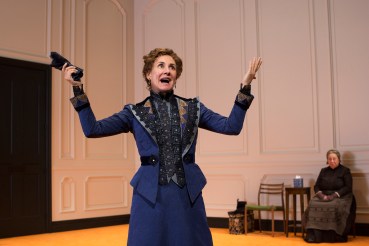 Nora Helmer’s exit from Henrik Ibsen’s A Doll’s House was the door slam heard around the world. Since 1879, scholars, sociologists, and others have speculated about her fate. Now playwright Lucas Hnath attempts to reveal what came next in A Doll’s House, Part 2, using modern language and the commanding Laurie Metcalf to deliver a post-feminist message about marriage, freedom and self-knowledge.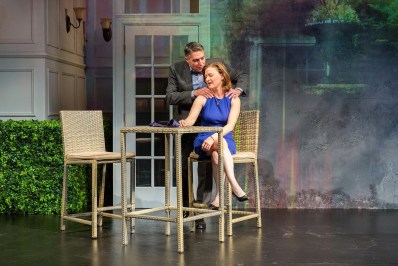
![[4]_Jenn Colella and the cast of COME FROM AWAY](https://theunforgettableline.com/wp-content/uploads/2017/03/4_jenn-colella-and-the-cast-of-come-from-away.jpeg?w=370&h=270) When the air space above New York closed on 9/11, nearly 7000 passengers were diverted to Newfoundland off the coast of eastern Canada. That airport had retained several large runways dating from a time when flights between the United States and Europe had to stop and refuel. Suddenly inhabitants of this 43,000 square foot island had to prepare to double their population for an unknown duration.
When the air space above New York closed on 9/11, nearly 7000 passengers were diverted to Newfoundland off the coast of eastern Canada. That airport had retained several large runways dating from a time when flights between the United States and Europe had to stop and refuel. Suddenly inhabitants of this 43,000 square foot island had to prepare to double their population for an unknown duration.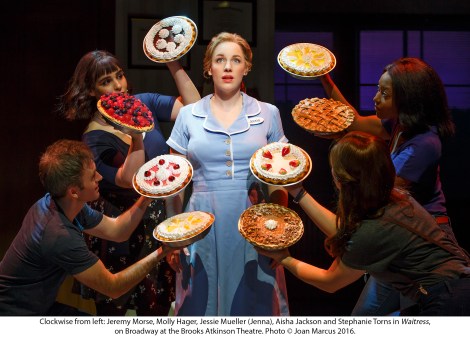 The sweet story of a sorrowful originator, the soaring melodies of Sara Bareilles, and the soulful voice of Jessie Mueller blend like butter, sugar, and flour. Together they produce a tasty joy-inducing creation that was nominated for four Tony Awards in 2016. Regular readers of this column know I am not the world’s biggest fan of modern day musicals, but I honestly can’t wait to see Waitress again. And I’m not just saying that because the entire theater smells like pie.
 The supremely talented Cate Blanchett has come to Broadway. Unlike many film celebrities who flounder on stage, Ms. Blanchett is the former co-artistic director of the Sydney Theatre Company, where she also made her theater debut nearly 25 years ago. The same incredible nuance she brings to her on-screen characters is alive and in proper proportion in her role as Anna in The Present, a modern reinterpretation of an unpublished play by Anton Chekhov. I would recommend this show simply for the opportunity to bathe in her deeply considered and exceptional work.
 In Transit is a delightful bon-bon box of a musical. A loose structure of interconnected stories holds together 11 appealing New Yorkers and 16 catchy production numbers. A prerecorded introduction by the producers reminds us that all the sounds we hear are created by human voice. The pieces are performed a cappella and the “orchestra” is a beatboxing whiz appropriately named Boxman.

