Tag Archives: Cathy Hammer

Lunar Eclipse

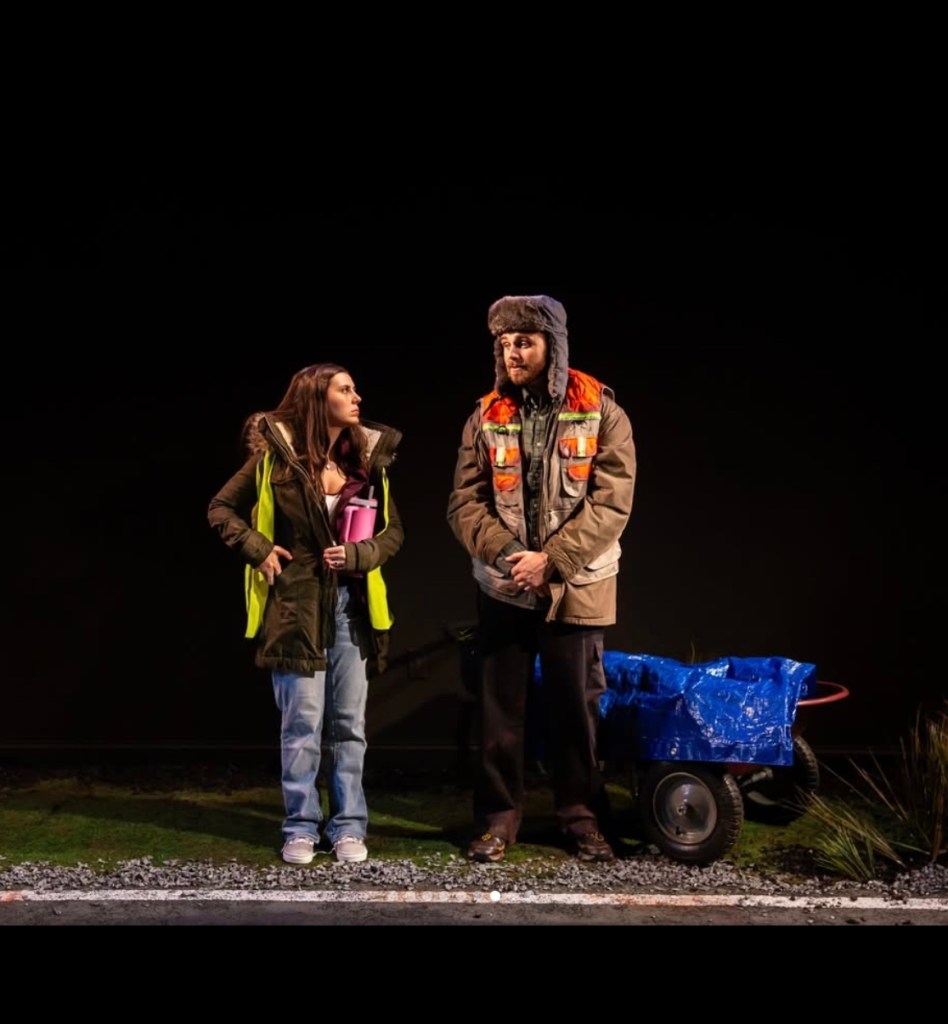
When the earth, moon, and sun are in alignment, the moon moves into earth’s shadow blocking light from reaching the moon’s surface.  This lunar eclipse is the featured event of Donald Margulies play of that name.  It also serves as a somewhat strained symbol for the darkness that has engulfed the long marriage of 70-something George and Em.

The piece opens with George alone on stage crying in the vastness of night in a field on his Kentucky farm.  Soon Em arrives with a gigantic bag filled with items that might make him more comfortable, though he doesn’t show much interest in her offerings.  They talk as they wait for the moon to take on its eery red glow.  The phases of the astronomical phenomenon — umbra, penumbra, total — are projected behind them, inserting breaks in flow of their conversation.  It soon becomes clear that much as the moon’s shine is being swallowed up, so have they been swallowing their fears and sadness.

George is intellectual with a particular interest in the stars and a strong need to stop and appreciate his surroundings.  Em is more an instinctual “city girl” and her relative ignorance allows George to explain events to us as well.  As time elapses and the bourbon flows, their increasing levels of honesty and respect break chinks in the wall between them.  Despite all the disappointments they’ve had to face, they are reminded why they chose each other in the first place.

Lisa Emery and Reed Birney in Lunar Eclipse; Photo by Joan Marcus

Marital every day moments and eventual strain is not new territory for playwright Margulies, who previously won the Pulitzer Prize for Drama in 2000 for Dinner with Friends.  Much of the terrain here is as well-ploughed as George’s family farm.  But director Kate Whoriskey has been blessed with her cast.  Lisa Emery and Reed Birney — reprising his role from Shakespeare & Company’s 2023 production in Lenox, Massachusetts — remain two of the most reliable stage performers and watching their exchange is enthralling.  The dialogue may not be radical, but much is communicated in a touch, a look, or a pause. Their poetic descriptions of worry, loss, and grief ring true, though the fog doesn’t just roll across the skies.  

Scenic designer Walt Spangler has created a thick black box around the proscenium, restricting the space and cushioning the actors’ movements with earth (though what that does to the audience view from the first few rows is unwelcome.)  Just a few wild flowers add color to the landscape.  The tinkling of a piano lulls the audience upon entry to the theater.  Occasionally the soft sounds of the surrounding nature join Sinan Refik Zafar’s soundscape.  Lighting by Amith Chandrashaker provides metaphoric bright and shadow building to the crescendo of S. Katy Tucker’s video.

Unsurprisingly, though seeped in tragedy, Lunar Eclipse with its slow reveals and well-earned sorrow, is a master class in acting.  Performances take place on The Irene Diamond Stage in the Pershing Square Signature Center, 480 West 42nd Street. Runtime is approximately 90 minutes without an intermission.  Tickets are available through June 22 at https://2st.com/shows/lunareclipse

The United States vs Ulysses

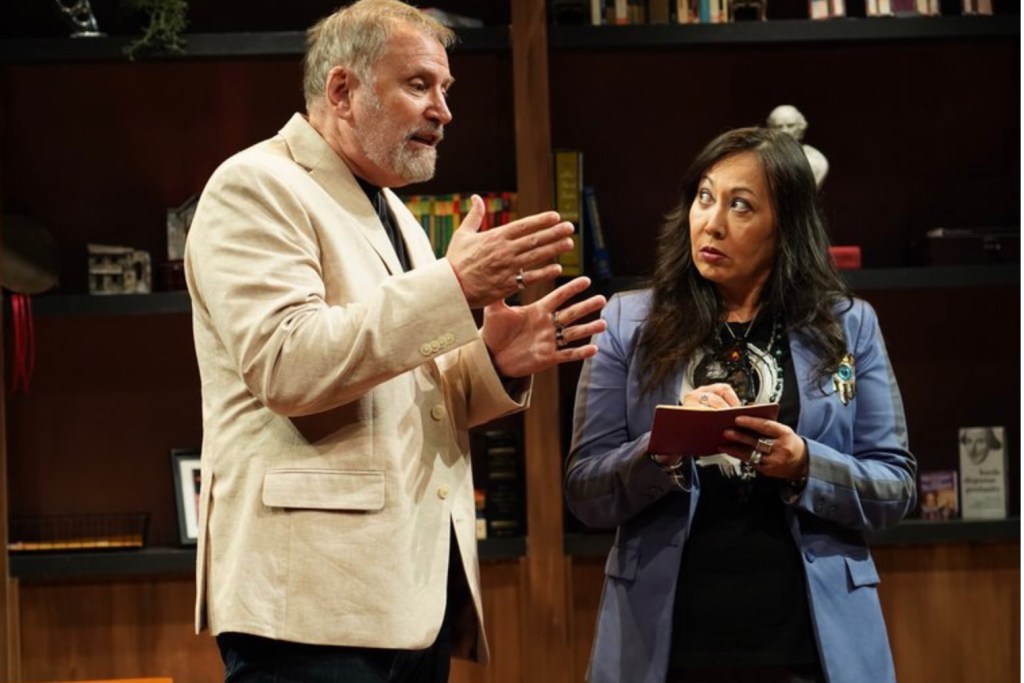
In 1933, the landmark trial of “United States v. One Book Called Ulysses” cleared the way for the publication of many significant works of literature that include sexual content and adult language.  Though James Joyce’s seminal novel was readily available in Europe at the time, it had twice been deemed obscene by a New York court. Random House founder, Bennett Cerf, determined that being the first in America to print the book in its entirety would launch them into the big leagues.  To that end, his company attorney, Morris Ernst, strategized what became a test case for freedom of expression.  Judge Woolsey’s deeply considered decision is practically a literary work in itself.

The events of the trial — its echos reverberating off the walls of today’s public libraries and scholastic institutions — form the foundation of The United States vs Ulysses currently running at the Irish Arts Center.  Playwright Colin Murphy takes the name of the actual case to heart, positioning sections of the book in the role of defendant.  He also fuses the courtroom drama with a rather unrefined behind the scenes look at the live reenactment produced by CBS’s The March of Time.  

This multilayered investigation is executed by a skillful cast of six under the adept hand of director Conall Morrison.  The send-up of the radio broadcast gives way to a serious lesson in interpretive performance.  The ensemble moves through characters historic and fictional, often brushing one against the other.  Jonathan White provides cohesion even while portraying a number of different narrator types.  Clare Barrett is an utter delight as Molly Bloom, especially in her interactions with Morgan C. Jones’s cerebral Judge Woolsey.  Ali White serves as a counterbalance to Barrett’s wild abandon, taking on the sterner female roles.  Ross Gaynor pulls off playing Bennett Cerf and the prosecuting lawyer as well as Molly’s oily lover.  Ernst is rendered by Mark Lambert, personifying this production’s blend of honest reflection and sharp-edged humor.  

The Cast of The United States vs Ulysses; Photo by Nir Arieli

The entire design team facilitates the slide between modes of storytelling. The actors are able to switch roles with the rapid exchange of a hat, the wrapping of a scarf or the removal of glasses (costumes by Catherine Fay).  Liam Doona’s set is like a gift box, with sound proofed radio studio opening to reveal Paris, Dublin, and the Southern District of New York.  Each state of the narrative is given its own tonal palette thanks in large part to John Comiskey’s lighting.  Music and sound by Simon Kenny enhance the atmosphere.

Combining elements of history, literature, law, society and culture, The United States vs Ulysses reminds us of the fight which won us the right to read whatever we choose.  Along the way, it pokes fun at the powerful men who tried to silence a fictional woman for being a sexual being.  Performances continue through Sunday, June 1, at The JL Greene Theatre in the Irish Arts Center,  726 11th Avenue.  There is a lovely cafe in the lobby that is open before and after the show.  Runtime is a sleek 85 minutes.  Tickets start at $25 and are available at https://irishartscenter.org/event/the-united-states-vs-ulysses.

Bowl EP

I am not young, black, gay, or well acquainted with club drugs. What I am is a fierce advocate for theater as an art and communication form. Being in a performance space filled with 20-somethings who are stomping, clapping, hooting, and laughing, even while relating strongly to Morales trying to feel like an ice cream cone, was thrilling. That was my recent experience at a matinee of Nazareth Hassan’s Bowl EP, a joint production of Vineyard Theatre and National Black Theatre in association with The New Group.

If you are a fossil like me, you remember Extended Plays or EPs as the record albums comprised of a few songs. These days they are used by artists to stay on the charts while they are working on larger musical projects.  Bowl EP begins with short “tracks,” the titles of which are projected around the sides of the “bowl,” an empty swimming pool that Quentavius da Quitter (Oghenero Gbaje) and Kelly K Klarkson  (Essence Lotus) use for skateboarding… and other activities.  Similar to that short form, the scenes are performed by the same pair, but don’t firmly connect in style or content.

Also like an EP, much of what the two say to each other has more of the quality of song lyrics than naturalistic dialogue: abstract and disconnected, yet deeply emotional. They never call each other by name and there are no characters listed in the program.  They talk very little about their lives away from this space as if there is no meaningful world away from the bowl.   It’s even hard to tell how long they’ve known each other.  The exchanges do produce a recurring cycle: flirtation, overt sexuality, and comic relief as they try come up with a name for their nascent rap duo.  Their “yums” are quite different, but each one is greeted with acceptance.

At a turning point Kelly — bedecked in wrap skirt over jeans and a sparkling baby-T (costumes by DeShon Elem) — mentions a cathartic therapy session during which she was able to vomit up her demon and become her.  Then during an intensely intimate act she is able to do the same for Quint.  The demon expelled into the pool is the high energy Lemon Pepper Wings (Felicia Curry).  From here, this pan-gender all-knowing character with oversized anime head, pink and purple frills, beat up teddybear backpack and a heart shaped tailed, takes over.  The rapid “tunes” are replaced by a relentless tirade akin to a drum solo as he/she/they shares Quint and Kelly’s relationship past and future in gory detail, personally involving the audience as well.  (Shout out to the stage managers who facilitate the magic.)

Essence Lotus and Oghenero Gbaje in Bowl EP; Photo by Carol Rosegg

Much thought has gone into transforming the venue for this unusual work.  Seating is in the round and blocked off from the stage with chain link fencing.  Playwright Hassan follows the flow of his words in the actors’ movement accented by Teniece Divya Johnson’s fight and intimacy choreography.  Scenic design team Adam Rigg & Anton Volovsek have created a gorgeous curvaceous pool in peaceful sea-foam complete with useful ladders and a diving board to contain the ferocity of the action.  Kate McGee’s lighting simulates street lamps and headlights until the colorful shift to the unconscious.  The projections as designed by Zavier Augustus Lee Taylor telegraph the intensity and vibe of each beat with the formation of the lettering.  Music by Judah “Free Fool” Girvan caps the undertaking, even effectively incorporating some of the lyrics devised in earlier chapters.

Intentionally and undeniably different, Bowl EP continues through June 22 at the Vineyard Theatre, 108 East 15th near Union Square.  Runtime is 80 minutes without intermission. Tickets are available at https://vineyardtheatre.org/shows/bowl/  beginning at $37.80.  Seating is unique and a look at the chart is helpful in selecting your preferred location.  ADA seating is available in the North section.  A joint fundraising initiative is striving to provide tickets to first-time theatergoers, though if this production was on film the content would likely be rated M for violence and sexuality. The venue continues to offer two masked performances per run, honoring their commitment to make theater accessible to everyone.

Lights Out: Nat “King” Cole

In November of 1956, singer/pianist Nat “King” Cole became the first Black man to host a variety show on network television.  Though he eventually had multiple Billboard hits including Mona Lisa, L-O-V-E, and Nature Boy, he never secured a National sponsor for this groundbreaking program.  Major markets, especially those in the South, pressured advertisers to drop their support of the broadcast.  Despite an array of popular guest stars with household names, beaten down by the color barrier, NBC and Cole agreed to terminate the venture the following year after 53 episodes.

Lights Out: Nat “King” Cole, written by Colman Domingo and Patricia McGregor, uses the final taping of the Nat “King” Cole Show to explore not only this chapter in the life of the beloved crooner, but the systematic erasure of Black voices.  It’s an intriguing pick for a central character.  Though Cole participated in civil rights marches and avoided segregated venues, he felt his public role was one of an entertainer.  He sang ballads, not protest songs, even after a cross had been burned on the lawn of his home in a wealthy white Los Angeles neighborhood.  

The play is set in a television studio (scenic design by Clint Ramos) complete with an applause sign, clever lighting (Stacey Derosier), and a live “Nelson Riddle” band on the stage.  This enables the easy integration of music, live-feed camera work and audience reaction.  However, it quickly becomes obvious that this is not a recreation of one night.  Shortly before airtime someone (someTHING) causes the ghost light to flicker and briefly go out, allowing the spirit of Sammy Davis Jr. to explode onto the scene.  In an effort to inspire Cole to go out on a combative note, The Rat Packer takes him through a phantom version of events.  Classic song lyrics are incorporated into the spoken dialogue along with a mix of historical fact as seen through the lens of modern times and Cole’s personal reflection as imagined by Domingo and McGregor.

Dulé Hill in NYTW’s LIGHTS OUT; photo by Marc J. Franklin

Dulé Hill gives soothing voice and gravitas to Cole, a part he cultivated at the Peoples’ Light in Malvern, PA and further developed at the Geffen Playhouse in Los Angeles.  Daniel J. Watts, also reprising his role, grabs Davis by the lapels, practically ricocheting off the walls with intensity.  He is high octane gasoline to Hill’s humming battery pack.  Playwright McGregor directs, bouncing the two very different friends off one another, culminating in a dynamic dance number (choreography by Edgar Godineaux with tap by Jared Grimes). Though the plot line is choppy and likely to challenge those unfamiliar with the named celebrities and cultural touchstones, the songbook alone (arrangements and orchestrations by John McDaniel) makes for highly satisfying entertainment.  

Hill and Watts positively dazzle in the leads, capturing key qualities of their characters and steering clear of imitation.  The action is kicked off by Elliott Mattox’s convivial Stage Manager.  Cole’s white producer is portrayed in myriad forms by Christopher Ryan Grant.  Krystal Joy Brown makes an early impression as a purring Eartha Kitt, later embodying an enchanting daughter Natalie Cole. Also displaying range is another vet of the previous run, Ruby Lewis, who depicts both spunky Betty Hutton and sultry Peggy Lee.  Matriarch Perlina Coles, who first introduced Cole to the piano, is played with soulful sincerity by Kenita Miller with Mekhi Richardson performing as young Nat (and a younger Billy Preston) the afternoon I attended.  Adding a comedic touch is Kathy Fitzgerald as make-up artist Candy.  She is also featured in the highly creative live commercials that run throughout the program.   

You feel the ripples of connection move through different sectors of the audience depending on whether it is Cole performing his rendition of The Christmas Song, Lift Every Voice and Sing vocalized by mother Perlina, or young Natalie joining him for a duet of Unforgettable (something she created in the studio long after his death).  When you layer in the profound racism, disgraceful accepted stereotypes, and aggressions micro and macro, the entire experience becomes a social study as well as a piece of engaging theater.

Likely to fill you with a bubbling combination of elation and frustration, Lights Out: Nat “King” Cole provides a worthwhile conclusion to a bold season at New York Theatre Workshop.  Performances continue through June 29 on the main stage at 79 East 4th Street.  Runtime is 90 minutes without intermission.  The actors smoke heavily, making me grateful to remain a mask-wearer.  Tickets start at $49 and are available at https://www.nytw.org/show/lights-out-nat-king-cole/.

EPIC’s Seussical the Musical

Seussical the Musical was not exactly a hit with the critics when it ran on Broadway about 25 years ago.  Nonetheless, the familiarity of the characters and its themes, including the consequences of cronyism and the importance of staying true to yourself, resonated with audiences.  It continues to be performed regionally with its “junior” version popular in schools throughout the country.  These messages also make it a fitting selection for EPIC’s diverse troupe.  The cast’s palpable joy in performing a work that embraces such a delightful and distinctive population makes for an easy-to-love experience for the whole family.

Horton the Elephant (Gianluca Cirafici) surrounded by the Wickersham Brothers

For those unfamiliar with the script, it is adapted from several children’s books written and illustrated by Theodor Geisel aka Dr. Seuss.  Music is by Stephen Flaherty with lyrics by Lynn Ahrens.  Two of the plots feature a compassionate elephant portrayed by an endearing Gianluca Cirafici sporting soft floppy ears.  The third story line moves the focus to his love-struck neighbor, Gertrude McFuzz, depicted with pizzazz and warmth by Natalie Kaiser, accompanying herself on kazoo.  To attract Horton’s attention, the self-conscious bird grows an impressive tail with the help of Dr Dake (Ethan Jones).  Other Seuss inventions that make appearances large and small are the famous trickster The Cat in the Hat (Shoshanna Gleich), a bluesy Sour Kangaroo (Emily DeMaio) and her Baby (Anjel Bell), a judicious Yertle the Turtle (Prince Hurst), and the Wickersham Brothers (Miles Butler, Ethan Homan, Nick Moscato, Sven W) who never get tired of literally monkeying around.

Gertrude McFuzz (Natalie Kaiser, center) growing a tail with the help of Dr Dake (Ethan Jones) and encouragement from The Cat in the Hat (Shoshanna Gleich).

The opening is primarily based on Horton Hears a Who. Finding an entire populated planet on a clover, Horton appoints himself protector aided by the Smallest Who of All, Jojo embodied in the tiny but mighty Christine Newberry.  It is she who calls forth a universe of Seussian creations with her unbridled imagination.  Standout Matt Tierney has a wonderful time soliciting both laughs and donations from the audience as her father the Mayor.  Sandy Gladstone Karpe is Mrs. Mayor rendered with overflowing glass of chardonnay in hand.

Jojo (Christine Newberry) with her disapproving parents, Mrs. Mayor (Sandy Gladstone Karpe) and Mr. Mayor (Matt Tierney)

As if the Whos of Whoville and their speck of dust world (Bre Baron, Sami Binder, Miles Butler, Tess Carvelli, Shafer Gootkind, Prince Hurst, Ethan Jones, Genesis Solivan) weren’t responsibility enough, Horton then falls for the manipulations of Mayzie Labird, taken on with sass a-plenty by Kayla Robinson, who tricks him into sitting on her egg.  As is appropriate, all the birds, including Kaiser and Robinson plus the powerhouse “Bad Girls” trio of Alice Frannsen, Rachel Paine, and Elisa Weiss, bring vocal purity to all of their songs. 

Mayzie Labird (Kayla Robinson, second from the left) with the Bad Girls: Alice Frannsen, Rachel Paine, and Elisa Weiss

Scenic designer Christian Flemming has done an admirable job capturing Seuss’s drawing style in three dimensions encircled by an “Oh, the Places You’ll Go” rainbow sidewalk.  Likewise Izzy Kitch’s whimsical costumes and elaborate headgear.  Props by Dana Weintraub include miniature everyday items for the Whos and of course a Red Fish and a Blue Fish.  Against this background, Artistic Director Aubrie Therrien and her Co-Director Meggan Dodd have added their usual high-energy interaction.  Choreographer Travis Burbee provides several effervescent dance numbers. 

The Cast of EPIC Players’ Seussical the Musical

Since 2016, EPIC Players (Empower, Perform, Include, Create) has been dedicated to creating professional performing arts opportunities and a supportive social environment for Neurodivergent and Disabled artists.  With its wonderful range of colorful characters, Seussical the Musical is a perfect match for their talents and mission.  As a Mother’s Day “gift,” on Sunday May 11th their performance will be relaxed with ASL interpretation.  There couldn’t be a better time to deliver the message that “a person’s a person’s no matter how small.”  So if you could use a reminder of How Lucky You Are, head to ART/NY The Mezzanine Theatre, 502 W 53rd St. now through May 18.  Tickets are $35-$65 and can be purchased online at https://epicplayers.ticketspice.com/epic-players-presents-seussical.  

Photos by Zui Gomez

Eboni Booth: Story/Teller

Eboni Booth’s Pulitzer Prize winning Primary Trust is currently one of the most performed plays regionally.  It is the kind of work that people say leaves them “shattered,” “undone” and “wrecked” and they mean that in a good way.  The New York Premiere was my return to live theater after more than three years because of COVID.  The themes explored, especially when delivered by the incomparable William Jackson Harper, could not have provided a more perfect balm.  Though written in May of 2023, that review remains my second most read.  (You can read it for yourself here: https://theunforgettableline.com/2023/05/30/primary-trust/)   

To celebrate the printing of the Primary Trust script, TCG, dramatic literature’s largest independent trade publisher, presented an evening with Ms. Booth. The book’s cover shows a small town street with each side mirrored in the other, beautifully reflecting the feelings evoked by the original set design. 

The evening opened with a short reading by Harper accompanied by original composer/perform Luke Wygodny on cello and the bell meant to represent the way in which our thoughts frequently interrupt themselves.  These scenes gave newcomers a taste of Primary Trust’s beauty and provided a strong reminder to anyone who saw the full production.  

Eboni Booth and Heidi Schreck on April 16, 2025

The conversation was hosted by another recognizable actress turned playwright, Heidi Schreck (What the Constitution Means to Me).  Both women have participated in the collaborative incubator, Clubbed Thumb, and are raising families in New York City.  This provided plenty of common ground.  The two comfortably chatted as if in their own local tiki bar about writing, acting, and what keeps them up at night.  

Ms. Booth came to playwriting in her late 30s when she pivoted away from acting and got herself into an advanced program at Juilliard in Manhattan.  She is honest about her sometimes clumsy first steps and counts David Adair and Marsha Norman among her teachers/guides to success.  

As with most powerful work, Primary Trust arose from a genuine place both personally and professionally.  Booth believes in the power of kindness from strangers, vividly remembering an encounter on the subway when the person next to her saw her crying and offered a tissue.  The notion that small steps can be life changing eventually grew into lead character Kenneth’s way of being.  By tapping into the discomfort left by prolonged COVID isolation and the need for tenderness towards one another, the audience became deeply invested in his wellbeing.

 All four cast members have rich material to work with. As a former struggling actress, Ms. Booth has distrain for the type of roles that serve a plot purpose but don’t give the performer anything meaty to do.  Booth’s style is more like that of a fiction writer, with long prosaic passages.  Shreck speculated that the radical structure of the play was likely one element that drew the attention of the Pulitzer jury and ultimately won her the prize.  

The event took place at the Center for Fiction, a 200 year old cultural non-profit in Brooklyn that promotes the values of engaging with fiction at all levels.  It was streamed through their YouTube channel (https://www.youtube.com/@TheCenterforFiction/streams) and will soon be available to view.

Glass. Kill. What If If Only. Imp.

The announcement of any performance of British playwright Caryl Churchill is cause for excitement.  She has long been a powerful and intriguing voice for gender equality, environmental protection, and sense of self while providing memorable entertainment.  On that score, the premiere program of four of her short works — Glass. Kill. What If If Only. Imp. — at The Public Theater is a disappointment.  Director James Macdonald and his artistic team have done a masterful job of making the production visually interesting.  But while moments gleam, it never comes together as a cohesive event.

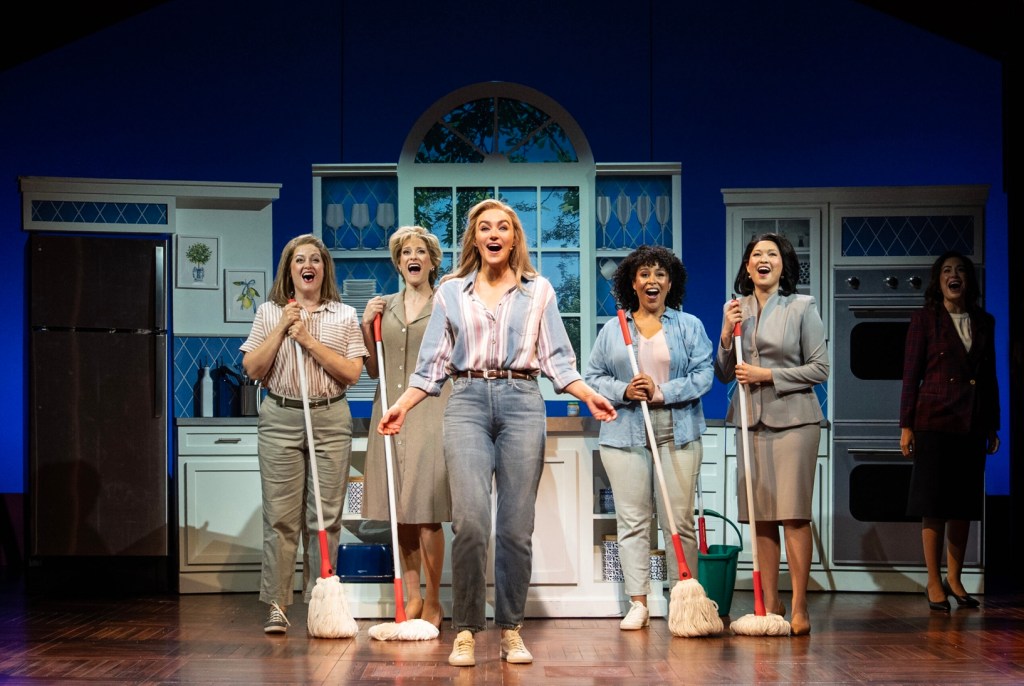
Glass explores the melancholy lives of four decorative items (Japhet Balaban, Adelind Horan, Sathya Sridharan, and Ayana Workman) beyond the confines of their shared mantelpiece. Designer Miriam Buether’s first impactful set is a solid LED jutting out from the darkness and demanding attention.  Though a soulful Workman gives depth to the glass figurine who is the catalyst for the tragic events that unfold, Glass plays out more like an acting class exercise than a full fledged work of theater.

Adelind Horan, Ayana Workman, Sathya Sridharan, and Japhet Balaban; photo by Joan Marcus

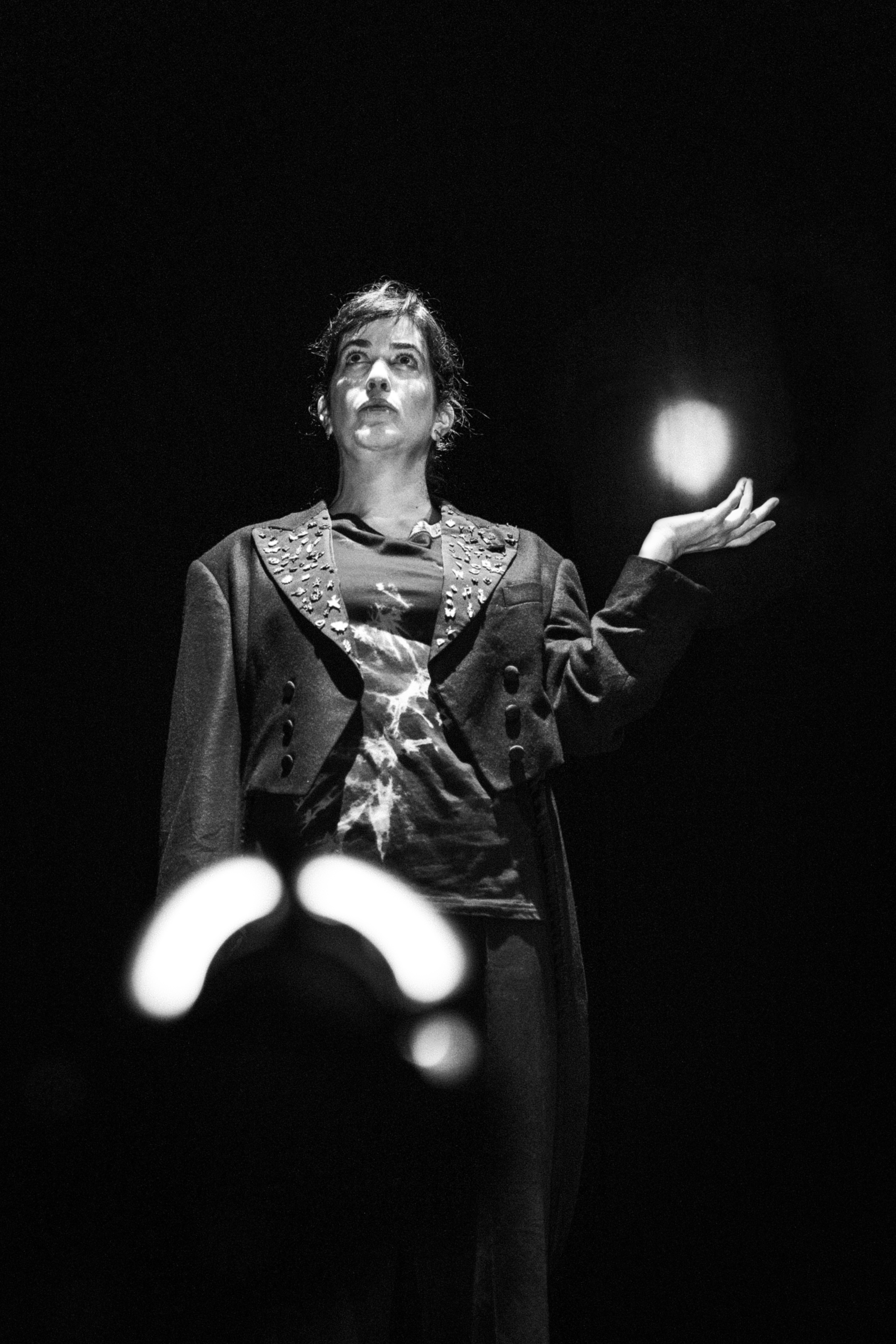
Deirdre O’Connell, who won a Tony Award for her solo work in Dana H, pulls off the chillingly violent patter of Kill.  Sitting comfortably on a puffy cloud, a sparkling god of Olympus recounts many evil deeds performed by men — from the prideful Tantalus to the warrior Agamemnon — in the Pantheon’s name.  The repetition would sound like the narration of a five-year-old were the content less bloody.  A knowledge of Greek mythology is essential for following the rapid-fire references, though the essence is clear from O’Connell’s tone and manner.

The first half is closed out with What If If Only, a meditation on love, loss, and the risks of second chances.  For this solemn reflection, Buether provides a still life setting in stark black, white and red.  The sound design of Bray Poor also plays a key role by reinforcing the oppressive atmosphere.  The philosophical theater game is anchored by John Ellison Conlee, who makes the absurd sound completely natural.  

Breaks between these plays are filled by two talented acrobats.  The first is Junru Wang, who performs a balletic work while her hands balance on small stools at the foot of the stage.  For the second, we are treated to what I christened a “juggler-tease” performed with flirtatious glee by Maddox Morfit-Tighe.  Unfortunately some of his choreography was out of the sight lines of the back half of the audience.  Whether these two talented people provide unity, distraction, or a fleeting moment of joy is up to the beholder.

The second half of the program is fully occupied by the more plot-heavy Imp.  Conlee and O’Connell portray Jimmy and Dot, friends close enough to consider themselves brother and sister of different parents.  The affable Jimmy lifts his mood with running and chess.  Slumped in a nearby chair, Dot is ill-temperated and unwell.  She also believes herself to be in possession of a magical imp imprisoned in a wine bottle.  

The rhythm of their lives is altered by the arrival of two newcomers.  First their niece, Niamh, a recent transplant from Ireland stops by.  (Horan is wonderful at delivering Neve’s wildest fears in recognizable Churchill style.)  Then the couch surfing Rob enters their lives (Balaban again).  The younger pair is tossed about, though who’s to say whether their bumpy ride is caused by a supernatural being, the differing attitudes of their hosts, or just life.

It is fitting that the stage on which Glass. Kill. What If If Only. Imp. are performed is framed in chase lights with definite personality (Isabella Byrd lighting design).  With its bitesized ideas and high level of engagement, it’s Caryl Churchill for the TikTok generation.  Churchill’s signature poetic language and extraordinary themes are intact, but there is too little structure.  The Playbill notes encourage us to look beyond conventional narratives, but humans are storytellers with a need for an organizing rope to hold.  The feeling left behind by experiencing these four shorts is more akin to a stroll through a depressive art gallery than witnessing an emotionally fulfilling theatrical work.  Performances continue through May 11th at the Martinson Theater at The Public, 425 Lafayette Street.  Running time is 2:15 with one intermission.  Tickets are available at https://publictheater.org/productions/season/2425/caryl-churchill-plays/ and start at $89.

All The World’s a Stage: First Look

Only two weeks into previews, the World Premiere of All the World’s a Stage is developing into a warm and enjoyable spring offering.  Though set in 1996 in small-town Pennsylvania, sadly the themes covered could be ripped from today’s headlines.  Adam Gwon’s lyrics are dense and expressive, but despite the many complex subjects he explores — bullying, book banning, religious indoctrination, and the very human need to be seen — it is hopefulness that is heard above them all.  Pair that with a memorable score and a quartet of talented performers, and this tale of a gay math teacher and the unusual student he mentors add up to a winning piece of entertainment.

The actors work together like four limbs of the same magical being.  Eliza Pagelle is wonderfully squirmy, adrift in her baggy cloths as unpopular high school senior Sam.  Matt Rodin embraces both the nerdiness and attractiveness of her protective closeted teacher Ricky.  Jon-Michael Reese and his big bold voice are perfectly suited to self-possessed bookstore owner Michael, who is out accompanied by trumpets and klieg lights.  And Elizabeth Stanley puts a relatable chink in the armor of by-the-book administrator Dede.  

Matt Rodin, Elizabeth Stanley and Eliza Pagelle in All the World’s a Stage at Theatre Row
Production Photography: Richard Termine

Keen Company’s Artistic Director, Jonathan Silverstein, takes the helm as the director of this lovely work.  The effect employed to create the unseen school principal is an example of his clever approach to promoting the big things in this small package.  Set designer Steven Kemp has made the most of the tight space in Theatre Row’s Theater 5, placing a short cinder block wall around the musicians and steps downstage to add more dimension.  Jennifer Paar has built an impressive wardrobe for each of the four central characters giving them even more to work with.   

Gwon’s book is filled with cultural references that have traveled well through time, especially the admiration for Tony Kushner’s Angels in America which was recently revived in New York and London.  Many lines earn a laugh of recognition from the audience.  (Who among us didn’t prefer listening to the cast album of Chess over following the stock market?)  His love for and knowledge of the theater is particularly needed at this time when the art form has been under attack.  The musical numbers cover a wide range of styles from the jingly “Saturday Night in a Small Auditorium”, through the campy “The Show Must Go On,” to the heartfelt “Mirrors” which had the hulk of a man sitting next to me weeping hard enough to wiggle my seat.  The four musicians under the direction of Andrea Grody stay wonderfully engaged with the onstage happenings without calling attention to themselves.

All the World’s a Stage packs a lot of emotion and life lessons into its current runtime of an hour and 40 minutes without getting preachy or losing its humanity.  It’s a compact work with enough heart to feel expansive.  Performances continue at Theatre Row thought May 10.  Tickets beginning at $25 can be purchased  online at www.keencompany.org, by phone at 212-714-2442 ex 45, or at Theatre Row Box Office at 410 W 42nd Street.  

Twelfth Night

Twelfth Night is arguably the most lovely of all of Shakespeare’s comedies.  It reflects the same lighthearted and celebratory nature as the Christmas holiday for which it is named.  Set along the sun-kissed coast of Illyria with happily-ever-after always in view, it includes many of the playwright’s favorite motifs — tangled affections, mistaken identify, and class contrasts — and blends them into a frothy mixture.  Now playwright Alison Carey has given it a delicate layer of modern polish, increasing the ease of comprehension while leaving the most memorable lines intact.  Her translation is being produced at TheatreSquared and performed by the National Asian American Theatre Company (NAATCO) who co-present along with Play On Shakespeare.  Further enlivened by new music soaringly sung by Joyce Meimei Zheng, it’s a delightful family-friendly entertainment.

Nima Rakhshanifar, Karen Li, Eston J. Fung, and Anula Navlekar are among the National Asian American Theatre Company cast members of Twelfth Night at TheatreSquared, now streaming.

At the opening we are introduced to Count Orsino (Eston J. Fung) who pines for the lovely Olivia (Karen Li).  But the lady is in mourning over the recent death of her brother and is not open to his wooing.  She is protected and served by the crafty Maria (Nandita Shenoy).  Living with them is Olivia’s uncle, Sir Toby Belch (Victor Chi), who spends much of his time drinking and playing tricks on those around him.  He hopes his niece will accept a proposal of marriage from his good friend, the sweet but foolish Sir Andrew Aguecheek (Alex Lydon).  The two other members of this household could not be less alike.  Her house manager, the self-important Malvolio (audience favorite Rajesh Bose), is the most humorless man in the realm, while her fool, Feste, (Joyce Meimei Zheng) is often seen around town entertaining everyone with jokes and songs.

Meanwhile, a shipwreck just off shore has separated devoted twins Viola (Anula Navlekar) and Sebastian (Nima Rakhshanifar).  Each believes the other to be drowned.  Recognizing the potential perils of living as a woman alone in a strange land, Viola has disguised herself as a young man and now serves as a page to the broken-hearted Orsino.  When she is sent to court Olivia in the Count’s name in her male garb, she inadvertently wins the woman’s heart for herself.

Vibrantly directed by Aneesha Kudtarkar making her T2 debut, the cast whizzes through nearly 2 ½ hours of poetry, music and storytelling.  An amusingly choreographed duel is a highlight.  Each line is spoken clearly and with natural rhythm.  The set by scenic designer Chika Shimizu provides ladders, platforms, and a bridge that promote physicality and an openness that is bathed by Marie Yokoyama’s seaside-colored lighting.  Costume designer Mariko Ohigashi adorns the actors in warmly colored relaxed fabrics that move with them, further enhancing the ease and fluidity of the entire play.

The welcome comfort is palpable in this Twelfth Night.  While I was anticipating some form of cultural spin, what I saw was a first rate production of an easy-to-like play.  Illyria can be reimagined to be anywhere where the only person who is mocked is the one who stomps on everyone else’s delight.  The point is not what these people look like, but rather the joy they take in each other’s company.  TheatreSquared is located at 477 W. Spring St. in downtown Fayetteville, Arkansas.  In person tickets ($30-$60) as well as an on-demand stream ($25/$35) are available on the TheaterSquared website (https://www.theatre2.org/twelfth-night).  Performances continue through Sunday, March 30.

Amerikin

With his promising recent promotion, loyal best friend, and gorgeous new baby, Jeff Browning seems to be well on the way to living the life he’s always dreamed of.  The acceptance of his application to a local organization — The World Knights — is almost assured, making him and his fragile wife, Michelle, members of a supportive community.  Despite all he has, a deep sense of belonging remains a missing piece.  True, the Knights are dangerously anti-Black, but Jeff doesn’t consider himself a bigot.  He would never have called his dog a racist slur if he lived within hearing distance of a person of color.  Yet Jeff is rocked to the core when his required DNA test reveals he is 14% Subsaharan African.

These events unfold in the first few scenes of Amerikin, a new work by Chisa Hutchinson presented by Primary Stages.  With its highly provocative and uncomfortable themes, it’s no wonder this production became a target of the current administration and lost its NEA grant.  But for those who enjoy their live performances dexterously delivered and dowsed with hot sauce, the play provides enough rousing dialogue and surprising twists.

Playwright Hutchinson has much that she wants to communicate and she uses both sharp wit and emotional intelligence to largely accomplish her goals.  The simultaneous display of past and present makes for engaging storytelling.  Well-earned laughter breaks up the mounting tension.  The breaking of the fourth wall by several characters is a less effective short-cut and too frequently employed.  

Tobias Segal and Daniel Abeles in Primary Stages’ 2025 production of AMERIKIN;
photo by Justin Swader

Housed primary in a perfectly scuffed up set by scenic designers Christopher Swader and Justin Swader, the production is shaped by intuitive director Jade King Carroll and a skillful acting ensemble. Daniel Abeles takes the lead in Act 1, imbuing Jeff with alternating waves of swagger and vulnerability.  Act 2 is anchored by Victor Williams as a dauntless clear-eyed Black Washington Post reporter, Gerald, and Amber Reauchean Williams as his self-assured college age daughter, Chris.  The seasoned political journalist is looking for a fresh angle, preferable one that is Instagrammable.  Chris’s life has been more profoundly impacted by the execrating pace of police brutality against her race.  Their banter-filled car rides between D.C. and Jeff’s home in small-town Maryland compellingly illuminate a generational divide and are highlights of the script.  

The outsiders are the ones who bring the schism between Jeff’s sense of self and harsh reality into focus.  Additionally, Tobias Segal as best friend “Poot” is sweetly well meaning, expressing what many in the audience are thinking.  His character is a welcome counterbalance to Luke Robertson’s solid but offensive sponsor, Dylan.  His “Black Labs Matter” T-shirt (costumes by Jen Caprio) says it all.  Jeff’s wife and ex-girlfriend, portrayed by Molly Carden and Andrea Syglowski respectively, are plot-fillers written with limited range.

Amerikin is to be praised both as a springboard for productive and thoughtful conversation as well as an evening of quality ensemble acting.  The program notes contain several warnings including discussion of postpartum depression and suicidal ideation and the ending is so punishing it diminishes what came before.  Runtime is 2 hours plus a 15 minute intermission.  Performances continue through April 13 as part of the AMPLIFY Festival being celebrated at 59e59 Theaters at 59 East 59th Street.  Tickets begin at $66 and can be purchased at https://www.59e59.org/shows/show-detail/amerikin/#show-info.  In honor of their founding year, Primary Stages has also made $19.84 lottery tickets available through the TodayTix app for every performance.