Tag Archives: Cathy Hammer

We Live in Cairo

In 2011, a number of Egyptian youth groups gathered together in Tahrir (Liberation) Square to protest the corrupt authoritarian rule of President Hosni Mubarak.  His 30 year stranglehold on power had led to economic stagnation, human rights violations, and media restrictions.  The young peoples’ acts of civil disobedience in concert with a series of labor strikes forced Mubarak’s resignation and brought about a democratic election.  Their victory was short lived, however, and Egypt now stands at a miserable 18 out of 100 on the Freedom House scale.  

Inspired by a photo of several of the activist artists, brothers Daniel and Patrick Lazour wrote We Live in Cairo, developing the score and book over ten years.  The results are inconsistent in their ability to sway the audience, primarily carried along on waves of tuneful music.  Most numbers combine instruments and musical themes from Egypt with traditional structures including love ballads and rock anthems.  Director Taibi Magar joined the collaboration to add depth and movement to song.  The voices of the all-Arab ensemble blend beautifully (vocal arrangements by Madeline Benson) even when their characters falter.  For the scene depicting the toughest days of uprising, the musicians join the actors center stage, enveloping them with melody.

Michael Khalid Karadsheh, Ali Louis Bourzgui, Rotana Tarabzouni, Nadina Hassan, Drew Elhamalawy and John El-Jor in WE LIVE IN CAIRO at New York Theatre Workshop; Photo by Joan Marcus

The atmosphere developed by the design team wraps the audience in the sights and sounds of the struggle for freedom.  Tilly Grimes’ set is kept simple with a collection of pillows, rugs, lamps and household items filling a few shelves. The visual emphasis is on the evocative projections designed by David Bengali, some of which appear overhead.  He and lighting designer Bradley King added their graphical layers to the look and feel when they joined the crew during the run at A.R.T. in Boston.

Unfortunately, the story, though it was restructured several times, lacks the same level of vibrancy.  While the idea of looking at this revolution through varying lenses of artistry, policy, and simple human compassion is an interesting concept, the issues are all frustratingly abbreviated and the actions poorly motivated. Initially apolitical and fearful, Layla (Nadina Hassan) suddenly turns her entire life inside out based on exposure to a single image.  The societal significance of her boyfriend, Amir (Ali Louis Bourzgui), and his brother Hany (Michael Khalid Karadsheh) living as Coptic Christians in the majority Muslim country is mentioned, but never meaningfully explored.  Fadwa (Rotana Tarabzouni) is so driven by her identity as the child of dissidents that her every opinion becomes a cause which muddies their significance.  The attraction between the majestic Karim (John El-Jor) and the tentative Hassan (Drew Elhamalawy) is covered over as quickly as one of Karim’s satiric murals.  The vagaries of this critical thread border on homophobic.  Even the impact from country’s former status as a British colony doesn’t receive more than a single line.

New York Theater Workshop, which has been helping to nourish this production for nearly 7 of the 10 development years, has done what they can to broaden the world of the play beyond the walls of the theater.  E-tickets include the promotion of local Egyptian restaurants, invitations to post-show topical talkbacks at their sister space, and lighter cultural fare like a hummus-making contest.   A brief historical timeline and the “origin story” of the production are inserted into the program.

Like the ending of the Arab Spring it depicts, We Live in Cairo ultimately fizzles.  But it leaves behind a feeling of purpose that makes the experience worthwhile at this delicate point in our own history.  The Off-Broadway premiere continues through November 24 at New York Theatre Workshop, 79 East 4th Street in Manhattan. The performance runs 2 ½ hours with one intermission and contains images and sounds of a violent nature.  Tickets begin at $49 and can be purchased at https://www.nytw.org/show/we-live-in-cairo/tickets/ or by calling the NYTW box office at 212-460-5475.  You will get a better sense of place seated further back from the stage.  This is the first play of four in the NYTW 2024-25 season and subscriptions are still available for as little as $230.

HOTHOUSE

Fringe Festivals are known for launching imaginative artists and exploring unconventional art forms.  Content is uncensored and therefore often provocative, sometimes to the point of discomfort.  Those traits are true of HOTHOUSE, a performance work from 2023’s Dublin Fringe.  Written by Carys D. Coburn (co-founder of the award-winning collective, Malaprop), the theatrical statement piece loosely strings together generational abuse, repressed feelings, and Rachel Carson’s 1962 book Silent Spring, which led to the discontinued use of DDT in farming and the creation of the Environmental Protection Agency.  

Ebby O’Toole Acheampong , Maeve O’Mahony, Peter Corboy, Thommas Kane Byrne, and
Bláithín Mac Gabhann in HOTHOUSE; Photo by Nir Arieli

Entering the well-raked, friendly JL Greene Theatre, we are greeted with a medley of “bird” songs from Bye Bye Birdie to Bird is the Word.  This motif continues into Section 1, a performance within a performance on the cruise ship Crystal Prophecy.  Scenes from the life of Ruth — a young girl growing up in an abusive household who finds solace in Carson’s writing — are played out in cabaret style.  Periodically a species of Las Vegas Showgirl “bird” goes dramatically extinct with a little help from the Captain.  The palette and mood tonally shift in Section 2 as our Captain undergoes a “shamanic transformation.” It is the near future and Ruth’s daughter, Ali, is a passenger cruising on the Crystal Prophecy to see the last of the ice caps.  The epilogue moves us further forward into a time when Annie’s great grandson is growing up in a new normal.  Years are displayed boldly within the burning sun stage left to help us keep track.

The family functions more as a container for Coburn’s thoughts on our rapidly changing world, with issues overtaking narrative and character development.  Along the path we hit stock Irish cultural touchstones from whiskey to Enya.  That doesn’t stop the ensemble from quite literally leaving it all on the floor.  For the full 90 minutes, they work as a unit: dancing, singing, and switching roles in an array of campy life-vest orange costumes designed by Molly O’Cathain from the original Irish production and fabulous wigs by Carina Metz from the U.S.creative team.  Director Claire O’Reilly, a Malaprop co-founder, ignores gender and age in leveraging the talent.  The way she stages a flurry of activity towards the end of Section 2 is particularly clever.  Peter Corboy’s Captain functions as the rudder with Thommas Kane Byrne the most fluttery of the sails.  Maeve O’Mahony (another Malaprop co-founder), Bláithín Mac Gabhann, and Ebby O’Toole-Acheampong breathe life into characters who are tragically emotionally out to sea even on dry land.  While it is unlikely you will whistle any of Anna Clock’s songs upon leaving the theater, the tunes do work to connect the various jigsaw pieces.  

Even with little that would pass as realistic dialogue, HOTHOUSE is certain to spark conversation.  Though short on structure, it is long on dizzying feeling and visual impact (The original festival iteration won for Best Ensemble and Best Production Design.)  The North American debut runs through November 17 at the Irish Arts Center, 726 11th Avenue.  Tickets start at $25 and can be purchased at https://irishartscenter.org/event/malaprop-hothouse.  

In the Amazon Warehouse Parking Lot 

Like the cruel corporation that manipulates Jen, Ani, Sara and their co-workers, for the most part In the Amazon Warehouse Parking Lot delivers the goods.  What this piece has in common with several of this year’s Off-Broadway productions is an over-stuffed plot that takes on too many critical issues to the detriment of them all.

Similar to Carol Churchill’s memorable Far Away, playwright Sarah Mantell begins by sketching oblique fine lines of a chilling future in a failing country and dramatically discloses details of the lives of an outrageously exploited underclass.  (Churchill twice won the Susan Smith Blackburn prize that Mantell was awarded for this work.)  Descriptions of an advanced climate crisis set to the “music” of Sinan Refik Zafa’s enveloping sound, are vivid, alarming, and all too possible.  The abusive work environment is also cleverly revealed and based just enough on reality to strike a chord.  The more publicized love story is not as well motivated and becomes a distraction.  It doesn’t help that Donnetta Lavinia Grays, who otherwise turns in a strong and steady performance, can’t conjure up any chemistry with Deirdre Lovejoy.   Ultimately, this thread may be essential to the playwright, but not to the play.

In her personal note, Mantell explains her intention to make this production “both art and a hiring document” particularly for women, trans, and nonbinary actors over 50.  The reward for her worthy goal is a memorable cast — Grays and Lovejoy are joined by Barsha, Sandra Caldwell, Ianne Fields Stewart, Tulis McCall, and Pooya Mohseni — so congenial and cohesive it is easy to believe they hang out at the (still open!) West Bank Cafe after every performance.  With no clear path forward, these people can only move “towards.”  Their palpable warmth is in stark contrast to Emmie Finckel set.  The characters are unmoored in a sea of cold conveyer belts and unwelcoming mountains awash in the purple hues of Cha See’s lighting.  

Ianne Fields Stewart, Pooya Mohseni, Tulis McCall; Photo credit: Valerie Terranova

Director Sivan Battat  draws on their background in ritual and diverse mythological storytelling to enrich the anchoring “around the campfire” scenes.  Even the most peculiar and futuristic banter feels organic.  (A lighter detail is Mantell’s selection of the social deduction party game Werewolf as the group’s preferred method of entertainment.)  The more mixed result stems from the monologues about how each of the workers spent their first night sleeping in a vehicle.  This often repetitive contrivance begins to bog down rather than deepen the unfolding of events.    

At its core, In the Amazon Warehouse Parking Lot  is a story of families lost, found, and made. The elements largely come together in a satisfying theatrical experience with a refreshing cast you will want to see more of.  While there are missteps in the dance between Mantell’s personal mission and broader audience appeal, if you give yourself over to her vision (as the mostly under-35 audience did at the performance I attended) the effects will linger.  Presented in association with Breaking the Binary Theatre, the world premiere continues on the MainStage theater at the Playwrights Horizons (416 West 42nd Street) through November 17.  Runtime is approximately an hour and half with no intermission.  Tickets begin at $62.50 and can be purchased at https://my.playwrightshorizons.org/events/amazon.  

twenty50

Oddly, one of the best distractions from the tumultuous election before us comes in the form of a drama about a political contest taking place 25 years from now.  In twenty50, playwright Tony Meneses sets his fresh and calculated thriller in an America in which the southern border is completely closed and Latinos — most of whom have fully assimilated — make up the majority of citizens.  Against this backdrop, farm owner Andres Salazar (who goes by Andy) is running for congress somewhere in the middle of the country.  With his campaign manager urging him to drop references to his background in order to appeal to a wider electorate, he finds himself torn between his traditional mother and his inquisitive daughter who doesn’t know a word of Spanish.  Though the bilingual dialogue sometimes blunts the pacing, it’s essential to the unfolding of the story.  Meneses is drawing on a deeply personal understanding of how much can change in a single generation.  His family moved from Guadalajara, Mexico, and he was raised in Albuquerque and Dallas.  The result of his honest excavation is a fair weighing of the many sides of culture, authenticity, and the desire to belong that are not exclusively LatinX.

In creative partnership with scenic designer Tanya Orellana, director Rebecca Rivas has reshaped T2’s intimate space to represent a house with a sloping roof that engulfs the audience placed on either side of a thrust stage. Lighting Designer Nita Mendoza adds emphasis to this metaphorical container.  The clever use of “farmhands” as stagehands, helps convert the landscape for the final scene.  Within the dwelling, the characters circle one another, trying to find their equilibrium.  Orlando Arriaga makes Salazar both approachable and questioning.  It is his genuine warmth that provides the production with a solid center.  He is particularly strong in exchanges with Isabel Quintero as the mother whose memories of the recent past wash in waves over the present.  Cary Hite as the farm’s manager presents an opportunity for another variation of Andy’s balancing act.  Yet a third foil is Gabriella Perez’s policewoman Lydia, the most obviously futuristic character.  As daughter Jenny, Alyssa Martinez is unnecessarily burdened with a childish wardrobe and mannerisms.  She is best when she leans into the role’s purity instead of relying on these distracting crutches.  Ricardo Pérez Dávila and Freddy Acevedo round out the cast.

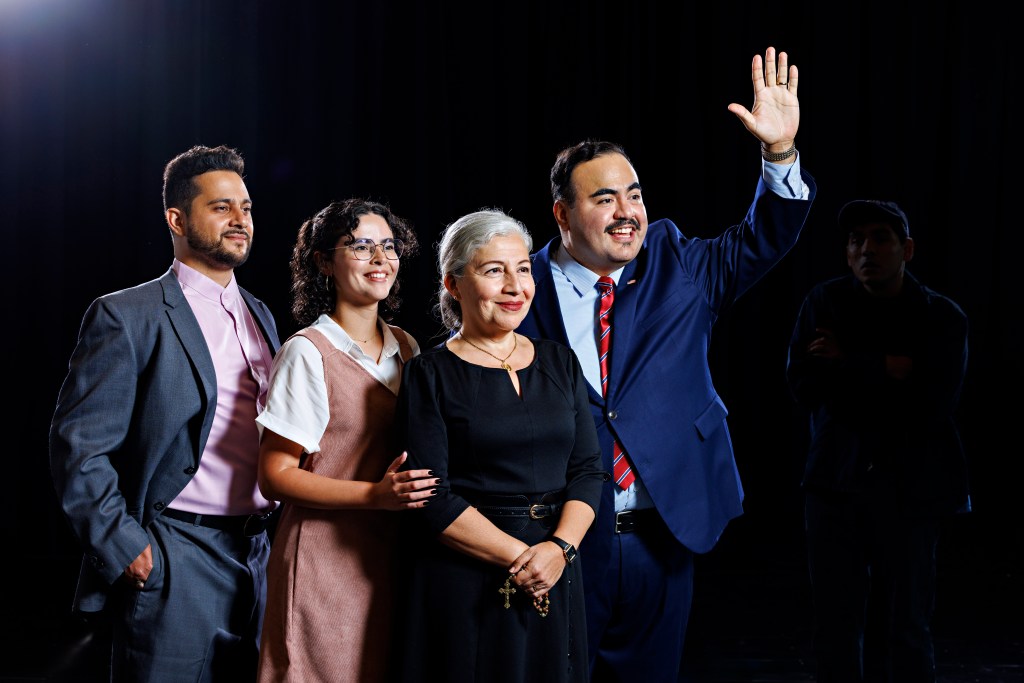
Ricardo Pérez Dávila (Sebastian), Alyssa Martinez (Jenny), Isabel Quintero (Irene) , Orlando Arriaga (Andres), Freddy Acevedo (Oscar) | Photo Credit: Wesley Hitt

In a brisk 90 minutes, twenty50 offers a buffet table ladened with food for thought. This is only the second time this play has been mounted and the rhetoric around immigrants has only grown louder and more destructive.  It’s a coup for TheatreSquared and their loyal audience. As the Executive and Artist Directors say, this insightful work “serves as both mirror and beacon.” Note that the content is written for adults, though there is nothing overtly “mature” in the action. 

The best way to see the performance is live for as little as $20, coming face to face with your fellow attendees at TheatreSquared’s Spring Theatre in Arkansas.  But those of us who cannot easily get to downtown Fayetteville should take advantage of the digital tickets to get in on the experience any way they can.  The camera switches house sides in an attempt to bring us fully into the thick of things.  Individual streams are $25 and household streams are $35.  Both types of links are good for 24 hours.  Tickets for performances through November 3 are available by calling (479) 777-7477 or visiting theatre2.org/twenty50.

The Counter

Your ability to feel liberated by the story that unfolds in The Counter will depend greatly and how well the aftermath of the COVID pandemic and the current political climate have treated you.  The Playbill makes clear that the actions take place a few years ago, seemingly before we were all cut off from one another while living under extreme conditions.  If you have maintained or regained the muscle memory of a singular connection with someone in your life, Meghan Kennedy’s newest work will leave you with an increased sense of appreciation.  If, however, you remain in the grip of isolation and anxiety, the honesty with which the playwright confronts those feelings may overwhelm the more pleasant sensations of watching skillful actors drawing generously from sincere emotional wells.

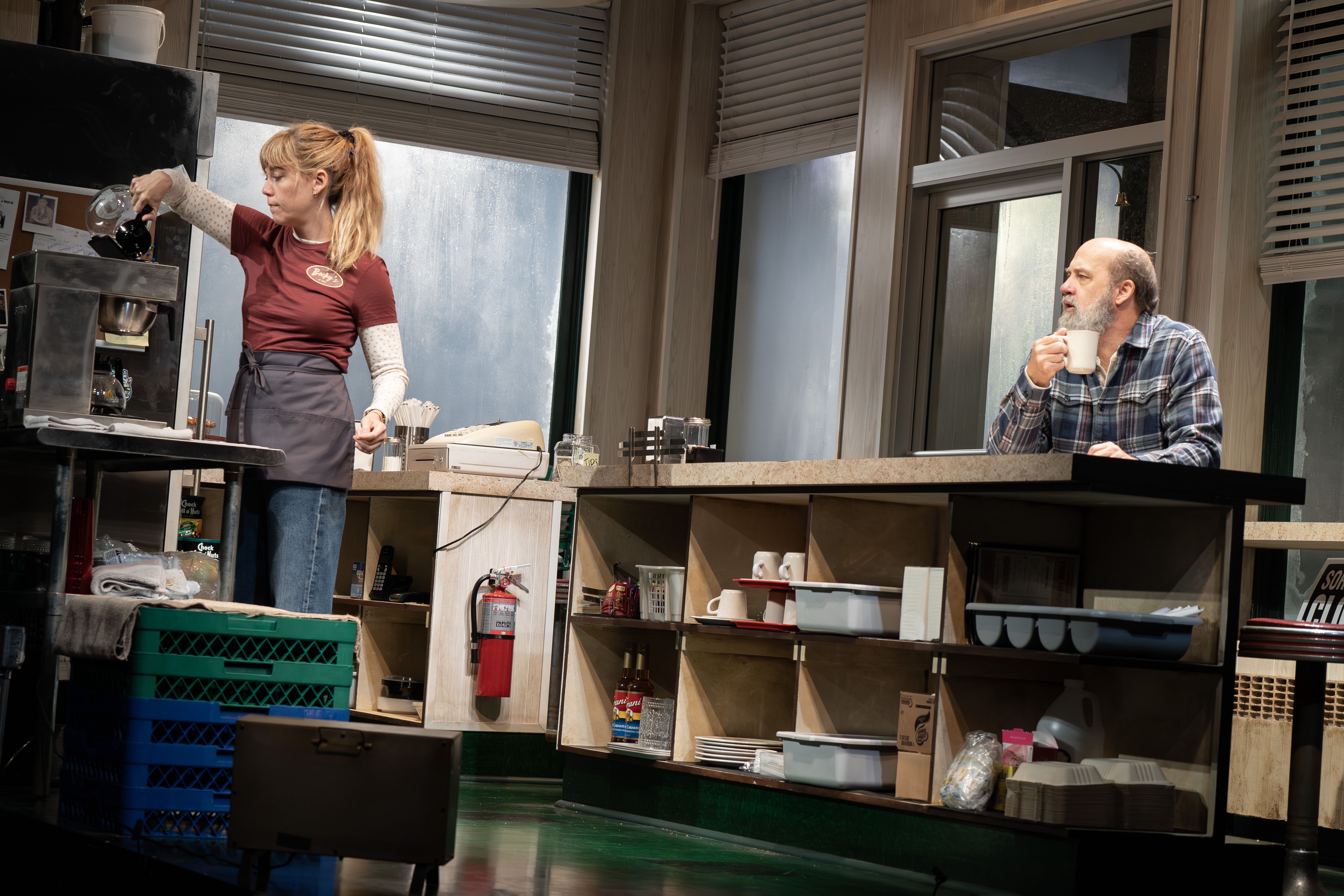
Susannah Flood and Anthony Edwards in
Roundabout Theatre Company’s The Counter; Photo by Joan Marcus

In an economic 75 minutes, Kennedy explores universal themes of grief and opportunities lost and found in a much more successful way than most of the COVID-panic-inspired plays I’ve reviewed this year (see Three Houses, Staff Meal and Six Characters).  Paul (a wholehearted Anthony Edwards nearly unrecognizable under a bushy beard) is a retired firefighter in small town New York close to the Canadian border.  He has an endearing ability to perceive, remember, and value the tiny gestures that make those around him special.  For reasons that come increasingly into focus, his life never fully launched.  Katie (Susannah Flood spreading her gloriously skittish wings) owns the cafe where Paul eats breakfast six mornings a week.  Unlike Paul, she has chosen this quiet and contained life.  With his frank urging, the two begin to form a friendship.   Amy Warren portrays third character, Peg, in a scene made pivotal by all we hear about her character before her entrance. 

Kennedy takes many shortcuts that some may find manipulative in order to move her story along to the key moments that propel each of them down their destined paths.  But in playing out their stories at 1 ½ speed, she accelerates our emotional investment in them both.  With increasing trust, they share “tough talk” with each other and us.  The balance of power shifts frequently, offering us fresh perspective with each twirl.

The scene is laid out in realistic detail by designer Walt Spangler, whose museum-worthy sets always provide an evocative sense of place.  The cafe is set on a angle, coming to a point audience center so everyone gets a pure view of every exchange.  Award-winning director David Cromer gives the central couple just enough business to heighten the small yet critical variation in the day-to-day.  Stacey Derosier’s lightening and Christopher Darbassie’s sound move the emphasis from exterior to interior dialogue and practically allow the windy world outside to swirl around our knees.  

We often hear about the importance of meeting people where they are.  The Counter illustrates exactly how powerful this connection point can be.  The underlying notes around self-care could also not come at a more appropriate time.  This limited engagement — part of Roundabout’s 2024-25 season — runs through November 17 at the Laura Pels Theatre (111 W 46th St).  Full priced tickets start at $58 and are available by calling 212.719.1300, or online at roundabouttheatre.org.

Lifeline

If you combined a biopic with a public service announcement and a Scottish jam session, you’d have Lifeline, the musical that opened Wednesday night at the Pershing Square Signature Theater.  Lifeline tells the story of Alexander Fleming, the Scottish microbiologist who stumbled upon Penicillin and introduced the world to the lifesaving power of antibiotics.  From the outset, Fleming recognized that if used incorrectly his discovery could lead to the formation of “superbugs,”: bacteria that becomes resistant to the drugs.  In tandem with Fleming’s history is the fictional tale of a rising musician, Aaron, and his childhood sweetheart now his attending physician, Jess.  While out on his first tour, Aaron had developed serious digestive issues and began taking antibiotics to relieve his symptoms.  Eventually seeking proper medical attention at Jess’s hospital, he underwent successful surgery, but developed a post-operative infection that won’t abate.  

With a book by Becky Hope-Palmer and music and lyrics by Robin Hiley and his songwriting partner James Ross, Lifeline was brought to New York by Hiley’s Charades Theatre Company, a charity that promotes community and social issues through their work.  The production started life at the Edinburgh Fringe as “The Man Behind the Mould,” and continued to evolve over six years as it toured London and D.C. among other stops.  The current rendition is described as “reinvented” and quotes from critics who reviewed the earlier two-time sell-out do not rightfully represent this run.

Drawing inspiration from practicing doctors and scientists who have engaged with the piece, the playwright does a splendid job of underlining the parallels between Fleming’s findings and current events.  Though the storyline is tough to witness and the outcome telegraphed from the outset, the first act of Hope-Palmer’s time-hopping script moves along briskly, buoyed by the musical talents of and chemistry between Scott McClure’s Aaron and Kirsty MacLaren’s Jess and the sincerity of Matthew Malthouse as the grounding Alexander Fleming.  (McClure doubles as Fleming’s war buddy, Clowes.) Alone, it would have been enough to amplify the threat that antimicrobial resistance (AMR) poses for the entire world.   Act II goes deeper into Fleming’s past and the aftermath of Aaron’s failed treatment.  But except for “I’ve Done All that I Can”, a song about the proliferation of antibiotics in our food and water delivered by Julian (Robbie Scott) a politician friend, there is little that adds to our understanding of the problem. And at a running time of 2:35, the endeavor becomes relentless — more likely to overwhelm than impress — and ends in a way that may be pure but is not satisfying.  The most thrilling twist, revealed in the last moments, concerns some of the cast members rather than the characters they portray.

In its current form, the production also seems better suited to a much larger space.  The leads are backed by five ensemble players and a rotating chorus of twelve.  A spirited band performs upstage throughout.  Alice McNicholas’s set is anchored by an illuminated turntable.  It so dominates the stage that Alex Howarth’s direction is primarily comprised of walking in circles and standing back to back while Wayne Parsons’ dance numbers featuring alter-egos and younger selves are forced to be nearly vertical.  The scenic arrangement also requires the cast to repeatedly hoist Aaron’s hospital bed on and off the platform.  Wonderfully creative visuals by Will Monks blend film, hand drawing, and helpful facts.  They are projected onto hospital privacy curtains to fill out the look, though some of Monks’ lighting is nearly blinding mid-house.

Aaron/Clowes (Scott McClure) is assisted by medical staff in Lifeline; photo by Andrew Patino

In light of a movement to have drug companies sell medications directly to patients, Lifeline provides palatable critical counsel about a rarely discussed healthcare crisis.  As a celebration of medical professionals, it’s superior to the beating of pots and pans.  As an introduction to Fleming and his achievements, it’s a shame that the whimsy of the original piece has been shed in favor of glum earnestness.  

It would be easier to recommend Lifeline as a daring artistic experiment if regular tickets were not $72 and premium seating $91, though that is understandable given the number of professionals involved who deserve to be making more than bus fare. The show continues through September 28 at the Alice Griffin Jewel Box at 480 West 42nd Street in New York.  Tickets are available at https://www.lifelinemusical.com/.   The current run is ironically sponsored in part by biopharma company GSK and pharmaceutical giant Merck.  Despite requests to turn off your phone in the lobby, don’t.  The only way to access the Playbill is with a QR code.  

FRIGID’s Little Shakespeare Festival

Saturday marked the closing night of FRIGID New York’s 4th annual Little Shakespeare Festival.  Known for their emphasis on creativity, collaboration, and affordability, this year’s line-up included seven original pieces.  Each one act script was built around the theme of Camaraderie and Community using the vast oeuvre of the Bard as a jumping off point.  

Festival curator, Conor D. Mullen, points out that Shakespeare himself was an independent artist whose casts were often composed of close friends who were given too little rehearsal time. Having a stripped down set and costumes “designed” by Goodwill is a fitting way to present productions inspired by his work.  Highlights included Mindy Mawhirter’s and Alyssa Cokinis’s The Lark and the Nightingale, which gave Juliet and Desdemona a second chance at love and happiness, and the bravely improvised As You Will created by Conor D Mullen, David Brummer, and George Hider.

Unfortunately FRIGID’s current home at UNDER St. Marks (94 St Marks Place) is literally “under,” in a basement and not fully accessible.  Aiming to remain truly inclusive, the producers added live-stream performances throughout the run.  This was how I was able to watch Hamlet Isn’t Dead’s utterly delightful When My Cue Comes with my elderly mother.  While I hope it won’t be too long before they find a space that more fully meets their needs, I encourage them to keep this option for those with mobility and caregiving issues and to reach out to audiences beyond New York. 

When My Cue Comes depicts a time when Hamlet’s Reynaldo, As You Like It’s Jaques de Boys, The Tempest’s Boatswain, and a very overworked Messenger find themselves deserted in a Waiting Room.  They had believed themselves to be essential workers.  Instead, they’ve been clipped from many a modern production and slowly bond while awaiting their next cue from The Playwright.  Quick witted and cleverly timed by writer/director B. Carty, the comical work also manages to be touching and relevant to today’s disconnected times.  

Jaques de Boys (Aaron Moore) tries to find himself with support from Reynaldo (Reid Watson), Messenger (Natalie Deboer), and Boatswain (Gabriel Ethridge) in When My Cue Comes.

This off-off-Broadway offering may be low budget, but it’s definitely not low talent.  Much of joy in this production radiates from the exuberant cast.  With perky energy possibility derived from a morning bowl of cookie crunch, Natalie Deboer’s Messenger punches through the fourth wall.  Reid Watson brings warm devotion to the abandoned Reynaldo.  As played by Aaron Moore, Jaques de Boys is profoundly rattled by his exile.  Mining every line for comic gems, Gabriel Ethridge’s Boatswain has never been more at sea.  Grounding them as long as she can is Madeline Parks, whose Playwright isn’t in as much control as she’d like.  The ease of the entire ensemble was palpable even at a distance.

Having (mostly) recovered from lockdown, FRIGID New York recently resumed their resident artists program.  Last week they announced the programming for their very full 27th season. This includes their annual Days of the Dead Festival, a celebration of nothing less than life and death, taking place October 17 to November 2. This will be followed November 3 through 17 by the 12th Gotham Storytelling Festival.  A complete schedule and ticketing information can be found at https://www.frigid.nyc/

Someone Spectacular

When their grief counselor, Beth, fails to show up for their group therapy session, the majority of her six clients vote to go on without her.  The revelation of their interaction is not in the manifestation of their grief.  Theirs is the expected cocktail of misplaced guilt, regret for things both said and unsaid, and the pain caused by the absence of “their person.”   Rather, the eye-opening moments of Someone Spectacular stem from each participant’s attempt to move the meeting — and the others in attendance— forward.  Do you keep your feelings to yourself?  Do you breathe, sleep or eat your way through?  Do you force yourself to take an obvious next step?  Can anyone just snap you out of it?

Playwright Doménica Feraud has dedicated this warm play to her mother, Nathalie Feraud-Salame, who had nurtured her through a crippling eating disorder.  It is Feraud-Salame’s whose passions and heart run through each of the characters.  Doménica’s deep understanding of Nathalie’s way of being has enabled her to use knowing shorthand to tell us much about each character in just 90 minutes.  Feraud’s genuine affection for each of her creations shines through even when she has to rely on a few tropes to find essential connections and get to her point.

The confident ensemble brings out the best in the material.  Delia Cunningham’s delicate Jude attracts attention even before the official start of the piece, dashing off stage as the audience is still finding their seats.  A moody Lily played by Ana Cruz Kayne makes herself known with a bang of her bag, a thump of her tiny rump, and a conspicuous costume adjustment. Next to catch our eyes and ears is Shakur Tolliver’s Julian, drumming on the back of his chair with a discomfort that has taken over every aspect of his life.  Dressed for business even on a Sunday afternoon, Damian Young’s Thom seems more invested in taking phone calls than in staying present.  It is Alison Cimmet’s crisp and impatient Nelle who pushes for action.  And Gamze Ceylan elegant and vulnerable Evelyn who brings the most skilled therapeutic elements to their time together.  Though Beth hasn’t arrived, her essence takes shape through their interpretation of her techniques and motivations.

Delia Cunningham, Alison Cimmet, Damian Young, Shakur Tolliver, Gamze Ceylan and Ana Cruz Kayne; Photo by Julieta Cervantes

With the exception of Thom, Director Tatiana Pandiani moves the restless mourners around the traditional talking circle of chairs.  Scenic design team dots provides them with plenty to work with from the children’s toys in the corner, the dying plant upstage, an unexplained helium balloon hugging the ceiling, and the sparse coffee set-up stage left.  This gives each audience section an opportunity to experience everyone as they literally jockey for their rightful place. 

Writing this play may have been cathartic for Feraud and it certainly is for the audience.  The more serious conversations are interspersed with understandable snark and amusing insight.  I saw friends and couples touching hands and heads in connection.  A young woman got as far as an exit door only to return to her seat and watch the remainder of the piece clutching her purse. The majority laughed and nodded in recognition.  There are plenty of moments for all present to breathe.

Grief is obviously not a problem that has a solution.  But Doménica Feraud has turned a discussion about this tough experience into an engaging and touching theatrical work.  The world premiere of Someone Spectacular has been extended at the Pershing Square Signature Center, 480 West 42nd Street,  through September 7.  (Note that it is not a Signature Theater production, but the first creation of B3-A12, a partnership which was founded in honor of Nathalie Feraud-Salame.)  The action starts promptly on the hour and there is no intermission.  Tickets range from $39 to $119.  For more information and to purchase tickets, visit https://someonespectacularplay.com/.  

Six Characters

When theater-goers hear “Six Characters,” they expect them to be in search of an author.  But the half dozen who populate Six Characters, a new theatrical by Phillip Howze currently running at Lincoln Center, are in search of deserved attention, Italian tailoring, an equitable theater community, additional paid vacation, a through-line between scenes, a tolerant audience and, in the case of “the slave,” a really good book.  Howze concepts are ambitious, but the experience is less like attending a fully formed play and more like a 2AM doom scroll through Instagram.

While sitting in the Claire Tow bar area enjoying a theme drink — a mood-setter that might make you more receptive to the edgy content ahead — you will be offered a yellow bracelet if you’re open to being a participant.  You’ll be confronted no matter your answer since the Lincoln Center audience is repeatedly called out for supporting the white dominance of performing arts with houselights ablaze.  This piece kicks, scratches, punches, and admonishes, but without a cohesive narrative or genuine depth, little of it lands.  The overarching aim appears to be making everyone in the room uncomfortable with the messages and the messengers.  This would be more effective if we weren’t already feeling rubbed raw by current events and Howze had a clearer target.

No one can fault the commitment of the cast who must ride the bumpy waves of the script.  Julian Robertson is The Director, who starts off on an unfamiliar stage trying to corral an unruly troop of strangers.  They are led by the blustery Sassafras, played with boundless energy by Claudia Logan.  She is joined by her former boyfriend (Will Cobbs), a baby-faced younger man named Newman (CG), a runaway Slave who calls herself Road (Seven F.B. Duncombe) and the theater’s janitor (Seret Scott).  Scott is given the most to work with in her embodiment of all those who hold three jobs and yet remain invisible.  And Robertson has a sense of majesty that surfaces even when he is physically tied down.

Seret Scott and Julian Robertson in Six Characters at LCT.
Photo by Marc J. Franklin

Six Characters may be short on story, but it is long on atmosphere.  Starting off on a bare stage, the piece becomes increasingly visually interesting.  Director Dustin Wills — who has collaborated with Howze before —keeps finding ways to constrain his people even in this wide open space.  Regulars of LCT in particular will appreciate the wit infused in Wills’ set design, most notably at the top of Act II.  Each of the characters is given layers of fakery and playfulness to literally try on by costumer Montana Levi Blanco.  And the sound by Christopher Darbassie is relentless even during intermission.

Steps are being taken in boardrooms and on leadership teams throughout the American theater world to make space for a variety of voices and viewpoints.  And just as there is no such thing as a “Black job” (a line that was likely added in the last few days) no play should be labeled a color.  But Howze does a disservice to Six Characters and to a willing audience by leaving us feeling exhausted, peering out a tiny window with no sense of a healthy way forward.  

Six Characters run through August 25th at the Claire Tow Theater in Lincoln Center, 150 West 65th Street.  All tickets are $33 including fees, though the Telecharge interface is poorly designed and frustrating to use.  Runtime is 2 hours and 10 minutes including intermission.  The lobby and roof top deck open one hour before curtain. 

Responders

As Tucker’s mother sees it, everything happens at the same time: the good, the bad, and the random.  That paradigm is evident in Responders, Joseph Scott Ford’s new play currently running at Arkansas’s TheatreSquared. The good, is the apparent affection the characters hold for one another, even the squabbling exes Daryl and Suzie. The bad is the suicide paramedic Daryl and his newly minted partner Ang have found hanging from a billboard near the highway.  The police who should be first responders are running late because of a flat tire.  The school buses will soon be driving by and Ang — deeply concerned about the impact the gruesome sight will have on the town’s young children — is considering bending the rules and disturbing the scene.  But Suzie, an ambitious local news reporter, needs a big story. She would rather capture every traumatized face with her loyal cameraman, Tucker.  The random will not be spoiled here except to say it completes Ford’s exploration of mental distress through a droll and compassionate lens.  

An Arkansas native, Ford applies a distinctive perspective to rural middle American life that is simultaneously loving and probative. This Oklahoma town is so small that the Uber service is simply “Sandra.”  The contained setting promotes both the closeness and the friction that makes the action and the dialogue click.  The banter is relaxed and humorous even when the situation clearly isn’t.

Director vickie washington, who collaborated with Ford when the piece was being developed at T2’s 2022 Arkansas New Play Festival, returns to the helm.  She leverages the obvious comfort between her cast members, all of whom appeared in previous incarnations of the work.  From the outset, the body remains mostly obscured by a stark and dusty roadside set designed by Sydney Lynne, chillingly a prop more than a person.  The victim’s suit jacket and polished shoes (props by Brodie Jasch) sadly hang on fencing nearby.  Kelsey Claire’s plain-speaking Ang and Bradley Campbell’s world-weary Daryl arrive with the gurney through an aisle between the two perpendicular audience sections, immediately drawing everyone into the action.  The two actors play warmly together and each one is given an intimate scene with Edwin Green’s recently returned veteran Tucker.  The conversation between Daryl and Tucker, built on the awareness that their jobs have warped their senses of humor, is particularly moving.  Though her dialogue also offers glimpses of a tender side, Miranda Jane remains too shrill and edgy to give Suzie the balance that is evident in Ford’s script.  Costume designer Jennifer McClory has taken care to ensure her character literally stands out in fuchsia against the uniforms and earth tones of the others, so this further push is unnecessary.  Levi J. Wilkins’s lighting offers gentle shading where it’s needed.

Bradley Campbell and Kelsey Claire in Joseph Scott Ford’s Responders.
Photo credit: TheatreSquared

By blending clever repartee with straightforward talk, Responders finds the sweet spot between entertainment and message.  It is a true homegrown product marking the fourth co-production of the Fayetteville, Arkansas based TheatreSquared and Arkansas Repertory in Little Rock.  Running time is an hour and 15 minutes with no intermission.  This World Premiere continue through June 30 at the Spring Theatre on 477 W. Spring Street in downtown Fayetteville, Arkansas. Tickets are $43-$68.  Digital tickets are available through T2 at Home for just $25.  Though the audio is slightly muffled and best experienced with headphones, it’s a nice option if you are unable to get to a live performance.  Visit https://www.theatre2.org/ for more information and to purchase tickets.