Tag Archives: Cathy Hammer

Appraisal (Preview)

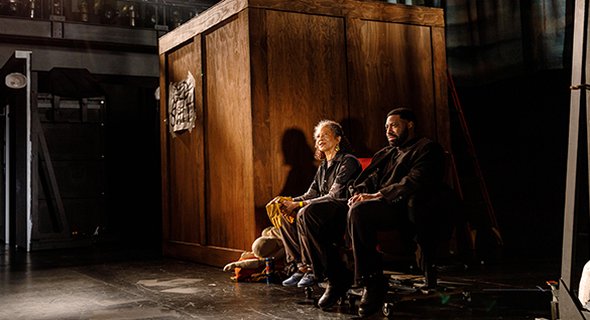
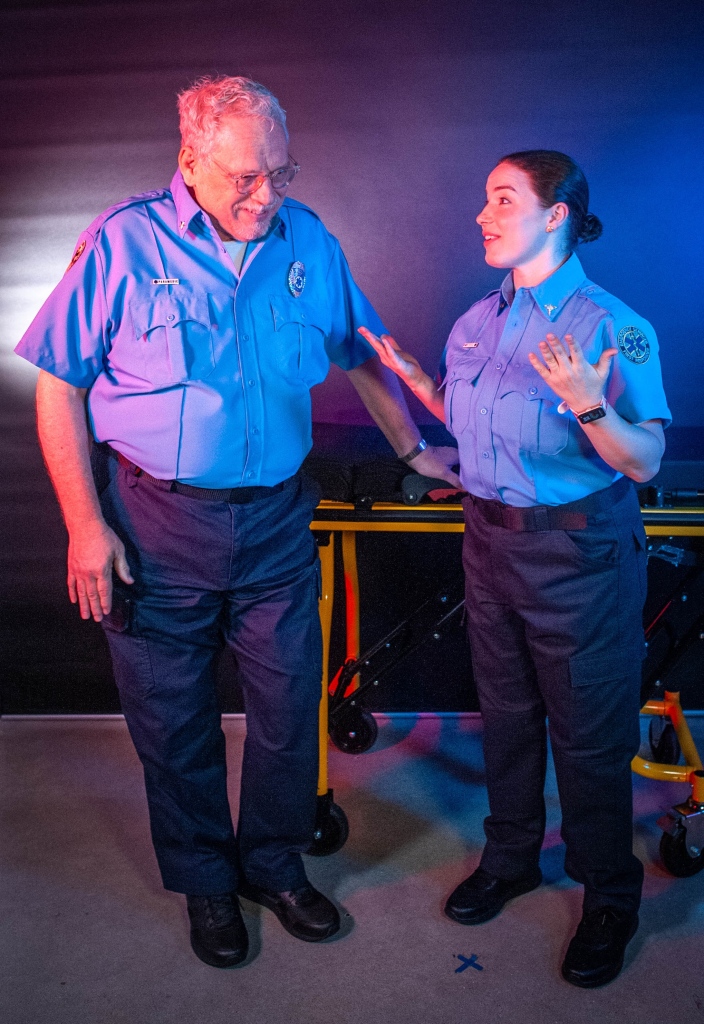
Plato said, “One of the penalties for refusing to participate in politics is that you end up being governed by your inferiors.”  This sagacious line — quoted about halfway through the dark comedy Appraisal — summarizes Nicky’s worst fear as she enters the political minefield of her annual review. Her evaluation will be conducted by Jo, a man she’s privately told others is lazy among other shortcomings.  Nicky has admitted to making a few missteps in her ten years of supervising her team.  Like many office workers, she’s frustrated by the amount of paperwork and meetings that have chewed up her time.  But by traditional standards, she is a caring and dedicated employee who delivers measurable results.  Unfortunately for Nicky, Jo isn’t applying traditional standards.  His professional agenda — which falls somewhere below his desire for a better golf swing — is revealed turn by turn.  

As constructed by playwright Tim Marriott, who also portrays Jo, Appraisal travels some well-known pathways.  Having us settle into a rhythm of comfortably nodding our heads only serves to make the arrival at less familiar territory more jarring.  Director Margarett Perry has given the affable Marriott some wonderfully revealing staging.  He increasingly displays the physicality and emotional intelligence of a spider.  With a baring of his teeth that he hopes passes for a smile and some inappropriately chummy body language, Jo is off-putting even when he’s delivering something of a compliment.  Alex Sunderhaus’s Nicky is, engagingly, harder to peg.  The only questionable artistic decision is to dress her in a sleeveless yellow striped pantsuit (presumably from the actresses’s own closet since no costume design credit is given) topped off with messy hair held back by dime store barrettes.  It’s an incongruous look for an astute corporate player and an unnecessary distraction from a strong edgy performance.

Marriott and Sunderhaus in Appraisal; photo by Carol Rosegg

The power struggle between Jo and Nicky is relatable even to those who have never held an executive position.  There is a universality in the desire to be heard and valued and a general loathing of the dysfunctional hierarchies that seemingly weed out talent.  Another strength of Marriott’s lightly humorous script is the succinct yet vivid descriptions of characters we never get to see including Nicky’s child, Sam, and her co-workers, Cassie and Kat.  

With an peppy work-related soundtrack (Morning Train, Nine to Five, Manic Monday), 59e59 Street Theaters sets the tone for a pleasant and distracting hour of entertainment fitting for a hot summer evening.  Appraisal continues through June 30 in their Theater B as part of their Brits Off Broadway Season. Tim Marriott’s Smokescreen, a contemporary issues-based production company, co-produces with Twilight Theatre Company, a non-profit that supports the development of new works primarily by emerging UK artists.  Tickets are $30 for members and $44 for non-members.  Due to the intimacy of the space, there is no late seating and no reentry.  For more information visit https://www.59e59.org/shows/show-detail/appraisal/

Coach Coach

Dr. Meredith Martin is not just any old coach.  She is an esteemed coach coach running a very exclusive program for coaches who are struggling.  Her current retreat — held in an aging and overstuff rental home centered between an airport for convenience and the woods for aesthetics — is so exclusive there are only four attendees.  Each of the participants hopes Dr. Martin will elevate her practice and perhaps even give her a place on the insider team.  

This is the set-up of Bailey Williams’ new comedy Coach Coach, the second entry of  Clubbed Thumb’s 2024 Summerworks.  Commissioned by the daring incubator, the script is not as wholly satisfying as some of their past offerings.  Williams has fun playing with the language of psycho babble and marketing spin and earns many chuckles, but the work could be far more expansive in its views of what is admittedly a poorly regulated speciality and more probing in its observations about the sway of some players within it.  While each soliloquy highlights an aspect of a character’s struggle, collectively they give a choppiness to the unfolding of events without significantly varying the tone or the emotional undercurrent.  

Despite its shortcomings it is, in the words of one CT insider, very “on brand”: thoughtful, explorative, and marching to the beat of its own rhythm section.  Also in keeping with Clubbed Thumb’s deserved reputation, all the artistic elements are of high quality.  The cast  — Purva Bedi, Cindy Cheung, Becca Lish, Kelly McAndrew, Susannah Millonzi and Zuzanna Szadkowski — is terrific both as individuals and as a well orchestrated ensemble. Even when the characters are not fully listening to one another, the actresses clearly are.  Director Sarah Blush has mined the recursive dialogue for maximum impact, for example having death coach Velma (Millonzi) slither over the furniture with reptilian delight and often leaving the deflated Patti (Cheung) perched at the end of her chair as if she isn’t sure she deserves to even sit.  Dan Wang’s costumes are color coded for each specialty: green for business, hot pink for romance, black for death and so on.  His initial wardrobe choice for assistant coach Margo (Szadkowski) received its own round of applause.  Scenic designer Colleen Murray’s selection of furnishing styles lends the right oppressive air. And lighting design by Masha Tsimring and sound design by Johnny Gasper lean heavily into the eeriness of the ill-fated gathering.  

Margo (Zuzanna Szadkowdki) contemplates her options in Clubbed Thumb’s Coach Coach; photo by Maria Baranova

Coach Coach runs through June 13 at the Wild Project on 3rd Street between Avenues A and B.  Running time is 75 minutes with no intermission.  Evening performances are almost completely sold out, but there are newly posted 3:00pm matinees on June 12 and 13.  Tickets are $25 for students, $30 for general admission, and $40 for a reserved seat (highly recommended.)  You can also “pay it forward” for $60.  And if you find yourself too late to secure a spot for this very limited run, consider being ahead of the curve for Crystal Finn’s Find Me Here opening on June 19.  With its starry cast and notable design team, this final entry of the season is sure to be a Clubbed Thumb treat.  Visit https://www.clubbedthumb.org/productions/2024/ for more tickets and information.

Breaking the Story

Alexis Scheer’s Breaking the Story begins quite literally with a bang.  A shell has just exploded next to conflict journalist Marina and her cameraman/romantic partner, Bear.  Renowned for unearthing the human side of war, she’s made a bad call while covering yet another war zone.  Missing and presumed dead, headlines featuring Marina’s many accomplishments dominate the news cycle.  Then as the lights come up a second time, all is peaceful at the large house in Wellesley, Massachusetts that  Marina has just purchased.  Due to receive a distinguished achievement award for her 20 years of service, she decides to tack on a wedding and hastily proposes to Bear.  She invites all those who are closest to her for the double celebration.  Attempting to devote herself to this new life, she promises her mother, daughter, and best friend that she’s ready to hang up her flak jacket for good.

It is immediately obvious that whatever she says, Marina is not at home here.  In scenic designer Myung Hee Cho’s set and Elaine J. McCarthy’s projections, the grass is too green, the flowers are several feet high, and the house is an empty frame. Her professional drive is at war with whatever love she feels for those around her.  Her trauma-triggered nightmares keep intruding on this world. Lighting designer Jeff Croiter ensures that everything is uncomfortably bright around her.  Noises from the front penetrate the sound design of Darron L West.  Even as she plans her wedding, costume designer Emilio Sosa never switches up her khaki and black garb.

Julie Halston and Maggie Siff in Breaking the Story; photo by Joan Marcus

It also becomes evident that though her coverage of the perpetrators and victims of battle are deep and affecting, Marina has never been able to properly tell her own story.  For that report, the lead has been taken by Nikki, a fan and rival with a podcast about Marina’s work. As a very-long-distance Mom, she has relinquished her say in the life of her daughter Cruz, an 18 year old aspiring singer. Marina’s mother — known to all as Gummy — has woven her own personal motivation into the history of her daughter’s chosen profession. Her bestie, Sonia, considers herself one step ahead of her friend, though she might not be on the same road at all.  Even Bear really only knows her under extraordinary, often perilous circumstances.

Though the overarching themes of war and politics are handled with brutal honesty, Scheer’s dialogue is full of humor, warmth and insight.  The effect is simultaneously funny and horrifying.  Director Jo Bonney brings out the best in her entire cast, helping them smoothly ride the changing emotional waves.  Maggie Siff’s Marina is at once delightful and infuriating.  In perfect contrast, Tala Ashe brings perky polish to Nikki.  With a gorgeous voice and a sullen look, Gabrielle Policano fleshes out young Cruz while the invaluable Julie Halston delivers Gummy with her well-known spunk and wit.  Sonia is total class and business in the hands of Geneva Carr.  And Louis Ozawa lends his warmth and charm to Bear.  Matthew Saldívar makes a brief but memorable appearance as Marina’s suave ex-husband, Fed.

Breaking the Story is a captivating and intelligent night of theater.  With wars in Ukraine and Gaza regularly leading the news, it’s an opportune moment to dive into the world of those who take risks — sometimes fatal ones — to put faces to these tragedies. It also marks the penultimate production Second Stage will present in their longtime home at 305 West 43rd Street and it’s a shame to be losing this venue.  Even towards the back of the house, the sound was crisp and the sightlines clear.  Performances are available through June 23.  Running time is an absorbing 85 minutes.  Curtain is at 7PM with matinees on the weekends.  Tickets begin at a bargain $35 and can be purchased at https://2st.com/shows/breakingthestory.

Away on Australian National Theatre Live

Michael Gow’s Away remains one of the most produced plays in Australia.  First performed nearly 40 years ago and set in 1967/68, it explores grief, family relationships, and xenophobia against the backdrop of a distant war in Vietnam.  Away may be considered uniquely Australian, but those themes are timeless and have continued to reverberate, making this play forever relevant and moving.  Fortunately for those of us in this hemisphere, an all-around excellent production from 2017 — a co-production of the Malthouse Theatre and Sydney Theatre Company — is available to watch on Australian National Theatre Live.  With a first rate cast led by Heather Mitchell at her biting best as Gwen, this layered revival makes for a fulfilling 1:40 for any theater fan.

Bookended by the words of William Shakespeare, the action opens with the final scene of an emotive and balletic high school production of A Midsummer Night’s Dream.  The evening is hosted by the outwardly jovial Roy, whose wife Coral is consumed with depression over their son who died in battle.  Puck has been played by the sweetly awkward Tom, the only child of working class English expats, Harry and Vic.  He has fallen for his costar, Margaret, whose nouveau riche parents, Jim and Gwen, aren’t thrilled about the boy’s attentions.  All three families leave for beachside holidays over Christmas break, but at three very different levels.  Roy and Coral are flying to a ritzy resort where they’ve been regulars.  Margaret, Gwen and Jim are off to an upscale caravan park in their luxury camper-van packed with fishing equipment and other gear.  Meanwhile, Tom, Harry, and Vic load their lean-to pup tent into the family car.

Playwright Gow seamlessly blends lighthearted humor, social commentary, and surreal fantasy.  The three parallel stories beautifully and economically unfold, with all the actors playing ancillary characters in each other’s tales.  The juxtaposition of the high anxiety of Gwen with the genuine warmth of Vic set up the confrontations that ripple through each encounter.  There is no situation Gwen can’t make worse nor one that Vic can’t see the best side of.  The young couples’ exchanges ring true and are deeply touching.   There continue to be reverberations of Midsummer with an increasing number of besotted Bottoms among the dancers and a Shakespearean-sized storm brewing.  Tom often watches from the sidelines, like Puck overseeing his handiwork, though Tom has little control over any story, especially his own.  

Cast of Away (2017); Production Photo by Prudence Upton

Even through the lens of a camera crew, the top notch design shines through.  Powerfully directed by Malthouse Artistic Director Matthew Lutton, the staging includes several etherial dances choreographed by Stephanie Lake.  Though the stage remains nearly bare throughout, there is always a strong sense of place centered around an almost-magical wardrobe (set and costumes designed by Dale Ferguson).  Most of the surroundings are conveyed in light and sound with Paul Jackson’s lighting providing the eery warm glow of backstage, garish pink of a dance floor and stark whiteness of a deserted beach.  The atmosphere is made more jarring by the discordant sound design of J. David Franzke.  In addition to Ms. Mitchell, the cast includes Liam Nunan (Tom), Naomi Rukavina (Margaret), Glenn Hazeldine (Roy), Wadih Dona (Harry), Julia Davis (Vic), Marco Chiappi (Jim), and Natasha Herbert (Coral).

This stirring production of Away was among the first dramas uploaded to Australian National Theatre Live during the pandemic.  While there is no substitute for being in a darkened room with strangers, the service (https://australiantheatre.live/) does a first rate job of sharing a range of quality work live-captured by Peter Hiscock and his crew.  The concept is to allow a wide audience to enjoy these productions regardless of their location, income level, or physical limitation.  Subscriptions are $7.99 per month or $74.99 per year and a free trial is available.

Three Houses

For a play named after a family dwelling, Dave Malloy’s Three Houses has surprisingly little structure.  Set in a magical cocktail bar with an orchestra that can follow along in any key, three strangers share their experiences in a confessional open-mic night.  When the pandemic broke out, each one of them had just gone through a break-up with a partner and found themselves secluded and struggling mentally.  While there are similar strands within their tales, their ordeals only lightly touch, like their pinkies when they finally share a table.  Along the way, there are some wonderfully creative moments and beautiful melodies.  But like the current drive along the crumbling Highway 1 in Big Sur, a final point remains illusive.

In House #1, Susan (Margo Seibert) had been researching her next novel in Finland when COVID hit.  Unable to get back to the United States, she retreats to her grandmother’s abandoned house in the Latvian woods.  In a haze of red current wine, weed, and OCD, she uses the time to learn what she can about her ancestor.  House #2 is set to more uptempo tunes as we move from the deep woods to the sunny desert.  When her aunt returns to Korea leaving her New Mexico home unoccupied, Sadie (Mia Pak) takes refuge there.  Painfully missing her girlfriend, she further retreats into a SIM she has meticulously modeled on memories of her grandparents.  House #3 is actually a small basement apartment into which Beckett (J.D. Mollison) has moved after the end of his marriage.  On every level, it becomes the darkest of the dwellings, especially after he learns that his grandparents have just passed away in Ireland and paranoia sets in.  

Three Houses is the final piece of Malloy’s trilogy which includes Ghost Quartet and the memorable Octet.  Having written the music, lyrics, book and orchestrations, this work completely embraces his usual fascination with fables.  As they grapple with the effects of isolation and regret, each of our storytellers develops a relationship with a fictional being represented by puppets with tremendous personality designed by James Ortiz.  Elements of The Three Little Pigs play key roles and even show up in a sweater.  But when the inevitable wolf finally makes it to the door, he is dressed in grandma’s nightgown, which for fairytale purists will be perplexing.  

Mia Pak (with Pookie the Household Dragon) and Margo Seibert in Three Houses

All three soloists are terrific and support each other vocally and energetically.  Henry Stram and Ching Valdes-Aran appear as all of the mystical grandparents.  Scott Stangland rounds out the cast exuding something between command and menace as the bartender/MC Wolf.  However, Annie Tippe’s direction is both mystifying and maddening, especially given her assured hand with Octet.  The same black box space has been splendidly designed by the imaginative team of dots to feel warm and inclusive and a tad old-fashioned.  Fabric is draped all along the mezzanine, and the orchestra members sit in armchairs adorned with crocheted throws.  Center stage is an elaborate wooden bar, but even from the middle of the side section — normally a great spot in ¾ round — I could not make out what was on the changing backdrop behind it.  The vast majority of the staging is forward facing with the actors sometimes positioned side-by-side blocking each other from view.  Lighting designer Christopher Bowser has added some attention-getting effects and Haydee Zelideth costumes are a likewise literally colorful component that visually adds to the stories.  Nick Kourtides envelops the audience with his sound design, which appropriately alternates between feeling comforting and smothering.

Ultimately, Three Houses is more like a trio of discontinuous chapters of an unfinished novel than a fully fleshed out musical.  While the emotive songs and fanciful imagery of Octet have carried over, the clear interconnection of  those characters is missing here.  But there is some interesting terrain explored in finding discipline amid chaos and all the ways in which you can and can’t get to know someone else and — through them — yourself: vast themes to cover in a mere 100 minutes.  The production runs through June 9 at the Signature Theatre  (480 West 42nd Street) where Malloy is Premiere Resident.  Tickets ($49 – $124) and information are available at https://signaturetheatre.org/show/three-houses/

EPIC Players’ Spring Awakening

For their current musical production, EPIC  — an acronym for Empower, Perform, Include and Create — has chosen Spring Awakening.  Boasting memorable harmonies by Duncan Sheik and scathing lyrics by Steven Sater, it was a Tony winner for the original Broadway production and nominated again for its revival.  It famously gave rise to the careers of Jonathan Groff and Lea Michele.  But despite its starry origins, it is best remembered for the bluntness with which it explores abuse, neglect, and desperation. The seemingly insurmountable challenges of adolescence are what resonated particularly strongly with the neurodivergent cast, whose community is often desexualized, infantilized, and sometimes even mistreated.  (Cast members are all over the age of 16 and on the spectrum of autism.) 

Based on a 19th century work by German playwright Frank Wedekind that was subtitled A Children’s Tragedy, there are unfortunate ripples in today’s world in which healthcare for women and protections for the queer community are being restricted.  The Romeo and Juliet of sorts are Melchior (William Ketter) and Wendla (Sydney Kurland), his former childhood friend.  Her deeply repressed childhood has left her ill-equipped to take care of herself and longing to feel absolutely anything.  In a classroom where there is no room for critical thinking, he has read so much unsanctioned material that he has figured out the mysterious world of sex.  Their collision course is set.

Sydney Kurland and William Ketter

More lost to each other are Mina Cuesta’s Ilse and Reuben Baron’s Moritz.  Both have been abandoned by family, but she has found freedom and shelter within an artistic community, while he is utterly adrift.  Arguably the most charismatic pair are Hanschen played by deaf actor Samuel Langshteyn and his voice emotively interpreted by Chloe Rose Solomon.  Their literal intertwining provides many of the most bewitching moments.  All are backed by a chorus exemplifying range and expressiveness. 

Chloe Rose Solomon and Samuel Langshteyn

EPIC has always excelled in their musicality and this production is no exception.  The orchestra under musical director Blake Bauer is lyrical and clear.  Cast member Laisha Gonzalez delivers Martha’s solo in “The Dark I Know Well” with an Amy Winehouse soulfulness.  Cuesta provides Ilse with the voice of an angel complete with a wing-like shawl (costumes by Nicole Zausmer) that she bestows on a thoroughly dispirited Moritz in “Blue Wind”. And in an Act II showstopper, “Totally Fucked”, Ketter grabs a hand-mic to transform into full-on rock idol.

Mina Cuesta and Reuben Baron

Director Travis Burbee has placed his cast down the middle of the black box space so the attendees provide support from both sides.  The layout constricts the range of motion possible by the large troop of actors, but it boost the level of intimacy with the audience. Burbee also handles the violence in a way that is visceral without being unnecessarily graphic. (The team worked with a Mental Health Counselor, an Access Coordinator, and an Intimacy and Fight Director to support the cast throughout the development process.)  The set by designer Matthew Imhoff is centered around a long plot of earth, which at times symbolically nourishes the affection-starved teens.  Soft banks of lights by Cameron Filepas rise like plantings on either end.  

Deeply meaningful to a generation, Spring Awakening gives the EPIC cast a darker voice.  A content warning is announced before the lights dim.  Noise cancelation headphones are available and audience members are invited to decompress in the lobby if needed. Running time is 2 hours and 10 minutes.  Performances are Wednesday through Sunday until May 19 at ART/ NY’s The Mezzanine Theatre, 502 West 53rd Street, 2nd floor.  General admission Tickets start at $35. $20 Video streaming tickets will be available during the second week of shows. All tickets can be purchased online at https://epicplayers.ticketspice.com/epic-players-presents-spring-awakening-.

EPIC Players’ Spring Awakening

CAST:
Wendla: Sydney Kurland 
Martha: Laisha Gonzalez 
Thea: Rachel Barcellona 
Anna: Katherine Tepan 
Ilse: Mina Cuesta
Melchior: Will Ketter
Moritz: Reuben Baron
Hanschen: Samuel Langshteyn
Ernst: Josh Cartagena
Georg: Rafiq Tate
Otto: Shafer Gootkind
Adult Women 1:  Shoshanna Gleich
Adult Women 2: Samantha Elisofon
Adult Man 1: Gerard Riley
Adult Man 2: Max Tunney
Ensemble: Henry Houghton
Ensemble: Emy Ramos
Voice of Hanschen: Chloe Rose Solomon 

CREATIVE TEAM AND CREW:

Director: Travis Burbee
Assistant Director:  Gabe Girson 
Music Director: Blake Brauer
Choreographer: Miles Butler
Stage Manager: Sydnee Davis
Production Manager: William Morris
Assistant Stage Manager: Carol Hoverman
Assistant Stage Manager: Cassidy Kaye
Director of Artistic Sign Language: Kailyn Aaron-Lozano
Intimacy and Fight Director: Hannah “Rock” Roccisano
Intimacy and Fight Assistant: Scarlet Yousif
Scenic Designer: Matthew Imhoff
Sound Designer: Sean Ramos
Costume Designer: Nicole Zausmer
Props Designer: Madisen Frazier
Light Designer: Cameron Filepas 

Executive Artistic Director: Aubrie Therrien
Front of House:  Talia Eapen
Access Coordinator: Jamie Rose Hays
Mental Health Counselor: Taupa Fogo-Toussaint

Production Photos: Zui Gomez

Shimmer and Herringbone

At the opening of its full and fleeting 85 minutes, Shimmer and Herringbone introduces us to a range of people each trying on a pile of clothing and judging themselves in a mirror.  It’s a familiar dance with capes and belts as unhelpful partners.  Their search is not just for the right look, but the right feeling; one they might just find at the titular vintage clothing store.  

With witty and insightful rapid-fire exchanges written by Ellen Maddow (who appears within the play as Rhonda, the over-sharing dressing room lady) and Paul Zimet (who directs with deep understanding), the play is located in a city sophisticated enough to be home to a semi-famous soap actor (Jack Wetherall), a townhouse-owning retired teacher (James Tigger! Ferguson), and the aforementioned boutique.  But it is also small enough to enable the chance encounters and meaningful interactions that only happen in a true neighborhood.  Maddow also wrote the music played by a live string trio (Rachel Feldhaus, Marija Kovacevic, and Agustin Uriburu who good-naturedly appear on stage and fully participate) which the characters acknowledge as the soundtrack to their actions.  In their lightest moments, they are moved to dance in celebration, guided by choreographer Sean Donovan.

From details in the dialogue, the story is unfolding shortly after the toughest winter of the pandemic.  Residents are no longer wearing masks of the N95 variety, but they are still veiled.  Their outfits shape how they feel about themselves and also how they wish to be perceived by others.  Each is slightly oddball, but utterly endearing.  We meet Louise Smith’s Grace, a real estate agent who is forever staging her surroundings, and her former best friend Lizzie Olesker’s Lilly, an ornithologist who seems to relate quite strongly to the pigeons she studies.  There is also Lilly’s struggling entrepreneur daughter Bree (Ebony Davis) and Bree’s possible business partner, a former actress named Melanie played by Talking Band co-founder Tina Shepard.  The actors seem to be having a blast and the audience is tickled just to be in their company.

James Tigger! Ferguson, Louise Smith and Lizzie Olesker; photo by Maria Baranova

The true star of the show is arguably Serbian costume designer Olivera Gajic.  She has stocked the central store and surrounding closets with a delightful and nearly indescribable wardrobe.  Our attention is further captured by the deceptively simple set and revealing videos of Anna Kiraly.  Additional color is brought forth by Mary Ellen Stebbins’s lighting.

Like a small scale and less mysterious Tales of the City, Shimmer and Herringbone is above all about self-acceptance and living comfortably in ones own skin.  It also provides a humorous and uplifting visit with literally colorful characters who form a most-welcome community.  A creation of the 50 year old interdisciplinary company, Talking Band, this play with music continues through May 19 at Mabou Mines’ Second Floor Theater at 122CC, at 150 First Avenue near Saint Marks Square in Manhattan. Performances take place Wednesday – Saturday at 7pm and Sundays at 2pm.  Tickets are $30-$35 and can be purchased at https://talkingband.org/works/shimmer-and-herringbone/.

Staff Meal

A staff meal at a typical restaurant is an opportunity for the entire crew to be treated as equal members of a “family.”  However, in Abe Koogler’s Staff Meal currently being served up at Playwrights Horizons, there is something odd transpiring around the table.  While the enthralled servers moan in delight, what we see is unremarkable.   The true source of their reaction is imperceivable to outsiders.

At this same unnamed venue, Ben (Greg Keller) and Mina (Susannah Flood) are out on a what would strike most of us as a dreadful first date, though they seem quite comfortable with each other’s horror-tinged stories.  Their waiter (Hampton Fluker) is on a mesmerizing walk through the dark, deep, and disorganized wine cellar.  And the Servers (Jess Barbagallo and Carmen M. Herlihy) are just giddy to be employed by the elusive Gary Robinson (Erin Markey who is also — somehow — the chef and a vagrant) a man of wealth whose philosophy is what keeps them full.  Along the way, these characters don’t just break the fourth wall, they bulldoze it, build a fresh one, and then smash that one with a mallet as exemplified by Audience Member (Stephanie Berry).

Vagrant (Erin Markey) goes job hunting in Staff Meal; photo by Chelcie Parry

Similar to many artistic endeavors that were completed during the pandemic, Koogler’s piece is much more intent on capturing an unfamiliar mood than it is on telling a story.  The restaurant at its center is a unique universe with a distinct environment and even — it would seem — its own gravitation pull.  Individual scenes are like a Matryoshka Doll in reverse, with each character revealing a bigger, more colorful veneer without changing much of the plot’s shape.  Koogler imbues them all with astoundingly vivid and detailed memories and imaginations.  Poetic meditations on food, love, the past, and being of service are passionately delivered.  But while the people on stage search for common ground, you too might be casting about in hopes of feeling a connection. 

Under the hand of director Morgan Green, the artistic team functions in concert to support the absurdist tenor of the work.  Comparable to quarantine at COVID’s height, time spirals and sense of place becomes illusive.  Jian Jung’s papered walls are both elegant and nondescript.   The costumes by Kaye Voyce start off as commonplace and morph into outright bizarre.  As the players grow increasingly wary, Masha Tsimring’s lighting follows that tone.  Tei Bow’s sounds and music complete the vague and uneasy landscape.

Not unlike the restaurant that is Staff Meal’s home base, this play serves up some novel flavors. If you are willing to hover somewhere between drama and performance art, you might savor the experience without the need to define each morsel.  But also akin to dining in that central establishment, the undertaking might leave you feeling hungry for something more solid.

Staff Meal continues through May 19 at the Peter Jay Sharp Theater on the 4th floor of Playwrights Horizons at 416 West 42nd Street.  Running time is one hour and 35 minutes with no intermission.  Tickets are $51 – $91 and can be purchased at https://my.playwrightshorizons.org/events/staffmeal.

Agreement

The younger generations in America may not remember “The Troubles,” a violent nationalist, religious and political conflict in Northern Ireland that lasted over 30 years and reverberated through England and mainland Europe. It was declared at an end on Good Friday of 1998 after a long and difficult negotiation led to an agreement between factions.  The brave and complex process that led to the signing of this historical document is dramatized in Agreement, currently running at the JL Green Theatre in New York.

Senator George Mitchell (Richard Croxford) had been sent by then-President Bill Clinton to facilitate the proceedings.  He described it as simultaneously juggling knives and balloons.  For those unfamiliar with this historic event, the other participants in the room were:

Gerry Adams (Chris Corrigan): president of Sinn Féin, which was associated with the new Irish Republican Army

Bertie Ahern (Ronan Leahy): a Christian Conservative who served as the equivalent of Prime Minister of Ireland

Tony Blair (Martin Hutson): the newly elected and immensely popular British Prime Minister

John Hume (Dan Gordon): founder of the Social Democrats and Labour Party who won the Nobel Peace Prize

Mo Mowlam (Andrea Irvine): Secretary of State for Northern Ireland in Blair’s cabinet

David Trimble (Ruairi Conaghan): the leader of the Ulster Unionist Party who became the first leader of Northern Ireland

These introductions are covered in the first minutes of the play and characters frequently break the fourth wall to update the audience on their thinking and motivations.  Most of the cast members don’t look much like their real-life counterparts nor do they attempt imitation.  Rather they capture the essence of each person as seen through smiling Irish eyes.  With the gruff plain spoken delivery of his first line, Chris Corrigan’s Adams gets a knowing chuckle from the audience.  Dan Gordon’s John Hume, the realist of the group, delivers the clearest insider view. Martin Hutson plays Blair as a puffed up buffoon, high on his “mandate” stardom.  As Ahern, Ronan Leahy wonderfully performs the highest wire act both emotionally and politically.  The lone woman, Andrea Irvine has some of the same struggles as her opposite number, not given enough to do to fully define herself.  

The cast of Agreement at the Irish Arts Center

Director Charlotte Westenra could have done more to vary her actors’ approach to the text, but her straight-line approach does help audience members remember who stands where on the thorny issues.  With the focus on playwright Owen McCafferty’s fiery exchanges of dialogue, the artistic craftwork is also kept to a minimum.  The set by Conor Murphy centers on an overhead projection screen of a slowly shifting cloudy night sky.  It also serves as a television monitor and timekeeper with videos designed by Eoin Robinson.  Desks and chairs are continually rearranged by the players, more to provide variety than to establish any particular sense of place.  May Tumelty turns up the heat and the lights at key moments, which are punctuated by the contributions of composer Kate Marlais.

It is significant that the work is simply called Agreement and not “The Good Friday Agreement” or even “*The* Agreement.”  At a time when civil discourse and true negotiation seem impossible, the happenings portrayed are a refreshing reminder that informed and motivated people can find their way to a middle ground if they stay true to the greater good.  Despite passionate disputes over critical areas, democratic principles held. Ah!

Agreement continues through May 12 at the newly christened JL Greene Theatre in the Irish Arts Center, 726 11th Avenue.  The venue opened at the end of 2021 and boasts comfortable seats, a welcoming café, and a conversational staircase.  The production comes to us from the Lyric Theatre of Belfast.  Running time is 1 hour and 48 minutes with no intermission. Tickets are $25-$90 and can be purchased at https://irishartscenter.org/event/lyric-theatre-agreement.  

Fish

We’ve heard the old proverb, “Give a man a fish and you feed him for a day; Teach a man to fish and you feed him for a lifetime.”  But what are you supposed to do if you don’t have the money for a rod, line, or bait?  That is the provocative question behind Fish, a world premiere play by Kia Corthron currently running at Theatre Row on 42nd Street in New York.

The story revolves primarily around Latricia, known as Tree, a sharp 18 year old senior attending a typical urban high school that is short on funds and long on drop outs.  The teen has much more on her plate than 100 word essays.  With her mother incarcerated for a minor drug violation, she is responsible for running the household and overseeing her high-energy asthmatic 11 year old brother, Zay.  To add to her burden, her best friend LaRonda has won a spot in the Peak and Pinnacle Academy Charter School.  While only on the 6th floor of the same building as the rundown public school, with its gleaming computer lab and health center it might as well be on Mars.  English teacher, Jasmine Harris, can see Tree’s intellectual curiosity and capability below the layers of tough talk and anger.  But she’s so overburdened by the “teach to the test” requirements of Common Core she doesn’t have the time or tools to draw them out.  

Director Adrienne D. Williams does a brilliant job of incorporating the posture and movement of today’s cellphone obsessed youth.  Scenic designer Jason Simms has divided the small stage into three sections with smudged walls, mismatched chairs, and familiar posters, so that the action can move seamlessly from classroom, to project, to the streets.  The sound design by Michael Keck incorporates the thumping beats that greet us at the theater door.  Nic Vincent’s lighting design includes flickering fluorescents, an illuminated metaphor for the overall decline.  Scenes are cleverly titled overhead with the names of typical high school classes, for example “Speech and Debate” for a heated argument between teacher and student.   

Torée Alexandre makes a very believable Tree.  Even though she captures the cadence of a typical teen, with the guidance of dialogue coach Xavier Clark she takes the speed of delivery down just enough to make every impassioned word come across to the oldest of ears.  Equally good is Mikayla LaShae Bartholomew as best friend LaRonda, especially with dialogue that emphasizes the girls’ genuine caring for each other.  Acting as a worthy foil in her exchanges with Tree is Rachel Leslie as Jasmine Harris.  The cast also includes Josiah Gaffney as a sweet and playful Zay and Morgan Siobhan Green, Margaret Odette, and Christopher B. Portley playing multiple classmates and teachers.

Josiah Gaffney and Torée Alexandre in Fish at Theatre Row

This scathing portrait of a failing system and the magic of having a teacher see the value within a student would have been enough to satisfyingly sustain the 105 minute runtime.  Instead, the storytelling becomes defused in the last 20 minutes, with several tangential issues introduced.  It’s unfortunate that after all the times she is let down, Latricia doesn’t get the full attention that she deserves from the audience either.

Fish — a co-production of Keen Company and Working Theater — is playing in Theatre 4 at Theatre Row through April 20.  The script contains mature language and tough themes and is most suited to those over 10.  Running time is 105 minutes with no intermission.  Tickets are being sold on a sliding scale starting at $0 and can be purchased online (https://bfany.org/theatre-row/shows/fish/), by phone (212-714-2442 ext. 45,) or in-person (410 W 42nd Street).  You can learn about how to pick the price point that suits your budget by visiting www.keencompany.org/tickets.