Tag Archives: Cathy Hammer

Cambodian Rock Band

The actions perpetrated by the Khmer Rouge in Cambodia were so extreme they are quite literally incomprehensible to many Americans.  The brutal regime very nearly decimated the cultural heritage of the Southeast Asian nation.  Nearly a quarter of the population was wiped out including the majority of doctors, teachers and artisans.  To this day, it is considered one of the world’s least developed countries by the United Nations.

Lauren Yee’s play with music, Cambodian Rock Band, takes us through the Cambodian Civil War and genocide through the eyes of one family and a prison commander who has finally been brought to trial on charges of Crimes Against Humanity.  It’s 2008 and Chum has arrived in Phenom Penh for a surprise visit with his American-born daughter, Neary.  She has been investigating Duch, who oversaw the murder of so many prisoners that only seven were found alive at the time of liberation.  For reasons that become obvious, Chum has conflicted feelings about his “lost” homeland and would love nothing more than for his child to give up her fact-finding mission, return to the USA and attend law school.  Flashbacks to 1975 complete the picture.  A time when music thrived in the country, these scenes include the amateur recording of the titular rock band with songs by Dengue Fever under the musical direction of Jason Liebson.  (Whether they have you dancing at your seat or tapping your foot with impatience to get on with the story depends very much on your love of tunes from that period.)

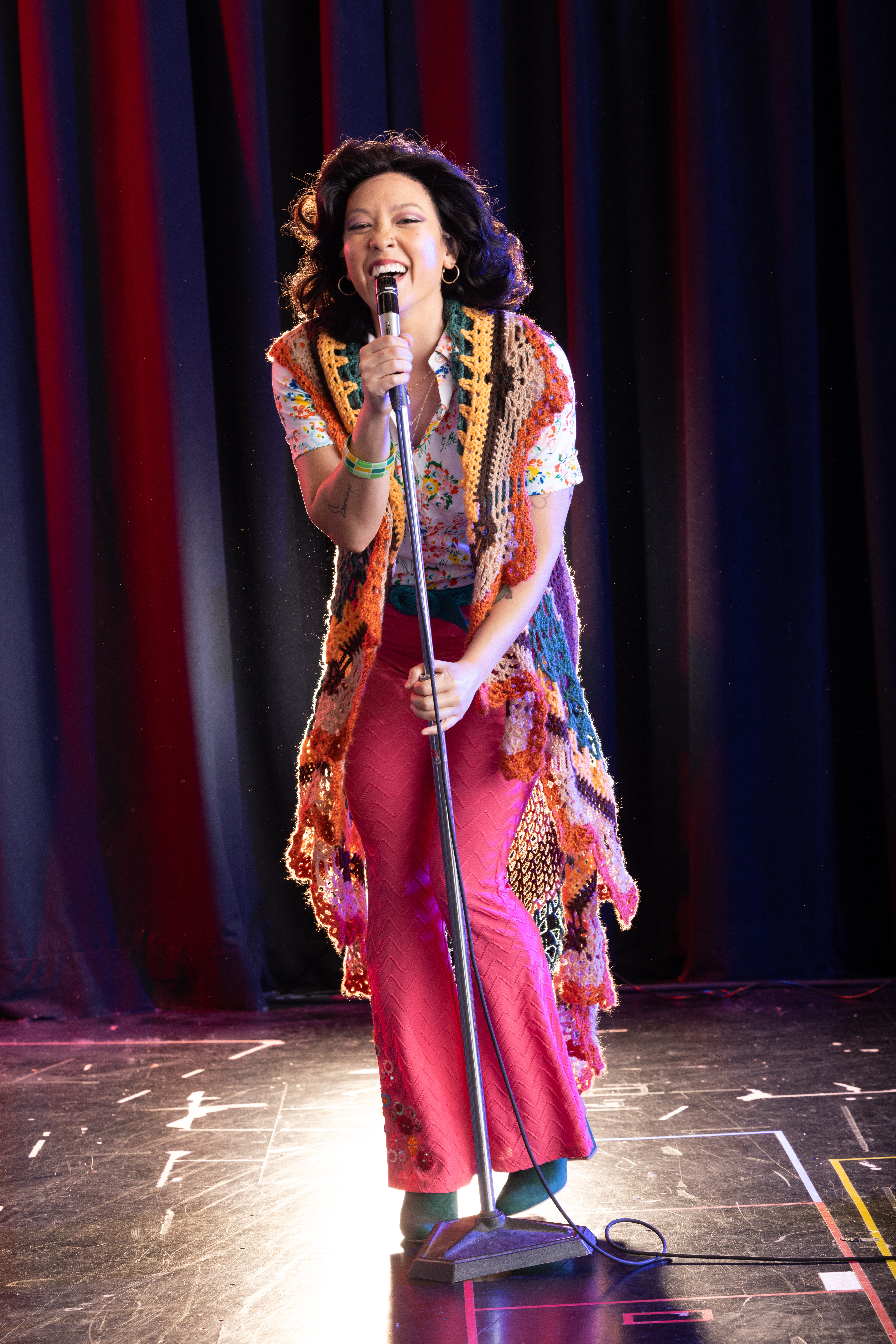
The work warmly humanizes the examination of the different ways in which people respond to danger and the instinct to survive. Using Duch as a narrator, Yee never lets us forget that we are watching a play orchestrated by a storyteller who can manipulate the plot.  Along the way, she weaves enough fact into the dialogue to carry everyone along without feeling lectured to.  Director Nelson T. Eusebio III skillfully handles the transitions between history, thriller, and dark comedy.  The ensemble — Eileen Doan, Jojo Gonzalez, Alex Lydon, Shawn Mouacheupao, K Chinthana Sotakoun, and Greg Watanabe — radiate emotional energy.  Many cast members perform dual roles, enhanced by the costume designs of Yoon Bae. The stark set by Riw Rakkulchon keeps our attention on the powerful language with the concert elements, including colorful projections by Caite Hevner, allowing us to breathe or maybe even scream. 

K Chinthana Sotakoun as Neary/Sothea; Photo Credit Wesley Hitt

In light of our own current struggles with authoritarianism and the reevaluation of America’s role on the international stage, the themes explored in Cambodian Rock Band ring even louder than in 2019 when it premiered.  While Yee softens the blows of the story with song, she never blunts the message.  Running time is 2 ½ hours including a 15 minute intermission.  Theatre Squared provides a lounge with a live stream at their venue in Fayetteville, Arkansas for those who need to take a mid-performance break.  There is also the option to stream the production from home, which is how I was able to see it in New York.  Performances continue through March 24.  Visit https://tix.theatre2.org/overview/25509/ for ticket prices and further information.

John Proctor is the Villain

Writers are often told to write what they know.  Playwright Kimberly Belflower has gone several steps further.  In John Proctor is the Villain she has boldly written from her very marrow, jangling the skeletons in our collective social-values closet.  Raised in Appalachian Georgia, Belflower sets her piece in a one stoplight town in her home state, using the locally accepted ways and belief systems to draw parallels between a circle of high school sophomore girlfriends and the characters in Arthur Miller’s The Crucible.  The year is 2018 and there is much in these young women’s lives that was not solved by Harvey Weinstein’s arrest.

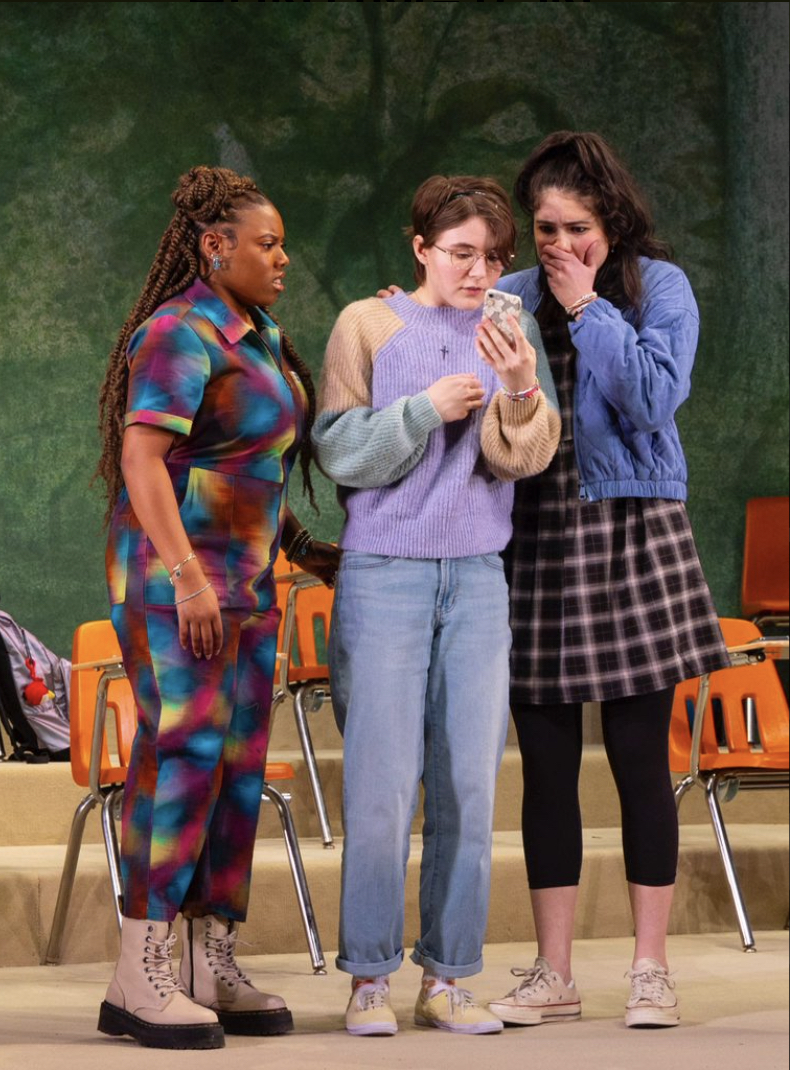
Victoria Omoregie, Jules Talbot, Haley Wong in John Proctor is the Villain; directed by Margot Bordelon; photo by T Charles Erickson

The dialogue is wicked-smart, filled with references from classic literature to song lyrics.  Though all are understandable because of clever context, only one is fully explained.  Belflower begins Act 1 in a classroom where sex education has been buried inside English-Lit, all the better to rush through the uneasy curriculum.  Along with getting a quick hit of each of “Villain’s” characters, this opening enables teacher Carter Smith (a  charmingly approachable Japhet Balaban) to also introduce any audience members not already familiar with Miller’s work to the major themes of The Crucible and the historical background of Witch Hunts.  It also becomes clear very quickly how much the study of the arts is giving meaning and purpose to the lives of these students

While serious issues of feminism, sexuality, body positivity and all varieties of belief run under the surface, front and center is a story of the power of female friendship.  The young ladies are created with some stereotypical DNA, but every one is layered with unique and endearing details.  Caught in a very personal #MeToo scandal through the actions of her father is Ivy Watkins (a warm Brianna Martinez).  Her former best friend Shelby Holcomb (a thorny Isabel Van Natta) has just returned to school after an unexplained “sabbatical” which might be connected.  Often speaking truth to power is Nell Shaw (a high-octane Victoria Omoregie) bringing “worldly wisdom” to the conversation from her upbringing in Atlanta.  At the other end of the confidence spectrum is Raelynn Nix (a fabulously wriggly Haley Wong) the local preacher’s daughter. The ultra serious Beth Powell (a ready-to-spring Jules Talbot) launches a feminist club in part to boost her college application but also to give them a container for discussing their feelings. They have a developing ally in Mason Adams (a sweetly awkward Maanav Aryan Goyal ) who experiences a particularly lovely character arc.   Filling out the attendance sheet is Raelynn’s ex-boyfriend Lee (Benjamin Izaak) and the class guidance councilor Bailey (Olivia Hebert) who are essential to the plot.

Seasoned director Margot Bordelon, who has a history of amplifying new voices, seems to have deep love for these characters, bringing out every delicate moment of discomfort and rage with authenticity.  The school room’s simple set by Kristen Robinson changes temperament with the help of Aja M. Jackson’s lighting.  Sound designer Sinan Refik mixes snippets of pop tunes with school bells and eery noises to further shift the tone of the room.  The girls also make themselves heard in their choice of wardrobe (Zoë Sundra) and in Raelynn’s case evolving eye make-up.

Whether it is exploring weighty matters (like why is “too much” simply parental shorthand for “a girl)” or making us laugh in solidarity, John Proctor is the Villain always keeps us entertained.  True enjoyment requires the ability to think big and a tolerance of of other points of view.  It is available as an On Demand stream from The Huntington Theatre in Boston through March 24.  Running time is about 100 minutes with no intermission. Digital tickets are available at four price points starting at $30 and can be purchased at https://bostontheatrescene.huntingtontheatre.org/28317/28319.  

Dragon Lady

Sara Porkalob had received praise for playing a white Founding Father, Edward Rutledge, in the Broadway revival of 1776.  But she had never had the opportunity to represent someone with her Filipino background until she wrote a role for herself.  Her solo performance — Dragon Lady — tells the colorful story of Porkalob’s grandmother, Maria Porkalob Sr.  A karaoke-loving daughter of a gangster, Maria I moved from the Philippines to the Pacific Northwest as a pregnant newly wed wife of an American soldier.  (Senior made a cameo in the show until her death in 2022 and now appears in projection.)  The show premiered in 2017 and has been touring the country, now joined by Dragon Mama, another Porkalob creation told from Sara’s mother’s perspective.

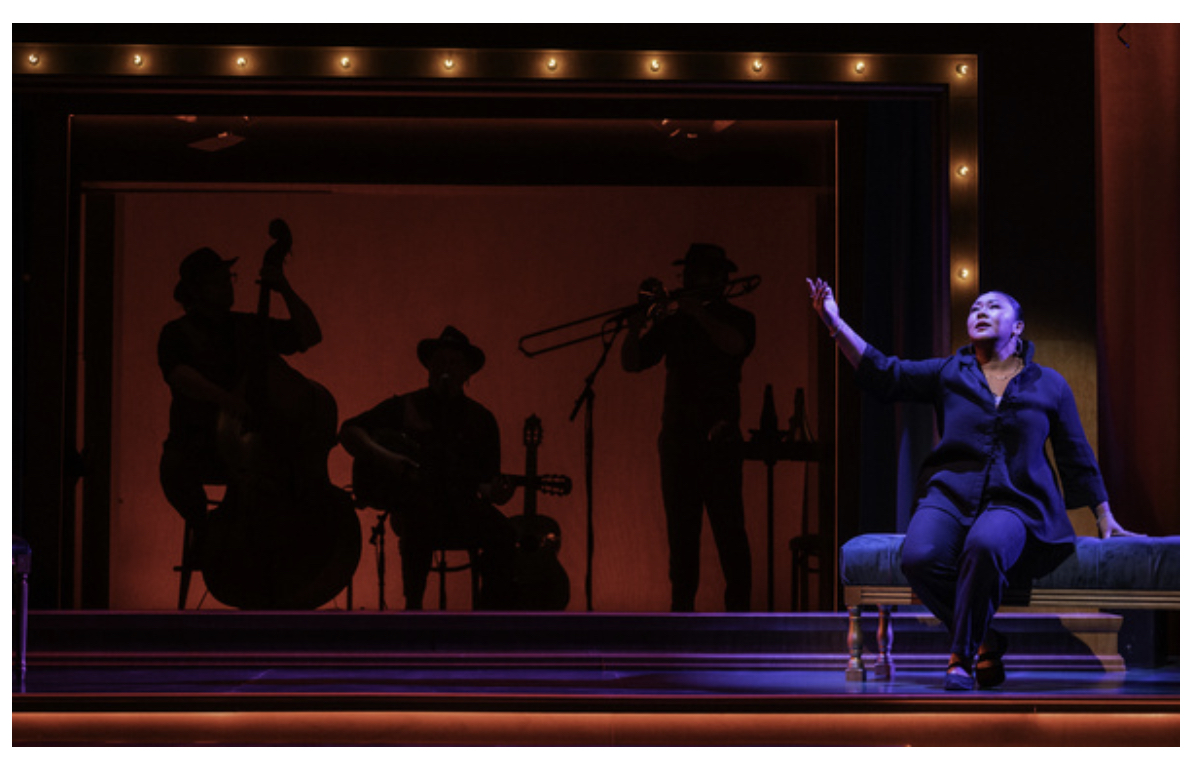
The Pittsburg Public Theater recently shared Dragon Lady with a broader audience through the League of Live Stream Theater, a non-profit that works primarily with regional theaters to broadcast their productions in real time.  Built tenderly from a 9 minute senior year workshop assignment, the production runs 2:15 and spans over 40 years.  Designed in a framework of a cabaret act with a three piece band, Hot Damn Scandal (Pete Irving, Jimmy Austin, and Mickey Stylin), the performance is engaging and freeing.  On the night before her 60th birthday, Maria Sr. pulls her granddaughter aside in order to share some family secrets.  Sara’s mother, Maria Jr., is obviously not the matriarch’s biggest fan.  By revealing some less-than-flattering elements of her history, the elder Porkalob hopes to at least elicit understanding of if not forgiveness for her past actions from the newest generation.

Sasha Jin Schwartz’s set, bathed in blue with its raised rounded platforms and crisscross patterns, conveys the essence of a casino or nightclub.  Under the guiding hand of director Andrew Russell and leveraging the intimacy of this ¾ round space, Porkalob changes skins in a flash, portraying those closest to Maria Sr. including her father, lovers, and five children. Each relationship shines a little more light into the painful darker corners (physical lighting by Spense Matubang).  There is a particularly lovely and insightful exchange between Maria Sr’s two sons, Ron and Charlie, when they were younger.  Sara’s singing voice is remarkably strong and soaring as she delivers a range of musical numbers from torchlight to jukebox.  Mixed with atmospheric sound by Erin Bednarz, the selections help shift the mood and lighten the load.  

Sara Porkalob backed by the Hot Damn Scandal in Dragon Lady at Pittsburg Public Theater

Having broken away from the comfort of scene partners and backdrops, Porkalob has had to tap deeply into her own power as an artist.  By appreciating the value of a personal story and sharing a genuine human experience, Porkalob has given us a work that resonates far beyond her own family.  The language and themes are decidedly R-rated and intended for audiences over 18.  A third play, Dragon Baby, told from Sara’s vantage point, as well as a TV adaptation of the entire cycle are currently in development. 

For more information about Sara Porkalob and The Dragon Cycle, visit http://www.saraporkalob.com/.  To explore the rest of the Pittsburg Public Theater Season, visit https://ppt.org/.  To learn more about upcoming real-time simulcasts by the League of Live Stream, visit https://www.lolst.org/.  

Sunset Baby

My first experience with Sunset Baby – Dominique Morisseau’s 2012 drama being revived at New York’s Signature Theatre – was a series of tweets from colleagues grumbling about the treatment of the playwright’s program insert. Indeed the tiny handout is a puzzling choice of physical manifestation for her enticing invitation to the audience to fully participate even vocally in her tale of a recently released social revolutionary, his traumatized daughter, and her loving thug of a boyfriend.  But it wasn’t so much that the “Permissions of Engagement” were on a 4×6 piece of paper in nine point font. The more disappointing aspect was that the production did not elicit so much as a peep from Sunday’s audience.

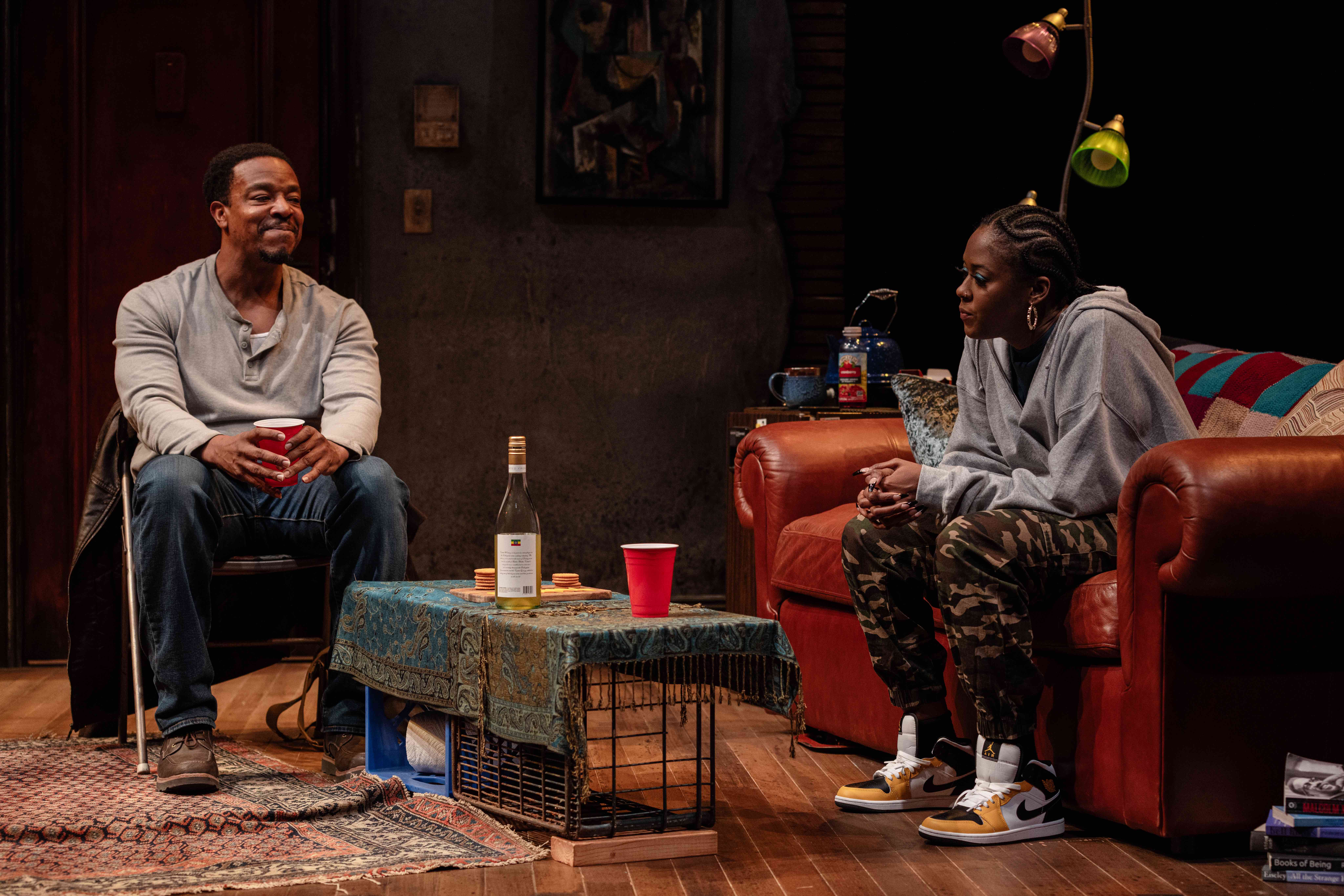
Russell Hornsby and Moses Ingram in Sunset Baby; Photo Credit, Marc J Franklin

The ability to fulfill Sunset Baby’s promise is boldly displayed in the concise history of the show’s world displayed on the wall outside the theater door. It is visible in Wilson Chin’s economical yet thoughtful scenic design with its peeling paint, well-used furniture, and intriguing choice of artwork.  The decision to move the proscenium forward and raise the rake between the rows increases the accessibility and brings the audience further into this room.  Small touches from a shower caddy (props by M. Picciuto) to the nearby train (sound by Curtis Craig & Jimmy Keys) bring the setting into clearer focus. The promise is most palpable in the emotive performance of Russell Hornsby as Kenyatta, who in warm and slightly trembling tones opens the show by vividly describing not only the struggles of his role in the Black liberation movement and resulting incarceration, but of the bigger challenge of trying to be a loving father. And it occasionally pokes its head out in Morisseau’s careful plotting such as the discovery that Kenyatta’s daughter Nina expands her world beyond her rundown room in East New York by watching the Travel Channel.  Indeed, Morisseau’s knowing and complex feelings about parenthood are strongly woven throughout the dialogue. But none of these sparks ever becomes flame in the frustratingly inert 90 minute runtime.

What seems to have put a dulled layer between the work and the experience of it are artistic choices by director Steven H. Broadnax III.   The pacing is slow and there are false notes along the way.  Nina comes home from her “job” as a fake hooker who helps her boyfriend, Damon, lure black men into dark alleys to rob them.  She slips off her shiny royal blue thigh-high boots — among the apt selections by costume designer Emilio Sosa — only to wrap her cozy pink bathrobe around her skin-tight leather mini. Is this a symbol for her constant discomfort or an inability to smoothly incorporate a wardrobe change?  The actress embodying Nina, Moses Ingram, has proven herself capable of deep emotional range.  But here she is stuck at the pitch of a petulant teen. Nina’s lack of full development is most notable in a pivotal scene between her and Kenyatta. It should play like a musical movement that shifts from minor to major.  Instead this sly turning point is tonally more like a repeated refrain.  As her literal partner in crime, J. Alphonse Nicholson is also wedged into a single groove when the character could be providing meaningful counterpoint. 

I deeply admire Signature Theatre as a surviving safe harbor of affordable, expansive community theater. The commitment to reexamine an older work by Dominique Morisseau that focuses on the personal impact of the socioeconomic divide is a timely one. But Sunset Baby 2024 misses an opportunity to more engagingly enlighten a new audience about the fallout from another period during which the Black community’s efforts to serve their own were villainized and politicized.  

The first of three offerings this season, Sunset Baby runs through March 10 in the Romulus Linney Courtyard Theatre at the Pershing Square Signature Center (480 W. 42nd Street).  Tickets are available at https://order.signaturetheatre.org/events and are $59/$79/$99/$119.

Australian Theatre Live – Emerald City

In 2014, when the artistic director of the Griffin Theatre Company,  Lee Lewis, had the opportunity to direct any play she wished, she reached back nearly 30 years to David Williamson’s comedic drama Emerald City.  The work continues to travel maddeningly well through time.  Using his own experience as a springboard, the Australian playwright examines the struggle between artistic passion and the desire for money and power.  Available to stream on the relatively-new-to-the US Australian Theatre Live, it is a treat for those who missed it during an early run produced by New York Theater Workshop.

The city in question is not the one Dorothy visited, but rather the glittery harbor-famed Sydney where in-demand screenwriter Colin (Mitchell Butel) has recently relocated his family from the more staid and traditional Melbourne.  He hopes the colorful energy of his new surroundings will be creatively renewing after his latest film disappointed at the box office.  But a new partnership with the well-connected vulgarian Mike (Ben Winspear) plays havoc with Colin’s priorities and reputation.  A secondary plot involving Colin’s wife of 18 years, Kate, (Lucy Bell) centers on book publishing and the question of who can tell a story, once-again relevant in the season of The Killers of the Flower Moon.  Colin’s agent, Elaine, (Jennifer Hagan), his bank manager, Malcolm, (Gareth Yuen) and Mike’s live-in girlfriend, Helen, (Kelly Paterniti) play pivotal roles in the unfolding of events.

Kelly Paterniti as Helen and Ben Winspear as Mike in Emerald City;
photo by Brett Boardman

There are two main reasons why the play still resonates.  While there has been an increase in the appetite for quality on screens big and small, there is still little profit to be made in arthouse projects: a dilemma for talent.  But there is also a timelessness to Williamson’s satiric conversation and smartly drawn characters.  His observational ability is on full display, especially when actors break the fourth wall and make us coconspirators.  Focus whips between them connecting with their audience and being in the moment, providing side-by-side viewpoints.  Butel is particularly skilled at humorously parroting the others.  Though it is the men who take up most of the 125 minute runtime with their posturing and machismo, the women with their deeper combination of beauty and brains are the ones behind the more surprising and memorable moments.  The piece begins to drag a bit towards the end, though that may be my post-pandemic attention span unaccustomed to two full acts.

Designer Ken Done supports the central conflict with his backdrop for Act I playfully drawn and the one for Act II dressed for business, shrouded in beige fabric.  A single couch and coffee table serve as all living rooms and a sole desk and sectional Everyman’s office.  This allows director Lewis to squeeze every millimeter from the tiny stage, including the area between staircases, and facilitates seamless handoffs between characters at a brisk pace.  Lighting designer Luiz Pampolha provides emphasis as does costumer designer Sophie Fletcher’s pops of color.

The Griffin was launched by actors and remains artisan-focused.  In his introduction to the digital version of Emerald City, Williamson makes clear that this is not a film but rather a first rate production viewed from the best seat in the house.  Indeed the camerawork is smooth and obviously well rehearsed, the sound is pristine, and the acting style genuinely theatrical.  Closed captioning is available as is a 10 second back button.  The stream costs $7.99 at https://stream.australiantheatre.live/ and is just one entry in a growing library developed with the intention of expanding access to Australian performing arts.

True Community Theater: The LA Poverty Dept

Post pandemic, there’s been an uptick in conversations around the relationship between community and the theater.  Concerns have risen as regional theaters have reduced their offerings or closed altogether.  So when I was invited to a discussion entitled “How Theater Serves Community, and Community Serves Theater” I quickly signed up.  The event was being hosted by Bob Ost of Theater Resources Unlimited (TRU), a supportive group of playwrights, producers, writers and promoters.  Their COVID-motivated move to Zoom in April of 2020 has so far resulted in 175 conversation involving many TRU associates who live outside the New York City area where the organization was founded.  Although the evening was not what I had expected from the subject line, it was fascinating and ultimately quite moving.  

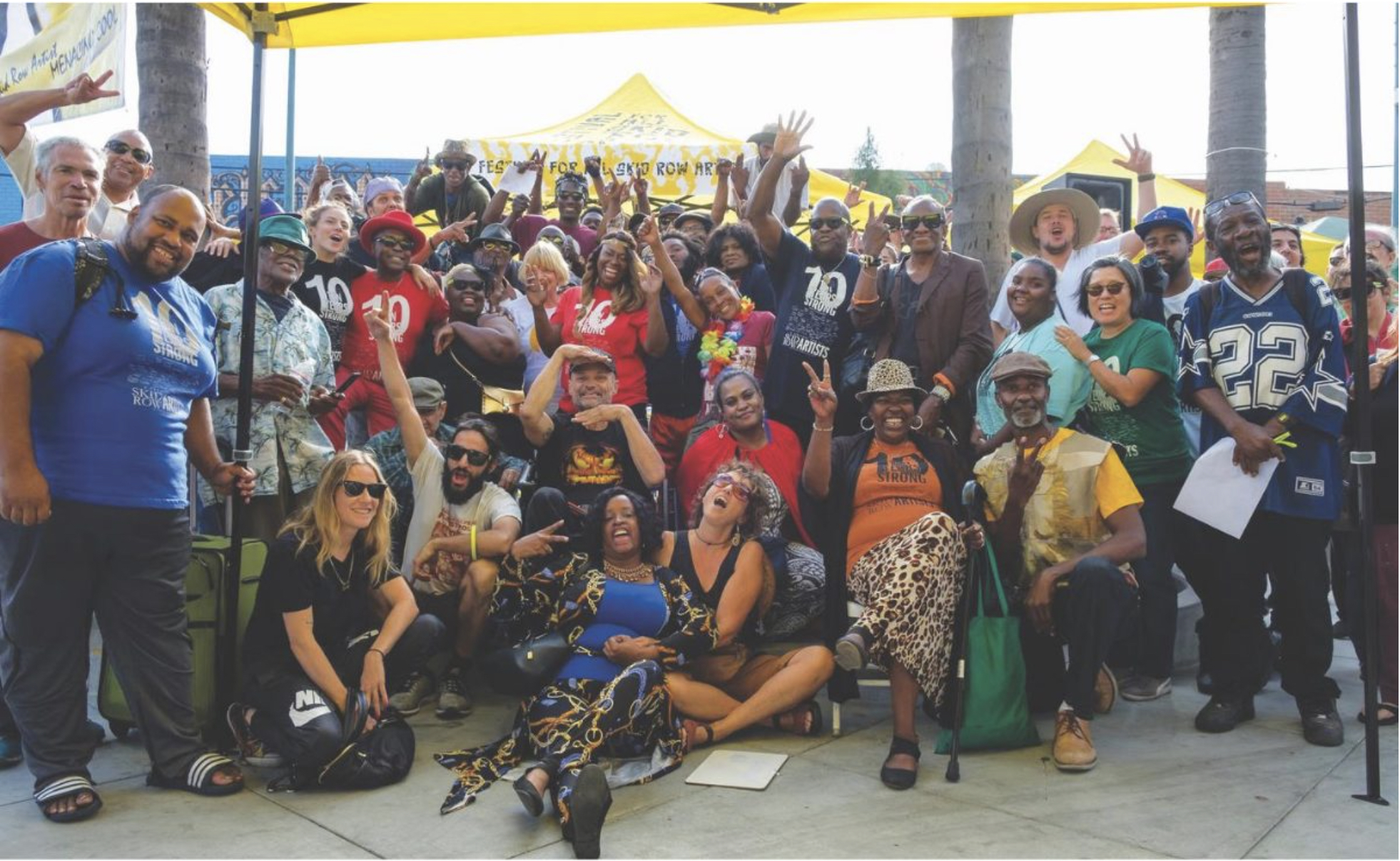
The guest speaker, John Malpede, heads up an unusual ensemble.  He is the Artistic Director of Los Angeles Poverty Department (LAPD, a deliberately stinging abbreviation).  The members of his ever-changing troupe are homeless.  The company grew out of Malpede’s meetings with activists from skid row and has been nurtured using his experiences gained in workshops throughout lower Manhattan.  He originally moved to the west coast to do outreach for the Inner City Law Center, and found overlap with his in-the-moment listening skills developed as as a performance artist.  Built on a firm foundation of compassion and Malpede’s knowing approach, the LAPD has continued to thrive for over 30 years.  For many, their participation in the project has been literally life changing.  

Malpede keeps the productions inclusive, which is a balm to those who are used to being marginalized or completely ignored.  With an open heart as well as open ears, he is able to tap into their natural creativity.  Most works start by improvising around an agreed-upon scenario.  This way even those with poor reading skills can be involved.  The process evolves like a huge trust-building excise with the constituents.   In lieu of a dedicated venue, the neighborhood has offered up offices, computer rooms, and other shared spaces that are available rent free usually after hours. No tickets are sold and promotion is almost exclusively through word of mouth.  Financial support comes through community grants, humanitarian support, and in-kind contributions.

The LAPD circa 2018; photo courtesy of The 18th Street Arts Center of Santa Monica

Most shows begin as a riff around a current high profile issue.  Representative Maxine Waters gave LAPD a transcript from a congressional hearing which they were able to perform in the style of Is This A RoomBack Nine grew from a movement to rezone a golf course, which raised awareness about the impact the elimination of public land has on the homeless.  State of Incarceration, which was presented in the Queens Museum in New York City, explored prison overcrowding by having the performers literally pressing in around the audience, referred to as “the witnesses”.  Their most recognized show was the B-movie style No Stone for Studs Schwarz. Inspired by the killing of several homeless people who had been sleeping on the streets near Chinatown, it featured a cast of 15. There was no “hard” script, so the outcome was slightly different each night, lending a genuine quality to every viewing. It ran for nearly a year, achieving a cult following.

For some participants, the LAPD theater program works as a springboard to a new chapter in their lives.  A paralegal is able to learn more about their issues and help them gain entry into the right city programs.  Still others have stayed with the population in order to improve policies and conditions for the unhoused.  Visit LAPovertyDept.org  if you would like to learn more about this extraordinary group or watch one of their programs.  To receive the Zoom invitation for future TRU meetings, email TRUnltd@aol.com with “Zoom Me” in the subject header.  There is a small attendance fee for non-TRU members.

The Heart Sellers – Streaming

There are many recent plays and movies that investigate the immigrant experience.  Most scout the important but familiar terrain of fear and pain resulting from being in our country illegally.  The Heart Sellers takes on far less explored territory by rolling back to the early 1970s.  The two young women involved — one from the Philippines, the other from Korea — have been able to move to the United States under the provisions of the Hart-Celler Act.  This law made major changes to our immigration policy, making it easier for people from Asia and other areas previously discriminated against to come here for work.  In the case of Luna and Jane, their husbands are both in residential rotation at the local hospital.  But the wives have had to leave their dreams and most of what had given their lives meaning back in their home countries.  When fate brings them together in the supermarket on Thanksgiving, they make the most of the opportunity to find connection in what has been a very lonely world.

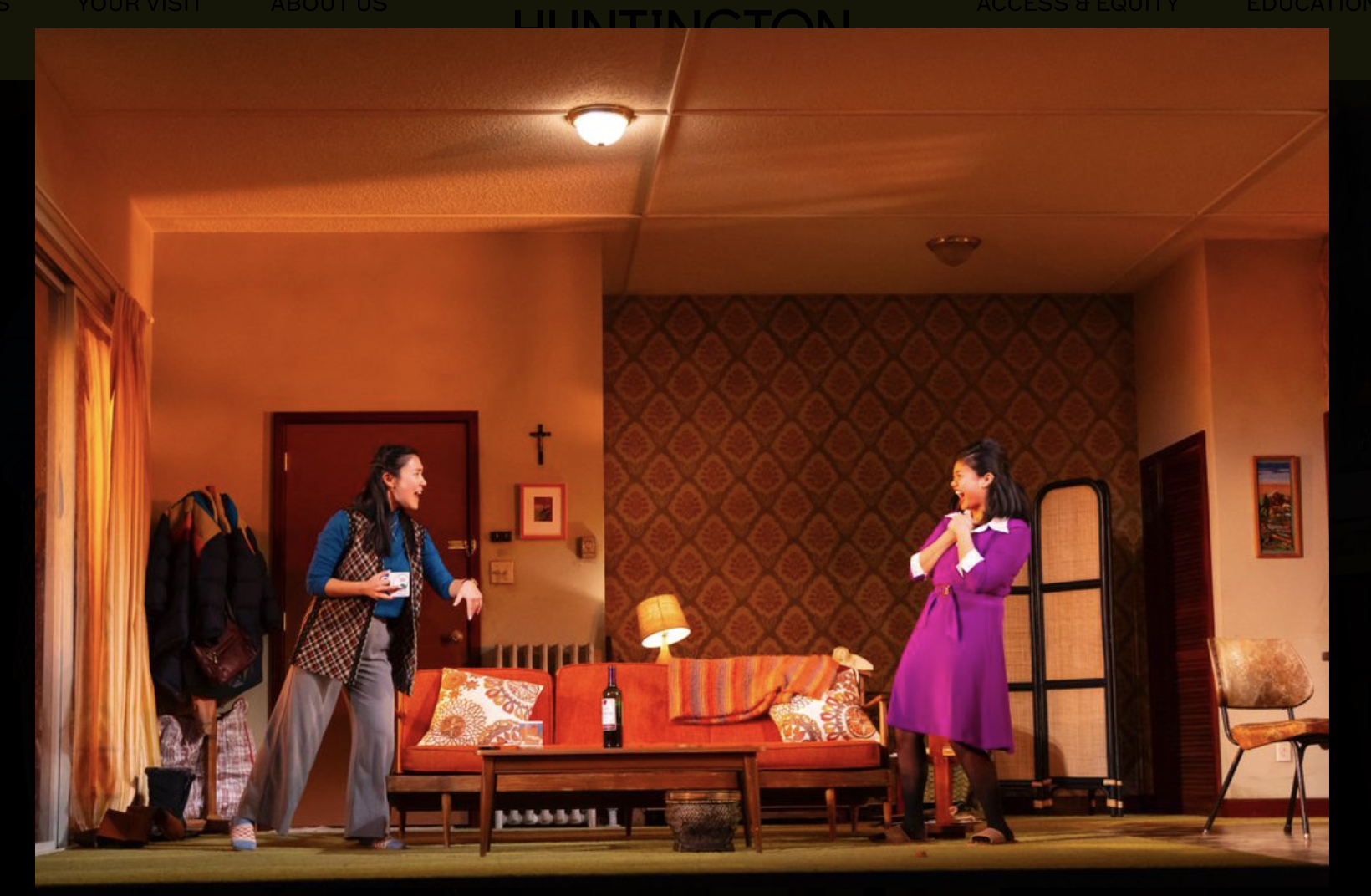
With an adept ear for dialogue, playwright Lloyd Suh treats us to a fabric of rich detail while keeping the conversation flowing.  His examination of the cultural norms of 1970s America is both funny and touching.  Luna and Jane’s exchange is at first realistically halting as they each employ their second language in search of common ground.  Scenic and costume designer Junghyun Georgia Lee sets the perfect tone, literally putting the two women in a tiny box that encloses the stage.  Luna’s apartment is dressed in wild and warm shades and the character herself appears in bright pink.  Matching that colorful energy, Jenna Agbayani’s Luna is buzzy and overly familiar, high on adrenaline from her daring step of inviting Jane into her home.  In contrast, Judy Song, making her North American stage debut, keeps Jane as fact-based as her earth and sky outfit would suggest.  Only when she changes into Luna’s flowered “house clothes” does her imagination soar.  

Judy Song, Jenna Agbayani; photo by T Charles Erickson

Echoing the characters’ testing of their lives’ constrictions, director May Adrales has created something of a dance for Luna and Jane within the small space.  The pacing of the piece is as zestful as the women’s search for friendship.  With its mixture of viewpoints and high level of intimacy, The Heart Sellers is a great choice for a hybrid production.  The On-Demand version was filmed at the Huntington’s Calderwood Pavilion in Boston on December 6 and is beautifully produced and edited by Kligerman Productions.

Though set during a November holiday, The Heart Sellers is a delightful treat for the end of a tough year and a hopeful start to the new one.  It is as warm and sweet as the yams the women devour with joy and gusto.  $30 digital tickets are still available at https://www.huntingtontheatre.org/whats-on/the-heart-sellers/  and can be used any time before January 6, 2024.  Playback is smooth and easy, with quality sound and image.  Runtime is 95 minutes.

Australian Theatre Live – Orange Thrower

For a little over a year, the non-profit Australian Theatre Live has made some of that continent’s most innovative stage productions available on demand.  Much like the New York Public Library’s Theatre on Film and Tape Archive, the platform also serves to preserve the works of a variety of performing artists. ATL is making their official US debut by hosting two public screenings — the second of which is in New York tomorrow* — as a springboard for building a relationship with a new audience. In addition to attracting theater lovers and fellow artists, they are offering an education-specific subscription service to bring this enriching content into the classroom.

For my introduction to the platform, I chose Kirsty Marillier’s Orange Thrower presented by the Griffin Theatre Company.  Griffin is Australia’s only theatre company that is dedicated exclusively to producing new playwrights.  Their Stables Theatre is a 105 seat house with a “kite shaped” stage that promotes a distinct and intimate relationship between performers and viewers.  That vibrancy translated well to the digital realm where director Peter Hiscock used three cameras to bring the home audience into the world created on stage by director/musician/performer Zindzi Okenyo.

The 80 minute comedic drama covers familiar territory from a unique perspective.  There is a layer of the mystical which is fittingly never fully explained.  This is not just a coming-of-age story, but rather one of coming-into-being.  We meet Zadie (Gabriela Van Wyk), a young woman of African decent living in a white suburban development, ironically called Paradise.  While she has code switched to the point of being almost permanently “on,” her younger sister Vimsey (Mariama Whitton) cannot wait to escape to a big city like Johannesburg where she’d find more people who look like her and share her perspective.  Their conflicting views are heightened when the two girls receive an unexpected visitor, Stekkie (director Okenyo) while their parents are away in South Africa.  Rounding out the cast is Callan Colley who provides brightness and levity in his two catalytic roles.  

Gabriela Van Wyk, Mariama Whitton and Callan Colley in Orange Thrower, a Griffin Theatre Company production available on ATL; photo by Brett Boardman

Designer Jeremy Allen’s set is centered around an open rectangle which is both a physical and a metaphorical window.  The moody lighting by Verity Hampson and a soundscape by Benjamin Pierpoint in which memories make a noise add to the feeling of otherworldliness.  Easily changed costumes topped off by Dynae Wood’s perfect wigs complete the imagery.  There is a warning that the production includes depictions of drug use, gun violence and mature themes, though these moments are nearly dreamlike.

During the pandemic, some American theatre companies offered a streaming option, but more often in the US the art form has been entangled in red tape and mismanagement. The on-demand vault of Australian Theatre Live currently has 26 entries created in partnership with nearly two dozen theatres and arts organizations.  It illustrates the value of making theatre accessible to everyone whether they live miles from a venue, have limited income, or have mobility issues.  As important, every cent of a $7.99 per month subscription goes to supporting the artists.  Learn more at https://australiantheatre.live/.  

* New Yorkers: You can join ATL for the New York debut of Indigenous artist Dylan Van Den Berg’s Whitefella Yella Tree, another Griffin Theatre Company production, at the Australian Theatre Festival (1350 Avenue of the Americas, Suite 2400), on November 16, at 7:30 p.m. (doors open at 7:00 p.m.)  To  register your interest in attending, please fill out this form.

Merry Me

The new comedy Merry Me has plenty going for it.  The layered writing by Hanson Jung is packed with witty spins on pop culture and references to classicists from Euripides to Shakespeare all built around a structure most similar to a Restoration Comedy.  The cast — everyone making a New York Theatre Workshop debut — is masterful.  It would be easy to play up every clever note, which would also be exhausting.  Instead the punches are delivered in slowly rising waves under the direction of the always excellent Leigh Silverman.  It’s all quite attention getting and yet somehow lacks stickiness, which is not meant to be a sexy pun despite the prominence of bawdy humor in the dialogue.

Marinda Anderson, Esco Jouley, Shaunette Renee Wilson and Nicole Villamil in Merry Me; photo by Joan Marcus

The plot unfolds on the front lines of a war that has been paused by a well-known Angel (sassy  Shaunette Renée Wilson).  She introduces us to the interdependent characters as she and her cohorts manipulate their lives.  There is Lieutenant Shane Horne (magnetic Esco Jouléy) who having seduced the General’s Wife (pixieish Cindy Cheung) is on a quest for her next “Merry.”  Shane enlists the help of therapist Dr. Jess O’Nope (exuberant Marinda Anderson) to convince the rather dim General Memnon (David Ryan Smith with just the right amount of dopiness) that they are now heterosexual.  Meanwhile the General’s equally dim son Private Willy (Ryan Spahn taking the hit for cis white men everywhere) has smuggled his beautiful new wife Sapph (Nicole Villamil managing an incredible balancing act between allure and innocence) onto the base.  Bored out of her mind and her body, she dresses in “boy drag” in order to explore her surroundings and seek out Shane. 

Playwright Jung pulls in references from Illyria to Wakanda with a hefty serving of Kushner and a soupçon of E.L. James.  All of her characters are self aware and often speak in stage directions and subtext. The energy is that of an old-fashioned farce but the would-be cliches are almost literally turned on their heads.  Having directed many productions in the NYTW space, Leigh takes actions that would typical be horizontal and stages them vertically with wonderful results.  There is one tiny portable foley door that gets run in and out of, but for the most part that classic farcical piece is “performed” by a remarkable back wall designed by Rachel Hauck.  The effects are fully achieved with the help of Barbara Samuels lighting and Caroline Eng and Kate Marvin’s sound design.  

A combination of intellectual exercise and frank sexuality, unsurprisingly Merry Me is attracting an unusual blend of followers.  The age range of the audience was fresh out of college to well into AARP membership.  Faces represented the colors of the rainbow.  And reactions spanned from gently bobbing heads to energetic fist pumping.  Performances continue through November 19 at New York Theatre Workshop, 79 East 4th Street.  Runtime is 90 minutes with no intermission.  Full priced tickets are $65.  For more information visit https://www.nytw.org/show/merry-me/.    There is room in this world for something different even if it isn’t enduring.

Young, Gifted, and Black

Young, Gifted and Black lived up to its title with a lineup of talented musicians of color ranging in age from 12 to early 30s.  Most grew up in the neighborhood of the Classical Theatre of Harlem, which produced the evening as part of Bryant Park’s Picnic Performances.  Made available by Bank of America as a free first-come-first-serve live event with a streaming simulcast, the concert was enjoyed by over 4000 people according to Producing Artistic Director, Ty Jones, who hosted with sincere enthusiasm and praise.

The poised 12 year old pianist, Emery Mason, opened with three short pieces punctuated by the rapidly changing tempos of Debussy’s Cakewalk.  She was followed by 16-year-old Kaden Kennedy, a cellist who somehow also finds time to compete in track and field.  His selections honored both beauty with  Camille Saint-Saëns’ “Le Cygne” (“The Swan”) and pain with Élégie, Op. 24, which Gabriel Fauré wrote for his deceased wife.  Kennedy later returned to play Johann Sebastian Bach’s Cello Suite No. 1 in G major, an ambition of his since the age of 7.  Accomplished 15 year old Melissa Mosley — an attendee of the Special Music High School who recently returned from concerts in Canada — closed out the first part of the program with Chopin’s Nocturne in C-sharp minor and the downright jazzy 1984 composition by Nikolai Kapustin, Concert Etude, Op. 40, No. 3: Toccatina.

For her solo, 14 year old Roen Jones, who has performed in prominent public spaces including the Metropolitan Museum, chose Violin Partita No. 3 in E major by Johann Sebastian Bach, a work she said has made her a better violinist.  Wrapping up the instrumental portion was the extraordinary violinist/composer/teacher Edward W. Hardy.  He began with his own composition, Evolution, which required employing a variety of styles in a single song.  Commencing with musical phrases from Wading in the Water and inspired by the evolution of Black music, the piece was included in the opening night program at the Smithsonian’s African American Museum in Washington D.C.  After a smooth re-arrangement of Chopin and a swirling Tennessee Whiskey dedicated to his “Colorado Family” at the University of Northern Colorado, Hardy switched gears. As a child, his mother had encouraged him to play his violin in the subway as a way to build confidence in front of a crowd.  So he reached back to his hits previously heard in the 103rd street station.  Shouts of “OK!” and grass-muted toe-taps accompanied his rendition of If I Ain’t Got You by Alicia Keys.  He ultimately brought the crowd to its feet with his mind-blowing twist on Freddie Mercury’s Bohemian Rhapsody.   

As a coda to a lovely evening, Tony nominee Crystal Lucas-Perry interpreted a monologue from “Mother to Son” by Langston Hughes.  The words honored those who have smoothed the way and the power of a community to elevate others.  Then the mezzo-soprano ended on a literal high note with her performance of Greatest Love of All by Michael Masser.

With its approachable blend of classical and modern selections, The Classical Theatre of Harlem’s Young, Gifted and Black fulfilled its goal of shining a well-earned spotlight on the exceptional Black youth of New York City.  The full show is available to stream on demand at https://bryantpark.org/calendar/event/the-classical-theatre-of-harlem/2023-09-01.