
Eboni Booth’s Pulitzer Prize winning Primary Trust is currently one of the most performed plays regionally. It is the kind of work that people say leaves them “shattered,” “undone” and “wrecked” and they mean that in a good way. The New York Premiere was my return to live theater after more than three years because of COVID. The themes explored, especially when delivered by the incomparable William Jackson Harper, could not have provided a more perfect balm. Though written in May of 2023, that review remains my second most read. (You can read it for yourself here: https://theunforgettableline.com/2023/05/30/primary-trust/)
To celebrate the printing of the Primary Trust script, TCG, dramatic literature’s largest independent trade publisher, presented an evening with Ms. Booth. The book’s cover shows a small town street with each side mirrored in the other, beautifully reflecting the feelings evoked by the original set design.
The evening opened with a short reading by Harper accompanied by original composer/perform Luke Wygodny on cello and the bell meant to represent the way in which our thoughts frequently interrupt themselves. These scenes gave newcomers a taste of Primary Trust’s beauty and provided a strong reminder to anyone who saw the full production.
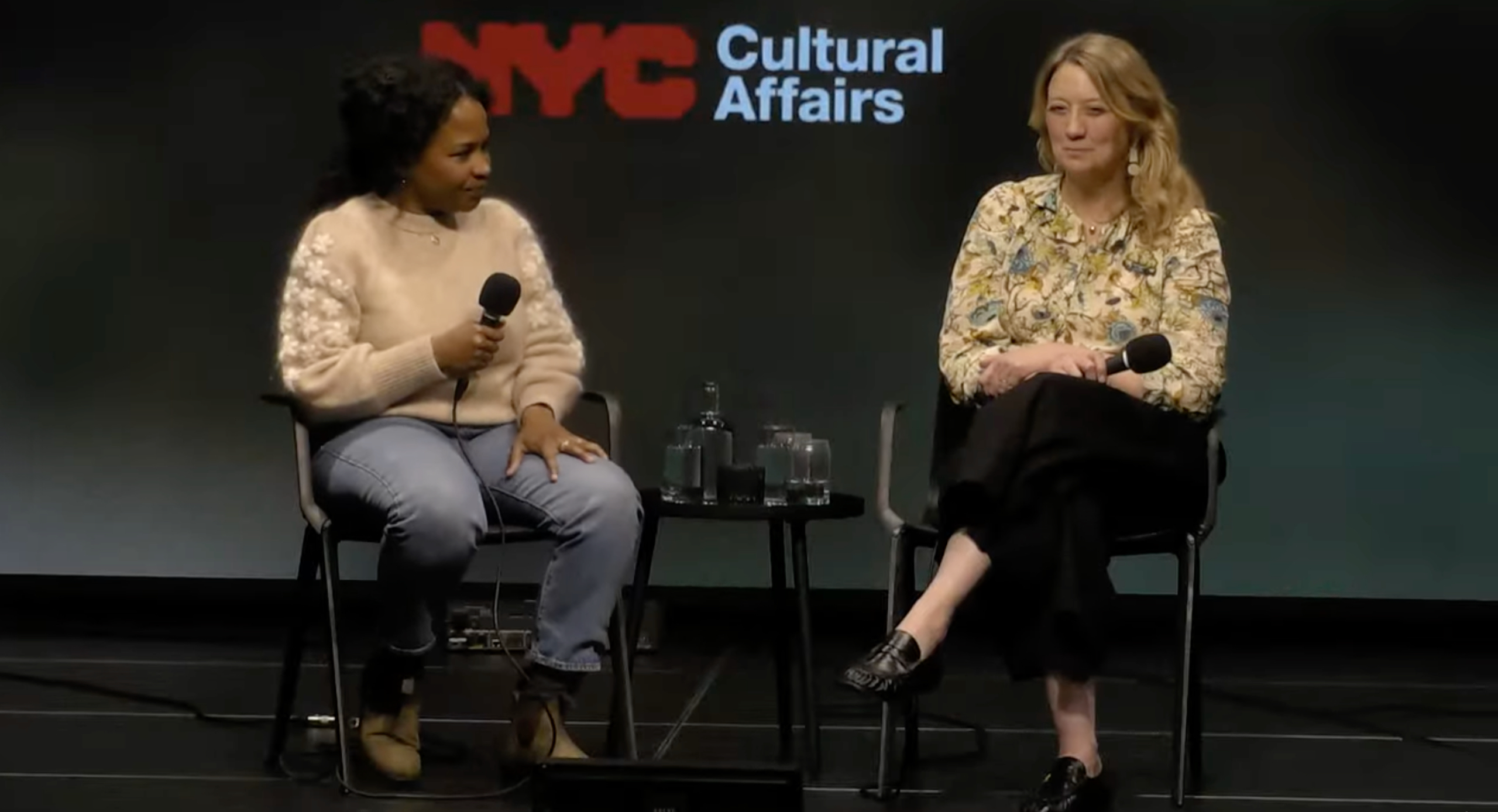
The conversation was hosted by another recognizable actress turned playwright, Heidi Schreck (What the Constitution Means to Me). Both women have participated in the collaborative incubator, Clubbed Thumb, and are raising families in New York City. This provided plenty of common ground. The two comfortably chatted as if in their own local tiki bar about writing, acting, and what keeps them up at night.
Ms. Booth came to playwriting in her late 30s when she pivoted away from acting and got herself into an advanced program at Juilliard in Manhattan. She is honest about her sometimes clumsy first steps and counts David Adair and Marsha Norman among her teachers/guides to success.
As with most powerful work, Primary Trust arose from a genuine place both personally and professionally. Booth believes in the power of kindness from strangers, vividly remembering an encounter on the subway when the person next to her saw her crying and offered a tissue. The notion that small steps can be life changing eventually grew into lead character Kenneth’s way of being. By tapping into the discomfort left by prolonged COVID isolation and the need for tenderness towards one another, the audience became deeply invested in his wellbeing.
All four cast members have rich material to work with. As a former struggling actress, Ms. Booth has distrain for the type of roles that serve a plot purpose but don’t give the performer anything meaty to do. Booth’s style is more like that of a fiction writer, with long prosaic passages. Shreck speculated that the radical structure of the play was likely one element that drew the attention of the Pulitzer jury and ultimately won her the prize.
The event took place at the Center for Fiction, a 200 year old cultural non-profit in Brooklyn that promotes the values of engaging with fiction at all levels. It was streamed through their YouTube channel (https://www.youtube.com/@TheCenterforFiction/streams) and will soon be available to view.
 The Unforgettable Line
Lynn Nottage on Mlima’s Tale
Playwright Lynn Nottage is seemingly everywhere. Her wide appeal and astonishing tonal range stretch from the gut-wrenching Ruined to the broad humor of By the Way, Meet Vera Stark. Two of her plays — Clyde’s and Sweat — are among the ten most produced of this year’s season. The operatic version of her drama, Intimate Apparel, for which she wrote the libretto, is currently on PBS as part of their Great Performances series. And she wrote the book for the Michael Jackson jukebox musical, MJ, now playing on Broadway. Her long reach is made possible in part by a form of self-care. She gives herself a mental break from covering thornier issues by simultaneously writing a comedy.
Last Thursday in an evening co-presented by the Center for Fiction in Brooklyn and Theatre Communications Group (TCG), the two-time Pulitzer Prize winner sat down for her first conversation with Damon Tabor. The investigative journalist wrote an article, “The Ivory Highway,” that inspired her play Mlima’s Tale. He had tracked the intertwined entities responsible for the horrendous international ivory trade. Offenders include poachers, smugglers and all-too-knowing buyers. Moved by what she read in his piece, Nottage buried herself in research. It revealed a genuine possibility of a world without elephants and she felt the need to sound an alarm. She educated herself about the communication style of elephants, especially their deeply social nature. Eventually she developed a story from the viewpoint of a rare big-tusker, beginning with his murder and following the trail through all of those who were complicit in his death. She named him Mlima, Swahili for mountain.
The script is structured as a series of one-on-one conversations illustrating the chain as Mlima’s tusks move from one possessor to the next. Always one for putting a face on an issue, Nottage had the lead character of Mlima portrayed by a human actor. This enabled her to let him more easily communicate to the audience and bring his emotions fully into the room. Rather than using the traditional approach of hiring the production crew after the cast had begun their work, Nottage brought the entire team together from day one, resulting in a more cohesive artistic statement. Oscar winning director, Kathryn Bigelow, brought her genuine outrage and big picture thinking to the initial run-throughs. The impactful concept of having Mlima physically leave his mark on all the perpetrators by smearing them in white came from costume designer Jennifer Moeller.
Mlima’s Tale, was nominated by the Outer Critics Circle in several categories when New York’s Public Theater presented the world premiere in 2018 under the direction of Jo Bonney. The book can be purchased here: https://shop.aer.io/tcg/p/Mlimas_Tale/9781559369114-9511. Performances are currently playing at 1st Stage in Tysons, Virginia and due to open soon at the Arsht Center in Miami, Florida. Productions are also being prepared internationally, though significantly not in China where the ivory trade still flourishes.
Image: Ito Aghayere, Sahr Ngaujah and Kevin Mambo in the 2018 World Premiere of Mlima’s Tale. © Joan Marcus.