Tag Archives: David Bengali

Joy: A new True Musical

Tired of not being able to answer the simple query, “how are you?” without sighing? Ken Davenport and AnnMarie Milazzo may have an answer.  Their creation Joy: A New True Musical is a type of musical optimism that has audience members returning from intermission wearing the freshly-purchased official T-shirt.  Its message of resolve and imagination envelops people in a purple and yellow cloud that even has them warmly hugging the mops they’ve been handed by the ensemble.

You may be familiar with Joy Mangano from her book “Inventing Joy: Dare to Build a Brave & Creative Life,” from seeing the 2015 movie simply entitled “Joy,” or maybe even from buying her products through the QVC home shopping network.  She was a young mother with a house full of people depending on her when she was suddenly laid off from a steady if uninspiring job.  In other words, she had much in common with women around the country who are behind in their mortgage and anxious to fully provide for their families.  Using a combination of vivid imagination, determination, and a few lucky breaks, she turned her life around.  

The musical retelling of her tale stars the dynamic Betsy Wolfe, who gained a wide range of fans with her Broadway turns in Waitress and & Juliet.  She’s surrounded by an accomplished cast including Adam Grupper as her well intentioned father Rudy, Jill Abramovitz as her overly cautious mother Toots, and Honor Blue Savage as the daughter Christie who only wants Mom to be able to come to her games.  Along her road to success she has dealings with Paul Whitty’s underhanded Cowboy Eddie, and Charl Brown’s experienced network exec Dan, both of whom are given showy performance numbers.  
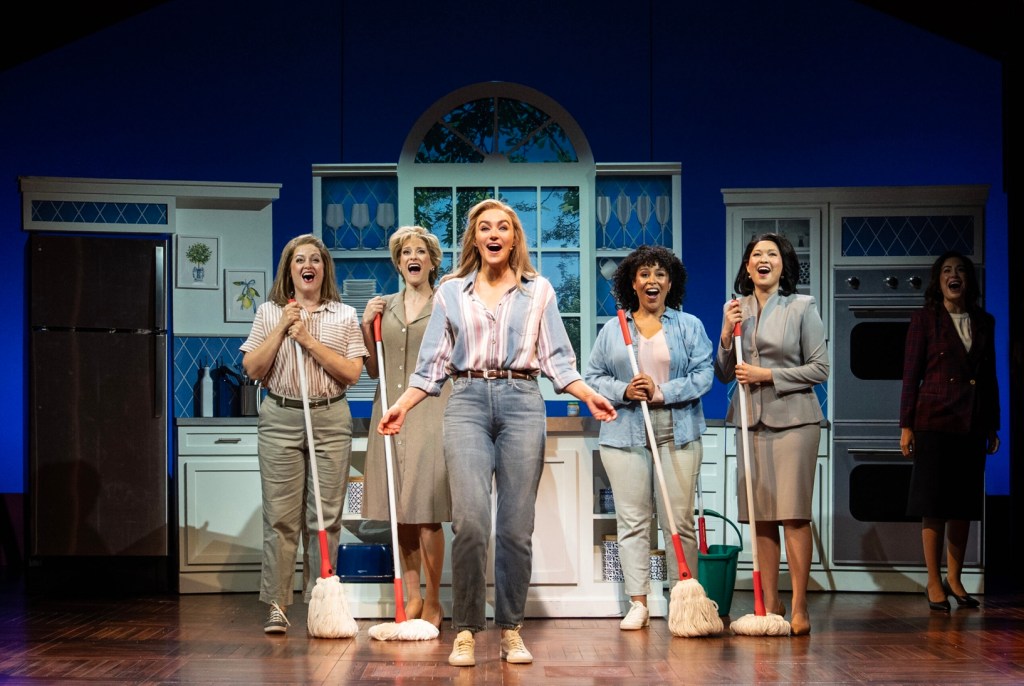
Betsy Wolfe (with ensemble members) in Joy: A New True Musical; Photo by Joan Marcus

It is easy to see why Wolfe is so popular that she gets a round of applause before she opens her mouth. Her very presence fills the house and she sings with much appreciated clarity and emotion.  Milazzo’s score isn’t the most varied and the refrains bleed into one another, but it is tuneful, carried along by Andy Einhorn’s arrangements.  The opening “Welcome to My World” does some heavy lifting, rapidly introducing us to a number of important characters and plot points.  The book by Davenport is considerably more assured than Hollywood’s interpretation of Mangano’s biography.  Filled with broad humor that makes a point, the plot gets bogged down in the second Act in part because it’s hard to top the momentum of Act I.  

Director Lorin Latarro uses her actors and limited space well, giving us glimpses of Bigger Show potential.  Likewise the choreography of Joshua Bergasse is muffled by shoulder shrugs and knee bends when it could eventually soar. The creative team has also delivered with vision but to scale.  Scenic designer Anna Louizos takes a lesson from the TV studios that brought Joy fame, filling a generic cityscape proscenium with small rolling set pieces.  Also taking a cue from television is David Bengali whose projections are critical to the storytelling.  Clever props including the co-staring Miracle Mop are designed by Andrew Diaz. Tina McCartney lets a few key outfits shine, and keeps the rest timely and simple. Liz Printz’s wigs and hair design age the lively Abramovitz and allow the ensemble to cover myriad roles.  Shout out to House Manager Dovber Dier and the incredible organization of the venue staff.

Who doesn’t welcome an upbeat story of success under trying circumstances?  Sure to be a crowd pleaser, the show is exactly what you’d expect from something called Joy: A New True Musical.  Performances are at the Laura Pels Theatre at the Harold and Miriam Steinberg Center for Theatre, 111 West 46th Street near 6th Avenue.  Running time is 2 hours including a 15 minute intermission.  The limited engagement is currently scheduled to end on August 17.  For more information and tickets starting at $72, visit https://joythemusical.com/.

We Live in Cairo

In 2011, a number of Egyptian youth groups gathered together in Tahrir (Liberation) Square to protest the corrupt authoritarian rule of President Hosni Mubarak.  His 30 year stranglehold on power had led to economic stagnation, human rights violations, and media restrictions.  The young peoples’ acts of civil disobedience in concert with a series of labor strikes forced Mubarak’s resignation and brought about a democratic election.  Their victory was short lived, however, and Egypt now stands at a miserable 18 out of 100 on the Freedom House scale.  

Inspired by a photo of several of the activist artists, brothers Daniel and Patrick Lazour wrote We Live in Cairo, developing the score and book over ten years.  The results are inconsistent in their ability to sway the audience, primarily carried along on waves of tuneful music.  Most numbers combine instruments and musical themes from Egypt with traditional structures including love ballads and rock anthems.  Director Taibi Magar joined the collaboration to add depth and movement to song.  The voices of the all-Arab ensemble blend beautifully (vocal arrangements by Madeline Benson) even when their characters falter.  For the scene depicting the toughest days of uprising, the musicians join the actors center stage, enveloping them with melody.

Michael Khalid Karadsheh, Ali Louis Bourzgui, Rotana Tarabzouni, Nadina Hassan, Drew Elhamalawy and John El-Jor in WE LIVE IN CAIRO at New York Theatre Workshop; Photo by Joan Marcus

The atmosphere developed by the design team wraps the audience in the sights and sounds of the struggle for freedom.  Tilly Grimes’ set is kept simple with a collection of pillows, rugs, lamps and household items filling a few shelves. The visual emphasis is on the evocative projections designed by David Bengali, some of which appear overhead.  He and lighting designer Bradley King added their graphical layers to the look and feel when they joined the crew during the run at A.R.T. in Boston.

Unfortunately, the story, though it was restructured several times, lacks the same level of vibrancy.  While the idea of looking at this revolution through varying lenses of artistry, policy, and simple human compassion is an interesting concept, the issues are all frustratingly abbreviated and the actions poorly motivated. Initially apolitical and fearful, Layla (Nadina Hassan) suddenly turns her entire life inside out based on exposure to a single image.  The societal significance of her boyfriend, Amir (Ali Louis Bourzgui), and his brother Hany (Michael Khalid Karadsheh) living as Coptic Christians in the majority Muslim country is mentioned, but never meaningfully explored.  Fadwa (Rotana Tarabzouni) is so driven by her identity as the child of dissidents that her every opinion becomes a cause which muddies their significance.  The attraction between the majestic Karim (John El-Jor) and the tentative Hassan (Drew Elhamalawy) is covered over as quickly as one of Karim’s satiric murals.  The vagaries of this critical thread border on homophobic.  Even the impact from country’s former status as a British colony doesn’t receive more than a single line.

New York Theater Workshop, which has been helping to nourish this production for nearly 7 of the 10 development years, has done what they can to broaden the world of the play beyond the walls of the theater.  E-tickets include the promotion of local Egyptian restaurants, invitations to post-show topical talkbacks at their sister space, and lighter cultural fare like a hummus-making contest.   A brief historical timeline and the “origin story” of the production are inserted into the program.

Like the ending of the Arab Spring it depicts, We Live in Cairo ultimately fizzles.  But it leaves behind a feeling of purpose that makes the experience worthwhile at this delicate point in our own history.  The Off-Broadway premiere continues through November 24 at New York Theatre Workshop, 79 East 4th Street in Manhattan. The performance runs 2 ½ hours with one intermission and contains images and sounds of a violent nature.  Tickets begin at $49 and can be purchased at https://www.nytw.org/show/we-live-in-cairo/tickets/ or by calling the NYTW box office at 212-460-5475.  You will get a better sense of place seated further back from the stage.  This is the first play of four in the NYTW 2024-25 season and subscriptions are still available for as little as $230.

Einstein’s Dreams

Alan Lightman’s novel, Einstein’s Dreams, follows a fictionalized Albert Einstein during the period he was developing his theory of relativity.  This literary exploration of time and our relationship to it has in turn inspired a number of artists including Joanne Sydney Lessner and Joshua Rosenblum.  Their musical version — also called Einstein’s Dreams — is currently making its off-Broadway debut at 59E59 Theaters, produced by Prospect Theater Company.

A theoretical physicist may seem odd subject matter for song and dance.  Indeed the numbers that are the most tuneful and consequently memorable — such as the spirited Relativity Rag — are those that portray universal feelings.  The all too human desire to hold onto a special moment or to feel stuck in an unpleasant one are sensations that are easily translated to a musical language.  It is when Lessner and Rosenblum move into storytelling mode that the quality of the lyrics suffers and the piece becomes problematic.

To convert the book — which centers on 30 varied dreams — to a manageable structure for performance, this retelling focuses on a relationship Einstein develops with Josette.  The tantalizing and intriguing woman only comes to him when he is asleep.  Their conversations supply him with fresh insight and inspiration.  Alexandra Silber gives soaring voice to this muse, set off from a sea of earth tone clad players by a fiery red outfit designed by Sidney Shannon.  Zal Owen counterbalances Silber’s flamboyance with his sensitive portrayal of a genius with no peers who is bored in his job and troubled by his deteriorating marriage.  

scenic design ISABEL MENGYUAN LEcostume design SIDNEY SHANNON

lighting design HERRICK GOLDMAN

sound design KEVIN HEARD

projection design DAVID BENGALI

props design SEAN FRANK

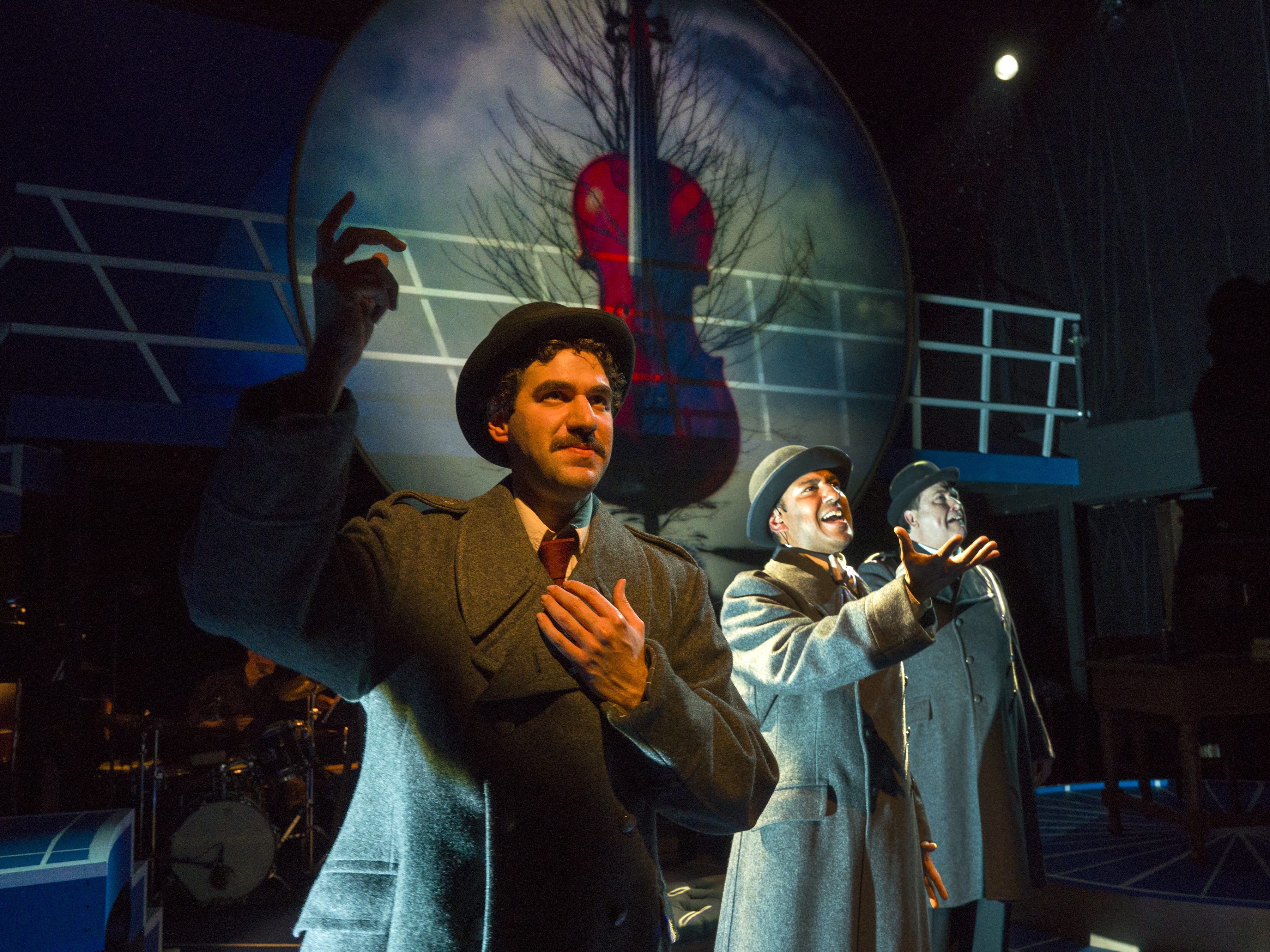
l-r- Zal Owen, Vishal Vaidya, Michael McCoy in EINSTEIN’S DREAMS at 59E59 Theater. Photo by Richard Termine

Even this central relationship isn’t given much spark by Cara Reichel’s clunky direction.  The biggest contributing factor to the unwieldiness of the work is the wideness of Isabel Mengyuan Le’s dramatic set.  While it is eye catching and brilliantly brought to life by David Bengali’s projections (the production element that makes the most of the theatrical medium and the dreamscape environment), it takes up so much of the stage that actors are sometimes forced to scoot awkwardly between sections.  Movement contributed by Dax Valdes is often limited to stunted waving of arms while the actors’ feet remain planted.

Of the supporting cast, Brennan Caldwell is a standout, providing comic relief and a blast of humanity as Einstein’s closest friend Besso.  Caldwell even manages to make physics sound conversational.  The rest of the company members (Talia Cosentino, Stacia Fernandez, Lisa Helmi Johanson, Michael McCoy, Tess Primack, and Vishal Vaidya) move mechanically from scene to scene.  Those who play multiple characters struggle to find meaningful differentiation.  Thankfully everyone in the cast has a pleasing voice and articulates clearly and the overall sound is comfortably modulated for the space.

The vast concepts that Einstein’s Dreams sets out to explore feel constrained by this production.  Yet those who love musicals as a means of expression will find enough here to keep them engaged for the swift 95 minutes of running time.  This limited engagement runs through December 15 at 59E59 Theaters (59 East 59th Street, between Park and Madison). Tickets are $25 – $70 ($49 for 59E59 Members) and can be purchased by calling the 59E59 Box Office at 646-892-7999 or
visiting http://www.59e59.org.