Tag Archives: David Cromer

Meet the Cartozians

What establishes our identity?  Skin color?  Language?  Scientific evidence?  In a country comprised primarily of immigrants, how do we balance our cultural heritage with our recognition as Americans?  In Meet the Cartozians, Talene Monahon, “a playwright of actor descent,” explores these weighty and often murky issues with keen insight and a knowing sense of humor using an Armenian family as her instruments.  With its complex history and even more complicated geography,  Armenia provides a wellspring of arguments about nationality, culture, and sense of self.  And if the play’s title brings to mind the most famous Armenian American of all, that, too, is very intentional.

In Act 1 we meet Tatos Cartozian, a character based on the man who was at the center of an Oregon court case in 1924.  As was true for the real Tatos, Monahon’s variation has been classified as a non-white Asian and on those grounds had his citizenship revoked.  It does not help his argument that his company makes Persian “oriental” rugs and employs “Islamics”.  To say more would detract from the delights of experiencing the reasoning of the family — Tatos’s mother Markrid, son Vahan, and daughter Hazel — along with their lawyer Wallace McCamant as he guides them in their preparation.  Monahon’s ear for dialogue and director David Cromer’s meticulous direction of each exchange should be freshly savored.

Act 2 takes place 100 years later in the Glendale, California home of Leslie Malconian. Several other Armenian Americans have been asked to gather with her to discuss and celebrate their ancestral heritage.  Their conversation will be featured in a special holiday episode of a wildly popular reality television show.  Despite the passage of time as well as that of many congressional bills, the subject of whiteness is no less thorny.  But it has taken on a very different hue.

The same six actors — Raffi Barsoumian, Will Brill, Andrea Martin, Nael Nacer, Susan Pourfar, and Tamara Sevunts — play parts in both acts.  Martin delivers her characters’ retorts with the wry “who me?” inflection we’ve come to expect from the seasoned comedian.  Fellow Tony winner Will Brill gets even bigger laughs with his quiet earnestness.  But a work this dialogue-heavy only succeeds because of the talent of the entire ensemble. The 2 ½ hour piece sails along at a satisfying clip.

Will Brill, Andrea Martin, Nael Nacer in MEET THE CARTOZIANS ; Photo by Julieta Cervantes.

The artistry behind the scenes is equally accomplished, particularly Enver Chakartash Act 2 costumes in relation to their Act 1 counterparts.  Scenic designer Tatiana Kahvegian creates the illusion of expansive depth in both living room settings.  Stacey Derosier’s lighting shifts from the muted tones of low watt bulbs and filtered sunlight to the intensive glare of actual spotlights.

Those who, like me, consider our country to be less of a melting pot and more of a stew — with distinct ingredients that complement each other — will find the brainy banter of Meet the Cartozians a sparking and engrossing entertainment.  The story also serves as eye-opening education as we witness a renewed struggle against those who wish to “preserve America’s white, Christian identity”.  It’s an auspicious opening for the 47th Season for celebrated 2nd Stage.  Performances continue through December 7 in the Irene Diamond at the Pershing Square Signature Center, 408 West 42nd near 10th Avenue.  The house is comfortable and well raked, but noticeably breezy.  Tickets begin at $86 and can be purchased at https://2st.com/shows/meet-the-cartozians#info.

The Antiquities – A First Look

When I heard that Playwrights Horizons, Vineyard Theatre and Goodman Theatre were co-producing a project, I jumped at a ticket to a late preview.  The Chicago-based Goodman — the oldest ongoing venue in the area — is a Regional Tony winner known for its community inclusiveness.  Vineyard Theater in Manhattan is renown for its support of new voices and unconventional works.  And the focus of Playwrights Horizons is to develop writers whose works promote conversation.  Recently they nurtured the seemingly impossible to stage Stereophonic which won a Tony for its Broadway transfer. 

Added to my incentive was that the playwright, Jordan Harrison, wrote two plays that have stayed with me over the years.  The characters in his Maple and Vine become so uncomfortable with the abundance provided by  modern technology that they move to a town filled with 1950s re-enactors.  In Marjorie Prime, which put Harrison on the short list for the Pulitzer Prize, a digitally generated companion assists an aging woman in recapturing her memories.  Both works are alternatively witty and chilling as they explore the relationship between technological advancement and what keeps us human.

While the performance I saw of Harrison’s latest occurred too early in the run for me to write an official review, I wanted to share a few thoughts.  In A Tour of the Permanent Collection in the Museum of Late Human Antiquities — or simply The Antiquities — two AI curators guide us through a museum built for preserving essential chapters in the human story.  The Playbill includes a quote by Oscar Wilde: “Every portrait that is painted with feeling is a portrait of the artist, not of the sitter.”  In this case, the artists are the systems into which we’ve fed everything from our grocery lists to sensitive photos and we are merely the byproduct of their process.

The trip forward begins in 1816 — when Mary Shelley concocted an original horror story that has since become a metaphor for many of man’s inventions —  and ends in 2240.  The journey is disjointed and abrupt, with some scenes lasting mere minutes.  The diverse cast, described only as Man/Woman 1-4 and Boy, moves with skill and comfort through roles and tone, though not all interactions land with the same level of impact.  For nearly an hour, Harrison relies on an intelligent and informed audiences to fill in blanks. The ride back to 1816 smashes the museum metaphor, but mostly succeeds in stitching together the incidents we’ve witnessed.  The conclusion leaves a stinging mark. 

Kristen Sier and Julius Rinzel in The Antiquities, opening February 4, 2025 at Playwrights Horizons; Photo by Emilio Madrid

The co-directors are multiple award winner David Cromer and ascending star Caitlin Sullivan. This creative pairing may explain the wide range of flavors imparted by each bite-sized chunk.  It will be interesting to see what changes are made by the artistic team before the show is frozen.  The scenic design by Paul Steinberg is composed of metallic walls shiny enough to make us feel included by not clearly reflected. They move to constrict the characters, and are enhanced with a few set pieces.  Tyler Micoleau’s lighting is harsh and eery, blending well with the occasionally distorted sound design of Christopher Darbassie. 

The Antiquities is not an easy show, but it is an admirable offering for the subscriber base of the collaborating producers and others who don’t mind doing some cerebral heavy lifting.  After opening on February 4, the World Premiere runs through March 2 at Playwrights Horizons, 416 West 42nd Street.  Tickets begin at $52.50 and can be purchased at https://www.playwrightshorizons.org/about/production-history/2020s/2425-season/the-antiquities-jordan-harrison.  A second production begins on May 3 at Goodman’s Owen Theatre in Chicago.

The Counter

Your ability to feel liberated by the story that unfolds in The Counter will depend greatly and how well the aftermath of the COVID pandemic and the current political climate have treated you.  The Playbill makes clear that the actions take place a few years ago, seemingly before we were all cut off from one another while living under extreme conditions.  If you have maintained or regained the muscle memory of a singular connection with someone in your life, Meghan Kennedy’s newest work will leave you with an increased sense of appreciation.  If, however, you remain in the grip of isolation and anxiety, the honesty with which the playwright confronts those feelings may overwhelm the more pleasant sensations of watching skillful actors drawing generously from sincere emotional wells.

Susannah Flood and Anthony Edwards in
Roundabout Theatre Company’s The Counter; Photo by Joan Marcus

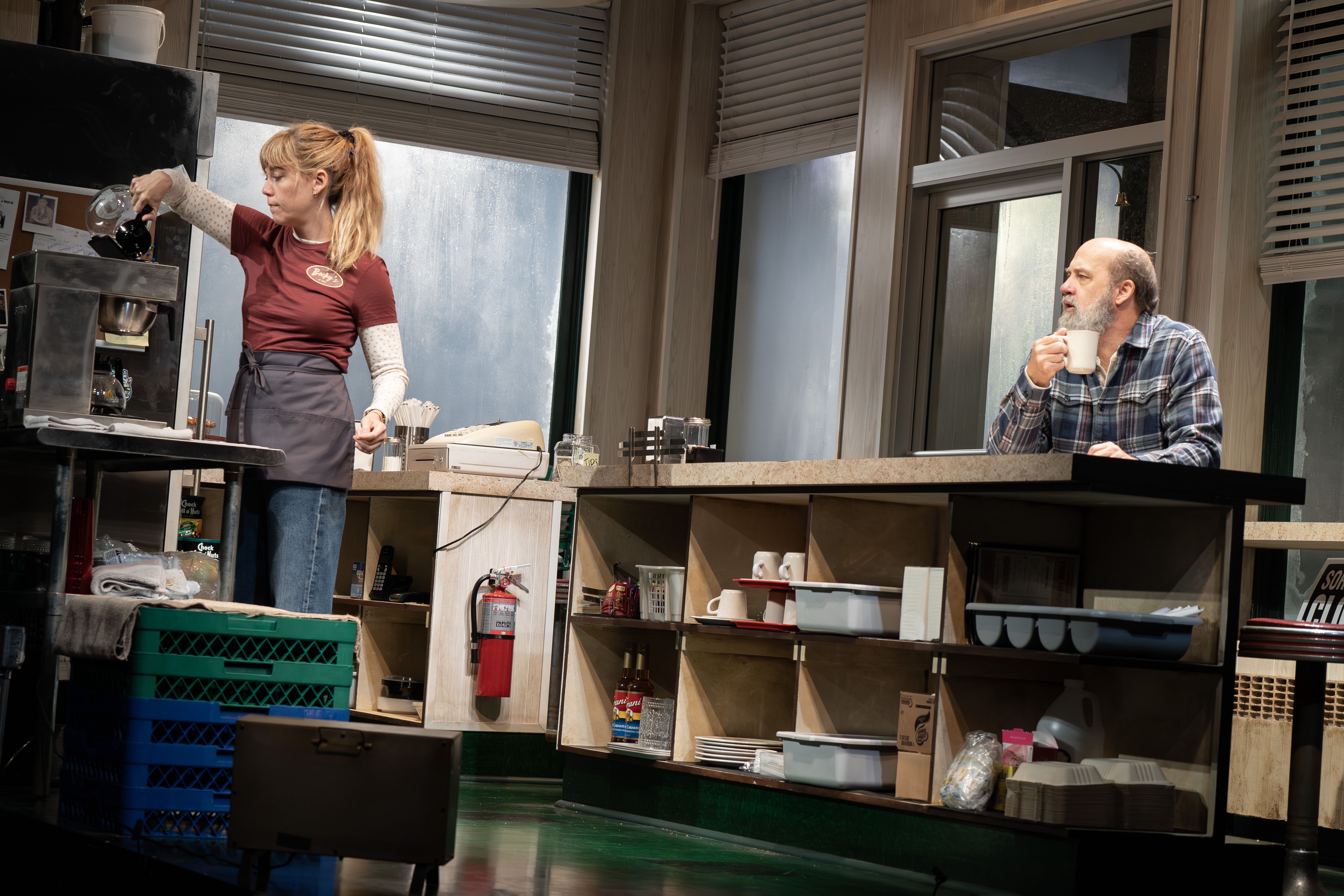
In an economic 75 minutes, Kennedy explores universal themes of grief and opportunities lost and found in a much more successful way than most of the COVID-panic-inspired plays I’ve reviewed this year (see Three Houses, Staff Meal and Six Characters).  Paul (a wholehearted Anthony Edwards nearly unrecognizable under a bushy beard) is a retired firefighter in small town New York close to the Canadian border.  He has an endearing ability to perceive, remember, and value the tiny gestures that make those around him special.  For reasons that come increasingly into focus, his life never fully launched.  Katie (Susannah Flood spreading her gloriously skittish wings) owns the cafe where Paul eats breakfast six mornings a week.  Unlike Paul, she has chosen this quiet and contained life.  With his frank urging, the two begin to form a friendship.   Amy Warren portrays third character, Peg, in a scene made pivotal by all we hear about her character before her entrance. 

Kennedy takes many shortcuts that some may find manipulative in order to move her story along to the key moments that propel each of them down their destined paths.  But in playing out their stories at 1 ½ speed, she accelerates our emotional investment in them both.  With increasing trust, they share “tough talk” with each other and us.  The balance of power shifts frequently, offering us fresh perspective with each twirl.

The scene is laid out in realistic detail by designer Walt Spangler, whose museum-worthy sets always provide an evocative sense of place.  The cafe is set on a angle, coming to a point audience center so everyone gets a pure view of every exchange.  Award-winning director David Cromer gives the central couple just enough business to heighten the small yet critical variation in the day-to-day.  Stacey Derosier’s lightening and Christopher Darbassie’s sound move the emphasis from exterior to interior dialogue and practically allow the windy world outside to swirl around our knees.  

We often hear about the importance of meeting people where they are.  The Counter illustrates exactly how powerful this connection point can be.  The underlying notes around self-care could also not come at a more appropriate time.  This limited engagement — part of Roundabout’s 2024-25 season — runs through November 17 at the Laura Pels Theatre (111 W 46th St).  Full priced tickets start at $58 and are available by calling 212.719.1300, or online at roundabouttheatre.org.

The Treasurer

The Son is going to Hell.  This is not a spoiler, but rather one of the opening lines of Max Posner’s The Treasurer.  This assured destiny stems from his loveless relationship with his self-centered and fiscally irresponsible mother, Ida Armstrong.  It is a wearying connection only hardened by her slow mental deterioration. The play is partially autobiographical, the second such dubious attempt produced by Playwrights Horizon this season. (The first was For Peter Pan on her 70th Birthday, Sarah Ruhl’s ode to her mother.  Interestingly, both Ruhl and Posner were writing students of the magnificent Paula Vogel.)

There is an almost therapeutic feel to some of the Son’s monologues.  Deeply personal scenes like the return of a pair of pants to Talbots may not translate for someone who is not Ida’s grandson.  Posner adds even more distance between characters by having the bulk of the dialogue take place on the phone.  But the biggest challenge with this story is that their family tie isn’t particularly tumultuous either.  The Son eventually complies with Ida and his siblings at every turning point.  Audience members seeking warmth — or at the very least electricity — at the heart of a production will be sorely disappointed.

The Treasurer ©️Joan Marcus

Deanna Dunagan and Peter Friedman in The Treasurer ©️Joan Marcus

Fortunately for all ticket-buyers, the performances are gripping.  Theater vets Deanna Dunagan and Peter Friedman take on the roles of Ida and her perpetually challenged Son.  Both give deeply human interpretations despite little new or informative ground.  Friedman is our guide here, frequently addressing the audience to share his exasperation, utter disbelief, and eventual acceptance.  Dunagan manages to lend freshness to Ida’s all too familiar arc of decline and multitude of stock scenes.  They are brilliantly supported by Marinda Anderson and Pun Bandhu, color-blind and gender-fluid in multiple roles.  Despite obvious talent, these two can’t quite replicate Ida’s once vibrant social circle, the more detailed loss of which would have given Ida’s failing more meaning.

David Cromer’s staging is difficult bordering on the bizarre.  Characters are often addressing each other from three distant points on the stage, making viewing more similar to a tennis match than a creative endeavor.  In the case of Anderson and Bandhu, actors sometimes start a scene as one character, then have to slide into another in a beat.  Laura Jellinek does what she can to support this vision with a compartmentalized minimal scene design.  Shout out to Brett Anders and his stage management team for slipping in to keep each section updated with the proper touches.  The lighting by Bradley King sets the tone with the houselights slowly dimming during Friedman’s first speech.  Sound design by Mikhail Fiksel includes perfectly replicating the tinny sound of cellphones and the stiltedness of online chatbots.  Lucy Mackinnon’s projections are attractive, though it’s hard to see how they clarify the plot or intensify the sentiment.

Those who relate to Playwrights Horizons’ mission to support emerging writers as well as those who believe in the crushing power of guilt, may be attracted to spending 90 minutes with The Treasurer.  It has been extended in the Peter Jay Sharp Theater through November 5, 2017.  For tickets and information visit https://www.playwrightshorizons.org/shows/plays/treasurer.