
Alison only knows one way of being. All waving arms and defensive language, she’s a fast talker in all the meanings of that phrase. Having been incarcerated for taking a hatchet to her lover’s car, she’s been released into the loving care of a church-sponsored sober house in the Blue Ridge Mountains of Western North Carolina. We meet her at her very first group session where she recites Carrie Underwood lyrics instead of the bible passage she’s supposed to have prepared. Within minutes she’s telling the circle why she’s not really responsible for her crime and emphasizing that, having never done drugs, she doesn’t have need of any one of the twelve steps.
Anyone who has experience with someone in recovery will know exactly how this story is going to unfold. That’s the essential problem with Blue Ridge, now playing at the Atlantic Theater Company’s Linda Gross Theater. While Abby Rosebrock’s script is beautifully written with textured dialogue, it doesn’t have anything new to say about mental health, boundary issues, or the powers of addiction in its many forms. Only those who find a new path have a real prayer of moving on intact enough to survive in the outside world.
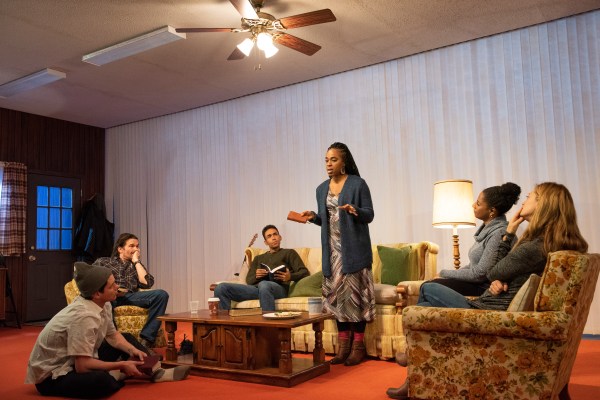
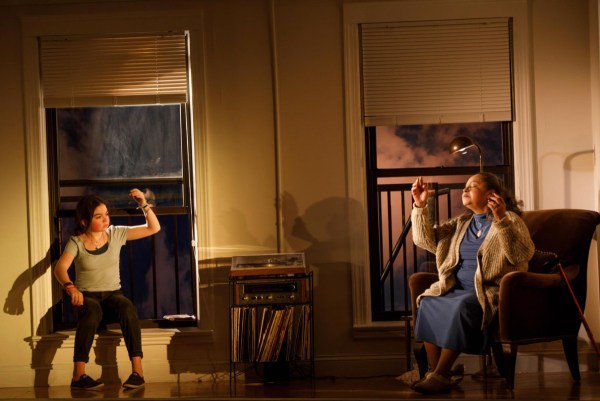
From lower left: Peter Mark Kendall, Chris Stack, Kyle Beltran, Kristolyn Lloyd, Nicole Lewis and Marin Ireland in Blue Ridge. Photo by Ahron R. Foster.
In the hands and body of stage steady Marin Ireland, Alison is particularly irksome. Her constant shrillness and twitching makes it hard to believe anyone in this substitute family would warm to her. This is especially true of her devoted roommate Cherie, played with deep sincerity by the excellent Kristolyn Lloyd. The male housemates’ reactions come from two diametrically opposed yet equally predictable directions. Peter Mark Kendall brings genuine vulnerability to the easily beguiled Cole while the endlessly watchable Kyle Beltran’s Wade creates friction in his struggle to find inner strength. The program’s co-founders are equally ill-equipped to lead everyone safely through a troubled journey. Pastor Hern (a smooth Chris Stack) weakly attempts to guide the housemates in a more mindful direction, and Nicole Lewis’s insufficiently defined Grace generally lives up to her name by simply finding the good in what comes naturally to each of her residents.
Director Taibi Magar successfully explores the shifting mood as the house moves from warm community to too close for comfort. Confrontations have a palpable and fiery emotional core. Her pacing is off, though, with the play running nearly 15 minutes over the prescribed two hours on Thursday night. Mikaal Sulaiman provides the intelligently curated soundtrack for both conflict and healing. Unfortunately, some of the other design choices are distracting. Why is the ten year old furniture of Adam Rigg’s set in a palate associated with the late 70s? Why does Amith Chandrashaker’s lighting incorporate an incongruous brilliant December sunshine streaming through the window and ugly fluorescent overheads that play a supporting role for just a few minutes? Why, while indicating the passage of time through Thanksgiving throws and a Rudolf mantlepiece, do we need to break the story’s flow and see each item put in place by the glow of a proscenium of LEDs?
Taken as a whole, this production of Blue Ridge is flawed and consequently frustrating. Writer Rosebrock has obvious talent, but her storytelling has not yet been brought into focus. However, if you are fascinated by the ways in which broken people can either fit together with or puncture those around them, you may find enough with which to engage. This limited run is scheduled through Sunday, January 27th. Regular tickets begin at $65 and can be purchased online at atlantictheater.org, by calling OvationTix at 866-811-4111, or in person at the Linda Gross Theater box office (336 West 20th Street between 8th and 9th Avenues).




 The Unforgettable Line
The Price of Thomas Scott
Long before there was Reverend Moore in Footloose, there was dance adversary and forceful chapel congregant Thomas Scott. Scott has been offered a small fortune for his declining neighborhood textile business. The problem? The new owners would turn the desirable corner location into a dance hall: a devil’s playground as far as Scott is concerned. A righteous Protestant Nonconformist, he must now weigh his family’s future against his steadfast convictions.
Despite being written in 1913 by rising star Elizabeth Baker, The Price of Thomas Scott is brimming with modern dilemmas. Class still dictates potential opportunity for education and career. Our highly divided social climate is filled with the voices of strong convictions that have soured into prejudice. Many become even more entrenched in the familiar and pass judgement on those who are open to differing opinion. Yet as time moves forward, the seemingly outrageous and unusual can find more acceptance.
Scott’s family in question includes his far-sighted and talented daughter Annie (a radiant Emma Geer), whose creativity is stifled by her tasteless clientele. Her brilliant brother Leonard (Nick LaMedica who does his best to come across as a teenager) has the potential to become upwardly mobile. Their mother Ellen (an underutilized Tracy Sallows) longs to retire with her husband to Tunbridge Wells where they first met. While Scott himself (a crackling Donald Corren) has built his life around his chapel and now seems driven to protect everyone’s prospects for entrance to heaven. Temptation is provided in the form of Wicksteed (a polished and eloquent Mitch Greenberg) a former friend now employed by the successful Courney Company. The story is made richer by the Scott’s friends and neighbors played by Andrew Fallaize, Josh Goulding, Jay Russell, Mark Kenneth Smaltz, Ayana Workman and Arielle Yoder.
Tracy Sallows, Donald Corren and Emma Geer. Photo by Todd Cerveris.
Director Jonathan Bank is constrained in his approach, relying heavily on Tracy Bersley’s choreography to pick up the momentum. All the action takes place in the back parlor of the Scott’s shop, represented by the perfectly rundown set created by Vicki R. Davis. The charming mostly muted costumes by Hunter Kaczorowski tell the story of period and class in pre-WWI England. The hats on display illustrate the gap between Annie’s instinct for style and her clients’ misguided requests. Shifts in the lighting by Christian Deangelis and music and sound by Jane Shaw help set mood and pace.
All are in service to the clever and often humorous words of Ms. Baker. Growing up in a household similar to that of the Scotts, she took in her first play at the age of 30. In short order she had transformed from an obscure stenographer to recognized playwright. At first you may need to navigate the various accents and a few older expressions, but then the flow is established and the characters come into focus. However, the ending will feel extremely abrupt to a modern audience. (Those around me failed to clap for a full 30 seconds, though they appeared stunned more than unhappy with the performance.) The production team seems to have recognized Baker’s departure from what has become an acceptable character arc and tacked on a post-curtain call “coda” to better manage expectation. Your reading of the Artistic Director’s statement and dramaturgical notes will help you better appreciate the work.
The Price of Thomas Scott poses some deep questions through pleasant voices. It is Mint Theater’s latest project in support of giving new life to neglected women playwrights. Runtime is 90 minutes with no intermission. It is playing through March 23 at the Beckett Theatre in Theatre Row. Full priced tickets are $65, though there are several discount options including $32 day-of Rush. For more information and to purchase seats visit http://minttheater.org/current-production/