
Dogs of Rwanda is like that really sweet guy you wanna like, but you just can’t get beyond his shortcomings. There are several unfortunate distractions that prevent it from being as powerful as it should be. Given that the Rwandan genocide took place in 1994 and the audience spans a large age range, a short background beyond the artistic director’s statement would have helped. By necessity, the tale we hear is a deeply personal one and moments are certainly shocking, but they are not given sufficient context or a sharp enough lens through which to see. There are also some artistic choices that have hindered the impact of the piece.
The script by Sean Christopher Lewis is delivered as a monologue told solely from the point of view of David Zosia, who at 16 volunteered for a church run spring break program in order to spend time with his crush, Mary. At their Ugandan camp, they are assigned laundry duty working just downstream from Rwanda. When the fight between the Tutsis and the Hutus breaks out, bodies begin floating by the horrified youth. The pair is drawn deeper into the conflict when they attempt to help a local boy named Gods Blessing. Over the course of 90 minutes, David vividly describes what happened at the time and also 20 years later when he receives a note from Gods Blessing that takes him back to Africa. The audience is present to bear witness to his account: an integral role in any deeply meaningful ritual.
David is portrayed by Dan Hodge, an actor and director with an impressive resume. Unlike most solo performances this isn’t Hodge’s story and that is the first stumbling block to its success. Hodge never fully inhabits the role: he is acting not being. The only other person on stage is musician Abou Lion Diarra who accompanies David’s tale with original music performed on a variety of percussion instruments. This creative embellishment was added by the Urban Stages team, but the execution doesn’t quite work. Hodge is inconsistent about including Diarra in the action, sometimes exchanges glances and sometimes ignoring him. Furthermore, the talented Diarra is often so swept away by the joy he finds in playing that it is easy to catch him smiling incongruently to the horrors being described.

Actor Dan Hodge with instrumentalist Abou Lion Diarra. Photo by Ben Hider.
There is also the critical issue that David is essentially a selfish SOB. Everyone else we hear about — Mary, Gods Blessing, and his current girlfriend — have been treated with contempt by our narrator and guide. He is not without redeeming qualities, having literally bled to share at least some of his story with the public in a book called Letters From The Red Hill. While David is certainly contrite by the end, that is where we leave him, never witnessing any actual change in his behavior. This makes his confession a rather hallow one. How can we forgive David as we are meant to if we never see him embody the lessons he claims to have learned and put them into action?
Urban Stages Founder, Frances Hill, and Director of Musical theatre, Peter Napolitano are responsible for the meandering direction. The creative team is the same as the one that brought Zhu Yi’s A Deal to life. Their vision is much murkier this time around. The set by Frank J. Oliva is made to look like a village clearing with a faux earthen floor and thatch peering through a side opening. It lends an interesting flavor to the atmosphere, though the setting is only appropriate some of the time. John Salutz’s lighting casts long shadows which may be intended to add mood but come across as an amateurish mistake. The brilliant Ryan Belock has once again designed the projections, but the screen is at an angle over Hodge’s head. This is effective for planes, trees, and clouds, and a head scratcher for ocean waves.
While not completely successful as a drama, Dogs of Rwanda can serve as a reminder of the dehumanizing effects of war, the atrocities committed based on tribalism, and the many treasured places around the globe devalued by Americans. It is a worthy end to a season in which Urban Stages has been shining a light on works with an international point of view. It runs through Saturday, March 31, 2018. Tickets for are $35 ($25 during previews; $50 on opening and $15 student rush) and may be purchased via OvationTix at www.urbanstages.org or by phone at 1.866.811.4111.


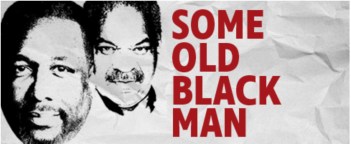 I attended the performance of your play, Some Old Black Man, at 59E59 Theaters on Saturday, February 10. Co-star Roger Robinson was out sick, replaced by Phil McGlaston. I understand that Mr. Robinson has been with the production since the beginning and that it is your request that the show not be reviewed without him. Certainly I was disappointed not to see his turn as Donald, but it was a marvelous afternoon nonetheless. I wanted to take this opportunity to applaud your wonderful work in full view of my readers.
 Many of us have experience working with someone who’s a big picture dreamer. Unchecked by a healthy skeptic — much less an opponent with a better idea — they good-naturedly lead their team down a path to The Emoji Movie or Pets.com. Greg Pierce starts out telling one such story in Cardinal in which Lydia Lensky returns to her hometown with the wild idea of literally painting it red. With tremendous enthusiasm and few facts, she persuades the locals that this gimmick will attract tourism and new business.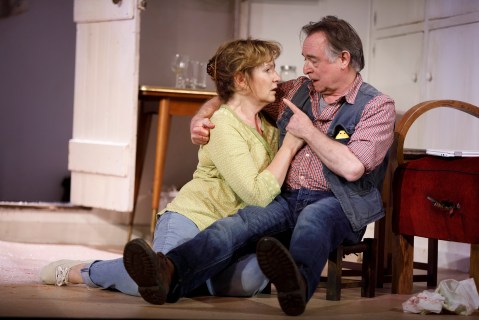

 When I lived in San Francisco, I volunteered at a residential program for former felons. I realize this makes me more likely to respond to the plight of bright creative people who make terrible decisions and are helped along that path by a lack of education, support and resources. Judging from the emotional reaction of audience members around me, these characters are so beautifully detailed, their situation will draw you in just because you are human.
 The Unforgettable Line
Bobbie Clearly
We are seated in the Milton Community Center witnessing the making of a documentary. Ten years ago, this small Nebraska town was rocked when the title character of Bobbie Clearly shot and killed Casey Welsh when she was 16 and he 14. For nearly 2 1/2 hours, we will hear from Bobbie and ten others about what led up to that horrific event and beyond it to present day. It will be as hard to see the next turn in their stories as it is to navigate the tall fields of corn where Casey’s body was found.
Avoiding the pitfalls of some of the seasons other issues-oriented productions, Bobbie Clearly focuses on the violent act’s human impact rather than on the shooting itself. Playwright Alex Lubischer has generously peppered his moving script with moments of humor, taking care to treat his characters with affection even when poking fun. Though primarily delivered in interview format (to an unseen host), the relationships sparkle. There are times when two people are telling separate segments using identical phrases, shining a light on the importance of context. Lubischer also captures a common progression of high school friendships, following four of Bobbie’s classmates from their summer jobs corn detasseling through their awkward fundraisers in Casey’s memory. Further, there is a profound exploration of the link between religion and forgiveness. Most importantly in this delicate time, Lubischer is careful not to take a stand on guns by making Casey’s father, Stanley, take delight in hunting as a distraction from his grief.
The entire cast is terrific, beginning with Ethan Dubin who — though used sparingly — manages to be both sweet and disturbing as Bobbie. Many will recognize the magnificent Constance Shulman from her equally wonderful ensemble work in television including Orange is the New Black. With her tiny wiry frame and high-pitched croak, she makes an unusual police officer, which is perfect given the unconventional bond she develops with Bobbie from the time he was the Sunday school bully to the day he makes his best attempt at repairing the huge hole he has ripped in his community. Her intensity is balanced by the performance of JD Taylor as Bobbie’s misguided and slightly goofy Big Brother Derek Nelson. As BF(F?)s and mismatched bookends Megan and Meghan, Talene Monahon and Sasha Diamond play off each other with great timing. And Tyler Lea taps into both vulnerability and inner strength as Casey’s younger brother, Eddie, the only witness to the murder.
The piece is performed in 3/4 round with what are essentially service doors to the space serving as entrances and exits. As directed by Will Davis, the energy flows consistently even through the silences. He may also be responsible for the brilliant choreography of two critical dance numbers, which call for very special talent. Kudos to Asta Bennie Hostetter for finding such great costumes-on-a-budget for those numbers as well as the more everyday items that fill in character details. Providing unsettling atmosphere are the smothering walls of dried corn that almost exclusively comprise the minimal set by Arnulfo Maldonado.
At $25 a ticket, Bobbie Clearly is superb bang for the theatrical experience buck. The play is presented as part of Roundabout Underground at The Black Box Theatre and is sure to keep developing its strengths. If you are looking for a who dunnit or even a why, look elsewhere. However, this slow-burn storytelling and honest examination of what is ultimately unknowable will leave you with your thoughts turning. For tickets, on sale through May 6, 2018, and information visit https://www.roundabouttheatre.org/Shows-Events/Bobbie-Clearly.aspx.