Tag Archives: Drama

White Guy on the Bus

WhiteGuyontheBus

Photo by Matt Urban/Mobius New Media

It’s been disquieting to hear a certain level of weariness creeping into the general dialogue about racism.  Headlines covering people of color unfairly detained or even killed may be a near-daily occurrence, but that doesn’t make any individual event less worthy of attention or thoughtful discussion.  White Guy on the Bus provides a gripping reminder that behind each incident is a person with hope for the ones they love and a potential for fear of those who are different.  Though Bruce Graham wrote the script over two years ago, it is shockingly appropriate for a time of deepening gulfs between people of varying races, socio-economic backgrounds, and opportunities.

The time-shifting plot is beautifully constructed.  Each twist that pulls us deeper into the story also jolts us into confronting our own racists thoughts.  How many of us make quick judgements about where to sit or walk based on what we feel about a certain neighborhood?  Yet how can we deny that while such reputation is based on generalizations and stereotypes, those in turn are based on facts and figures?  What happens when we push common ground to the side and focus on differences?  It’s hard not to become as unnerved as the characters we are watching, especially if you are white as most of the audience at 59E59 is.  It is worth noting that the director is another white man.  On the audience hand-out, Bud Martin confesses to being drawn to the play primarily because the story made him uncomfortable.

Two magnetic central performances rivet our attention for the two hour run.  Tony nominated for Jekyll and Hyde, Robert Cuccioli once again displays both calm professionalism as well as a more controlling dark side.  His non-white seat-mate Shatique is played with strength and grace by Danielle Lenee´, previously nominated for a Barrymore Award for this role.  Their supporting cast is a perky Jonathan Silver as devoted like-a-son Christopher, a steady Susan McKey as Ray’s feisty wife Roz and a far weaker Jessica Bedford as Christopher’s righteous wife Molly.

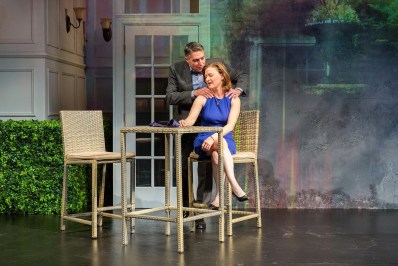
The simple yet clever set is designed by Paul Tat DePoo III and enhanced by Nicholas Hussong’s projections.  Together they move us from Ray’s stunning suburban home, to the critical public bus and to points beyond.  Wade Laboissonniere’s costumes fit the characters in all meanings of that word and help sell important details of the story.

As a five character one-set piece, White Guy on the Bus is attractive to small theater companies with tight budgets.  It has already played Wilmington, Trenton, Denver and Chicago and I imagine it will hit other cities with mixed populations.  That it should also spark discussion wherever it lands is exciting.  You can grab your chance to participate in the conversation by catching it at 59E59 through April 16.  For tickets and information visit http://www.59e59.org/moreinfo.php?showid=252.

The Present

(Note: This review is based on the December 24, 2016 preview performance.)

The PresentThe supremely talented Cate Blanchett has come to Broadway.  Unlike many film celebrities who flounder on stage, Ms. Blanchett is the former co-artistic director of the Sydney Theatre Company, where she also made her theater debut nearly 25 years ago.  The same incredible nuance she brings to her on-screen characters is alive and in proper proportion in her role as Anna in The Present, a modern reinterpretation of an unpublished play by Anton Chekhov.  I would recommend this show simply for the opportunity to bathe in her deeply considered and exceptional work.
Furthermore, there are additional elements to be enjoyed here.  Just as her character has invited friends to celebrate her birthday, Ms. Blanchett and playwright/husband Andrew Upton called upon close associates to share in this production.  Richard Roxburgh — who is technically the star as the pivotal Mikhail— has played opposite her many times including in Chekhov’s Uncle Vanya and The Seagull.  When I say he makes a terrific libertine, it’s meant to be a compliment.  The cast is rounded out by other actors who have collaborated frequently at STC and elsewhere.  There is an easy flow among them that only intensity over time can produce.  The range of feelings comes across as genuine even when the words sound less so.  Of particular note is Chris Ryan who gives the fragile and naive Sergei remarkable depth in his few scenes.

If you‘ve ever slogged through a so-called lost work, you can imagine that the finding of the play itself is a mixed blessing.  The original piece is a 300 page rambling tale which was locked away in Chekhov’s desk where it was unearthed after his death.   Upton is certainly skilled at updating classics, giving them new life for a modern audience.  This is a more challenging task when the piece in question has been deliberately set aside by its creator after being rejected by its intended leading lady.  Particularly adroit at restyling pre-revolutionary Russian drama, Upton has previously adapted Uncle Vanya plus two Gorkys and a Bulgakov.  For this unnamed tome, Upton chose to move the period to the more accessible 1990s and age the characters to add believable complexity to their emotional lives.  (I recommend reading his author’s note provided in the program to help you jump into the world and understand the relationships he has sculpted out of Chekhov’s rock.)

The first act of The Present is nearly two hours long, yet it moves steadily on waves of insightful conversation and palpable emotion.  It is surprisingly the far shorter second act that gets bogged down when the vodka-soaked characters more consistently speechify and the plot turns frustratingly soapy.  Director John Crowley has added a naturalness – if also an aural challenge – to the action by having his talent move about without any conventional awareness of the placement of the audience.  Alice Babidge provides a clean canvas for the colorful characters with stark scenic and costume design.  Only sad balloons and tacky streamers are employed to communicate the less-than-festive air surrounding Anna’s birthday bash.  Stefan Gregory’s edgy music and sound design add several strong jump-out-of-your seats moments.

If you relish the opportunity to see deeply connected old friends *play* deeply connected old friends, make time to catch this somewhat uneven endeavor.  Limited engagement ends March 19, 2017.  For tickets and information visit http://thepresentbroadway.com.  Shorties like me should note that the mezzanine of the Ethel Barrymore Theatre has those high hand rails attached to each aisle seat and along the edge of the balcony.  At 5’1” I was just able to see over them from the third row.

Heisenberg

HeisenbergMTCFriedman TheatreIf the name “Heisenberg” has frightened you into thinking this is a dense play about quantum mechanics, never fear.  It is, rather, about the most everyday of occurrences: two dissimilar people getting to know each other and determining the substance of their relationship.  Like protons, can they come together to form something bigger and more powerful?  And if they do, what is the potential for that configuration to change?

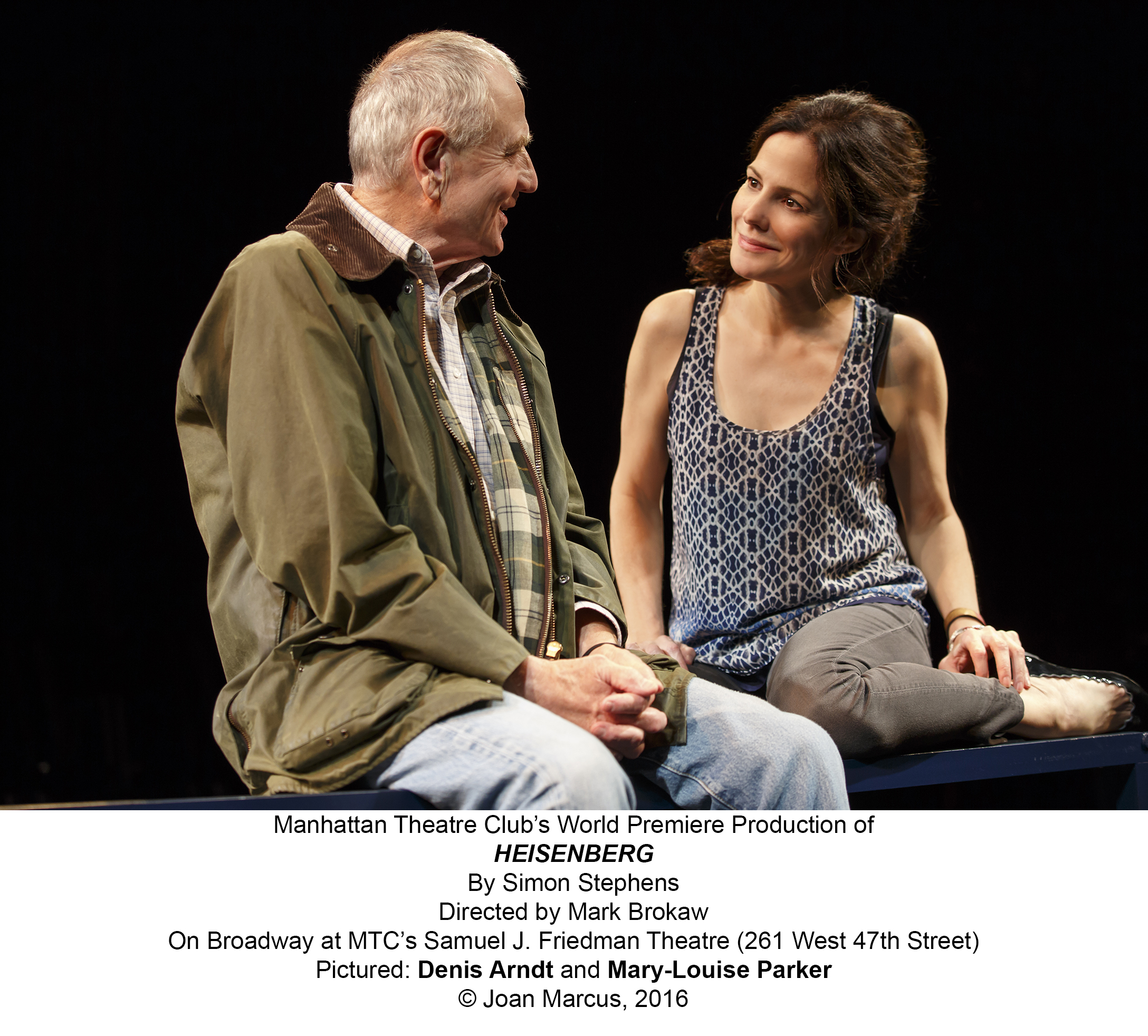
The series of somewhat commonplace conversations about life, work, and love is made compelling by two gifted actors: Denis Arndt as Alex and Mary-Louise Parker as Georgie.  The disparity in their ages is the least significant of their differences.  I had heard about their incredible chemistry, but that’s not the word I would use to describe their bond.  What flashes between them struck me as more skillful than emotional, like trapeze artists who know exactly when to extend their arms even when there is no music.  There is much communicated in a simple smile or touch.  But it is absorbing artistry, not as impassioned as I expected.

The slow-burn of personal revelations is pepped up with flashes of humor and provocative uncertainty.  Simon Stephens, who so brilliantly adapted The Curious Incident of the Dog in the Night-time, has here provided a simple dialogue with a intriguing angle.  We learn fairly early on that Georgie can tell a convincing and detailed lie.  That makes everything she says and does suspect, even when she’s admitting to lying.  It’s a tribute to the characters’ development — their ultimate sweetness and vulnerability —  that I found myself wondering for days whether the key turning points of their journey together stemmed from genuine crisis or Georgie’s well-constructed (possibly dubiously motivated) flights of fancy.

Heisenberg was commissioned by Manhattan Theatre Club and played off-Broadway last summer at City Center. Within its new Broadway home, director Mark Brokaw has recreated the proper space for his intimate yet significant production, greatly reducing the size of the stage by placing 200 members of the audience in seats on the stage.  The feeling is more of a small town sports arena than a professional New York theater, which is no doubt intentional.  With limited room to move, the two actors can’t help but confront each other at every turn. in action as well as in word.  Outlines of locations from a train station to a butcher shop to a hotel room are defined by scenic designer Mark Wendland using folding tables and chairs. Scenic beats are created with Austin R. Smith’s lighting and David van Tieghem’s sound.

Three of the closest people in my life I met randomly through uncharacteristic circumstances.  So it is not a surprise that the underpinnings of Heisenberg resonated with me.  If you, too, know that experience of a chance encounter that alters your life or you simply enjoy seeing potential unfold between strangers, then you will find Heisenberg an engrossing way to spend 80 minutes.  It is playing through December 11, 2016 at the Samuel  J. Friedman Theater.  For tickets and information visit http://heisenbergbroadway.com.

Oslo

Whether or not Oslo is your kind of play depends in large part on your enjoyment of the drama of diplomacy and the language of complex interpersonal communication.  The piece by J.T. Rogers is based on the true events that led up to the Oslo Peace Accords: the extraordinary peace deal between The PLO and Israel signed into being on September 13, 1993.  The little-known backstory — particularly the delicate and perhaps heroic involvement of the Norwegians in the series of intricate and touchy conversations between lifelong enemies — will hold a genuine fascination for some.  For others, the intervening 23 years of failure and violence will overshadow the struggle reproduced on stage.  Yes, Oslo portrays an incredible opportunity, but one that could not be held together long with cleverness, waffles and Johnny Walker Black.

Purely as an entertainment, Oslo has a lot to offer.  Though it clocks in close to 3 hours, it never stops moving.  There is a surprising amount of action in what could have been an overly-talky script.  History has been condensed and characters melded for ease of understanding without great loss of accuracy.  The crackling dialogue flecked with humor is interspersed with clarifying remarks made directly to the audience.  Positions are dealt with even-handedly, delivering the clearest picture possible of what’s at stake for all parties involved.

The vast cast under the seasoned hand of Bartlett Sher is first rate.  While I did not buy his closing remarks about the lasting impact of the proceedings, the always excellent Jefferson Mays as Terje Rød-Larsen makes an eager and human guide.  His noble and gifted wife, Mona Juul, is played by Jennifer Ehle with integrity and warmth that radiates to the exit doors.  Henny Russell in multiple roles adds charm and laughs by turns.  But it is Uri Savir the Director-General of Israel’s Foreign Ministry as portrayed by Michael Aronov who electrifies the space and keeps us rooting for something positive to emerge from the flutter of words.  Designer Michael Yeargan provides simple furniture supplemented with projections by 59 Productions which makes moving through locations quick and easy to follow.  Catherine Zuber’s costumes add “schlub”, utility and class in all the right places.

The short run currently at Lincoln Center Theater’s Mitzi E. Newhouse through August 28 (http://www.lct.org/shows/Oslo/) is sold out.  However it’s a good bet that lovers of mildly-fictionalized history and political intrigue will assure Oslo is repeated from time to time for at least as long as the Mideast face-off persists.

The Healing

In The Healing, a circle of friends who met at a religious camp 25 years ago reunites to honor the death of one of their own.  Before you can roll your eyes, let me add that the situation is set in motion by Samuel D. Hunter, the Obie Award winning playwright behind A Bright New Boise.  In both cases, Hunter explores what happens when extreme faith meets life’s curveballs with stunning agility and clarity.

Here he adds an extra thought-provoking layer.  All of the main characters and the actors who portray them are disabled.  This is both significant and irrelevant.  Commissioned by the Theater Breaking Through Barriers, the piece provides a welcome opening for a group of gifted actors who have more limited opportunities.   The work was written specifically for this cast and that customization shows in their ease with one another.  In the lead role of Sharon, the heart of the group, Shannon DeVido — a comic, improv artist, and frequent Hunter collaborator — conveys a delicate balance of command and doubt.  (Regrettably on this occasion her perfectly timed moments of reflection sometimes lead to too quiet a delivery.)  Even stronger and more approachable is actor/speaker/filmmaker David Harrell as down to earth Donald.  Jamie Petrone and John McGinty are adorable as newly coupled Bonnie and Greg.

Their presence on stage also holds up an important mirror to an underserved audience of partially sighted and deaf as well as those with limited mobility.  The energy zooming in both directions is electrifying.  Ultimately, though, this is simply a terrific story about friendship, loyalty and getting through the day.  While The Healing isn’t quite up to Boise’s level of greatness, Hunter’s set-up is intriguing, every little touch has relevance and the dialogue simply flows forward.  As a result, the script could be well executed by any talented troupe, all be it less sincerely and powerfully.

This world-premiere production has been well-mounted at the small Clurman Theatre in Theater Row.  UK and US director Stella Powell-Jones brings her delicate touch to even the most uneasy of the play’s beats. Jason Simms’ set design wonderfully captures the watched-too-much-QVC-ness of Zoe’s living room.  And I would give Christopher Metzger a separate round of applause for Mary Theresa Archbold’s physically overwhelming outfits for her role as the nearly defeated Laura.

If you like your theater on the natural side, The Healing will strike many graceful notes.  Tickets are available through July 16 at http://www.theatrerow.org/clurmannowplaying/.

Turn Me Loose

Standup comedian and civil rights activist Dick Gregory’s rise to fame began when Hugh Hefner heard him address a nearly all-white Southern audience at a black-owned establishment and brought him to the Playboy Club.  His big breakthrough came when he was invited to be the first African American guest to be seated on the famous couch at the Tonight Show.  Whether you remember his scorching political satire, heard about it second-hand or are completely unfamiliar with his history, revisiting his work in Gretchen Law’s Turn Me Loose is an opportunity not to be missed.  Hearing his words through a 2016 filter is a punch to the gut and a sad commentary on the one-step-forward-two-steps-back progression of race relations in this country.

On stage for a solid 90 minutes, award-winning actor Joe Morton is completely captivating in the lead.  Given the still-living Gregory’s real bite, it’s a tall order.  Yet Morton perfectly portrays a span of nearly 50 years solely with adjustments to his posture and a roughening of his voice.  His total control of the audience never waivers as he gets them to rise to their feet in approval or recoil when requested to shout out the N word.  Morton receives occasional and essential support from the versatile John Carlin as every background player including a heckler, cabbie, and radio interviewer.

Law’s script blends chapters of Gregory’s autobiography and clips of his routines with a touch of fiction to keep the storyline tight and clear.  Chris Barreca’s adaptable set holds the audience’s attention firmly on the electricity generated by Morton’s performance and Gregory’s words.  Director John Gould Rubin ensures that every audience member is treated to moments of direct eye contact with his star, helping each segment land with a thump.  The design team of Susan Hilferty (costumes), Stephen Strawbridge ((lighting) and Leon Rothenberg (sound) moves the action seamlessly from club to studio to home.  Unfortunately, the haze meant to recall the days when smoking was allowed is an unnecessary touch that leads to more coughing and watery eyes than nostalgia.

Turn Me Loose is playing at The Westside Theater through July 3, 2016.  For Boomers, it provides a profound reacquaintance with the past.  It is my hope that younger people will also flock to see Papa Pope of Scandal tear into something more worthy of attention than his daughter’s life.  For tickets and information, visit http://www.turnmelooseplay.com.

The Humans

Of all the plays this season, Stephen Karam’s The Humans elicited the broadest range of responses from my friends and colleagues.  For each one who put it at the top of their list there was someone who unequivocally hated it.  Now that I’m on the other side of my own viewing experience, I can see why this piece generates both broad smiles and crossed arms.  It’s a cake made with corrosive acid and vanilla buttercream frosting.  Which of these ingredients hits you harder will depend very much on your personal makeup.  The one thing you won’t feel is nothing at all.

Fittingly, the events take place on Thanksgiving, which — lets face it — even in the happiest of households is a holiday that never quite lives up to our vision.  This is certainly true for the sincerely loving Blakes, joined for the first time by the younger sister Brigid’s beau, Richard Saad.  The family is as close to typical middle class city dwellers as you are likely to find on a big stage.  Rich has inherited money in his near future and is therefore on a different plane.  Long held rituals, new practices, and lost traditions come together over the course of evening, making for an odd mixture of comfort, hope and longing.

It must have been challenging to preserve the necessary level of intimacy when the play moved from the Laura Pels Theatre to Broadway.  Multiple Tony winning director Joe Mantello accomplishes this by keeping the action chaotic and tight.  David Zinn’s set successfully recreates what passes for spacious in New York’s Chinatown: a windowless basement with a nearly windowless second story.  Justin Townsend’s lighting and Fitz Patton’s sound add layers of eeriness and occasional humor to the atmosphere.

But as the title suggests, it is the humans who stand out.  The chemistry among the actors (Cassie Beck, Reed Birney, Jayne Houdyshell, Lauren Klein, Arian Moayed and Sarah Steele) is top flight.  Their warm, genuine bond is essential to making this production a success.  No wonder of all the terrific recent collaborative works, the Drama Desk chose to honor this cast with a special award for Outstanding Ensemble.  Birney and Houdyshell are particular standouts whose every emotion can be read in their body language from the back row.

The Humans is playing at the barely comfortable Helen Hayes Theater.  If you like your theater on the raw side, this one is for you.  Tickets are currently available through July 24, 2016.  Visit http://www.thehumansonbroadway.com for more information.

The Crucible

The last time I attended a performance of Arthur Miller’s The Crucible, I had not yet seen the McCarthy-Era set Trumbo or heard a candidate for president propose the “complete shutdown of all Muslims” entering our country.  The plot struck me as plodding and the dialogue dense.  Those recent reminders that unfounded fear can easily transform into outright hostility gave me a deeper appreciation of the unfortunate relevancy of this classic work.  This is also a superior production, boasting a first-rate cast in the skilled hands of Ivo Van Hove, a director who has become synonymous with dark and moody productions.

The entire ensemble is polished and well-matched.  Leading the way is Ben Whishaw, who at 5’9” is a decidedly unusual choice for the role of John Proctor.  Whishaw’s Proctor — described as “big” throughout the script and typically played by actors large in stature — is undoubtably substantial on an emotional level.  Sweet-faced Saoirse Ronan becomes ugly to her core as his nemesis Abigail Williams.  She is balanced by the loving and warm interpretation of Proctor’s wife Elizabeth delivered by the dazzling Sophie Okonedo.  Act Two is further brightened (darkened?) by a frighteningly powerful Ciarån Hinds as Deputy Governor Danforth.  The headliners are supported by an able troop including Bill Camp as a growingly conflicted Reverend John Hale, Tavi Gevinson as Abigail’s tool Mary Warren, and Jim Norton as what passes for comic relief in the form of Giles Corey.

Throughout the nearly three hour running time, Van Hove proves adroit at slowly building the dread to an almost unbearable level.  To emphasize the timeless cycle produced by anxiety and hate, the director moves the locale from Salem, Massachusetts circa 1692 to a utilitarian “sometime” with a set designed and lit by Jan Versweyveld.  The starkness helps the audience focus on the lightning flashes of impressive effects that pepper the action.  His actors dress in earth-toned unisex clothing by Wojciech Dziedzic, the better to disguise who is friend and who is foe.  The relentless score that buries itself in the pit of your stomach is provided by Philip Glass, master of repetitive background music.

The Crucible is playing at The Walter Kerr Theatre through July 17, 2016.  For tickets and information visit http://www.thecrucibleonbroadway.com. While I admire all the new names that have been brought to Broadway this season, I am equally thrilled to see an evergreen given such fresh life.  It sets a high bar for those to whom this serves as an introduction to the great Miller’s work.

Blackbird

David Harrower’s Blackbird won the coveted Olivier Award over Frost/Nixon and Rock ‘n’ Roll, scripts by exceptional playwrights Peter Morgan and Tom Stoppard.  But while the runners-up feature a playfulness with and fluidity of language, Blackbird comes straight from the gut.  Many will find the central conversation frustrating, upsetting and too full of ambiguity.  This piece grew from questions Harrower asked himself after reading a newspaper story about an older man running away with a girl.  Not daring to presume what may be in the minds of others, he leaves it to you to answer some of those questions for yourself.  Your conclusions will almost certainly change during the 80 minute running time and may continue to morph for days after the lights come down.

The central discussion is about a life changing event the two characters shared 15 years before.  In those intervening years, the event has been defined and interpreted many times by people who weren’t involved.  We are witnesses to their first real-time exploration with the only other person who could really shine a light on that period.  Harrower’s writing style contains the poetry of Pinter, the brusqueness of Mamet and the discomfort of Shepard all rolled into a stomach-clenching ball. There is a constant flow of heightening and receding of vulnerabilities and therefore a shifting of which character is in command of the situation.  It’s easy to imagine that the power-shifts also happened in the past.  This possibility acts as a filter through which we struggle to find the truth.  We are forced to withhold final judgement, waiting to hear what the next piece of information will tell us about our two players.

The pair have moved forward in extremely different ways.  Peter (formerly known as Ray) has used the years to reconstruct himself and build a workable life.  It is a blessing that he is played by Jeff Daniels, who is not only immensely talented but supremely likable.  Even in his most ugly moments, you can envision really enjoying having dinner with him.  Conversely, Una has repeatedly lived only those few months from slightly different angles, so that they ARE her.  Having seen Michelle Williams grow up on television and in movies it’s actually quite easy to picture her at the necessary stages. What is missing is a feeling of genuine relationship between them.  While their individual speeches were pitch-perfect, their emotional connection was weak.  At times the actors just seemed tired.

This is the second time Joe Mantello has directed Blackbird on Broadway.  It is appropriate that he stages a messy, intimate conversation in a garbage strewn, claustrophobic break room. The candy wrappers and empty bottles also provide the actors with “business” to fill in their unfinished sentences.  Scott Pask’s set is so perfectly ordinary, the young man behind me kept comparing it to his own office.  Essential shading is provided by Brian Macdevitt’s lighting and Fitz Patton’s sound design. However, I found the creative decision to move the location from England to America less successful.  There are some plot details that would make more sense across the pond.

Blackbird is playing at the gloriously restored Belasco Theater through June 11, 2016. For tickets and information visit http://blackbirdbroadway.com.

Dead Dog Park

Dead Dog Park opens moments after a black 13-year-old has tumbled from a fourth floor window.  Did he fall as the white police officer who was with him suggests?  Or was he pushed as the youth’s mother and others suspect?  This critical question is examined over the course of the next 70 minutes with dramatic and traumatic results.

During this time, we as audience members have multiple opportunities to weigh our own prejudices.  Is one life ever more worthy than another?  And if so, what tips the scales for each of us?  As with the many true life cases we have seen in recent headlines, no matter what happens there are no real winners.  A boy will still be critically injured, a hard-working policeman’s life will remain in ruins and two families will never be the same.

Barry Malawaer’s script keeps the storyline tight.  Tom O’Keefe imbues policeman Rob McDonald with a powerful range of emotion that fittingly never settles for too long.  As the boy’s mother, Eboni Flowers strongly plays both offense and defense in equal measure.  Lawyer John Jones is given a quick tongue and worldly wisdom by Ryan Quinn.  The weak link is Susannah Millionzi as McDonald’s wife Angela, though it’s hard to say whether the role or the actress is at fault.

BEDLAM productions, which brings this work to 59E59, specializes in the utilization of raw, flexible space.  Director Eric Tucker nods to the black box by having his cast occupy the stage simultaneously with different players defining the scene as the precinct, the policemen’s home, a lawyer’s office and a court room. While artistically interesting, this technique often forced the actors to be positioned at odd angles to one another. Without the proper eye contact, they didn’t appear to be listening to one another and therefore couldn’t react as deeply as I felt was necessary.

This is the second play about racism that I have seen in a short span.  Here this theme is spoken of less directly than in Smart People.  In many ways that makes this piece more honest and powerful since the subject tends to be more of a subtle undercurrent in our daily encounters.  If you appreciate having your own standards on the subject tested, spend some time in Dead Dog Park.

Dead Dog Park is presented in association with BEDLAM at 59E59 Street Theaters through March 6.  Visit http://www.59e59.org/moreinfo.php?showid=232 for tickets and information.