
In 1899, Sarah Bernhardt decided to take on the role of Hamlet. The most famous actress of her—perhaps of any — time was no longer comfortable playing ingenues, and the parts written for women in their 50s held no interest for her. Her daring gender crossing is considered a seminal moment in the history of performing arts. She could keep a pet tiger and a fleet of lovers, and even sleep in a coffin, but her decision to play a man was treated by critics at the time as one “eccentricity” too far. The event should have made for a compelling play, at least for theater buffs and cultural historians. Unfortunately in Theresa Rebeck’s Bernhardt/Hamlet, the excitement is smothered by too much talk and upstaged by scenes written by the Bard himself.
Bernhardt/Hamlet is the first commissioned original work that Roundabout has brought to Broadway. Despite a lengthy development process, the piece still feels like it was created by committee and at the very least could do with another round of editing. There are a number of enlightening themes explored in Rebeck’s script including the inner life of Shakespeare’s famed Danish Prince. It becomes obvious that Hamlet and Bernhardt share an almost crushing doubt about their purpose. Strongest of all are Bernhardt’s observation about gender issues that persist to this day, especially the challenges facing talented women who are too old to play 20 something convincingly and too fierce to take a tiny supporting role. Bernhardt had successfully portrayed Cleopatra, Cordelia, Desdemona and Ophelia, all of which had become inappropriate. What was left for an actress of her range to play except Shakespeare’s most defining role? Sadly, too much of the banter sounds like it’s coming from the head instead of the heart, robbing the exchanges of any emotion that could move and inspire the audience. The production comes across like someone sharing the love of ballet by drawing it on a chalkboard.
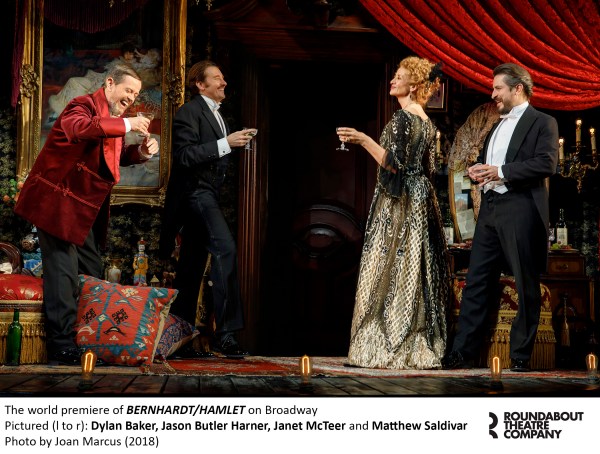
The characters’ nattering is made worse by the static direction of Moritz von Stuelpnagel. Even the more crackling stretches of Rebeck’s dialogue are choked off by the lack of movement. The enclosed feeling is made worse by Beowulf Boritt’s suffocating set. Never has Paris seemed less lively. This lack of energy becomes is most noticeable during fast paced scene changes, which are accompanied by dramatic original music by Fitz Patton. At least costumes by Toni-Leslie James and hair and wigs by Matthew B. Armentrout are appropriately jazzy.
What’s happening front and center is worthy of the Divine Sarah. Like the one-of-a-kind star she is portraying, Janet McTeer dominates the stage with her honeyed voice, graceful stature and sheer presence. Slightly more exaggerated is Dylan Baker’s performance as Constant Coquelin, Bernhardt’s frequent leading man. Though he can’t match her vigor, he injects wit into their banter. Jason Butler Harner as her lover Edmond Rostand embodies a realistic combination of lust and haplessness. As his wife, Ito Aghayere who sparkled in Junk last season, is disappointing and flat in a significant scene.
At nearly 2 1/2 hours, Bernhardt/Hamlet will likely be a slog for all but the most dedicated lovers of “straight” theater. It’s a missed opportunity to share a shining moment when a talented actress took charge of her own career. Bernhard, Hamlet, and Ms. McTeer all deserve better. Tickets are on sale through November 11 at https://www.roundabouttheatre.org/Shows-Events/Bernhardt-Hamlet.aspx.




 The Unforgettable Line
This Flat Earth
“Are you there,” implores 13 year old Julie at both ends of This Flat Earth to anyone who’s listening. Nine students were recently killed in a school shooting, disrupting her feelings of peace, safety, and normalcy. This topic should be the springboard for compelling discussion. Indeed there are some threads about socioeconomic conditions and adolescent turning points that click. But for the most part, this is a ninety minute missed opportunity that ultimately promises that trauma will be all but lost beneath the unrelenting waves of everyday life.
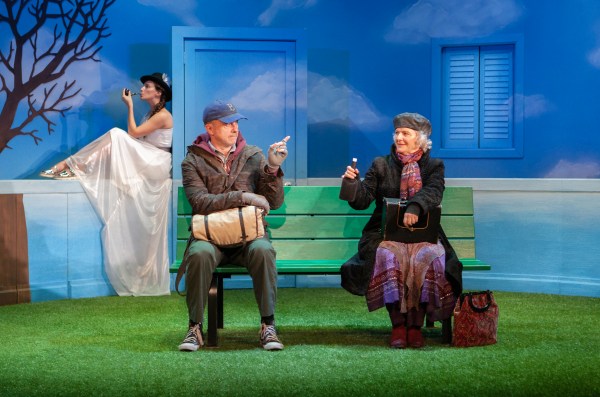
Ella Kennedy Davis (Julie) and Lynda Gravátt (Cloris), Photo by Joan Marcus.
The piece is set in the recent past, and yet somehow Julie has no idea that hers is not the first school to have gone through such an experience. She believes that her persistent jealousy of a talented and popular girl who died might have caused the tragedy. In her program notes, playwright Lindsey Ferrentino tells how she experienced a similar sense of misplaced power when the incidents of 9/11 occurred the day after she had written a diary entry about the joys of peacetime. The transference of those feelings to sadly more common circumstance are diminishing to her main character. The excuse provided for Julie’s ignorance is that her father is too poor to have purchased a laptop. But even her best friend/would-be-boyfriend Zander seems to think the girl just hasn’t been paying attention.
The casting of Ella Kennedy Davis as Julie doesn’t do much to shore up the character as an interesting representative of her generation. While speaking too quickly at a very high pitch and slurring key words is all too realistic, it also left many of the audience members trying to keep up as they attempted to fill in the missed dialogue. Faring much better is the gifted Ian Saint-Germain, who captures the natural flow of Zander’s assuredness and awkwardness. Lucas Papaelias has trouble navigating the clumsy role of Julie’s father, Dan, but it is hard to tell how much of the difficulty is in the lines and how much in his interpretation. While no parent can protect a child from all dangers, widower Dan comes across as particularly ill-equipped and Papaelias often flails around in his skin. In the role of Lisa, a mother who lost a child in the tragedy, Cassie Beck is also constrained by her character’s limited responses. The only adult providing any constructive contribution is Lynda Gravátt’s upstairs neighbor Cloris. Naturally she can’t answer the impossible, but she delivers sincere and often amusing descriptions of effective coping mechanisms.
The talented director Rebecca Taichman does her best to underscore the truer emotions in the script by matching it with genuinely motivated physicality. Dane Laffrey’s two story set works wonderfully, though it could use a few more tonal touches. Costume designer Paloma Young has put together a fitting wardrobe, particularly with a bag of clothes that plays a critical role. Adding to the mood as well as forwarding the story is cellist Christine H. Kim under the musical direction of Christian Frederickson.
This Flat Earth is one of several recent productions that poses probing questions about the world we are leaving to the new generation. The Artistic Director claims it was never conceived as a production about gun violence, but opening just a month after events at Parkland it’s impossible to view it separate from that issue. Even when evaluated as an artistic expression, the play is wan when compared to similar offerings. While there are moments when the authentic psyches of the teens shine through, there are too many uninspiring stretches. Performances of this world premiere continue through April 29 at Playwrights Horizons. For tickets and information visit https://www.playwrightshorizons.org/shows/plays/flat-earth/.