Tag Archives: Play

A Real Boy

I was attracted to the concept of A Real Boy the moment I read the log line: Puppet parents adopt a human child. (This is not a spoiler. Even the most inexperienced of theatergoers is bound to notice this attribute of Max’s parents the moment they shuffle into his kindergarten classroom on their little wooden feet, strings and control handles attached.) The play lands some of the anticipated satirical punches, but it’s hard to make the argument that the darkly comic work is a total success.

To be clear, I can accept even the highest of concepts provided the writer stays within the boundaries of his own mythology.  Unfortunately parameters that are drawn in the first few minutes are broken almost immediately when a character who is supposed to live in a black-and-white world enters wearing blue glasses.  This is only the beginning of the muddled thoughts that swirl around what it means to be “puppet”.  How much do you or we acknowledge your “other part”: the obvious human member of Actors Equity who sometimes participates in a scene whenever tiny hands won’t do?  Do humans evolve into puppets simply with enough exposure?  If so, how does that translate in families with members who are not exactly mainstream?

The unclear vision of the Puppet Universe is just the beginning of playwright Stephen Kaplan’s challenges.  As the plot moves along, he creates a serious case of metaphorical whiplash. He can’t seem to make up his mind exactly what point he’s trying to make. The untraditional family stand-ins in for children with disabilities, transgender persons, and mixed race families and more before moving on to a vague “you be you.”   Any one of these statements could have been profound if followed through with conviction. Together they come up as ideological ambrosia salad.  And that’s before adding multiple snide asides about home schooling, ambitious local politicians, and online MBAs.

The cleverer sections of the work are hindered by the direction of Audrey Alford who, with the help of scenic designer Ann Beyersdorfer,  manages to ensure that every seat in the house becomes partial obstructed view.  Audience heads throughout the theater are constantly jostling for a position around the pillars, down to the floor, and over to a critical stage piece on the side.  I missed several important visual cues because they were not in my line of sight. This is fairly inexcusable given the the current configuration of the theater is about 60 seats.
ARealBoy3

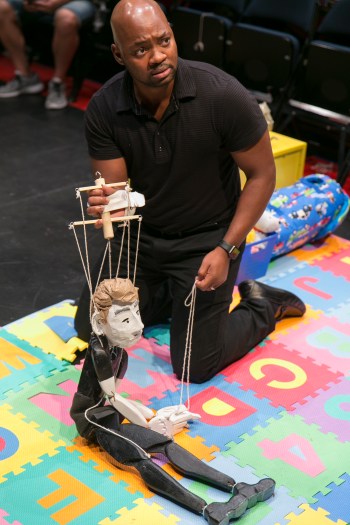
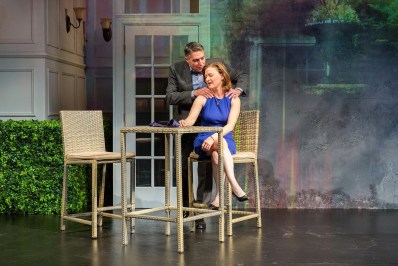
Brian Michael in A REAL BOY at 59E59 Theaters. Photo by Heidi Bohnenkamp

Ms. Alford has also made some curious casting choices.  At the performance I attend, young Max is played by 20-something Kelley Selznick, a talented puppeteer, but not particularly gifted actress.  Max’s mother, Mary Ann Myers, is played by Jason Allan Kennedy George making his theatrical debut.  He’s fine in the role, but I found the selection of a tall male for the part a distraction from what more obviously makes Mary Ann different from other members of the PTA.  It is also hard to figure out how Max would find comfort with Miss Terry, played at a near-vibrating pitch by Jenn Remke.  More successful is Brian Michael, striking all the right notes as Max’s father distraught father, Peter Myers.  Breaking the tension with great timing is Jamie Geiger in the role of Principal Klaus.  And of course there are the all-important puppets created by Puppet Kitchen Productions, close to blank canvases the better to project your own vision of what different means to you.

For lovers of live theater seeking an unconventional production, A Real Boy has enough artistry to make it worthy of the $25 ticket price.  It is brought to 59E59 by Ms. Alford’s Ivy Theatre Company in association with Athena Theatre, which is known for it’s unorthodox psychologically-based dramas.  Performances run through August 27.  For tickets and information visit http://www.59e59.org/moreinfo.php?showid=293.
The Terms of My Surrender

N.B. This review is based on a late preview.

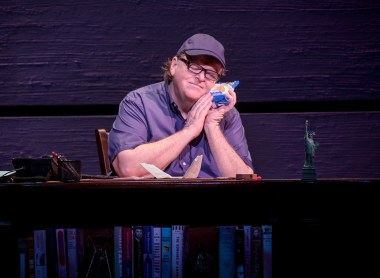
As film personalities on Broadway go, Michael Moore lands somewhere between a shining Bradley Cooper and a shunned Bruce Willis.  Stringing together personal accounts and observations, Moore makes some forceful motivating statements in The Terms of My Surrender. Unfortunately, these powerful moments are diluted by muttered off-the-cuff remarks and self-indulgent digressions.

Terms of My SurrenderMichael Moore

Michael Moore ©️Joan-Marcus

To be sure, there is plenty of anti-Trump rhetoric.  Moore has made it clear as a frequent talk show guest that he considers Mr. Trump an entertainer, unqualified to hold public office.  The show’s Playbill includes a somewhat sarcastic personal invitation to the President, written in Russian, to attend any performance.  But while Moore clearly has liberal leanings, he also recognizes that many of the issues about which he is concerned have roots before January of 2017.  He digs into his private vault of stories going back to the early 1970s to illustrate a number of social injustices and troubling trends that have only been magnified in the light of recent events.

Fans of Moore’s documentaries will likely enjoy learning about his formative years, when a combination of intellectual curiosity and a rabble-rousing nature led to the important discovery that anyone can make a difference.  These amusing and inspiring highlights are further enhanced by projections and videos by Andrew Lazarow making his Broadway design debut.  Tossed in are rapid sight gags (some of which work), a potentially funny game, a disturbing phone call, a needless interview, and a physical bit I won’t spoil in case it comes together after more rehearsal.  This piling on of elements resulted in a runtime of well over two hours on the night I attended.  That’s at least 30 minutes longer than necessary or desirable for Moore to make his point.  By the time he announced the terms of his surrender, I’d forgotten that was even the title of this work.  Moore is a bright and witty guy, but in this case he desperately needed an editor.

Director Michael Mayer, who was behind the vivacious and colorful revision of Hedwig and the Angry Inch, appears not to know what to do with what is essentially a monologue.  The stage seems to be unfamiliar territory under our hero’s feet.  One can almost sense the stage manager’s queues as he moves robotically from podium to desk set to faux living room.  At least there is plenty of distraction provided by David Rockwell’s backdrop of a magnificent and impressively functional American flag.

While I wish The Terms of My Surrender was a stronger piece, it has enough to recommend it.  Admirers of Moore’s films should take the time to see what he does with the live medium.  And those looking for a call to action in a polarizing political climate might well find one among his tales.  The limited run at the Belasco Theater is scheduled to end October 22.  Tickets and information are available at http://michaelmooreonbroadway.com.

In & Of Itself

Regular readers of this column know I pride myself on my no spoiler policy.  In the case of In & Of Itself , I couldn’t spoil it if I wanted to.  Is that because there is no plot?  Or because there are six plots?  As star Derek DelGaudio would likely agree, it all depends on how you look at it.

I was initially attracted to this production not because of Mr. DelGaudio, but by the notion of an event produced by Neil Patrick Harris and directed by Yoda… I mean four time Emmy winner and puppeteer extraordinaire Frank Oz.  What sort of mystery tour could possibly have attracted the backing of these two unique talents?  I’ve now taken the wild ride and my conclusion is “Of course.  Yes.  This one.”

7 - Derek DelGaudio in IN & OF ITSELF (c) Matthew Murphy

Derek DelGaudio in IN & OF ITSELF (c) Matthew Murphy

When attempting to describe the solo performer to me, my friend Jeremy called Mr. DelGaudio a magician.  True, DelGaudio has won the Academy of Magical Arts Award three times.  Nevertheless, I don’t believe that term really fits this storyteller/ fantasy travel agent.  He uses slight of hand the way most people in society use verbal persuasion.  It’s like Spalding Gray and Ricky Jay had a love child.  There are no rabbits or white doves in sight, though there is an elephant if one knows where to look.  Certainly I have never witnessed anyone else execute an illusion so profound and intimate it made someone cry, as happened to my friend.  (OK, I teared up a little too, but only cuz she was.)  I can’t imagine the self-preservation routine DelGaudio has developed in order to render this piece 8 times a week.  I’m going to need a visit to 16 Handles after just writing about it.

The direction by Frank Oz seems effortless, which is what’s required it in order to float through this evening.  There were a few occasions during which I wanted to look both in front and behind me, which was frustrating and perfect.  For once the term “production designer,” assigned to A. Bandit — the performance art collective founded by DelGaudio with artistic producer, Glenn Katino — is earned since the set would fit right in at MOMA.  Lighting by Adam Blumenthal is mood-transformative despite his techniques being unmasked in DelGaudio’s opening.  Original music by composer and Devo co-founder Mark Mothersbaugh hits all the right notes in all the meanings of that phrase.

Even in the season in which I saw Indecent, Sweat and Dear Evan Hanson, In & Of Itself rocked me to my core.  Be among the lucky ones to grab yourself a ticket for the run — now extended (for a third time!) through May 6, 2018.  Visit http://www.inandofitselfshow.com/#home, especially if you can picture yourself clearly on the steps of the landmark former Union Square Savings Bank having a fairly personal post-show conversation with 199 strangers.

At least that’s what happened to me.

And it was magical.

Building the Wall

If you admire our 45th President, you will likely consider Robert Schenkkan’s Building the Wall a bunch of liberal hysteria.  If on the other hand you are of the opinion that Mr. Trump’s policies have been injurious to the country, witnessing this production is like having someone poke a finger into the wound and fish around for the bullet.  The event is deeply painful and one can only hope to slightly feel better when it’s over.  For lovers of dramatic art, the extreme discomfort is offset somewhat by the exceptional lead performance delivered by James Badge Dale.

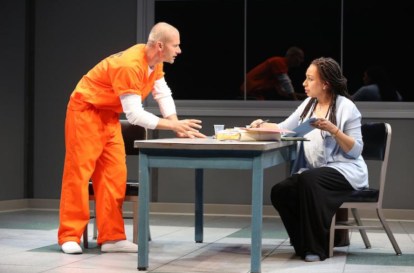
What often makes dystopian fiction palatable is that it takes place at a distant time or in a parallel universe.  This unpleasant tale unfolds in an El Paso, Texas prison in autumn, 2019.  Rick, the character portrayed by Mr. Dale, has been sentenced to death.  Over the course of 90 minutes we learn the details of his crimes through the questioning of Tamara Tunie’s Gloria, an historian who has come to capture Rick’s side of the story.

BuildingTheWallThough obviously embellished, Schenkkan’s premise is firmly rooted in current headlines.  There are references to true life incidents from as recent as February of this year.  Unfortunately, his dialogue — no doubt hastily written — is not realistic and often sounds like a PowerPoint lecture.  There is an additional challenge in having only one of the characters with something concrete to say.  The events are all in the past, with no action or dramatization of scene.  We get a few flashes of insight into Gloria, but for the most part Ms. Tunie is stuck asking, “why”.  Alot.

Thankfully, the focus is on Rick, who in the hands and mouth of Mr. Dale acquires depth that isn’t on the page.  One only has to flip through Dale’s IMDB photos to appreciate his chameleon-like range.  Confined in space and time, Rick attempts to take us on his journey from ex-military blue collar worker with a GED to a felon on death row.  Each step in his descent is made to sound completely reasonable, as is often true of Trump’s fans on the 6 o’clock news.  Perhaps that is part of the problem.  The play doesn’t stray far enough from a fairly predictable path until the last few irony-tinged lines.  As a result, it doesn’t give us much to think about except the faint hope that the worst will indeed be in the rearview in two years.

Director Ari Edelson, Founder of theatrical incubator The Orchard Projects, adds some essential physicality to Rick’s yarn spinning.  Tunie is little more than a coatrack.  Antje Ellermann’s set is suitable for its purpose.  Passages of time are defined by Tyler Micoleau’s subtle shifts in shaded lighting though Bart Fasbender’s tedious music and sound detract from rather than build tension.

Building the Wall has already played in four cities and is scheduled to be in New York through July 9.  If you wake up one morning feeling too good, you can likely score a $20 ticket and revel in Mr. Dale’s performance.  We may be in a political crisis, but there are more imaginative and helpful conversations on this topic than the one offered here.  Visit http://buildingthewallplay.com for details.

Indecent

Theater aficionados have long considered Paula Vogel a treasure.  Her plays — including Pulitzer Prize winner How I Learned To Drive — are generally unnerving and always thought-provoking.  Her work has given voice to the typically powerless: those who have been oppressed and abused.  Her teaching at Brown and Yale has nurtured another generation of powerful female voices, including Sarah Ruhl and the most recent Pulitzer winner, Lynn Nottage (for Sweat.)  With this impressive biography it is hard to believe that Indecent marks Ms. Vogel’s Broadway debut.  Fortunately it is an impressive one, with a story made more poignant by recent cultural shifts.

The events depicted stem from the development of another play: Yiddish playwright Sholem Asch’s God of Vengeance.  As newly inserted and much needed program notes explain, Ms. Vogel first read Asch’s piece as a graduate student.  The tender and natural love scene between two women moved the budding gay rights activist to her core.  Nearly thirty years later, director Rebecca Taichman stumbled across God of Vengeance and, as a descendant of a Yiddish poet, longed to understand why it had eventually been renounced by its creator.  She reached out to Vogel and the two eventually had the opportunity to collaborate on Indecent, exploring the entire lifecycle of the groundbreaking and controversial piece.

It took 7 years and 40 drafts for Indecent to finally land on Broadway.  The results are as significant and disquieting as Asch’s was in its time.   Here is a play that takes place at a time when immigrants remade the City of New York landing just when immigrant populations are being targeted by a fresh wave of intolerance and xenophobia.  Director Taichman said in an interview with The New Yorker, “My heart is broken at how much more relevant this play is today than when it opened at Yale, a mere year and a half ago.”

Indecent

Production photo by Carol Rosegg

It is fitting that Vogel and Taichman share “created by” credit.  Vogel’s words and Taichman’s vision are so deeply entwined it is impossible to imagine how one would work without the other.  We are taken on a 50 year journey that starts in Asch’s bedroom with a reading and ends with his retirement from theater.  The actors play multiple roles much as they would have in a touring troupe of that period.  Beautifully crafted exchanges are interspersed with lilting traditional Jewish music composed by Lisa Gutkin and Aaron Halva.  Dialogue beats are enhanced with projections in Yiddish, German and English designed by Tal Yarden.

The cast works so seamlessly together that it is difficult to call anyone out.  Richard Topol has been nominated for his featured role as Lemml, the stage manager who often serves as our narrator.  Katrina Lenk has also received nods, perhaps because she plays the graceful “older women” in the play within.  However she, along with Mimi Lieber, Max Gordon Moore, Tom Nelis, Steven Rattazzi and Adina Verson are named simply “Actor” in the Playbill.  Truly grace and strength course through every performance.  Most of the ensemble transferred to The Cort Theater from a run Off-Broadway.  Perhaps that explains why they seem so comfortable portraying a long-term well-respected road company.

This wrenching and precious play is currently set to run through September 10 at The Cort Theater.  If you value theater that will change you, visit http://indecentbroadway.com for tickets and information.

Pressing Matters

Jennifer Jasper’s Pressing Matters is like an artist’s sketchbook. Each of the six plays has strokes of brilliance, but none is fleshed out.  Bound solely by the loose thread of “imponderables of love,”  the event comes together as a frustrating and slightly sad illustration of what could be.  There are compelling moments, but they are never sustained for long.  The overall experience is more like a script being workshopped than a professional production.  In fact, a post-performance feedback survey would not have felt out of place.

Thanksgiving in July_ Molly Carden and Jennn Harris. Photo by Russ Rowland(2)

Molly Carden and Jenn Harris; ©  Russ Rowland

Each of Ms. Jasper’s short works is fashioned around a contrivance.  In every segment, it takes several minutes to work out the central puzzle and then view the content through the correct lens.  The most  developed of the six pieces is Free Range, a humorous and thought-provoking courtroom monologue set in the near future.  Jenn Harris fully commits to the role of Judy, a woman so riddled by anxiety that she takes squirming in a chair to new levels.  2014 Samual French Festival winner etymology holds together fairly well, with equal parts sweetness and shtick. In the case of Inheritance —a glimpse into the sociopolitical views of three generations of a family — by the time I worked out the scheme it was over.  The other three — Oscar Clyde Denman, Thanksgiving in July, and Destination Unknown — kept going long after the point was made.  I enjoy intellectual play, but by the end of Act One I was exhausted from all the mental gymnastics.

In addition to Ms. Harris, the cast includes Ito Ashayere, Molly Carden, Saum Eskandani, and Genesis Oliver.  Each is given at least one meaty role.  I found myself wondering how many of the artists were personal friends with Jasper or her crew.  They are all obviously capable of giving superior performances given the opportunity.

More successful is the work behind the scenes.  In fact, it is hard to fathom how this production would succeed at all without Amy Altadonna’s sense-of-place sound design or Grant Yeager’s targeted lighting.  Parris Bradley has done an admirable job delivering appropriate set pieces on a clearly limited budget.  Bringing it all together, director Adrienne Campbell-Holt makes the best of a small stage and gives her ensemble plenty of clever business to keep the energy up during scene changes.

I’m all for supporting emerging artists and giving new voices the opportunity to be heard.  Theatre Row is to be applauded for granting the use of the hall to Ms. Jasper and her team.  But unless you are inclined to be a very small patron of the arts, this is not a $49 experience.  Instead I suggest that lovers of “quirky and fresh” check out the various discounted ticket offers available online.  You’ll get a few laughs and the joy of live theater for less than the cost of a bargain matinee movie.  And you won’t be quite as bothered by Pressing Matters’ many mood swings.  The limited run ends on May 20, 2017.  For information visit http://www.theatrerow.org/clurmannowplaying.

The Play That Goes Wrong

If celebrated farce Noises Off struck you as too controlled, then The Play that Goes Wrong will knock your socks off, most likely while doing a pratfall.  A more apt title would be The Play That Starts Wrong and Goes Even More Wrong from There.  The entire two hours is loopy silliness, which is either cathartic or annoying depending on your taste.

Even before the curtain rises, we are immersed in the whacky world of The Cornley University Drama Society, a ragtag company of well-meaning amateurs.  Outside the Lyceum, posters of celebrities boast that they haven’t attended or did so to their great regret.  Inside, the cast wanders throughout the theater making small talk, many encouraging audience members to leave and go elsewhere in order to attend a better show.  This practice sets expectations for the messiness that is to come.

As gracelessly explained at the opening by director/designer/customer/prop maker/ box office manager/ etc, etc, Chris Bean, The Murder at Haversham Manor — the play within the play —  was chosen primarily for the number of parts it provides for his tiny organization.  So it is no surprise that the drama they present is a painfully bad jumble of stock characters, tired plot, and melodramatic lines, all the better to fall apart at the hands of the hapless players.  Whether they are reading keywords from their palms or substituting a flower vase for a misplaced notebook, the entire team is well versed in physical comedy.  It also helps set the tone that they come across as likable and well-intentioned.  This is unsurprising since the actors have worked together on multiple “…Goes Wrong” productions from Mischief Theater.

As the multipurpose Mr. Bean, Henry Shields sets the giddy pace.  While he doesn’t wear as many hats as his fictional counterpart, Shields did also write the play with his co-stars Henry Lewis and Jonathan Sayer, for which they won the 2015 Olivier Award.  He is wonderfully supported by Dave Hearn as the self-conscious Max who somehow landed two parts.  Broad broads Charlie Russell  as Sandra and Nancy Zamit as Annie battle it out to play the female lead role of Florence Colleymoore in full view of their horrified fellow actors.  In the smaller but crucial role of Trevor the Duran Duran-loving sound engineer, Rob Falconer never loses his focus except of course when he’s suppose to.  It is amusing to note that he also provided the original music.

The Play That Goes WrongAn equally important character is the set by Nigel Hook.  Every piece has impeccable timing.  Not since Alan Ayckbourn’s Bedroom Farce have I seen furniture collapse so slowly and perfectly.  (I will not give away any of its more clever secrets.)  The purposeful fiasco is deftly staged by director Mark Bell.  His training at Ecole Internationale de Theatre and experience teaching at LAMDA likely influence the more overt style of this buffoonery.

If you enjoy seeing one joke played to the millionth degree by an experienced good-natured troupe, pop on over to the Lyceum Theater for The Play that Goes Wrong.  Tickets are available http://www.broadwaygoeswrong.com through the end of the year.

A Doll’s House Part 2

DollsHouse2MetcalfNora Helmer’s exit from Henrik Ibsen’s A Doll’s House was the door slam heard around the world.  Since 1879, scholars, sociologists, and others have speculated about her fate.  Now playwright Lucas Hnath attempts to reveal what came next in A Doll’s House, Part 2, using modern language and the commanding Laurie Metcalf to deliver a post-feminist message about marriage, freedom and self-knowledge.
While it is certainly a bold move to take on an iconic illustration of the role of women in a male-dominated society, Mr. Hnath’s vision isn’t quite worth the wait.  To his credit, he recreates some of Ibsen’s original patterns, giving middle-aged Nora a number of unpleasant options from which to choose her next steps.  He also does not shy away from examining the questions of criminality and betrayal raised in the original classic.  Having set up his typically provocative framework, however, Hnath wraps it up in a mixture of flippant retorts, tedious arguing, and lectures that are only mildly engaging.  The laughs are largely of the cheap variety, stemming from mugging and the dropping of “shocking” f-bombs.  The plot becomes so buried under bluster that my companion — a wise and wonderful theater vet — missed the final point completely.  This made me wonder what experienced producer Scott Rudin saw on the page that made him invest in this production based solely on the script.  Perhaps the rush to Broadway was a misstep.  On the plus side, being intimately familiar with “Part 1,” while certainly adding to one’s understanding, is not essential.

Hnath is helped along his misguided route by the usually excellent Sam Gold.  Gold has chosen to stage many of the longer speeches as if they are TED talks, with the actors facing the audience instead of their scene partner.  This results in significant revelations being delivered butt first, which is as disengaging as it is contrived.  Whatever flow remains is halted by the intrusion of green neon signs projected on the walls announcing the central character for the next beat. How strong is the exchange of wits in dialogue if you need to be told which viewpoint to follow?  Set off by Miriam Buether’s clean scenic design, David Zinn’s costumes and Luc Vershueren’s hair and makeup are divine.  Nora conveys almost as much with her outfit as she does in her opening lines.

Despite what appears to be disappointing early ticket sales (there were tumbleweeds blowing through the mezzanine at the preview I attended), Ms. Metcalf is still being discussed as a possible Tony nominee.  She is indeed an excellent Nora-by-way-of-Hnath, with splendid delivery and body language that combines triumph and frustration.  Recent Tony winner Jayne Houdyshell takes on the lighter role of nanny/housekeeper Anne Marie in classic comedic style.  Chris Cooper, returning to Broadway after a 40 year absence, gives us a rather dry and somewhat disappointing Torvald.  (Although one could argue that’s exactly the Torvald we should expect.)  Rounding out the cast is Condola Rashad as the talking-slightly-too-fast Emmy, Nora’s daughter.

With its stark set, talky script and short runtime, this production is a modest one by Broadway standards.  It may be difficult to command the $147 asking price for premium seating.  But if you can grab a discounted seat and wade through the tidal wave of words, it is worth seeing the brilliant Metcalf  poke gently through a modern lens at a once scandalous character.  Tickets for the limited engagement ending July 23, 2017 are available at http://dollshousepart2.com.

White Guy on the Bus

WhiteGuyontheBus

Photo by Matt Urban/Mobius New Media

It’s been disquieting to hear a certain level of weariness creeping into the general dialogue about racism.  Headlines covering people of color unfairly detained or even killed may be a near-daily occurrence, but that doesn’t make any individual event less worthy of attention or thoughtful discussion.  White Guy on the Bus provides a gripping reminder that behind each incident is a person with hope for the ones they love and a potential for fear of those who are different.  Though Bruce Graham wrote the script over two years ago, it is shockingly appropriate for a time of deepening gulfs between people of varying races, socio-economic backgrounds, and opportunities.

The time-shifting plot is beautifully constructed.  Each twist that pulls us deeper into the story also jolts us into confronting our own racists thoughts.  How many of us make quick judgements about where to sit or walk based on what we feel about a certain neighborhood?  Yet how can we deny that while such reputation is based on generalizations and stereotypes, those in turn are based on facts and figures?  What happens when we push common ground to the side and focus on differences?  It’s hard not to become as unnerved as the characters we are watching, especially if you are white as most of the audience at 59E59 is.  It is worth noting that the director is another white man.  On the audience hand-out, Bud Martin confesses to being drawn to the play primarily because the story made him uncomfortable.

Two magnetic central performances rivet our attention for the two hour run.  Tony nominated for Jekyll and Hyde, Robert Cuccioli once again displays both calm professionalism as well as a more controlling dark side.  His non-white seat-mate Shatique is played with strength and grace by Danielle Lenee´, previously nominated for a Barrymore Award for this role.  Their supporting cast is a perky Jonathan Silver as devoted like-a-son Christopher, a steady Susan McKey as Ray’s feisty wife Roz and a far weaker Jessica Bedford as Christopher’s righteous wife Molly.

The simple yet clever set is designed by Paul Tat DePoo III and enhanced by Nicholas Hussong’s projections.  Together they move us from Ray’s stunning suburban home, to the critical public bus and to points beyond.  Wade Laboissonniere’s costumes fit the characters in all meanings of that word and help sell important details of the story.

As a five character one-set piece, White Guy on the Bus is attractive to small theater companies with tight budgets.  It has already played Wilmington, Trenton, Denver and Chicago and I imagine it will hit other cities with mixed populations.  That it should also spark discussion wherever it lands is exciting.  You can grab your chance to participate in the conversation by catching it at 59E59 through April 16.  For tickets and information visit http://www.59e59.org/moreinfo.php?showid=252.

The Liar

Set Design ALEXANDER DODGECostume Design MURELL HORTON Lighting Design MARY LOUISE GEIGER Original Music ADAM WERNICK Sound Design MATT STINE

Kelly Hutchinson and Carson Elrod in The Liar Photo Credit: Richard Termine

Decidedly cute, The Liar, is currently brightening the Classic Stage Company just off Union Square.  This quick-paced farce is adapted by David Ives of Venus in Fur fame from a comedy written by Pierre Corneille, a man known better for his well-received tragedies.   The light-hearted (and one could say well-timed) story centers on Dorante, a man who tells lies as easily as he skewers his friend with an invisible sword.  Written in iambic pentameter — including a few lines purloined from mighty Shakespeare — the crafty script is dotted with modern references to personal ads, fraternity handshakes, and general self-awareness.  This keeps the 17th century spirit intact while making the work relevant and entertaining for a broad audience.

Director Michael Kahn commissioned the piece in his role as artistic director of the Shakespeare Theatre Company in Washington DC, where it received a world premiere in 2010.  A quick perusal of the Who’s Who reveals a seasoned cast well connected with both the director and the writer, as well as a number of quality Off Broadway houses.  The results are surefooted if not stunningly original or particularly generous to audience members seated on the sides of the 3/4 round.

As portrayed by Christian Conn, Dorante is smooth if somewhat lacking in the necessary magnetism to fully hold the center.  He keep things flowing as fluidly as the falsehoods roll off the rogue’s tongue.  As the object of his current fancy, Clarice, Ismenia Mendes delivers too many of her lines at a high pitch squeal, leaving her nowhere to go as her situation escalates in intensity.  Amelia Pedlow in the role of Lucrece has slight advantage as her character is silent for much of play’s first half, allowing her to step into her own power in Act Two.

These leading players are greatly upstaged by the stars of the subplot, starting with Carson Elrod as the loyal and eternally truthful Cliton.  His joyful performance perfectly balances physical and verbal humor to delightful effect.  Even better is Kelly Hutchinson who by all appearances is having the time of her life playing twin sisters Isabel and Sabine. Kudos to wig and hair designer J. Jared Janas for finding the perfect clip-on to aid Ms Hutchinson in her rapid changes between the two.

Scenic designer Alexander Dodge supports the lively pace, keeping settings simple with a few flown-in paintings and chandeliers and other set pieces pushed into place by the characters.  Award winning costumer, Murell Horton, decks the cast in easy to move in gowns and tunics with a nod to the proper period.  Original music, which adds a frothy layer, was developed by Adam Wernick in his CSC debut.

Great for a date and a safe bet for Mom, The Liar provides a carefree, low stakes two hours.  Tickets are available through February 26, 2017 at http://www.classicstage.org/season/the-liar/