Tag Archives: Steven Rattazzi

The Door Slams, A Glass Trembles

A Talking Band production is to a typical scripted play what an impressionist painting is to a photograph.  The plot lines are delineated, but the total picture is brought into focus through imagination and experience.  Their newest work, The Door Slams, A Glass Trembles, is being presented in association with the famed experimental La MaMa.  Judging from audience reaction, this is a match made in avant-guard theater heaven.

Written and directed by founding member Paul Zimet and partially inspired by Thomas Mann’s The Magic Mountain, The Door Slams… takes place in a modern day rural family home and a pre-WWI alpine sanatorium as well as in the memory of Marc (Jack Wetherall).  Over the course of multiple dinners, we learn that he and his wife Clara (Ellen Maddow) have retired to a house in the forest after having their research funding abruptly terminated.  Their family — son Norm (Patrick Dunning), game-loving daughter-in-law Jenny (Amara Granderson), and unseen granddaughter Abby — are visiting for the summer.  They have forged a new community of similarly frustrated neighbors (Lizzie Olesker, Steven Rattazzi and Tina Shepard). Not content with the present and with more time stretching out behind him than in front, Marc often reflects on his first love Anne (Delaney Feener) and the promising work he was forced to leave unfinished.  
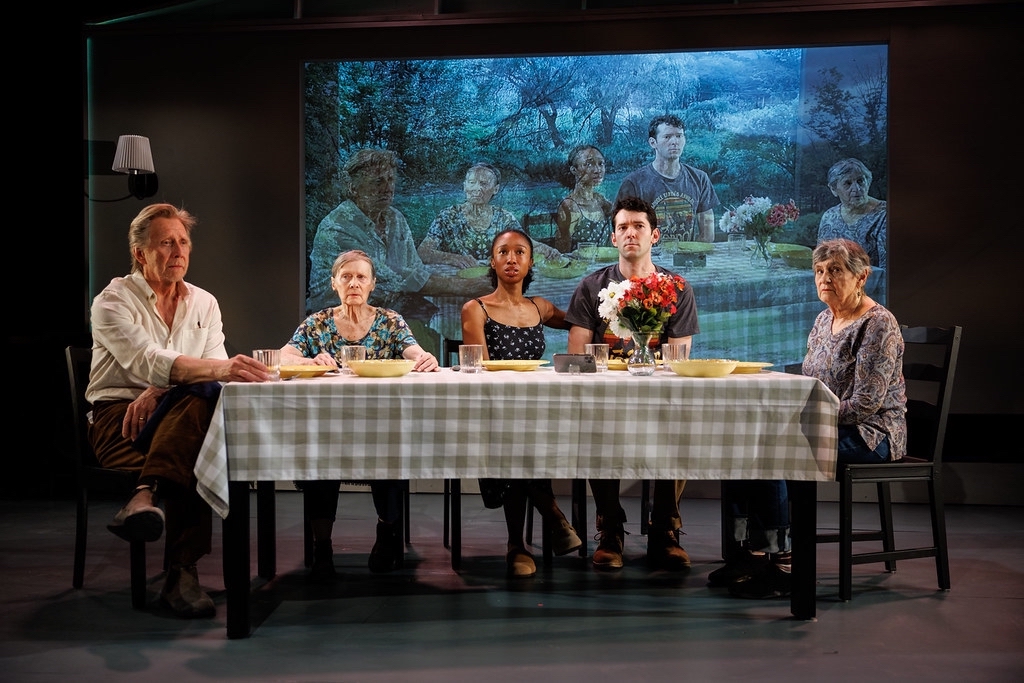
Left to Right: Jack Wetherall, Tina Shepard, Amara Granderson, Patrick Dunning, and Ellen Maddow; Photo by Maria Baranova

As with Talking Band’s previous collaborations, the story unfolds gently, with co-founder Maddow’s music, the choreography of Flannery Gregg, and lighting by Mary Ellen Stebbins playing as much of a role in the storytelling as the dialogue.  The ensemble — including third co-founder Shepard — is truly a band, with many of the players from previous shows making a return.  Actions are repeated but varied like a movement of a symphony.  Newcomers including Dunning and Feener pick up the rhythm.  Time with its patterns and alterations is central, especially as expressed by preternaturally forlorn-faced Wetherall.  There are well-placed moments of triumph and humor.  Politics is not the main course, but rather a scent wafting in from another room.

In Anna Kiraly’s set and video design, a few key pieces are all that is needed to convey time and space.  A slanted roof shape and window define the dwelling.  Rather than execute the scene changes under cover of darkness, the cast emphasizes the shifts with sound and gesture.  A well constructed family table easily converts to one appropriate for a large banqueting hall.  The front deck of the house is also the deck of a ship.  A window displays the actual woods outside and the murky waters of the mind.  Costume design by Olivera Gajic follows form with tees adorned with clever slogans swapped out for period formal attire and fancy dress.  

The Door Slams, A Glass Trembles has made a providential arrival, opening in a year when for many of us the nature of time feels like it is shifting.  The company’s comfort and understanding of the distinct Talking Band technique make the content flow like the waves and wind incorporated into the projections, even when the events are distressing. The World Premiere plays through May 10, 2026, at The Downstairs at La MaMa, 66 East 4th Street.  Tickets  ($40 General Admission, $35 students/seniors, $10 La MaMa members) can be purchased at https://lamama.org/the-door-slams-a-glass-trembles/ .  Running time is 70 minutes without intermission.  Due to the intimate nature of the piece, latecomers are offered stools to the side of the main seating area.  

Triplicity

Talking Band has been generating their unique brand of performance art for more than 50 years.  Last year, they received a Lifetime Achievement Obie Award for their whimsical thought provoking body of work, which includes Painted Snake in a Painted Chair (2003), Panic! Euphoria! Blackout (2010), and Shimmer and Herringbone (2024).  Their latest creation, Triplicity (rhymes with simplicity), fills their singular mold with its poetic storytelling, musical interludes and distinctive movement. Written and composed by founding member Ellen Maddow, it follows three people whose lives fleetingly touch as New Yorkers often do.  Adding a score to their communion is an attuned street performer stationed near the West Village Path train.

Anna Kiraly’s staggered set is suggestive of distinct yet related households, with welcoming doorways and windows that are more light display than light admitting.  A small projection screen stage right provides a musical title for each scene.  The only pop of color is behind the musician who is aptly named  Calliope after the muse of epic poetry.  The character is brought to blazing life by the one-of-a-kind El Beh, a performer with too many hyphens to list.  Costume designer Olivera Gajic has likewise saved her most vivid selections for this unique goddess, at one point reminding us they are the key by dressing them in keys.  The lighting design by Mary Ellen Stebbins by turns unites and divides the characters with cool pools.  

Though small, the cast well-represents the broad range of generations, appearances, and sensibilities of a New York City neighborhood.  The first resident we meet is Frankie, a retired bookkeeper played by Talking Band regular Lizzie Olesker.  At first she shrugs off her days as repetitive and grey, but they take on definition with each recounting.  Next we are introduced to an empathic budding non-fiction writer, an exuberant Amara Granderson.  Rounding out the unlikely trio is an exterminator from Bay Ridge with a soft spot for bee hives.  Steven Rattazzi’s rendering is so genuine, one could reasonably expect him to change into work overalls and grab a bag of sticky traps post-show.  The triad is doing its best to give each day a purpose and act responsibly.  With choreography by Sean Donovan and Brandon Washington augmenting Artistic Director Paul Zimet’s stage direction, the stories flow one to the other with phrases and key words echoed by Calliope’s dramatic accompaniment and wardrobe.  As Frankie often says, “That’s all; that’s it.”  But often that’s more than enough.

Steven Rattazzi and Amara Granderson in Triplicity; photo by John David West

Triplicity is a quieter piece than some of the Talking Band’s more overtly political work.  But it’s as diverting as a warm afternoon in Christopher Park.  The plot’s interlacing threads work as a reminder that ultimately we are in this life together.  The limited run is at Mabou Mines, a comfortable six row house at 122CC, 150 First Avenue between 9th and 10th Streets.  The performance schedule is Mondays and Wednesdays – Saturdays at 7pm with matinees Sundays at 2pm and an additional 2pm performance on Saturday, October 25. Running time is 70 minutes without intermission.  Tickets are $30/$40 and available for purchase at www.talkingband.org/triplicity.