Category Archives: Play

Dogs of Rwanda

Dogs of Rwanda is like that really sweet guy you wanna like, but you just can’t get beyond his shortcomings. There are several unfortunate distractions that prevent it from being as powerful as it should be.  Given that the Rwandan genocide took place in 1994 and the audience spans a large age range, a short background beyond the artistic director’s statement would have helped.  By necessity, the tale we hear is a deeply personal one and moments are certainly shocking, but they are not given sufficient context or a sharp enough lens through which to see.  There are also some artistic choices that have hindered the impact of the piece.

The script by Sean Christopher Lewis is delivered as a monologue told solely from the point of view of David Zosia, who at 16 volunteered for a church run spring break program in order to spend time with his crush, Mary.  At their Ugandan camp, they are assigned laundry duty working just downstream from Rwanda.  When the fight between the Tutsis and the Hutus breaks out, bodies begin floating by the horrified youth. The pair is drawn deeper into the conflict when they attempt to help a local boy named Gods Blessing.  Over the course of 90 minutes, David vividly describes what happened at the time and also 20 years later when he receives a note from Gods Blessing that takes him back to Africa.  The audience is present to bear witness to his account: an integral role in any deeply meaningful ritual.

David is portrayed by Dan Hodge, an actor and director with an impressive resume.  Unlike most solo performances this isn’t Hodge’s story and that is the first stumbling block to its success.  Hodge never fully inhabits the role: he is acting not being.  The only other person on stage is musician Abou Lion Diarra who accompanies David’s tale with original music performed on a variety of percussion instruments.  This creative embellishment was added by the Urban Stages team, but the execution doesn’t quite work.  Hodge is inconsistent about including Diarra in the action, sometimes exchanges glances and sometimes ignoring him.  Furthermore, the talented Diarra is often so swept away by the joy he finds in playing that it is easy to catch him smiling incongruently to the horrors being described.

Dan Hodge stars along with instrumentalist Abou Lion Diarra. Photo by Ben Hider (3)

Actor Dan Hodge with instrumentalist Abou Lion Diarra. Photo by Ben Hider.

There is also the critical issue that David is essentially a selfish SOB.  Everyone else we hear about — Mary, Gods Blessing, and his current girlfriend — have been treated with contempt by our narrator and guide.  He is not without redeeming qualities, having literally bled to share at least some of his story with the public in a book called Letters From The Red Hill.  While David is certainly contrite by the end, that is where we leave him, never witnessing any actual change in his behavior.  This makes his confession a rather hallow one.  How can we forgive David as we are meant to if we never see him embody the lessons he claims to have learned and put them into action?

Urban Stages Founder, Frances Hill, and Director of Musical theatre, Peter Napolitano are responsible for the meandering direction.  The creative team is the same as the one that brought Zhu Yi’s A Deal to life.  Their vision is much murkier this time around.  The set by Frank J. Oliva is made to look like a village clearing with a faux earthen floor and thatch peering through a side opening. It lends an interesting flavor to the atmosphere, though the setting is only appropriate some of the time.  John Salutz’s lighting casts long shadows which may be intended to add mood but come across as an amateurish mistake.  The brilliant Ryan Belock has once again designed the projections, but the screen is at an angle over Hodge’s head.  This is effective for planes, trees, and clouds, and a head scratcher for ocean waves.

While not completely successful as a drama, Dogs of Rwanda can serve as a reminder of the dehumanizing effects of war, the atrocities committed based on tribalism, and the many treasured places around the globe devalued by Americans.  It is a worthy end to a season in which Urban Stages has been shining a light on works with an international point of view.  It runs through Saturday, March 31, 2018.  Tickets for are $35 ($25 during previews; $50 on opening and $15 student rush) and may be purchased via OvationTix at www.urbanstages.org or by phone at 1.866.811.4111.

William Shakespeare’s Long Lost First Play (abridged)

06 New Vic_RSC_LongLost3_cTeresa Wood

Reduced Shakespeare Company’s Tichenor, Spencer and Martin as The Weird Sisters, ©️Teresa Wood

Since 1981, the Reduced Shakespeare Company has been delighting audiences of all ages with their mixture of classical theater, history, clowning, improv, and general silliness.  On the occasion of their 35th anniversary, this RSC (definitely not to be confused with the one based in Stratford-Upon-Avon) developed William Shakespeare’s Long Lost First Play (abridged).  The fanciful premise of their latest offering is that in a parking lot in Leicester, the company’s three members found the long lost first play written by William Shakespeare.  (This location is in fact where the skeleton of Richard III minus his feet was found not long ago.)  In this treasured manuscript, the then 17-year-old playwright first created his most famous characters, blending them Infinity Wars style into one sprawling nonsensical story.

The “war” at the center of this fictional work is a battle of magical wits and styles between Ariel from The Tempest and Puck from Midsummer Night’s Dream.  They duke it out using some of Shakespeare’s favorite ploys including mistaken identity, instant attraction, and shipwrecks.  The RSC playwrights use the opportunity provided by this mashup to include some audience favorites who have limited stage time in Shakespeare’s originals.  About two-thirds of the script is bona fide Bard generously blended with pop culture references and vaudeville schtick.  As a believer in the ‘loyalté me lie‘ vision of Richard III, I was particularly gratified by the acknowledgment in the script that Shakespeare portrayed his queen and her family in a good light and their enemies in a far less flattering one.

All of the 45+ characters are brought to buoyant life by co-writers and co-directors Reed Martin and Austin Tichenor along with boyish player Teddy Spencer.  The three are whizzes at delivering iambic pentameter and rimshot worthy jokes in equal measure.  They even interact with the audience, at once point providing the front row with water pistols to simulate a storm.  The entire piece is performed in front of a single cloth backdrop created by Tim Holtslag.  Sounds including trumpet blasts and ocean waves along with strategically placed spotlights help set locations. Character definition is highly dependent upon the contextually brilliant Halloween Warehouse level costumes and outrageous wigs provided by designer Skipper Skeoch.  Also invaluable are the even cruddier looking props cooked up by “goddess” Alli Bostedt.  Kudos to stage manager Elaine M. Randolph and her curtain-call shy team for the amazingly quick changes behind the scenes.

William Shakespeare’s Long Lost First Play (abridged) simultaneously provides an engaging introduction for older children and laughs for culture nerds.  It is currently in its off-Broadway premiere run at The New Victory Theater, through March 11, 2018, as part of a 20-city tour throughout the United States. Tickets start at $16 and are available online ( http://www.newvictory.org/boxoffice ) and by phone (646.223.3010).  The theater may offer booster seats, but the recommended age of 10 and over should be heeded to avoid excessive seat-back kicking and squeals of fatigue from your own little Mustardseeds and Peaseblossoms.

[PORTO]

In the world of prose, square brackets are used primarily for clarification: adding explanation or making a small correction.  In Porto’s world, [ ] is the near-constant narrator and commentator of all her thoughts and actions. We are told that  [PORTO] is Porto’s story, though [ ] does much to steer the ship, to the point where the punctation sometimes has the upper hand.  (That in literature square brackets are not supposed to alter the essential meaning of the original statement will likely only bother the most hardcore-ist of grammarians.)

Noel Joseph Allain, Julia Sirna-Frest, and Leah Karpel in [PORTO] -- Photography by Maria Baranova

Noel Joseph Allain, Julia Sirna-Frest, and Leah Karpel in [PORTO] — Photography by Maria Baranova

The piece opens with a long detailed description of how to make sausage, delivered in the dark by the off-stage [ ] in almost musical tones.  For lovers of podcasts such as Selected Shorts, this introduction elevates ones senses.  Indeed we are soon to witness the proverbial sausage making of relationships — complete with soft underbellies and the occasional metaphorical entrails —  as the staff and patrons of a small Brooklyn bar repeatedly come together almost in ritual with [ ] serving as a combination priestess, narrator and stage manager.  That she is portrayed by Kate Benson, the playwright, only adds depth to the role.  She appears omniscient until one of the other characters clearly disobeys [ ]’s directive.  From then on, all possibilities are open to our players.  Indeed Porto is also counseled by two titans of feminism at her kitchen table as well as a pair of dumb bunnies of the Oryctolagus Cuniculus variety.

The audience for this production skews younger than at most off-Broadway houses.  Jokes aimed at modern relationships and hipsters who embrace pickled vegetables and toasted garbanzos with their happy hour received the biggest laughs. The breaking of prescribed rules throughout Benson’s script is jarring for those who prefer that their fantasy come with understood guidelines.  Some of the inconsistencies are merely puzzling.  For example, the character of Hennepin drinks Hennepin ale, but Dry Sac drinks Vodka.  It is, however, truer to the way life unfolds: what seems established can be easily invalidated.

The quality of the acting can be appreciated at any age.  Julia Sirna-Frest imbues Porto with a realistic combination of determination and hesitancy with which many of today’s young women struggle.  As her frequent companion at the bar, Leah Karpel’s Dry Sac delivers loopy 80 proof stories with amusing conviction.  Jorge Cordova’s Hennepin is the perfect well-meaning Everyguy.  Doug the Bartender is played with measured amounts of drollness by Noel Joseph Allain.  Rounding out the cast is Ugo Chukwu who arguably steals the show as Raphael, the waiter with heart and sage advice.

Obie winning director Lee Sunday Evans makes the most of the small space and unconventional storytelling devices.  The steadiness of her cast is a testament to her deep understanding of how to tell this story well.  Kristen Robinson has replicated a bar setting with the actors in a straight line facing the audience.  Porto’s apartment is displayed above, inside a cutout reminiscent of a cross-stitched sampler.  This imaginative concept lends an ironic twist to the far-from-traditional-values exchanges that unfold there.  Costumes designed by Asta Bennie Hostetter give the characters a lived-in look.  Amith Chandrashaker’s lighting and Kate Marvin’s sound support sense of place and movement in a world in which people apparently do not need to open doors.

Whether you find [PORTO] a humorous work of art or say “alright already” like the man in front of me will very much depend on your enjoyment of intellectual play.  What you will certainly come away with is an entertainment experience you won’t forget on the subway ride home.  The production is presented by the WP Theater and The Bushwick Starr in association with New Georges.  Tickets for performances through March 4, 2018 are available at WWW.WPTHEATER.ORG/TICKETS.

Brilliant Traces

Brilliant Traces the Play | by Cindy Lou Johnson | NYC | NY | 2018 | at the WorkShop Theater NYC | presented by Art of Warr Productions | starring Blake Merriman and Alyssa May Gold

Blake Merriman and Alyssa May Gold in Brilliant Traces.  Photo by Grace Merriman

Inside his purposefully isolated Alaskan cabin and bundled under blankets, Henry Harry is in a deep sleep when he is disturbed by a series of panicked knocks at his door.  Enter Rosannah DeLuce incongruously dressed in full bridal attire, mascara running down her face and talking a mile a minute.  Thus begins Brilliant Traces, a two-character fantasy currently vying for the New York Innovative Theatre Awards for Off-Off Broadway.

The set-up is deliberately absurd and yet much of their exchange is rooted in genuine personal tragedy.  This asymmetrical construction runs throughout the work.  Perpetual loner Henry is clearly unused to casual conversation.  Yet it becomes equally obvious that he is a caregiver who instinctively reaches out to others when given the opportunity.  Rosannah describes herself in rapid succession as having felt encased in ice and too warm, propelled forward and completely stuck.  All these states are equally true for her.

As directed by creative impresario Joshua Warr, the piece starts slow, then moves along for the remainder of the 90 minute runtime.  Warr’s production team is strong.  Matthew S. Crane’s icicle covered cabin with its unadorned walls and spartan furniture is almost a third character.  Paul T. Kennedy’s lighting adds mood and supports the passage of time.  Costumes by Todd Trosclair are appropriately sporty and simple, except of course for the shiny gown and shoes.  No program credit is given for sound design, which is a shame given the important role played by whistling wind that had me snuggling under my coat.  Both Alyssa May Gold and Blake Merriman successfully lean into their characters’ duplexity.   Gold — an understudy for Broadway’s Arcadia — brings a rawness even to the most farcical of her lines.  Merriman leverages the quickness developed in improvisation training with the Upright Citizens Brigade and Second City to make Henry’s unexpected turns feel more plausible.

The script is intriguing, but not without problems.  By withholding deeper truths in order to have a big reveal, Cindy Lou Johnson has her characters speaking in circles much of the time.  Instead of deep story, Ms. Johnson simulates forward motion, shading the surface by having the same lines reappear with different context.  For example, “I cooked your shoes” is delivered by turns as comic, menacing, and sad.  Using rotating emotional filters is an interesting construct that gives the script a fairytale quality.  The challenge with Ms. Johnson’s technique is that it’s a block to audience involvement.  Uncomfortable chuckles and even a few talk-backs peppered the evening.  I never forgot for moment that I was watching a play about two people rather than being swept away by connection to the emotional life within the fantasy.

There is also an issue with how well the relationship between Harry and DeLuce has traveled through time.  Originally produced in 1989 by Circle Repertory Company, the piece has several anger-fueled fight scenes choreographed by Alberto Bonilla.  Whether you are able to accept these moments as intended or see two people in need of anger management therapy will depend on your tolerance for such things against the backdrop of #MeToo and #Timesup.  Rosannah needs to be alluring enough to pull Henry back to civilization.  By the same token, Henry needs to inspire trust so that Rosannah can get grounded again.   But even back in the 1970s, self-help guru John Bradshaw claimed that most people would walk into a room and find connection with the least appropriate person present.

Rosannah and Henry’s odd relationship touchingly illustrates that everyone needs to be seen to feel truly alive.  With communication, parallels can be drawn between any two human stories. The current incarnation of Brilliant Traces is presented by the director’s own Art of Warr Productions in association with Ruddy Productions and runs through March 4 at The Workshop Theater.  Tickets are $25 and are available at www.brownpapertickets.com

An open letter to the creative team of Some Old Black Man

SOBMI attended the performance of your play, Some Old Black Man, at 59E59 Theaters on Saturday, February 10.  Co-star Roger Robinson was out sick, replaced by Phil McGlaston.  I understand that Mr. Robinson has been with the production since the beginning and that it is your request that the show not be reviewed without him.  Certainly I was disappointed not to see his turn as Donald, but it was a marvelous afternoon nonetheless.  I wanted to take this opportunity to applaud your wonderful work in full view of my readers.

To playwright James Anthony Tyler: Congratulations on your script, the first to be fully staged by Berkshire Playwrights Lab. Your story cunningly explores relatable themes of aging and generational conflict using the distinct filter of race relations.  Both characters are so beautifully drawn with just a few strokes of your proverbial pen.  Father Donald may be cantankerous, but you have assured us that his concerns are clearly rooted in very real and hard experience.  I too am an only child and live with an aging parent, so I found it easy to relate to so many of son Calvin’s frustrations.  My Mom may not have a brightly colored afghan thrown over the back of our modern couch, but there are certainly parallels I could point to.  Judging from the reaction of my fellow audience members, I was not alone.  At so many turns, you blend stirring moments of vivid social and economic commentary with laughter and empathy.

To director Joe Cacaci and understudy Phil McGlaston: I admire how quickly you were able to get the piece moving again after Robinson took ill.  It is not easy to emote while on book.  McGlaston gave an exceptional performance for someone with only three solid days of rehearsal, navigating several of Donald’s tricky emotional turning points, not to mention delivering some terrific yogurt-oriented comedy.

To Co-Star Wendell Pierce: It was a joy to see someone whose television work I have long admired live on stage in such an intimate setting.  There are aspects of Calvin’s dialogue that seem ready made for your expressive growl and trademark loving exasperation.  Even when confronted with a co-star who couldn’t make much eye contact, you created a deep relationship.  And when the set popped a few stitches, you managed to cover in character and earn yourself an extra smile from the audience.

To Roger Robinson: I wish you a speedy recovery.  You have obviously laid some splendid groundwork here.  I am sorry to have missed your interpretation.

I wish you all a wonderful run at 59E59 — and beyond.

Cathy Hammer, The Unforgettable Line

The Chekhov Dreams

The lovers at the center of The Chekhov Dreams are an unusual pair.  Kate is dead, having been killed in a car crash several years ago.  Deeply depressed since the accident, the independently wealthy Jeremy has put his writing aside and spends his days asleep in order to visit her in his dreams.  A frequent topic of conversation between them is the possibility he might end his life and join his beloved in the hereafter.

Tired of watching this sad cycle, brother Eddie — who has chosen to spend his money on the more traditional wine, women and song — elicits a promise that Jeremy will make an effort to get out and meet new people.  A man of his word, Jeremy signs up for an acting class, thinking this exercise might have the benefit of expanding his relationship with the literature he loves almost as deeply as he does Kate.  Instead, he and his scene partner Chrissy are assigned The Seagull by Anton Chekhov, a playwright Jeremy considers dreary and uninspiring.

ChekhovDreams

Photo by Arin Sang-urai. L to R: ELIZABETH INGHRAM, DANA WATKINS, CHARLOTTE STOIBER

Playwright John McKinney ambitiously draws parallels between his characters, Chekhov’s Anna and Trigorin and Jeremy’s favorite fairytale, The Snow Queen.  The results are uneven, punctuated by some imaginative moments.  A few grimmer concepts are presented too off-handedly, which is jarring.  But by the second act we’re more firmly in Blithe Spirit territory than anywhere near a Cherry Orchard. The broader comedy works fine while we remain in Jeremy’s mind and apartment, but when the action shifts back to the acting class, McKinney breaks his established rules of conduct and produces an uneasy mix of personal hallucination and the reality of others.

The small cast works comfortably together.  The angular Dana Watkins provides Jeremy with an appropriately dreamy quality.  As his scene partner and potential lifeline, Chrissy is given bubbly charm by Charlotte Stoiber.  Christian Ryan channeling Jere Burns delivers the best zingers as Eddie.  The toughest challenge is handed to Elizabeth Inghram who struggles to bring the not-always-likable Kate to “life”.  Rounding out the team is Rik Walter as the time and realms-traveling Chekhov who fills in the blanks whenever Jeremy becomes too blind in grief.

Some of director Leslie Kincaid Burby’s staging is clever, particularly the dream sequences.  The mood of these all important scenes is enhanced by Diana Duecker’s lighting and sound designed by the playwright himself.  Burby is less successful when giving the actors “business”.  The already rapid-fire dialogue gets punched up with distracting sight gags. Scott Aranow’s scenic design also doesn’t quite work.  We are told that Jeremy inherited a great deal of money, but his furniture is inexplicably cheap and ratty.  At times the walls actually wobble.  It is clear from his ultra-casual wardrobe provided by costume designer Christina Giannini that Jeremy isn’t “spendy”, but he should at least honor basic building codes.

For all the talk of endless love and devotion for the ages, The Chekhov Dreams is more a diverting night out than a philosophical exercise.  The thought-provoking questions raised don’t hold up to much reflection.  Towards the end of the play, Eddie has a line that works as a wink to the audience, indicating McKinney knows that the ponderous moments won’t be sustained after the houselights come on. But really, what’s wrong with a little escape?  Tickets for the production at The Beckett at Theatre Row are available through February 17 at https://www.chekhovdreams.com.

Cardinal

Second Stage Theater Cardinal By  Greg Pierce Directed By Whorlsky Cast Beck Ann Baker Anna Chlumsky Alex Hurt Adam Pally Stephen Park Eugene YoungMany of us have experience working with someone who’s a big picture dreamer.  Unchecked by a healthy skeptic — much less an opponent with a better idea — they good-naturedly lead their team down a path to The Emoji Movie or Pets.com.  Greg Pierce starts out telling one such story in Cardinal in which Lydia Lensky returns to her hometown with the wild idea of literally painting it red.  With tremendous enthusiasm and few facts, she persuades the locals that this gimmick will attract tourism and new business.
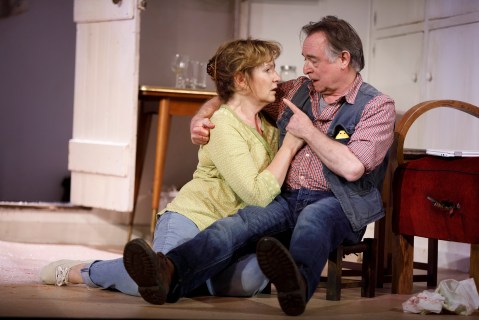
It’s clear from the moments that click in this production that if Mr. Pierce had focused on developing this plot line and fully explored the themes of unintended consequences and shifting alliances, Cardinal might resonate.  Towns around America are going through similar changes and struggling to find solutions.  Instead of trusting there was enough to say on this important topic, the playwright tosses in sexual obsession, cultural bias, the working poor, and addiction.  The final concoction is as tasty as the dish cooked up by Rachel Green in “The One Where Ross Got High.”  (For non friends of Friends, the recipes for shepherds pie and trifle had stuck together.)

I can see how Lydia’s well-meaning messiness might be attractive to Anna Chlumsky, fresh off yet another Screen Actors Guild win for VEEP.  The actress certainly pours energy into her attempt to create an emotional arc for a character that moves from A to B and then drifts back to A.  It is helpful that her primary foil is brought to life by Adam Pally who is known for mining comedy gold.  Sadly Pally’s timing cannot save their weightier exchanges from tumbling headlong into melodrama.  Scenes between Becky Ann Baker and Alex Hurt as a small business owner and her mentally challenged son ring truer, but all too soon their storyline also hits a wall.  Rounding out the characters, a Chinese businessman and his son portrayed by Stephen Park and Eugene Young are mostly offensive.

The behind the scenes team seems to have trouble keeping up with the scattered emotional beats and plot turns.  Director Kate Whoriskey — who helped bring the astoundingly powerful Sweat to life — establishes a pattern of using the town’s worker-bees to ease scene transitions only to be confronted with sections where this ploy doesn’t fit the action.  Derek McLane’s brick set may make location changes easier, but it too doesn’t consistently work to give us the proper sense of place.  Some of the sound and light elements are cheesy.  This may be intentional but in that case the artistic commitment isn’t strong enough.

Like many members of my profession, I believe it’s essential to fairly review those works that are not my cup of tea.  However, there are some offerings that must be called out for simply “not working.”  I attended Cardinal with five friends all of whom had a negative experience.  (They tell me it’s the first time in 25 years they’ve had the same reaction to a night at the theater.)  What did the good folks at 2nd Stage read that was lost along the way?  Perhaps the creative team behind this world premiere was carried away by its own Lydia Lensky when it added the commissioned work to the season.  Let me know what you think if you decide to purchase a ticket at https://2st.com/shows/current-production/cardinal.

The Children

Perhaps it’s our collective mood that has brought on a slew of dystopian dramas.  Certainly the catastrophe that prompts the events covered in Lucy Kirkwood’s The Children isn’t novel.  The facts of “the accident” in question are based on those that actually transpired in Japan just a few years ago.  What is fresh is the way in which Kirkwood all but ignores the usual condemnation of nuclear power and instead uses the localized event to explore bigger and more human issues including the responsibility of each generation to the next and what comprises a well-lived life.  Then she sprinkles in enough humor and love in its many forms to prevent the discussion from becoming soul-crushing.

THE CHILDRENAmerican premiere by Lucy Kirkwood Directed by James Macdonald With Francesca Annis, Ron Cook, Deborah Findlay

Deborah Findlay and Ron Cook in The Children, Photo © Joan Marcus 2017

To be honest, if the invitation to this production had announced that Francesca Annis, Ron Cook, and Deborah Findlay were coming to town to read American Greetings cards at my local Duane Reade, I still would have bought a ticket.  I know all three primarily from their television work (any other Reckless fans out there?) and wanted the opportunity to see them live.  The quality of the acting did not disappoint.  There is a lived-in feel to all three performances that is not only a delight to experience, but essential to making the story’s ending believable.


The character set-up is as deceptively simple as the situation.  Annis’s Rose has come to see Findlay’s Hazel and Cook’s Robin, a couple of retired physicists with whom she worked over 30 years ago.  These three supposed old friends obviously have serious catching up to do, and from the subtle undertones it’s clearly not just about Hazel and Robin’s biological children.  It is slightly disappointing that the playwright cannot come up with anything more original than off-stage phone calls to get characters out of the room when necessary, but this can be overlooked given the overall strength of the writing and its interpretation by a seasoned cast.

The behind-the-scenes team is equally sophisticated and deft in their approach to the material.  Director James Macdonald provides his talent with purposeful “business” that keeps the play from feeling talky while revealing subtleties about the characters.  His job is made easier by a brilliant, askew set conceived by multiple award winner Miriam Buether.  Buether also created the everywhere-and-nowhere costumes.  Peter Mumford’s disquieting lighting and projection designs add just enough menace to the atmosphere to hint at what lies beyond the slightly claustrophobic kitchen that we see.  The three players are confined, at least for the moment.

The Children is a play you simply cannot leave behind you.  The questions it poses and feelings it prods are too profound and intertwined in our everyday practices.  If that sounds enticing rather than overwhelming, get ye to The Manhattan Theatre Club at the Samuel J. Friedman Theatre.  Tickets are on sale through February 4, 2018, at http://thechildrenbroadway.com.

A Deal

Internationally known playwright Zhu Yi has given New Yorkers a gift with A Deal, which opened at Urban Stages last night.  On its surface, the piece tells the story of one Chinese family’s attempt to buy into the Manhattan real-estate market as a major step towards providing their daughter with the complete American Dream.  But this rich work has multiple layers and is by turns wonderfully thought-provoking, deeply troubling and oddly funny.

Lydia Gaston, Wei-Yi Lin and Alan Ariano. Photo bu Ben Hider

Lydia Gaston, Wei-Yi Lin and Alan Ariano. Photo by Ben Hider

For most of its 100 minute runtime, the play follows two tracks.  Li Su is a recent Columbia University MFA graduate vigorously pursing an acting career in New York City.  Her chosen profession necessitates that she be judged by how she looks, which regrettably for Asian talent is usually limiting and consequently frustrating.  Around the time of her first big break, her parents arrive from China.  They are proud Communists who made a small fortune which they want to invest it in the USA.  Early on in the plot, these two are reunited with Mrs. Li’s former beau Peter who has become an American citizen.  This set-up provides Zhu Yi with ample opportunities to skillfully explore emotional conflicts stemming from stereotypes, ideology,  and national pride.  None of these people is particularly likable, but each is admirable for a different reason.

Like her character, Taiwanese actress Wei-Yi Lin is making her off-Broadway debut as Li Su.  She is strident at times, though that may be a deliberate artistic decision meant to reinforce her alter-ego’s tenacity.  Alan Ariano and Lydia Gaston bring depth and passion to their proud parental fishes out of water.  Pun Bandhu— playing multiple parts here as he did in The Treasurer — provides Peter with equal parts sweetness and cunning.  Seth Moore seems genuine as a writer, (perhaps because he is one.)  Unfortunately Helen Coxe doesn’t provide enough distinction between her roles as a con artist, talk show host, receptionist and others causing slight confusion for those around me.

The entire creative team is strong and obviously united in their vision.  Director John Giampietro makes remarkable use of the small stage, most admirably in a beautifully choreographed fight scene.  The simple light-weight set by Frank J. Oliva is brought to vivid life by Ryan Belock’s exceptionally artful projections.  Audrey Nauman gives each of the characters their perfect wrapping, from Mrs. Li’s coordinated suits to Su’s darling babydoll dresses.

A Deal is a delightful departure from the limited world view that sometimes plagues commercial theater.  Zhu Yi  is a fresh and intelligent voice well-matched to the mission of Urban Stages to promote writers of diverse backgrounds.  Tickets (only $35 for full price) are available through December 10 at www.urbanstages.org.  Intriguing talkback sessions follow the performance on November 27, November 30 and December 4.  As an interesting side note, the piece delivered in Mandarin will simultaneously be touring throughout China.  I greatly look forward to reading the reviews from there.

Jesus Hopped The “A” Train

Stephen Adly Guirgis’s Jesus Hopped the “A” Train was first produced in New York in 2000.  Its portrait of a criminal justice system that is short on justice and long on system easily transferred to London’s Donmar Warehouse and earned the playwright an Olivier Award.  Shamefully, the predicaments the piece explores have only gotten worse, making the revival at the Signature as timely and poignant as ever.

Guirgis has a flare for language and exploring characters not often seen in commercial theater.  Similar to his recent Between Riverside and Crazy, the people we get to know in these two plus hours are trapped by circumstances.  In this piece, the playwright is able to draw on his expertise in violence prevention, taking a deep dive into what makes a criminal and what makes a crime.  He relies a little over-much on exposition, but even that is vivid and intense.

Those of you plugged into New York’s performing arts news may already know that *both* leads in this production had to be replaced: one for scheduling issues and the other for health reasons.  Though this meant extended creative tinkering for the supporting actors and director Mark Brokaw, Sean Carvajal as Angel and Edi Gathegi as Lucius have taken control of their roles body and soul.  The cast changes left SAG winner (for Desperate Housewives) Ricardo Chivira as the best known name in the lineup.  His Valdez is a tad mustache-twirly, but helps focus some of the angrier energy.

Jesus Hopped the A TrainWhen I lived in San Francisco, I volunteered at a residential program for former felons.  I realize this makes me more likely to respond to the plight of bright creative people who make terrible decisions and are helped along that path by a lack of education, support and resources.  Judging from the emotional reaction of audience members around me, these characters are so beautifully detailed, their situation will draw you in just because you are human.

Brokaw keeps the staging minimal, appropriate for the prison lock-down wing where most of the action takes place.  His focus is on well-paced dialogue delivery and appropriate physicality.  We deeply feel along with the characters as much as we hear their tales unfold.  It is slightly painful, yet wondrous.

The simple set by Riccardo Hernandez conveys a sense of confinement, while still giving the actors sufficient room for expression and interaction.  Prison garb by Dede M. Ayite has tiny touches of individuality.  Lighting by Scott Zielinski and sound by M. L. Dogg hint at what’s beyond the walls we see.

Whether you are a social justice advocate or a fan of emotionally moving drama, Guirgis’s work has something important to say.  Due to the delays caused by the recasting and resulting extra rehearsal days as well as to the enthusiastic response of the audience since the run’s relaunch, this production of Jesus Hopped the “A” Train has been extended through December 3.   The ticket price has been bumped from the regular $30 to the still-reasonable $55.  They are available on the Signature Theater website, http://www.signaturetheatre.org/shows-and-events/Productions/2017-2018/Jesus-Hopped-the-A-Train.aspx.