
Conspiracy theorist and former soldier, Rock, has turned his home’s basement bedroom into a doomsday bunker in a well-intentioned effort to keep his family safe from the Civil War he’s sure will break out shortly after the upcoming election. A former construction contractor with the Department of Defense, Rock has thought through every detail, from the air and water filters to the battery packs and shotguns. Far more of a domineering drill sergeant than a loving husband and father, Rock’s short fuse is a more obvious danger to the women of his household than any Democratic Socialist of his fanciful nightmares. Nevertheless, his wife, Slipper, and eldest daughter, Ashley, are helping to complete the project to his specifications and practicing their drills with conjured enthusiasm: anything to keep the peace, especially since the sudden disappearance of younger sibling, Claire, a year ago.
While the intention of this World Premiere drama, Safe House, is to explore a deeply emotional component of our current political climate, as written by New York physician L.B. Browne, the script also has a medical secret hidden inside its walls. We see early signs in the twitching of Rock’s hand and his confusion between the two sisters. The nurse friend who accompanied me felt the stakes of Rock’s condition were realistically portrayed, though they may not make for a successful theatrical experience. Still this is a new work with a short initial run and the potential to shed light on a family trauma that differs from the oft-explored addiction issues.
All the craft elements work together to form a relentless tension-filled whole. This begins with the main room with its dense, dark walls, freshly sawed wood smell and thin prison-like beams that separate the audience from the action in the set by Forest Entsminger. Director Benjamin Viertel establishes a pattern for using the areas of the tight space for conversation and confrontation. Due to the stage’s limitations, a secondary chamber in which a highly consequential and hugely disturbing scene takes place is too far audience right for the proper focus, though the outcome is impossible to miss. Realistic replicas of high grade weapons are the featured “decoration” of well-designed props by Samantha Tutasi. Shadowy lighting by Mary Ellen Stebbins signals the brewing danger.
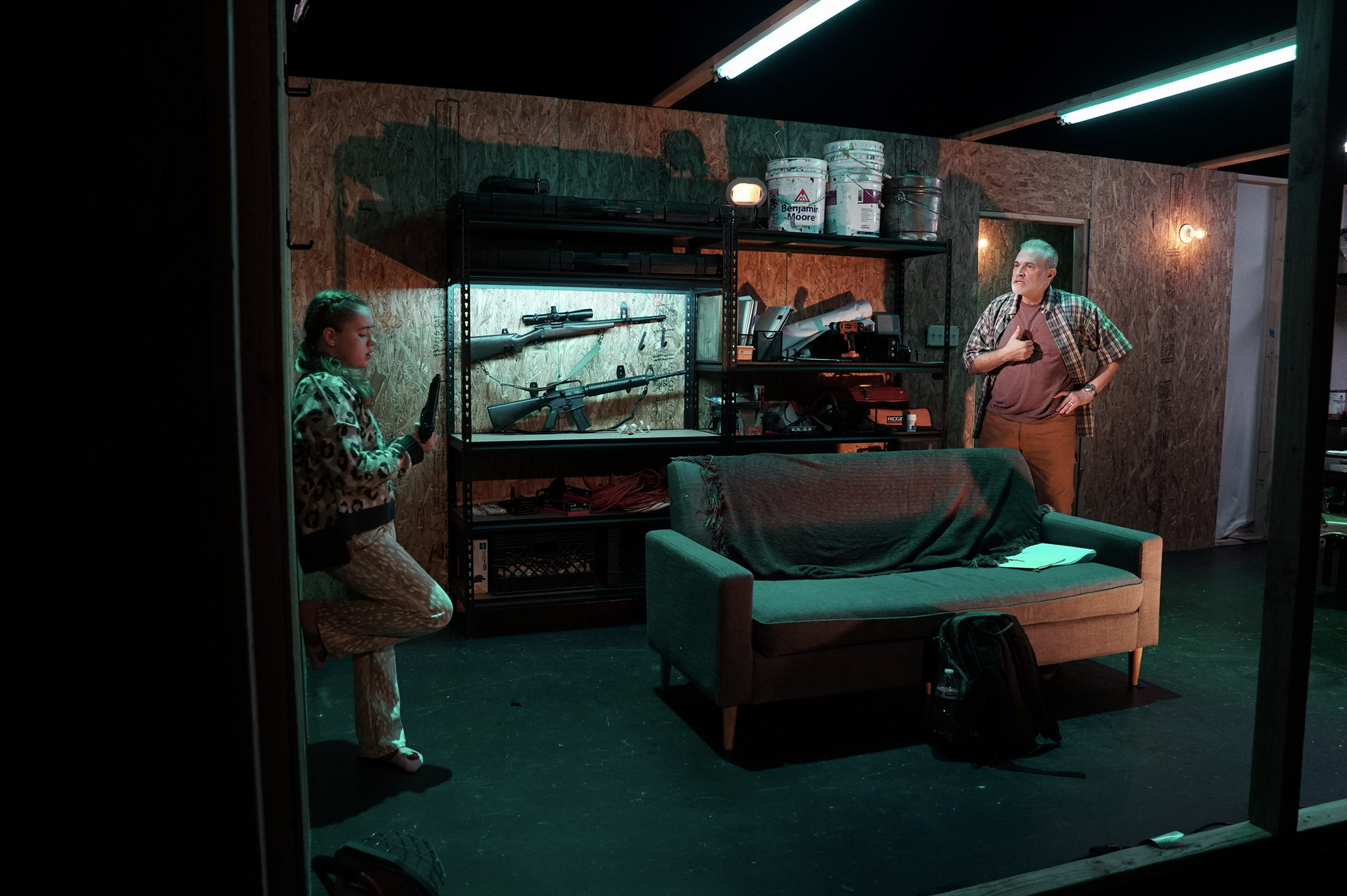
At center is Marc Kudisch’s performance as Rock on a constant boil. While the always-excellent Karen Ziemba beautifully modulates Slipper’s subservience, it is 12 year old Julianna Layne as young Claire in flashback scenes who dials up the unease and ultimate sorrow in Rock’s relationships. Grace Church picks up Claire’s mantle but is given too many tattered ends to project a distilled image while Anna Roman’s stalwart Ashley suffers from too little color. Filling out the narrative are Glenn Seven Allen as Rock’s father known as The General and Justin Lee Miller in the dual roles of Rock’s doctor and a local police officer.
You may find Safe House as difficult to weather as the women under Rock’s care. But it does succeed in crowding out one’s own concerns for its 100 minutes of run time. Performances continue through September 13 in Theatre Four at Theatre Row, 410 West 42nd Street between 9th and 10th Avenue. Be warned: the venue is as cold as the suburban Pennsylvanian November that serves as the setting.



Dropping Gumballs on Luke Wilson
On a soundstage, a talented production team is preparing to shoot an AT&T commercial featuring beloved Luke Wilson. The creative concept is to drop red gumballs around the star to symbolize all of Verizon’s dropped calls. Despite a lack of time to test the hastily put-together rig, prop lead Rob is able to toss the small projectiles just shy of Luke’s shoulder and the first few takes go smoothly. Then a case of nerves sets in and a few of the hard objects hit Luke squarely on the head. The actor sees stars; the director —award-winning documentarian Errol Morris — sees excitement and orders the crew to deliberately aim for the performer on the next take.
This is the set-up of the aptly named Dropping Gumballs on Luke Wilson, which is based on true events. Though the Directors Guild of America takes set safety very seriously, sadly there are occasional incidents of a director demanding a dangerous shot, as happened in this case. Rob Ackerman accurately has commercial Assistant Director, Alice, threaten to report Morris to the Guild. The script also provides enough background to realistically make her vulnerable to manipulation. It’s a creative stand-in for any project on which a concerned would-be whistleblower has instead been made complicit through intimidation. If only the playwright had trusted his audience to get his very clear and impactful message. Instead, after a lively and thought-provoking 55 minutes, he burdens the additional 20 with outright lectures on broader issues and political topics ranging from gender discrimination to Nazis. It’s an unnecessary departure from the previous territory that mars an otherwise engaging production.
First time director, famed playwright Theresa Rebeck, does an imaginative job of bringing us deep inside the physical set of the commercial and the mind set of each participant. The results are visually stimulating and often laugh-out-loud funny. The assorted screens that are employed by Morris for playback at the shoot are also used to show us the crew’s previous experiences that have brought them to this critical moment. (Yana Birkukova provides the ideal video design.) The nearly all-white set designed by Christopher and Justin Swader shows off these projections to great effect. Emphasis is achieved by Mary Ellen Stebbin’s well-placed lighting, which often shifts to a befitting green-screen green. The look is completed by the essential craft service table. Costumes designed by Tricia Barsamian will make any production pro feel right at home. All-important clever props are provided by Addison Heeren.
The Cast of Dropping Gumballs on Luke Wilson; Photo by Carol Rosegg
As a former prop person, Rob Ackerman makes the prop man, also named Rob, his spokesperson. George Hampe does a fabulous job of growing increasingly manic as character Rob struggles to remain the voice of reason and the closest thing we get to a hero. With a get-on-with-it gruffness, Dean Nolen is well cast as his boss and seasoned rigger, Ken. Reyna De Courcy is less successful at maintaining an appropriate emotional build in the role of their assistant, Jenny, becoming akin to a cartoon character with jerky motions and high-pitched yelps of displeasure. With enough charm and swagger, Jonathan Sale could easily be Luke Wilson’s deliberately pudgy body double. It’s less easy to know how well David Wohl impersonates Errol Morris. The part is written in one obnoxious note, though the theater vet certainly manifests a typical ego-driven artist. In the toughest role, Ann Harada swings rightly between assuredness and fear as Alice, but she struggles to differentiate the other small parts she takes on in memory and flashback.
Ackerman’s love of television production and those who strive to keep it creative and truthful shines through despite a dip in the ending. It is easy to see why both Luke Wilson and Errol Morris have given the project their blessing. With a little reworking of the last section, Dropping Gumballs on Luke Wilson has the makings of insightful modern satire. Running time is 75 minutes with no intermission. It plays through July 6, 2019, in the Mezzanine Theater at at A.R.T./ New York Theatre (502 W. 53rd Street). Tickets are $25 for union card holders, $30 general admission and $40 for reserved seating. For purchasing and additional information, visit TheWorkingTheater.org or call the Box Office (Ovationtix) at 866.811.4111.