
The Son is going to Hell. This is not a spoiler, but rather one of the opening lines of Max Posner’s The Treasurer. This assured destiny stems from his loveless relationship with his self-centered and fiscally irresponsible mother, Ida Armstrong. It is a wearying connection only hardened by her slow mental deterioration. The play is partially autobiographical, the second such dubious attempt produced by Playwrights Horizon this season. (The first was For Peter Pan on her 70th Birthday, Sarah Ruhl’s ode to her mother. Interestingly, both Ruhl and Posner were writing students of the magnificent Paula Vogel.)
There is an almost therapeutic feel to some of the Son’s monologues. Deeply personal scenes like the return of a pair of pants to Talbots may not translate for someone who is not Ida’s grandson. Posner adds even more distance between characters by having the bulk of the dialogue take place on the phone. But the biggest challenge with this story is that their family tie isn’t particularly tumultuous either. The Son eventually complies with Ida and his siblings at every turning point. Audience members seeking warmth — or at the very least electricity — at the heart of a production will be sorely disappointed.

Deanna Dunagan and Peter Friedman in The Treasurer ©️Joan Marcus
Fortunately for all ticket-buyers, the performances are gripping. Theater vets Deanna Dunagan and Peter Friedman take on the roles of Ida and her perpetually challenged Son. Both give deeply human interpretations despite little new or informative ground. Friedman is our guide here, frequently addressing the audience to share his exasperation, utter disbelief, and eventual acceptance. Dunagan manages to lend freshness to Ida’s all too familiar arc of decline and multitude of stock scenes. They are brilliantly supported by Marinda Anderson and Pun Bandhu, color-blind and gender-fluid in multiple roles. Despite obvious talent, these two can’t quite replicate Ida’s once vibrant social circle, the more detailed loss of which would have given Ida’s failing more meaning.
David Cromer’s staging is difficult bordering on the bizarre. Characters are often addressing each other from three distant points on the stage, making viewing more similar to a tennis match than a creative endeavor. In the case of Anderson and Bandhu, actors sometimes start a scene as one character, then have to slide into another in a beat. Laura Jellinek does what she can to support this vision with a compartmentalized minimal scene design. Shout out to Brett Anders and his stage management team for slipping in to keep each section updated with the proper touches. The lighting by Bradley King sets the tone with the houselights slowly dimming during Friedman’s first speech. Sound design by Mikhail Fiksel includes perfectly replicating the tinny sound of cellphones and the stiltedness of online chatbots. Lucy Mackinnon’s projections are attractive, though it’s hard to see how they clarify the plot or intensify the sentiment.
Those who relate to Playwrights Horizons’ mission to support emerging writers as well as those who believe in the crushing power of guilt, may be attracted to spending 90 minutes with The Treasurer. It has been extended in the Peter Jay Sharp Theater through November 5, 2017. For tickets and information visit https://www.playwrightshorizons.org/shows/plays/treasurer.
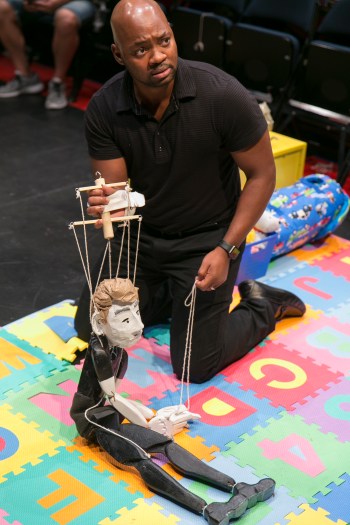
 As Broadway musicals go, the small scale charmer of a flick Groundhog Day doesn’t seem the most obvious of inspiring sources. The comedic drama relies heavily on Bill Murray’s ability to deliver a stinging blow that is somehow forgivable. With the film’s move to the stage, that burden falls on Olivier Award winner Andy Karl as weatherman Phil Conners. He is charismatic and a joy to watch, but his wonderful performance isn’t quite enough to balance out the slightness of the material. The overall experience is theatrical cotton candy: ultimately sweet and instantly vanishing.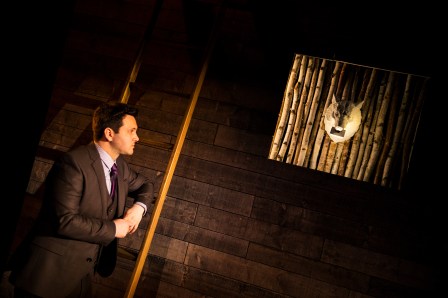
 Anyone looking to fill an evening this week with good theater that supports a great cause and an even better movement should head over to the Cherry Lane for the Project W Theatre Festival. Running June 6-10, this series of staged readings turns the spotlight on professional theater women in creative and business roles. Pay-what-you-wish donations will be given to Planned Parenthood of NYC, which provides reproductive healthcare and educational programs to women and their families throughout the five boroughs.
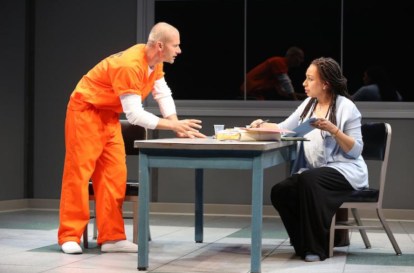 Though obviously embellished, Schenkkan’s premise is firmly rooted in current headlines. There are references to true life incidents from as recent as February of this year. Unfortunately, his dialogue — no doubt hastily written — is not realistic and often sounds like a PowerPoint lecture. There is an additional challenge in having only one of the characters with something concrete to say. The events are all in the past, with no action or dramatization of scene. We get a few flashes of insight into Gloria, but for the most part Ms. Tunie is stuck asking, “why”. Alot.

 An equally important character is the set by Nigel Hook. Every piece has impeccable timing. Not since Alan Ayckbourn’s Bedroom Farce have I seen furniture collapse so slowly and perfectly. (I will not give away any of its more clever secrets.) The purposeful fiasco is deftly staged by director Mark Bell. His training at Ecole Internationale de Theatre and experience teaching at LAMDA likely influence the more overt style of this buffoonery.
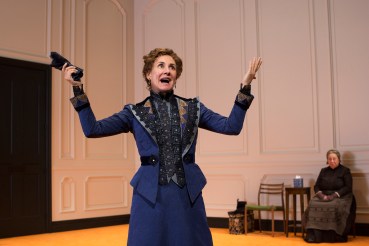 Nora Helmer’s exit from Henrik Ibsen’s A Doll’s House was the door slam heard around the world. Since 1879, scholars, sociologists, and others have speculated about her fate. Now playwright Lucas Hnath attempts to reveal what came next in A Doll’s House, Part 2, using modern language and the commanding Laurie Metcalf to deliver a post-feminist message about marriage, freedom and self-knowledge.
 The Unforgettable Line