
The lovers at the center of The Chekhov Dreams are an unusual pair. Kate is dead, having been killed in a car crash several years ago. Deeply depressed since the accident, the independently wealthy Jeremy has put his writing aside and spends his days asleep in order to visit her in his dreams. A frequent topic of conversation between them is the possibility he might end his life and join his beloved in the hereafter.
Tired of watching this sad cycle, brother Eddie — who has chosen to spend his money on the more traditional wine, women and song — elicits a promise that Jeremy will make an effort to get out and meet new people. A man of his word, Jeremy signs up for an acting class, thinking this exercise might have the benefit of expanding his relationship with the literature he loves almost as deeply as he does Kate. Instead, he and his scene partner Chrissy are assigned The Seagull by Anton Chekhov, a playwright Jeremy considers dreary and uninspiring.

Photo by Arin Sang-urai. L to R: ELIZABETH INGHRAM, DANA WATKINS, CHARLOTTE STOIBER
Playwright John McKinney ambitiously draws parallels between his characters, Chekhov’s Anna and Trigorin and Jeremy’s favorite fairytale, The Snow Queen. The results are uneven, punctuated by some imaginative moments. A few grimmer concepts are presented too off-handedly, which is jarring. But by the second act we’re more firmly in Blithe Spirit territory than anywhere near a Cherry Orchard. The broader comedy works fine while we remain in Jeremy’s mind and apartment, but when the action shifts back to the acting class, McKinney breaks his established rules of conduct and produces an uneasy mix of personal hallucination and the reality of others.
The small cast works comfortably together. The angular Dana Watkins provides Jeremy with an appropriately dreamy quality. As his scene partner and potential lifeline, Chrissy is given bubbly charm by Charlotte Stoiber. Christian Ryan channeling Jere Burns delivers the best zingers as Eddie. The toughest challenge is handed to Elizabeth Inghram who struggles to bring the not-always-likable Kate to “life”. Rounding out the team is Rik Walter as the time and realms-traveling Chekhov who fills in the blanks whenever Jeremy becomes too blind in grief.
Some of director Leslie Kincaid Burby’s staging is clever, particularly the dream sequences. The mood of these all important scenes is enhanced by Diana Duecker’s lighting and sound designed by the playwright himself. Burby is less successful when giving the actors “business”. The already rapid-fire dialogue gets punched up with distracting sight gags. Scott Aranow’s scenic design also doesn’t quite work. We are told that Jeremy inherited a great deal of money, but his furniture is inexplicably cheap and ratty. At times the walls actually wobble. It is clear from his ultra-casual wardrobe provided by costume designer Christina Giannini that Jeremy isn’t “spendy”, but he should at least honor basic building codes.
For all the talk of endless love and devotion for the ages, The Chekhov Dreams is more a diverting night out than a philosophical exercise. The thought-provoking questions raised don’t hold up to much reflection. Towards the end of the play, Eddie has a line that works as a wink to the audience, indicating McKinney knows that the ponderous moments won’t be sustained after the houselights come on. But really, what’s wrong with a little escape? Tickets for the production at The Beckett at Theatre Row are available through February 17 at https://www.chekhovdreams.com.
 Many of us have experience working with someone who’s a big picture dreamer. Unchecked by a healthy skeptic — much less an opponent with a better idea — they good-naturedly lead their team down a path to The Emoji Movie or Pets.com. Greg Pierce starts out telling one such story in Cardinal in which Lydia Lensky returns to her hometown with the wild idea of literally painting it red. With tremendous enthusiasm and few facts, she persuades the locals that this gimmick will attract tourism and new business.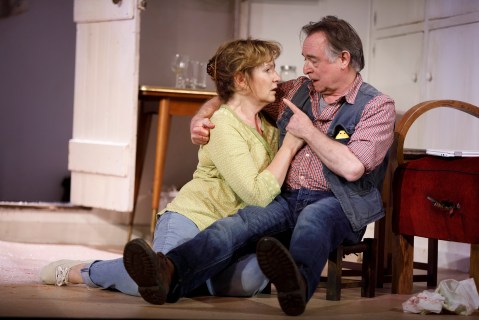

 When I lived in San Francisco, I volunteered at a residential program for former felons. I realize this makes me more likely to respond to the plight of bright creative people who make terrible decisions and are helped along that path by a lack of education, support and resources. Judging from the emotional reaction of audience members around me, these characters are so beautifully detailed, their situation will draw you in just because you are human.
 If the notion of a twelfth deuce point doesn’t tie your body in knots of exasperation mixed with exhilaration, Anna Ziegler’s The Last Match may not be the play for you. The tightly woven story of two couples whose lives revolve around professional tennis relies heavily on having at least a basic understanding of the sport. For those who are fans, it makes for an engrossing 100 minutes.
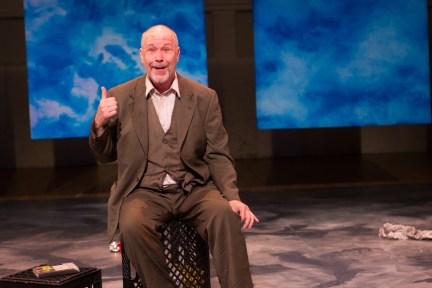 There is no denying that Richard Hoehler is a talented man. A winner of the The Off-Off-Broadway Review (OOBR Award) for Best Solo Performer, he knows how to own a room. In his latest monologue, I of the Storm, he tells tales, recites poetry, sings heartily and even dances a lick or two. You’re sure to take notice throughout even if it doesn’t quite all hold together in the end.
 The Unforgettable Line