Category Archives: Off-Broadway

Broad Comedy

There is a great deal of heart — and other select body parts — in Broad Comedy, the way way left of center review currently running on Mondays at the Soho Playhouse.  If the concept of  a senior talking vagina giving dating advice to a teenage model of the same makes you laugh, this one’s for you.  The program is heavy on the sex jokes plus witty cultural observations and of-the-moment politics. It’s distinctly “blue” in both the moral definition and also in the sense that the work is definitely not for the ears of anyone who voted Republican in 2016.

Musical comic, actress, author, speaker, and social activist Katie Goodman stars, delivering a high octane series of sketches, songs, and musical bumpers co-written and directed by her husband, Soren Kisiel.  Her chatty rapport with the audience is genuine and delightful.  She is flanked by a talented all-female ensemble, which in New York consists of Danielle Cohn, Molly Kelleher, Tana Sirois and Carlita Victoria.  All have big smiles, strong voices and perfect articulation.  The acting is at an early student level, but this isn’t intended to be Ibsen.

BroadComedyNYCThe lyrics rely heavily on the use of the F-word.  There are also long asides recited over a single note in almost every song.  These devices seem lazy given Goodman’s clear and strong opinions.  Most non-musical sections bring a smile and several are big-laugh worthy.  At a few intervals, Goodman asks the audience to participate, though mine was decidedly shy.  Gags include the aforementioned wise vaginas and a team of uncooperative dancing boobs.  Of the routines that stem from higher chakras, the right wing cheerleaders (pictured here) are among the most fully drawn.  The modern twist on Vanilla Ice’s theme is genius.  Another skit in which characters speak in Siri is just right.  The only bit that fell completely flat featured two literal empty nesters who contemplate getting hooked on painkillers.  This is one topic for which no amount of distance is enough.

The production values are stronger than one would expect in a stripped down vehicle.  The show moves speedily, with the players making so many quick changes into cleverly designed costumes that at one point Katie had to check to make sure she was wearing a skirt.  <She was.>  The cute choreography is skillfully executed with the cast handily managing everything from baby carriages to guns.  Only the scene changing soundtrack featuring Ariana Grande, Kay Boutilier and others of that ilk is ill-conceived given its glaring contrast to the style of the main event.

When you get tied of yelling along with Rachel Maddow, get out of the house and over to Broad Comedy.  $35 tickets for performances Mondays at 7:30 are available now through March 26 and can be purchased at www.sohoplayhouse.com.  After its current New York engagement, Broad Comedy will continue touring nationally, and at some stops will be raising money for feminist causes including Planned Parenthood.  For more information on their ongoing adventures, please visit www.broadcomedy.com

The Chekhov Dreams

The lovers at the center of The Chekhov Dreams are an unusual pair.  Kate is dead, having been killed in a car crash several years ago.  Deeply depressed since the accident, the independently wealthy Jeremy has put his writing aside and spends his days asleep in order to visit her in his dreams.  A frequent topic of conversation between them is the possibility he might end his life and join his beloved in the hereafter.

Tired of watching this sad cycle, brother Eddie — who has chosen to spend his money on the more traditional wine, women and song — elicits a promise that Jeremy will make an effort to get out and meet new people.  A man of his word, Jeremy signs up for an acting class, thinking this exercise might have the benefit of expanding his relationship with the literature he loves almost as deeply as he does Kate.  Instead, he and his scene partner Chrissy are assigned The Seagull by Anton Chekhov, a playwright Jeremy considers dreary and uninspiring.

ChekhovDreams

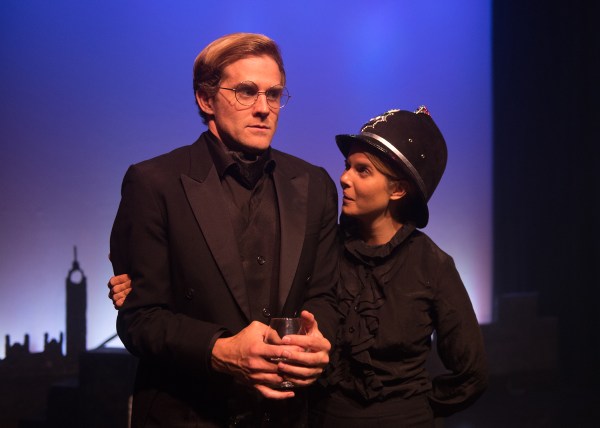
Photo by Arin Sang-urai. L to R: ELIZABETH INGHRAM, DANA WATKINS, CHARLOTTE STOIBER

Playwright John McKinney ambitiously draws parallels between his characters, Chekhov’s Anna and Trigorin and Jeremy’s favorite fairytale, The Snow Queen.  The results are uneven, punctuated by some imaginative moments.  A few grimmer concepts are presented too off-handedly, which is jarring.  But by the second act we’re more firmly in Blithe Spirit territory than anywhere near a Cherry Orchard. The broader comedy works fine while we remain in Jeremy’s mind and apartment, but when the action shifts back to the acting class, McKinney breaks his established rules of conduct and produces an uneasy mix of personal hallucination and the reality of others.

The small cast works comfortably together.  The angular Dana Watkins provides Jeremy with an appropriately dreamy quality.  As his scene partner and potential lifeline, Chrissy is given bubbly charm by Charlotte Stoiber.  Christian Ryan channeling Jere Burns delivers the best zingers as Eddie.  The toughest challenge is handed to Elizabeth Inghram who struggles to bring the not-always-likable Kate to “life”.  Rounding out the team is Rik Walter as the time and realms-traveling Chekhov who fills in the blanks whenever Jeremy becomes too blind in grief.

Some of director Leslie Kincaid Burby’s staging is clever, particularly the dream sequences.  The mood of these all important scenes is enhanced by Diana Duecker’s lighting and sound designed by the playwright himself.  Burby is less successful when giving the actors “business”.  The already rapid-fire dialogue gets punched up with distracting sight gags. Scott Aranow’s scenic design also doesn’t quite work.  We are told that Jeremy inherited a great deal of money, but his furniture is inexplicably cheap and ratty.  At times the walls actually wobble.  It is clear from his ultra-casual wardrobe provided by costume designer Christina Giannini that Jeremy isn’t “spendy”, but he should at least honor basic building codes.

For all the talk of endless love and devotion for the ages, The Chekhov Dreams is more a diverting night out than a philosophical exercise.  The thought-provoking questions raised don’t hold up to much reflection.  Towards the end of the play, Eddie has a line that works as a wink to the audience, indicating McKinney knows that the ponderous moments won’t be sustained after the houselights come on. But really, what’s wrong with a little escape?  Tickets for the production at The Beckett at Theatre Row are available through February 17 at https://www.chekhovdreams.com.

Cardinal

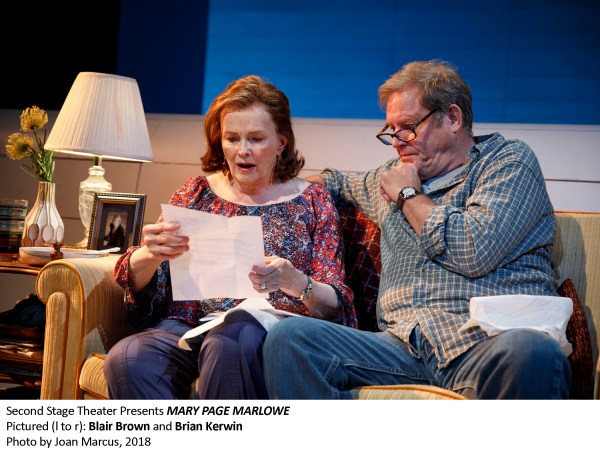
Second Stage Theater Cardinal By  Greg Pierce Directed By Whorlsky Cast Beck Ann Baker Anna Chlumsky Alex Hurt Adam Pally Stephen Park Eugene YoungMany of us have experience working with someone who’s a big picture dreamer.  Unchecked by a healthy skeptic — much less an opponent with a better idea — they good-naturedly lead their team down a path to The Emoji Movie or Pets.com.  Greg Pierce starts out telling one such story in Cardinal in which Lydia Lensky returns to her hometown with the wild idea of literally painting it red.  With tremendous enthusiasm and few facts, she persuades the locals that this gimmick will attract tourism and new business.

It’s clear from the moments that click in this production that if Mr. Pierce had focused on developing this plot line and fully explored the themes of unintended consequences and shifting alliances, Cardinal might resonate.  Towns around America are going through similar changes and struggling to find solutions.  Instead of trusting there was enough to say on this important topic, the playwright tosses in sexual obsession, cultural bias, the working poor, and addiction.  The final concoction is as tasty as the dish cooked up by Rachel Green in “The One Where Ross Got High.”  (For non friends of Friends, the recipes for shepherds pie and trifle had stuck together.)

I can see how Lydia’s well-meaning messiness might be attractive to Anna Chlumsky, fresh off yet another Screen Actors Guild win for VEEP.  The actress certainly pours energy into her attempt to create an emotional arc for a character that moves from A to B and then drifts back to A.  It is helpful that her primary foil is brought to life by Adam Pally who is known for mining comedy gold.  Sadly Pally’s timing cannot save their weightier exchanges from tumbling headlong into melodrama.  Scenes between Becky Ann Baker and Alex Hurt as a small business owner and her mentally challenged son ring truer, but all too soon their storyline also hits a wall.  Rounding out the characters, a Chinese businessman and his son portrayed by Stephen Park and Eugene Young are mostly offensive.

The behind the scenes team seems to have trouble keeping up with the scattered emotional beats and plot turns.  Director Kate Whoriskey — who helped bring the astoundingly powerful Sweat to life — establishes a pattern of using the town’s worker-bees to ease scene transitions only to be confronted with sections where this ploy doesn’t fit the action.  Derek McLane’s brick set may make location changes easier, but it too doesn’t consistently work to give us the proper sense of place.  Some of the sound and light elements are cheesy.  This may be intentional but in that case the artistic commitment isn’t strong enough.

Like many members of my profession, I believe it’s essential to fairly review those works that are not my cup of tea.  However, there are some offerings that must be called out for simply “not working.”  I attended Cardinal with five friends all of whom had a negative experience.  (They tell me it’s the first time in 25 years they’ve had the same reaction to a night at the theater.)  What did the good folks at 2nd Stage read that was lost along the way?  Perhaps the creative team behind this world premiere was carried away by its own Lydia Lensky when it added the commissioned work to the season.  Let me know what you think if you decide to purchase a ticket at https://2st.com/shows/current-production/cardinal.

A Deal

Internationally known playwright Zhu Yi has given New Yorkers a gift with A Deal, which opened at Urban Stages last night.  On its surface, the piece tells the story of one Chinese family’s attempt to buy into the Manhattan real-estate market as a major step towards providing their daughter with the complete American Dream.  But this rich work has multiple layers and is by turns wonderfully thought-provoking, deeply troubling and oddly funny.

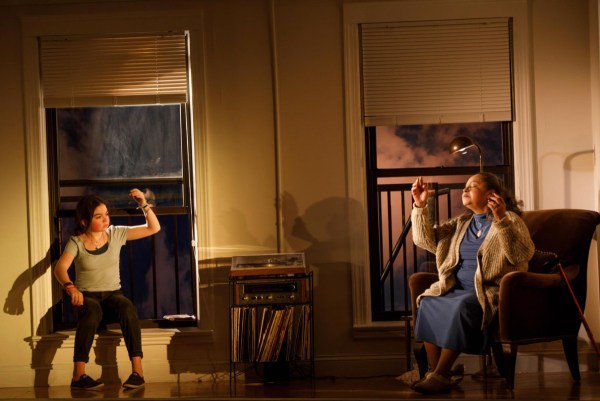
Lydia Gaston, Wei-Yi Lin and Alan Ariano. Photo bu Ben Hider

Lydia Gaston, Wei-Yi Lin and Alan Ariano. Photo by Ben Hider

For most of its 100 minute runtime, the play follows two tracks.  Li Su is a recent Columbia University MFA graduate vigorously pursing an acting career in New York City.  Her chosen profession necessitates that she be judged by how she looks, which regrettably for Asian talent is usually limiting and consequently frustrating.  Around the time of her first big break, her parents arrive from China.  They are proud Communists who made a small fortune which they want to invest it in the USA.  Early on in the plot, these two are reunited with Mrs. Li’s former beau Peter who has become an American citizen.  This set-up provides Zhu Yi with ample opportunities to skillfully explore emotional conflicts stemming from stereotypes, ideology,  and national pride.  None of these people is particularly likable, but each is admirable for a different reason.

Like her character, Taiwanese actress Wei-Yi Lin is making her off-Broadway debut as Li Su.  She is strident at times, though that may be a deliberate artistic decision meant to reinforce her alter-ego’s tenacity.  Alan Ariano and Lydia Gaston bring depth and passion to their proud parental fishes out of water.  Pun Bandhu— playing multiple parts here as he did in The Treasurer — provides Peter with equal parts sweetness and cunning.  Seth Moore seems genuine as a writer, (perhaps because he is one.)  Unfortunately Helen Coxe doesn’t provide enough distinction between her roles as a con artist, talk show host, receptionist and others causing slight confusion for those around me.

The entire creative team is strong and obviously united in their vision.  Director John Giampietro makes remarkable use of the small stage, most admirably in a beautifully choreographed fight scene.  The simple light-weight set by Frank J. Oliva is brought to vivid life by Ryan Belock’s exceptionally artful projections.  Audrey Nauman gives each of the characters their perfect wrapping, from Mrs. Li’s coordinated suits to Su’s darling babydoll dresses.

A Deal is a delightful departure from the limited world view that sometimes plagues commercial theater.  Zhu Yi  is a fresh and intelligent voice well-matched to the mission of Urban Stages to promote writers of diverse backgrounds.  Tickets (only $35 for full price) are available through December 10 at www.urbanstages.org.  Intriguing talkback sessions follow the performance on November 27, November 30 and December 4.  As an interesting side note, the piece delivered in Mandarin will simultaneously be touring throughout China.  I greatly look forward to reading the reviews from there.

Jesus Hopped The “A” Train

Stephen Adly Guirgis’s Jesus Hopped the “A” Train was first produced in New York in 2000.  Its portrait of a criminal justice system that is short on justice and long on system easily transferred to London’s Donmar Warehouse and earned the playwright an Olivier Award.  Shamefully, the predicaments the piece explores have only gotten worse, making the revival at the Signature as timely and poignant as ever.

Guirgis has a flare for language and exploring characters not often seen in commercial theater.  Similar to his recent Between Riverside and Crazy, the people we get to know in these two plus hours are trapped by circumstances.  In this piece, the playwright is able to draw on his expertise in violence prevention, taking a deep dive into what makes a criminal and what makes a crime.  He relies a little over-much on exposition, but even that is vivid and intense.

Those of you plugged into New York’s performing arts news may already know that *both* leads in this production had to be replaced: one for scheduling issues and the other for health reasons.  Though this meant extended creative tinkering for the supporting actors and director Mark Brokaw, Sean Carvajal as Angel and Edi Gathegi as Lucius have taken control of their roles body and soul.  The cast changes left SAG winner (for Desperate Housewives) Ricardo Chivira as the best known name in the lineup.  His Valdez is a tad mustache-twirly, but helps focus some of the angrier energy.

Jesus Hopped the A TrainWhen I lived in San Francisco, I volunteered at a residential program for former felons.  I realize this makes me more likely to respond to the plight of bright creative people who make terrible decisions and are helped along that path by a lack of education, support and resources.  Judging from the emotional reaction of audience members around me, these characters are so beautifully detailed, their situation will draw you in just because you are human.

Brokaw keeps the staging minimal, appropriate for the prison lock-down wing where most of the action takes place.  His focus is on well-paced dialogue delivery and appropriate physicality.  We deeply feel along with the characters as much as we hear their tales unfold.  It is slightly painful, yet wondrous.

The simple set by Riccardo Hernandez conveys a sense of confinement, while still giving the actors sufficient room for expression and interaction.  Prison garb by Dede M. Ayite has tiny touches of individuality.  Lighting by Scott Zielinski and sound by M. L. Dogg hint at what’s beyond the walls we see.

Whether you are a social justice advocate or a fan of emotionally moving drama, Guirgis’s work has something important to say.  Due to the delays caused by the recasting and resulting extra rehearsal days as well as to the enthusiastic response of the audience since the run’s relaunch, this production of Jesus Hopped the “A” Train has been extended through December 3.   The ticket price has been bumped from the regular $30 to the still-reasonable $55.  They are available on the Signature Theater website, http://www.signaturetheatre.org/shows-and-events/Productions/2017-2018/Jesus-Hopped-the-A-Train.aspx.

The Last Match

The Last Match Cast Wilson Bethel  Tim Alex Mickiewicz  Sergei Natalia Payne  Galina Zoë Winters  Mallory Creative Anna Ziegler  Playwright Gaye Taylor Upchurch  Director Tim Mackabee  Set Designer Montana Blanco  Costume Designer Bradley King  LightinIf the notion of a twelfth deuce point doesn’t tie your body in knots of exasperation mixed with exhilaration, Anna Ziegler’s The Last Match may not be the play for you.  The tightly woven story of two couples whose lives revolve around professional tennis relies heavily on having at least a basic understanding of the sport.  For those who are fans, it makes for an engrossing 100 minutes.

To mention the scenic design so early in a review is usually not a good sign.  But Tim Mackabee’s artistic rendering of the US Open is completely captivating and functions almost as a fifth character.  All the world’s a court and the men and women merely players.  The set pieces are accented by Bradley King’s mood-setting lighting which shifts from glaring spotlight to swirling night sky.

This splendid background does not distract from the terrific performances that take place in front of it.  Alex Mickiewicz is a standout as Sergei Sergeyev, a man for whom every decision is a tough one.  There is a captivating tautness to his tone and body language that is deeply honest and moving.  As the All-American Tim Porter, former tennis player Wilson Bethel expresses the combination of anxiety and drive that propels many champions to reach the top.  His wife Mallory is played by Zoë Winters with a dazzling mixture of tenderness and fortitude.  The quartet is rounded out by Natalia Payne as Sergei’s tough as nails fiancé, Galina.  Her pacing is perfection, but she misplaced her accent on several occasions, slipping from Russia to Queens.  This was particularly odd given that Ms. Payne has been with the play since its world premiere at the Old Globe in San Diego.

The piece is still considered a new work and may continue to developed, but it is already clear that the storytelling is wonderfully nuanced. Though there is a huge rivalry at its center, there are no bad guys in this tale.  We experience four realistic people just trying to do their best.  Ziegler picks her moments well, telling the audience so much in every glimpse through a window into their lives.  Director Gaye Taylor Upchurch manages to make scenes of tennis — effectively done in pantomime — and home life both past and present blend beautifully into four portraits that in turn become one.

While the tennis-as-life metaphor may limit the breadth of potential ticket-buyers, it really works.  It is a sport that is at its best when opponents have a respectful understanding of one another.  Each shot is the result of a decision, sometimes at an instinctive level.  Performance can be easily be influenced by the reaction of outsiders in the crowd.  And there’s weight to pondering how you will be remembered when it’s just not your day to win.

If you enjoy being caught up in the passions of others, The Last Match provides an immersive opportunity.  It’s a worthy time investment, though I could understand those who left confused or even frustrated not knowing a let from a footfall.  Tickets are available through December 24 at https://www.roundabouttheatre.org/Shows-Events/The-Last-Match.aspx.

The Treasurer

The Son is going to Hell.  This is not a spoiler, but rather one of the opening lines of Max Posner’s The Treasurer.  This assured destiny stems from his loveless relationship with his self-centered and fiscally irresponsible mother, Ida Armstrong.  It is a wearying connection only hardened by her slow mental deterioration. The play is partially autobiographical, the second such dubious attempt produced by Playwrights Horizon this season. (The first was For Peter Pan on her 70th Birthday, Sarah Ruhl’s ode to her mother.  Interestingly, both Ruhl and Posner were writing students of the magnificent Paula Vogel.)

There is an almost therapeutic feel to some of the Son’s monologues.  Deeply personal scenes like the return of a pair of pants to Talbots may not translate for someone who is not Ida’s grandson.  Posner adds even more distance between characters by having the bulk of the dialogue take place on the phone.  But the biggest challenge with this story is that their family tie isn’t particularly tumultuous either.  The Son eventually complies with Ida and his siblings at every turning point.  Audience members seeking warmth — or at the very least electricity — at the heart of a production will be sorely disappointed.

The Treasurer ©️Joan Marcus

Deanna Dunagan and Peter Friedman in The Treasurer ©️Joan Marcus

Fortunately for all ticket-buyers, the performances are gripping.  Theater vets Deanna Dunagan and Peter Friedman take on the roles of Ida and her perpetually challenged Son.  Both give deeply human interpretations despite little new or informative ground.  Friedman is our guide here, frequently addressing the audience to share his exasperation, utter disbelief, and eventual acceptance.  Dunagan manages to lend freshness to Ida’s all too familiar arc of decline and multitude of stock scenes.  They are brilliantly supported by Marinda Anderson and Pun Bandhu, color-blind and gender-fluid in multiple roles.  Despite obvious talent, these two can’t quite replicate Ida’s once vibrant social circle, the more detailed loss of which would have given Ida’s failing more meaning.

David Cromer’s staging is difficult bordering on the bizarre.  Characters are often addressing each other from three distant points on the stage, making viewing more similar to a tennis match than a creative endeavor.  In the case of Anderson and Bandhu, actors sometimes start a scene as one character, then have to slide into another in a beat.  Laura Jellinek does what she can to support this vision with a compartmentalized minimal scene design.  Shout out to Brett Anders and his stage management team for slipping in to keep each section updated with the proper touches.  The lighting by Bradley King sets the tone with the houselights slowly dimming during Friedman’s first speech.  Sound design by Mikhail Fiksel includes perfectly replicating the tinny sound of cellphones and the stiltedness of online chatbots.  Lucy Mackinnon’s projections are attractive, though it’s hard to see how they clarify the plot or intensify the sentiment.

Those who relate to Playwrights Horizons’ mission to support emerging writers as well as those who believe in the crushing power of guilt, may be attracted to spending 90 minutes with The Treasurer.  It has been extended in the Peter Jay Sharp Theater through November 5, 2017.  For tickets and information visit https://www.playwrightshorizons.org/shows/plays/treasurer.

For Peter Pan on Her 70th Birthday

By all appearances, For Peter Pan on her 70th Birthday should be a smash.  The star is the versatile Kathleen Chalfont.  The playwright is MacArthur “genius” Award winner Sarah Ruhl.  And at its heart is the universal struggle or how and when we grow up.  Yet somehow it all comes up slacker than a broken aerial wire.  This work was intended to honor Ruhl’s mother and the rest of us are challenged to understand the point of it all.

The “adventure” begins in a bleak hospital room in which five siblings have gathered at their father’s deathbed.  The scene is very long and a particularly tough test in an age when binge-watching has become the norm.  It would be artistically daring if only the conversation did more to enlighten us about the family.  Instead it’s likely to leave you as fidgety as if you were sitting in an actual waiting room.  While the pacing improves from there, the revelation level does not.  There’s a worn-out exchange of political views, a cliched examination of birth and pecking order, and a unfulfilled thread about life after death.  On occasion the characters share a story that is so unlikely to be forgotten by those involved it is obviously for our benefit.  It’s as if Ms. Ruhl wrote some ideas on index cards, shuffled them, and then forgot to put any meat on the bones.  The script may fit her ideal of theater as poetry, but it isn’t particularly expressive or even interesting.

For-Peter-Pan-on-her-70th-Birthday

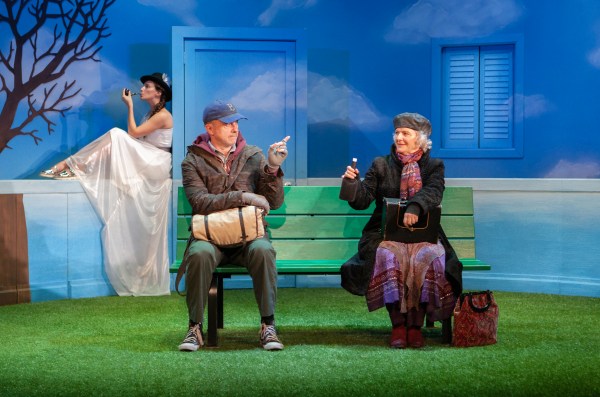
Photo by Joan Marcus

Initially, David Zinn’s set seems artistic and magical, but it just keeps getting in the actors’ way.  Equipment is hard to use while simultaneously delivering dialogue in a meaningful manner.  Pieces of the first scene remain in view for the rest of the act, yet serve no purpose.  Worst of all, the inside of the house is placed outside of the house, which seems intriguing until the Obie winning  director Les Waters’ staging grows awkward and then confusing.

At the center of all this muck, the actors perform like troopers.  The show’s highlight is Chalfont as birthday girl Ann addressing the audience as one from Iowa in the 1990s.  She is instantly engaging, sincerely reflectively, and almost completely wasted in this role.  The standouts in her supporting cast is the always remarkable Lisa Emery as Wendy in both her own story and the one that takes place in Neverland.  David Chandler doing double duty as brother Jim and nemesis Captain Hook (and maybe death?) supplies some laughs in Act II.  And kudos to Macy the adopted dog making her New York theatrical debut while generating an “aaaaw” or two.

If you are a devoted fan of Ruhl and want to be able to say you’ve seen all of her work, get yourself a seat.  For Peter Pan on her 70th Birthday is scheduled to play through October 1.  Playwrights Horizons (https://www.playwrightshorizons.org/shows/plays/peter-pan-her-70th-birthday/) has many loyal subscribers, but there are seats available through some of the usual discount channels.  Runtime is 90 minutes.

In & Of Itself

Regular readers of this column know I pride myself on my no spoiler policy.  In the case of In & Of Itself , I couldn’t spoil it if I wanted to.  Is that because there is no plot?  Or because there are six plots?  As star Derek DelGaudio would likely agree, it all depends on how you look at it.

I was initially attracted to this production not because of Mr. DelGaudio, but by the notion of an event produced by Neil Patrick Harris and directed by Yoda… I mean four time Emmy winner and puppeteer extraordinaire Frank Oz.  What sort of mystery tour could possibly have attracted the backing of these two unique talents?  I’ve now taken the wild ride and my conclusion is “Of course.  Yes.  This one.”

7 - Derek DelGaudio in IN &amp; OF ITSELF (c) Matthew Murphy

Derek DelGaudio in IN & OF ITSELF (c) Matthew Murphy

When attempting to describe the solo performer to me, my friend Jeremy called Mr. DelGaudio a magician.  True, DelGaudio has won the Academy of Magical Arts Award three times.  Nevertheless, I don’t believe that term really fits this storyteller/ fantasy travel agent.  He uses slight of hand the way most people in society use verbal persuasion.  It’s like Spalding Gray and Ricky Jay had a love child.  There are no rabbits or white doves in sight, though there is an elephant if one knows where to look.  Certainly I have never witnessed anyone else execute an illusion so profound and intimate it made someone cry, as happened to my friend.  (OK, I teared up a little too, but only cuz she was.)  I can’t imagine the self-preservation routine DelGaudio has developed in order to render this piece 8 times a week.  I’m going to need a visit to 16 Handles after just writing about it.

The direction by Frank Oz seems effortless, which is what’s required it in order to float through this evening.  There were a few occasions during which I wanted to look both in front and behind me, which was frustrating and perfect.  For once the term “production designer,” assigned to A. Bandit — the performance art collective founded by DelGaudio with artistic producer, Glenn Katino — is earned since the set would fit right in at MOMA.  Lighting by Adam Blumenthal is mood-transformative despite his techniques being unmasked in DelGaudio’s opening.  Original music by composer and Devo co-founder Mark Mothersbaugh hits all the right notes in all the meanings of that phrase.

Even in the season in which I saw Indecent, Sweat and Dear Evan Hanson, In & Of Itself rocked me to my core.  Be among the lucky ones to grab yourself a ticket for the run — now extended (for a third time!) through May 6, 2018.  Visit http://www.inandofitselfshow.com/#home, especially if you can picture yourself clearly on the steps of the landmark former Union Square Savings Bank having a fairly personal post-show conversation with 199 strangers.

At least that’s what happened to me.

And it was magical.

Building the Wall

If you admire our 45th President, you will likely consider Robert Schenkkan’s Building the Wall a bunch of liberal hysteria.  If on the other hand you are of the opinion that Mr. Trump’s policies have been injurious to the country, witnessing this production is like having someone poke a finger into the wound and fish around for the bullet.  The event is deeply painful and one can only hope to slightly feel better when it’s over.  For lovers of dramatic art, the extreme discomfort is offset somewhat by the exceptional lead performance delivered by James Badge Dale.

What often makes dystopian fiction palatable is that it takes place at a distant time or in a parallel universe.  This unpleasant tale unfolds in an El Paso, Texas prison in autumn, 2019.  Rick, the character portrayed by Mr. Dale, has been sentenced to death.  Over the course of 90 minutes we learn the details of his crimes through the questioning of Tamara Tunie’s Gloria, an historian who has come to capture Rick’s side of the story.

BuildingTheWallThough obviously embellished, Schenkkan’s premise is firmly rooted in current headlines.  There are references to true life incidents from as recent as February of this year.  Unfortunately, his dialogue — no doubt hastily written — is not realistic and often sounds like a PowerPoint lecture.  There is an additional challenge in having only one of the characters with something concrete to say.  The events are all in the past, with no action or dramatization of scene.  We get a few flashes of insight into Gloria, but for the most part Ms. Tunie is stuck asking, “why”.  Alot.

Thankfully, the focus is on Rick, who in the hands and mouth of Mr. Dale acquires depth that isn’t on the page.  One only has to flip through Dale’s IMDB photos to appreciate his chameleon-like range.  Confined in space and time, Rick attempts to take us on his journey from ex-military blue collar worker with a GED to a felon on death row.  Each step in his descent is made to sound completely reasonable, as is often true of Trump’s fans on the 6 o’clock news.  Perhaps that is part of the problem.  The play doesn’t stray far enough from a fairly predictable path until the last few irony-tinged lines.  As a result, it doesn’t give us much to think about except the faint hope that the worst will indeed be in the rearview in two years.

Director Ari Edelson, Founder of theatrical incubator The Orchard Projects, adds some essential physicality to Rick’s yarn spinning.  Tunie is little more than a coatrack.  Antje Ellermann’s set is suitable for its purpose.  Passages of time are defined by Tyler Micoleau’s subtle shifts in shaded lighting though Bart Fasbender’s tedious music and sound detract from rather than build tension.

Building the Wall has already played in four cities and is scheduled to be in New York through July 9.  If you wake up one morning feeling too good, you can likely score a $20 ticket and revel in Mr. Dale’s performance.  We may be in a political crisis, but there are more imaginative and helpful conversations on this topic than the one offered here.  Visit http://buildingthewallplay.com for details.