Category Archives: Play

Junk

Junk Photo by T. Charles Erickson

Photo by T. Charles Erickson

If you principally enjoyed the movie The Big Short but thought it had too much humor and heart, Junk might be the play for you.  The ripped-from-the-headlines drama by Ayad Akhtar is a work of fiction illustrating the exploitative practice that blossomed in 1985 of making debt an asset.  Akhtar’s dialogue is precise and natural and, when not bogged down by the essential vocabulary lesson, the 150 minutes pass swiftly.  But the experience is rather like a tasty dish that’s been added to the buffet table after you’ve already loaded your plate three times.  One only has to follow Twitter for five minutes to be reminded that the world is full of ultra wealthy predators. There simply isn’t room for any more in our collective bellies.

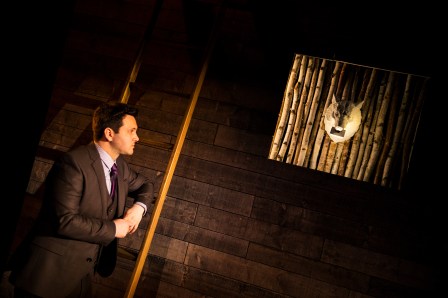
The quality of the acting throughout the piece is uniformly high.  The large dynamic cast is led by suave Steven Pasquale.  He’s silky smooth as power deal-maker and recent Time Magazine Cover Boy Robert Merkin.  Merkin is in the process of orchestrating the take-over of a family owned steel company and has obviously misplaced his soul several hundred million dollars ago.  He’s on a mission to reshape the world and won’t let anyone or anything dim his vision.

Having a cold-hearted manipulator at the center of the story would be thrilling if he weren’t surrounded by characters who are for the most part just as dislikable.  There is the captivating Ito Aghayere as Jacqueline Blount, a woman whose only loyalty is to herself.  Elegant Teresa Via Lim’s self-accepting Judy Chen who would fornicate with a dollar if she could figure out how.  Even would-be white knight Leo Tresler  played with bluster and a hint of insecurity by Michael Sieberry tramples all over his own code of ethics.  Miriam Silverman is the closest thing you’ll find to a hero as she finds strength and avoids shrillness in the tricky role of Merkin’s wife Amy.

Director Doug Hughes does his usual brilliant job of bringing out the best in each performance and every beat.  John Lee Beatty’s clever set of sliding platforms and illuminated doorways works well to define the space.  However, the essential projections created by 59 Productions are hard to see from the sides of the three-quarter round theater.  And the original music by Mark Bennett was sometimes so faint, it seemed to be seeping in from another room.

That “everything has a price” — including salvation — is not a new revelation.  If somehow you have not had your fill of this theme, then seek out a ticket to this well played production at the Vivian Beaumont.  Tickets for Junk are available at http://www.lct.org/shows/junk/ through January 7, 2018.

The Last Match

The Last Match Cast Wilson Bethel  Tim Alex Mickiewicz  Sergei Natalia Payne  Galina Zoë Winters  Mallory Creative Anna Ziegler  Playwright Gaye Taylor Upchurch  Director Tim Mackabee  Set Designer Montana Blanco  Costume Designer Bradley King  LightinIf the notion of a twelfth deuce point doesn’t tie your body in knots of exasperation mixed with exhilaration, Anna Ziegler’s The Last Match may not be the play for you.  The tightly woven story of two couples whose lives revolve around professional tennis relies heavily on having at least a basic understanding of the sport.  For those who are fans, it makes for an engrossing 100 minutes.
To mention the scenic design so early in a review is usually not a good sign.  But Tim Mackabee’s artistic rendering of the US Open is completely captivating and functions almost as a fifth character.  All the world’s a court and the men and women merely players.  The set pieces are accented by Bradley King’s mood-setting lighting which shifts from glaring spotlight to swirling night sky.

This splendid background does not distract from the terrific performances that take place in front of it.  Alex Mickiewicz is a standout as Sergei Sergeyev, a man for whom every decision is a tough one.  There is a captivating tautness to his tone and body language that is deeply honest and moving.  As the All-American Tim Porter, former tennis player Wilson Bethel expresses the combination of anxiety and drive that propels many champions to reach the top.  His wife Mallory is played by Zoë Winters with a dazzling mixture of tenderness and fortitude.  The quartet is rounded out by Natalia Payne as Sergei’s tough as nails fiancé, Galina.  Her pacing is perfection, but she misplaced her accent on several occasions, slipping from Russia to Queens.  This was particularly odd given that Ms. Payne has been with the play since its world premiere at the Old Globe in San Diego.

The piece is still considered a new work and may continue to developed, but it is already clear that the storytelling is wonderfully nuanced. Though there is a huge rivalry at its center, there are no bad guys in this tale.  We experience four realistic people just trying to do their best.  Ziegler picks her moments well, telling the audience so much in every glimpse through a window into their lives.  Director Gaye Taylor Upchurch manages to make scenes of tennis — effectively done in pantomime — and home life both past and present blend beautifully into four portraits that in turn become one.

While the tennis-as-life metaphor may limit the breadth of potential ticket-buyers, it really works.  It is a sport that is at its best when opponents have a respectful understanding of one another.  Each shot is the result of a decision, sometimes at an instinctive level.  Performance can be easily be influenced by the reaction of outsiders in the crowd.  And there’s weight to pondering how you will be remembered when it’s just not your day to win.

If you enjoy being caught up in the passions of others, The Last Match provides an immersive opportunity.  It’s a worthy time investment, though I could understand those who left confused or even frustrated not knowing a let from a footfall.  Tickets are available through December 24 at https://www.roundabouttheatre.org/Shows-Events/The-Last-Match.aspx.

The Treasurer

The Son is going to Hell.  This is not a spoiler, but rather one of the opening lines of Max Posner’s The Treasurer.  This assured destiny stems from his loveless relationship with his self-centered and fiscally irresponsible mother, Ida Armstrong.  It is a wearying connection only hardened by her slow mental deterioration. The play is partially autobiographical, the second such dubious attempt produced by Playwrights Horizon this season. (The first was For Peter Pan on her 70th Birthday, Sarah Ruhl’s ode to her mother.  Interestingly, both Ruhl and Posner were writing students of the magnificent Paula Vogel.)

There is an almost therapeutic feel to some of the Son’s monologues.  Deeply personal scenes like the return of a pair of pants to Talbots may not translate for someone who is not Ida’s grandson.  Posner adds even more distance between characters by having the bulk of the dialogue take place on the phone.  But the biggest challenge with this story is that their family tie isn’t particularly tumultuous either.  The Son eventually complies with Ida and his siblings at every turning point.  Audience members seeking warmth — or at the very least electricity — at the heart of a production will be sorely disappointed.

The Treasurer ©️Joan Marcus

Deanna Dunagan and Peter Friedman in The Treasurer ©️Joan Marcus

Fortunately for all ticket-buyers, the performances are gripping.  Theater vets Deanna Dunagan and Peter Friedman take on the roles of Ida and her perpetually challenged Son.  Both give deeply human interpretations despite little new or informative ground.  Friedman is our guide here, frequently addressing the audience to share his exasperation, utter disbelief, and eventual acceptance.  Dunagan manages to lend freshness to Ida’s all too familiar arc of decline and multitude of stock scenes.  They are brilliantly supported by Marinda Anderson and Pun Bandhu, color-blind and gender-fluid in multiple roles.  Despite obvious talent, these two can’t quite replicate Ida’s once vibrant social circle, the more detailed loss of which would have given Ida’s failing more meaning.

David Cromer’s staging is difficult bordering on the bizarre.  Characters are often addressing each other from three distant points on the stage, making viewing more similar to a tennis match than a creative endeavor.  In the case of Anderson and Bandhu, actors sometimes start a scene as one character, then have to slide into another in a beat.  Laura Jellinek does what she can to support this vision with a compartmentalized minimal scene design.  Shout out to Brett Anders and his stage management team for slipping in to keep each section updated with the proper touches.  The lighting by Bradley King sets the tone with the houselights slowly dimming during Friedman’s first speech.  Sound design by Mikhail Fiksel includes perfectly replicating the tinny sound of cellphones and the stiltedness of online chatbots.  Lucy Mackinnon’s projections are attractive, though it’s hard to see how they clarify the plot or intensify the sentiment.

Those who relate to Playwrights Horizons’ mission to support emerging writers as well as those who believe in the crushing power of guilt, may be attracted to spending 90 minutes with The Treasurer.  It has been extended in the Peter Jay Sharp Theater through November 5, 2017.  For tickets and information visit https://www.playwrightshorizons.org/shows/plays/treasurer.

I of the Storm

Richard Hoehler. Photo by Michael Abrams (4)There is no denying that Richard Hoehler is a talented man.  A winner of the The Off-Off-Broadway Review (OOBR Award) for Best Solo Performer, he knows how to own a room. In his latest monologue, I of the Storm, he tells tales, recites poetry, sings heartily and even dances a lick or two.  You’re sure to take notice throughout even if it doesn’t quite all hold together in the end.
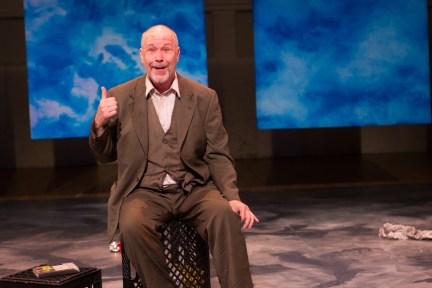
The story is told from the point of view of Hoehler’s alter-ego RJ Bartholomew.  In this adventure, an increasingly shady finance whiz who goes one deal too far, gets sent to jail, and winds up living on the streets.  There are clear-sighted descriptions of how poorly our society treats those who have paid that debt.  (It should be noted that Mr. Hoehler is the founder of Acting Out, a professional-level acting class for at-risk youth and men who are incarcerated.)  What is unusual is that his circumstances have led RJ to be more aware and alive than when he was in possession of money and power.  If this seems unrealistic, just tell yourself that for this particular Alan Watts reader it is the truth.  He is living his version of “holy poverty” in which having nothing to lose has given rise to complete freedom.

Over the course of 85 minutes, we learn snippets of RJ’s “riches to rags” story.  The through line is kept in broad-brush watercolor, with splashes of the darkness of his greedier days and the light of his relationship with a free-spirited artist who goes by the name of Mars.  Hoehler shares the narrative directly with the audience, but there is something missing from his invitation to completely enter his world.  On the night I attended, those around me remained unsure about whether they were actually meant to engage with the character or simply observe.

Bartholomew keeps his mind nimble by writing poems in a tattered notebook.  They range from Spike Milligan style doggerel to rap-ish verses akin to early Fresh Prince.  Hoehler’s energetic recitations, staged engagingly by director Janice L. Goldberg, are punctuated by song phrases from the Beatles to Broadway.  Along the way, Hoehler/Bartholomew make observations about the modern American way.  Though his declarations aren’t revolutionary and details are few, the hopeful viewpoint is refreshing and presented with flair.  A little editing would be wise.  75 minutes into the performance the presentation reached a saturation point, and the performer was in effect clapped-off by an appreciative but restless audience.

Painting also makes up the majority of Mark Symczak’s set.  Three striking canvases and a swirled floor stand in for light, sky, ground, and cityscape.  David Withrow’s costume captures almost the entirety of RJ’s rise and fall in a single blemished suit.  Michael Abrams’ lighting and Craig Lenti’s sound add texture to key moments while making use of every production dollar.

Whether you are a crusader for social justice or a fan of fresh solo work, I of the Storm makes for an absorbing evening.  It is scheduled to play through October 29 at The Gym at Judson.  Tickets are available though Ticket Central.  For more information visit https://www.iofthestormoffbroadway.com/about.

For Peter Pan on Her 70th Birthday

By all appearances, For Peter Pan on her 70th Birthday should be a smash.  The star is the versatile Kathleen Chalfont.  The playwright is MacArthur “genius” Award winner Sarah Ruhl.  And at its heart is the universal struggle or how and when we grow up.  Yet somehow it all comes up slacker than a broken aerial wire.  This work was intended to honor Ruhl’s mother and the rest of us are challenged to understand the point of it all.

The “adventure” begins in a bleak hospital room in which five siblings have gathered at their father’s deathbed.  The scene is very long and a particularly tough test in an age when binge-watching has become the norm.  It would be artistically daring if only the conversation did more to enlighten us about the family.  Instead it’s likely to leave you as fidgety as if you were sitting in an actual waiting room.  While the pacing improves from there, the revelation level does not.  There’s a worn-out exchange of political views, a cliched examination of birth and pecking order, and a unfulfilled thread about life after death.  On occasion the characters share a story that is so unlikely to be forgotten by those involved it is obviously for our benefit.  It’s as if Ms. Ruhl wrote some ideas on index cards, shuffled them, and then forgot to put any meat on the bones.  The script may fit her ideal of theater as poetry, but it isn’t particularly expressive or even interesting.

For-Peter-Pan-on-her-70th-Birthday

Photo by Joan Marcus

Initially, David Zinn’s set seems artistic and magical, but it just keeps getting in the actors’ way.  Equipment is hard to use while simultaneously delivering dialogue in a meaningful manner.  Pieces of the first scene remain in view for the rest of the act, yet serve no purpose.  Worst of all, the inside of the house is placed outside of the house, which seems intriguing until the Obie winning  director Les Waters’ staging grows awkward and then confusing.

At the center of all this muck, the actors perform like troopers.  The show’s highlight is Chalfont as birthday girl Ann addressing the audience as one from Iowa in the 1990s.  She is instantly engaging, sincerely reflectively, and almost completely wasted in this role.  The standouts in her supporting cast is the always remarkable Lisa Emery as Wendy in both her own story and the one that takes place in Neverland.  David Chandler doing double duty as brother Jim and nemesis Captain Hook (and maybe death?) supplies some laughs in Act II.  And kudos to Macy the adopted dog making her New York theatrical debut while generating an “aaaaw” or two.

If you are a devoted fan of Ruhl and want to be able to say you’ve seen all of her work, get yourself a seat.  For Peter Pan on her 70th Birthday is scheduled to play through October 1.  Playwrights Horizons (https://www.playwrightshorizons.org/shows/plays/peter-pan-her-70th-birthday/) has many loyal subscribers, but there are seats available through some of the usual discount channels.  Runtime is 90 minutes.

A Real Boy

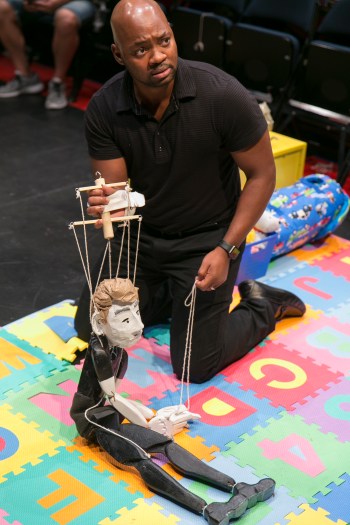
I was attracted to the concept of A Real Boy the moment I read the log line: Puppet parents adopt a human child. (This is not a spoiler. Even the most inexperienced of theatergoers is bound to notice this attribute of Max’s parents the moment they shuffle into his kindergarten classroom on their little wooden feet, strings and control handles attached.) The play lands some of the anticipated satirical punches, but it’s hard to make the argument that the darkly comic work is a total success.

To be clear, I can accept even the highest of concepts provided the writer stays within the boundaries of his own mythology.  Unfortunately parameters that are drawn in the first few minutes are broken almost immediately when a character who is supposed to live in a black-and-white world enters wearing blue glasses.  This is only the beginning of the muddled thoughts that swirl around what it means to be “puppet”.  How much do you or we acknowledge your “other part”: the obvious human member of Actors Equity who sometimes participates in a scene whenever tiny hands won’t do?  Do humans evolve into puppets simply with enough exposure?  If so, how does that translate in families with members who are not exactly mainstream?

The unclear vision of the Puppet Universe is just the beginning of playwright Stephen Kaplan’s challenges.  As the plot moves along, he creates a serious case of metaphorical whiplash. He can’t seem to make up his mind exactly what point he’s trying to make. The untraditional family stand-ins in for children with disabilities, transgender persons, and mixed race families and more before moving on to a vague “you be you.”   Any one of these statements could have been profound if followed through with conviction. Together they come up as ideological ambrosia salad.  And that’s before adding multiple snide asides about home schooling, ambitious local politicians, and online MBAs.

The cleverer sections of the work are hindered by the direction of Audrey Alford who, with the help of scenic designer Ann Beyersdorfer,  manages to ensure that every seat in the house becomes partial obstructed view.  Audience heads throughout the theater are constantly jostling for a position around the pillars, down to the floor, and over to a critical stage piece on the side.  I missed several important visual cues because they were not in my line of sight. This is fairly inexcusable given the the current configuration of the theater is about 60 seats.

ARealBoy3

Brian Michael in A REAL BOY at 59E59 Theaters. Photo by Heidi Bohnenkamp

Ms. Alford has also made some curious casting choices.  At the performance I attend, young Max is played by 20-something Kelley Selznick, a talented puppeteer, but not particularly gifted actress.  Max’s mother, Mary Ann Myers, is played by Jason Allan Kennedy George making his theatrical debut.  He’s fine in the role, but I found the selection of a tall male for the part a distraction from what more obviously makes Mary Ann different from other members of the PTA.  It is also hard to figure out how Max would find comfort with Miss Terry, played at a near-vibrating pitch by Jenn Remke.  More successful is Brian Michael, striking all the right notes as Max’s father distraught father, Peter Myers.  Breaking the tension with great timing is Jamie Geiger in the role of Principal Klaus.  And of course there are the all-important puppets created by Puppet Kitchen Productions, close to blank canvases the better to project your own vision of what different means to you.

For lovers of live theater seeking an unconventional production, A Real Boy has enough artistry to make it worthy of the $25 ticket price.  It is brought to 59E59 by Ms. Alford’s Ivy Theatre Company in association with Athena Theatre, which is known for it’s unorthodox psychologically-based dramas.  Performances run through August 27.  For tickets and information visit http://www.59e59.org/moreinfo.php?showid=293.

The Terms of My Surrender

N.B. This review is based on a late preview.

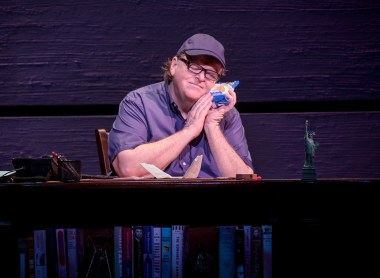
As film personalities on Broadway go, Michael Moore lands somewhere between a shining Bradley Cooper and a shunned Bruce Willis.  Stringing together personal accounts and observations, Moore makes some forceful motivating statements in The Terms of My Surrender. Unfortunately, these powerful moments are diluted by muttered off-the-cuff remarks and self-indulgent digressions.

Terms of My SurrenderMichael Moore

Michael Moore ©️Joan-Marcus

To be sure, there is plenty of anti-Trump rhetoric.  Moore has made it clear as a frequent talk show guest that he considers Mr. Trump an entertainer, unqualified to hold public office.  The show’s Playbill includes a somewhat sarcastic personal invitation to the President, written in Russian, to attend any performance.  But while Moore clearly has liberal leanings, he also recognizes that many of the issues about which he is concerned have roots before January of 2017.  He digs into his private vault of stories going back to the early 1970s to illustrate a number of social injustices and troubling trends that have only been magnified in the light of recent events.

Fans of Moore’s documentaries will likely enjoy learning about his formative years, when a combination of intellectual curiosity and a rabble-rousing nature led to the important discovery that anyone can make a difference.  These amusing and inspiring highlights are further enhanced by projections and videos by Andrew Lazarow making his Broadway design debut.  Tossed in are rapid sight gags (some of which work), a potentially funny game, a disturbing phone call, a needless interview, and a physical bit I won’t spoil in case it comes together after more rehearsal.  This piling on of elements resulted in a runtime of well over two hours on the night I attended.  That’s at least 30 minutes longer than necessary or desirable for Moore to make his point.  By the time he announced the terms of his surrender, I’d forgotten that was even the title of this work.  Moore is a bright and witty guy, but in this case he desperately needed an editor.

Director Michael Mayer, who was behind the vivacious and colorful revision of Hedwig and the Angry Inch, appears not to know what to do with what is essentially a monologue.  The stage seems to be unfamiliar territory under our hero’s feet.  One can almost sense the stage manager’s queues as he moves robotically from podium to desk set to faux living room.  At least there is plenty of distraction provided by David Rockwell’s backdrop of a magnificent and impressively functional American flag.

While I wish The Terms of My Surrender was a stronger piece, it has enough to recommend it.  Admirers of Moore’s films should take the time to see what he does with the live medium.  And those looking for a call to action in a polarizing political climate might well find one among his tales.  The limited run at the Belasco Theater is scheduled to end October 22.  Tickets and information are available at http://michaelmooreonbroadway.com.

In & Of Itself

Regular readers of this column know I pride myself on my no spoiler policy.  In the case of In & Of Itself , I couldn’t spoil it if I wanted to.  Is that because there is no plot?  Or because there are six plots?  As star Derek DelGaudio would likely agree, it all depends on how you look at it.

I was initially attracted to this production not because of Mr. DelGaudio, but by the notion of an event produced by Neil Patrick Harris and directed by Yoda… I mean four time Emmy winner and puppeteer extraordinaire Frank Oz.  What sort of mystery tour could possibly have attracted the backing of these two unique talents?  I’ve now taken the wild ride and my conclusion is “Of course.  Yes.  This one.”

7 - Derek DelGaudio in IN & OF ITSELF (c) Matthew Murphy

Derek DelGaudio in IN & OF ITSELF (c) Matthew Murphy

When attempting to describe the solo performer to me, my friend Jeremy called Mr. DelGaudio a magician.  True, DelGaudio has won the Academy of Magical Arts Award three times.  Nevertheless, I don’t believe that term really fits this storyteller/ fantasy travel agent.  He uses slight of hand the way most people in society use verbal persuasion.  It’s like Spalding Gray and Ricky Jay had a love child.  There are no rabbits or white doves in sight, though there is an elephant if one knows where to look.  Certainly I have never witnessed anyone else execute an illusion so profound and intimate it made someone cry, as happened to my friend.  (OK, I teared up a little too, but only cuz she was.)  I can’t imagine the self-preservation routine DelGaudio has developed in order to render this piece 8 times a week.  I’m going to need a visit to 16 Handles after just writing about it.

The direction by Frank Oz seems effortless, which is what’s required it in order to float through this evening.  There were a few occasions during which I wanted to look both in front and behind me, which was frustrating and perfect.  For once the term “production designer,” assigned to A. Bandit — the performance art collective founded by DelGaudio with artistic producer, Glenn Katino — is earned since the set would fit right in at MOMA.  Lighting by Adam Blumenthal is mood-transformative despite his techniques being unmasked in DelGaudio’s opening.  Original music by composer and Devo co-founder Mark Mothersbaugh hits all the right notes in all the meanings of that phrase.

Even in the season in which I saw Indecent, Sweat and Dear Evan Hanson, In & Of Itself rocked me to my core.  Be among the lucky ones to grab yourself a ticket for the run — now extended (for a third time!) through May 6, 2018.  Visit http://www.inandofitselfshow.com/#home, especially if you can picture yourself clearly on the steps of the landmark former Union Square Savings Bank having a fairly personal post-show conversation with 199 strangers.

At least that’s what happened to me.

And it was magical.

Building the Wall

If you admire our 45th President, you will likely consider Robert Schenkkan’s Building the Wall a bunch of liberal hysteria.  If on the other hand you are of the opinion that Mr. Trump’s policies have been injurious to the country, witnessing this production is like having someone poke a finger into the wound and fish around for the bullet.  The event is deeply painful and one can only hope to slightly feel better when it’s over.  For lovers of dramatic art, the extreme discomfort is offset somewhat by the exceptional lead performance delivered by James Badge Dale.

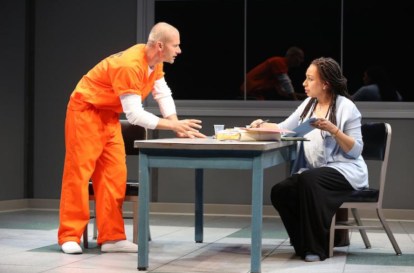
What often makes dystopian fiction palatable is that it takes place at a distant time or in a parallel universe.  This unpleasant tale unfolds in an El Paso, Texas prison in autumn, 2019.  Rick, the character portrayed by Mr. Dale, has been sentenced to death.  Over the course of 90 minutes we learn the details of his crimes through the questioning of Tamara Tunie’s Gloria, an historian who has come to capture Rick’s side of the story.

BuildingTheWallThough obviously embellished, Schenkkan’s premise is firmly rooted in current headlines.  There are references to true life incidents from as recent as February of this year.  Unfortunately, his dialogue — no doubt hastily written — is not realistic and often sounds like a PowerPoint lecture.  There is an additional challenge in having only one of the characters with something concrete to say.  The events are all in the past, with no action or dramatization of scene.  We get a few flashes of insight into Gloria, but for the most part Ms. Tunie is stuck asking, “why”.  Alot.

Thankfully, the focus is on Rick, who in the hands and mouth of Mr. Dale acquires depth that isn’t on the page.  One only has to flip through Dale’s IMDB photos to appreciate his chameleon-like range.  Confined in space and time, Rick attempts to take us on his journey from ex-military blue collar worker with a GED to a felon on death row.  Each step in his descent is made to sound completely reasonable, as is often true of Trump’s fans on the 6 o’clock news.  Perhaps that is part of the problem.  The play doesn’t stray far enough from a fairly predictable path until the last few irony-tinged lines.  As a result, it doesn’t give us much to think about except the faint hope that the worst will indeed be in the rearview in two years.

Director Ari Edelson, Founder of theatrical incubator The Orchard Projects, adds some essential physicality to Rick’s yarn spinning.  Tunie is little more than a coatrack.  Antje Ellermann’s set is suitable for its purpose.  Passages of time are defined by Tyler Micoleau’s subtle shifts in shaded lighting though Bart Fasbender’s tedious music and sound detract from rather than build tension.

Building the Wall has already played in four cities and is scheduled to be in New York through July 9.  If you wake up one morning feeling too good, you can likely score a $20 ticket and revel in Mr. Dale’s performance.  We may be in a political crisis, but there are more imaginative and helpful conversations on this topic than the one offered here.  Visit http://buildingthewallplay.com for details.

Indecent

Theater aficionados have long considered Paula Vogel a treasure.  Her plays — including Pulitzer Prize winner How I Learned To Drive — are generally unnerving and always thought-provoking.  Her work has given voice to the typically powerless: those who have been oppressed and abused.  Her teaching at Brown and Yale has nurtured another generation of powerful female voices, including Sarah Ruhl and the most recent Pulitzer winner, Lynn Nottage (for Sweat.)  With this impressive biography it is hard to believe that Indecent marks Ms. Vogel’s Broadway debut.  Fortunately it is an impressive one, with a story made more poignant by recent cultural shifts.

The events depicted stem from the development of another play: Yiddish playwright Sholem Asch’s God of Vengeance.  As newly inserted and much needed program notes explain, Ms. Vogel first read Asch’s piece as a graduate student.  The tender and natural love scene between two women moved the budding gay rights activist to her core.  Nearly thirty years later, director Rebecca Taichman stumbled across God of Vengeance and, as a descendant of a Yiddish poet, longed to understand why it had eventually been renounced by its creator.  She reached out to Vogel and the two eventually had the opportunity to collaborate on Indecent, exploring the entire lifecycle of the groundbreaking and controversial piece.

It took 7 years and 40 drafts for Indecent to finally land on Broadway.  The results are as significant and disquieting as Asch’s was in its time.   Here is a play that takes place at a time when immigrants remade the City of New York landing just when immigrant populations are being targeted by a fresh wave of intolerance and xenophobia.  Director Taichman said in an interview with The New Yorker, “My heart is broken at how much more relevant this play is today than when it opened at Yale, a mere year and a half ago.”

Indecent

Production photo by Carol Rosegg

It is fitting that Vogel and Taichman share “created by” credit.  Vogel’s words and Taichman’s vision are so deeply entwined it is impossible to imagine how one would work without the other.  We are taken on a 50 year journey that starts in Asch’s bedroom with a reading and ends with his retirement from theater.  The actors play multiple roles much as they would have in a touring troupe of that period.  Beautifully crafted exchanges are interspersed with lilting traditional Jewish music composed by Lisa Gutkin and Aaron Halva.  Dialogue beats are enhanced with projections in Yiddish, German and English designed by Tal Yarden.

The cast works so seamlessly together that it is difficult to call anyone out.  Richard Topol has been nominated for his featured role as Lemml, the stage manager who often serves as our narrator.  Katrina Lenk has also received nods, perhaps because she plays the graceful “older women” in the play within.  However she, along with Mimi Lieber, Max Gordon Moore, Tom Nelis, Steven Rattazzi and Adina Verson are named simply “Actor” in the Playbill.  Truly grace and strength course through every performance.  Most of the ensemble transferred to The Cort Theater from a run Off-Broadway.  Perhaps that explains why they seem so comfortable portraying a long-term well-respected road company.

This wrenching and precious play is currently set to run through September 10 at The Cort Theater.  If you value theater that will change you, visit http://indecentbroadway.com for tickets and information.