
When seeing Charles Mee’s First Love at the Cherry Lane, take your emotional cue from Edward Pierce’s Magritte-influenced set. From its cloud covered doorway, to the leaf-shaped tree, to that end point that wraps itself around the side curtain, everything here is inspired by the natural world and simultaneously fanciful. If you can get yourself firmly in that mind space there’s a pleasant ride ahead, witnessing two people who could benefit from their shared time.
The phrase first love is nearly synonymous with young love, but in this case the lovers are closer to 70. They initially connect over memories of activism in the 1960, though from the beginning their idea of involvement is wildly different. Edith was an eager and active participant while the biggest impact that tumultuous period had on Harold occurred when he wasn’t even present. Though this disparity persists, their relationship takes root, nurtured by a Young Woman who appears to have powers similar to those of Cupid.
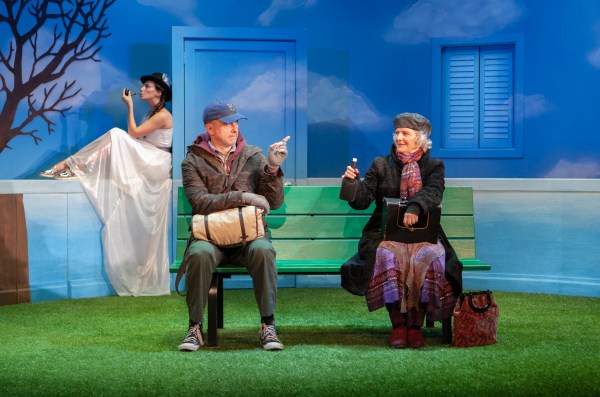
Taylor Harvey, Michael O’Keefe and Angelina Fiordelissi. Photo by Monique Carboni
The romance is portrayed in a series of clipped scenes, some with moments of tenderness and others largely cruel and cutting. Throughout their story, the two essentially hold true to their 1960s selves. Edith initiates, entices and at one point boogies down to the whoops and hollers of the audience. Harold reacts and expresses his inner thoughts and turmoil aloud, both to himself and to us. Though Edith professes that Harold is changing her life, there is little character growth, which is perhaps realistic for a tale of two people who are farther down the path of life. The couple occasionally engages with the Young Women, but more often she is an outside observer, floating in with a prop or playing the piano on stage left.
Mee’s dialogue is excessively flowery, at points sticking to the roofs of the actors’ mouths. Edith and Harold sometimes speak Braavos-like of “a man” and “a woman”. While potentially distancing, these artistic flourishes also bring an air of old love poetry to their exchanges. The opening scene is thick with cultural references to luminaries from 1960 counterculture, culminating in Edith and Harold shouting the lines from “Howl” at one another. No context is given and it might be tough going for someone not familiar with Ginsberg, Abbie Hoffman and Jack Kerouac. A gleeful rant about the very opinionated John Simon received the biggest laugh, but it is doubtful that many newer theater goers are familiar with a critical column that hasn’t been published in 13 years. Mee also makes questionable choices with the music used to connect beats of the script. The selection of classics from the 1940s — crowd-pleasers though they are — undercut the common ground from 20 years on that has been laid.
Given a script long on elements of the fantastic, director Kim Weild focuses attention on the more human elements of Edith and Harold’s interaction. Angelia Fiordellisi brings terrific exuberance to Edith while Michael O’Keefe has a realistic blend of vulnerability and soft sex appeal. Taylor Harvey makes a graceful spirit of love, though she falters in her unnecessarily lengthy tug of war with Harold over his selection of dessert. All three characters are buoyed by Theresa Squire’s costumes: flowing earth motherly layers for Fiordellisi, baseball cap and whatever is closest to the bed for O’Keefe, and sparkle, hearts, and flowers for Harvey. The back of Edward Pierce’s set is a delight, but the piece that functions as a bench, sofa, restaurant booth and more is not as clever as it should be to complete the vision. Paul Miller and Christian Frederickson are responsible for sturdy lighting and sound design.
The concept of developing a story of first love taking place between two people who came of age in the 60s in an intriguing one. While this First Love doesn’t quite fulfill the assignment, there is enough beneath its outer shell to provoke exploration. Performances continue at the Cherry Lane though July 8. Tickets are $65-$95 and are available at www.cherrylanetheatre.org or by calling Ovation Tix at 1.866.811.4111.



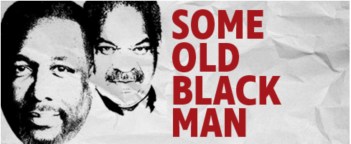 I attended the performance of your play, Some Old Black Man, at 59E59 Theaters on Saturday, February 10. Co-star Roger Robinson was out sick, replaced by Phil McGlaston. I understand that Mr. Robinson has been with the production since the beginning and that it is your request that the show not be reviewed without him. Certainly I was disappointed not to see his turn as Donald, but it was a marvelous afternoon nonetheless. I wanted to take this opportunity to applaud your wonderful work in full view of my readers.


This Flat Earth
“Are you there,” implores 13 year old Julie at both ends of This Flat Earth to anyone who’s listening. Nine students were recently killed in a school shooting, disrupting her feelings of peace, safety, and normalcy. This topic should be the springboard for compelling discussion. Indeed there are some threads about socioeconomic conditions and adolescent turning points that click. But for the most part, this is a ninety minute missed opportunity that ultimately promises that trauma will be all but lost beneath the unrelenting waves of everyday life.
Ella Kennedy Davis (Julie) and Lynda Gravátt (Cloris), Photo by Joan Marcus.
The piece is set in the recent past, and yet somehow Julie has no idea that hers is not the first school to have gone through such an experience. She believes that her persistent jealousy of a talented and popular girl who died might have caused the tragedy. In her program notes, playwright Lindsey Ferrentino tells how she experienced a similar sense of misplaced power when the incidents of 9/11 occurred the day after she had written a diary entry about the joys of peacetime. The transference of those feelings to sadly more common circumstance are diminishing to her main character. The excuse provided for Julie’s ignorance is that her father is too poor to have purchased a laptop. But even her best friend/would-be-boyfriend Zander seems to think the girl just hasn’t been paying attention.
The casting of Ella Kennedy Davis as Julie doesn’t do much to shore up the character as an interesting representative of her generation. While speaking too quickly at a very high pitch and slurring key words is all too realistic, it also left many of the audience members trying to keep up as they attempted to fill in the missed dialogue. Faring much better is the gifted Ian Saint-Germain, who captures the natural flow of Zander’s assuredness and awkwardness. Lucas Papaelias has trouble navigating the clumsy role of Julie’s father, Dan, but it is hard to tell how much of the difficulty is in the lines and how much in his interpretation. While no parent can protect a child from all dangers, widower Dan comes across as particularly ill-equipped and Papaelias often flails around in his skin. In the role of Lisa, a mother who lost a child in the tragedy, Cassie Beck is also constrained by her character’s limited responses. The only adult providing any constructive contribution is Lynda Gravátt’s upstairs neighbor Cloris. Naturally she can’t answer the impossible, but she delivers sincere and often amusing descriptions of effective coping mechanisms.
The talented director Rebecca Taichman does her best to underscore the truer emotions in the script by matching it with genuinely motivated physicality. Dane Laffrey’s two story set works wonderfully, though it could use a few more tonal touches. Costume designer Paloma Young has put together a fitting wardrobe, particularly with a bag of clothes that plays a critical role. Adding to the mood as well as forwarding the story is cellist Christine H. Kim under the musical direction of Christian Frederickson.
This Flat Earth is one of several recent productions that poses probing questions about the world we are leaving to the new generation. The Artistic Director claims it was never conceived as a production about gun violence, but opening just a month after events at Parkland it’s impossible to view it separate from that issue. Even when evaluated as an artistic expression, the play is wan when compared to similar offerings. While there are moments when the authentic psyches of the teens shine through, there are too many uninspiring stretches. Performances of this world premiere continue through April 29 at Playwrights Horizons. For tickets and information visit https://www.playwrightshorizons.org/shows/plays/flat-earth/.